Modern Supreme Court confirmation hearings look like theatrical cross-examinations, but senators did not always question nominees in public. For more than a century, the Senate debated judicial appointments behind closed doors without the nominee present.
Today, every nominee faces days of live, televised testimony under intense national scrutiny. You can trace this modern ritual back to specific moments when political crises, media shifts, and procedural clashes forced proceedings into the open.
Understanding these historical turning points reveals why senators frame their questions around judicial philosophy and past writings. It also shows why nominees routinely refuse to answer inquiries about how they might rule on future cases.
How Senate Questioning Evolved from Secret Ballots to Televised Inquiries
The U.S. Constitution provides in Article II, Section 2 that the president shall nominate judges with the advice and consent of the Senate. However, the text says nothing about public hearings or direct questioning of nominees.
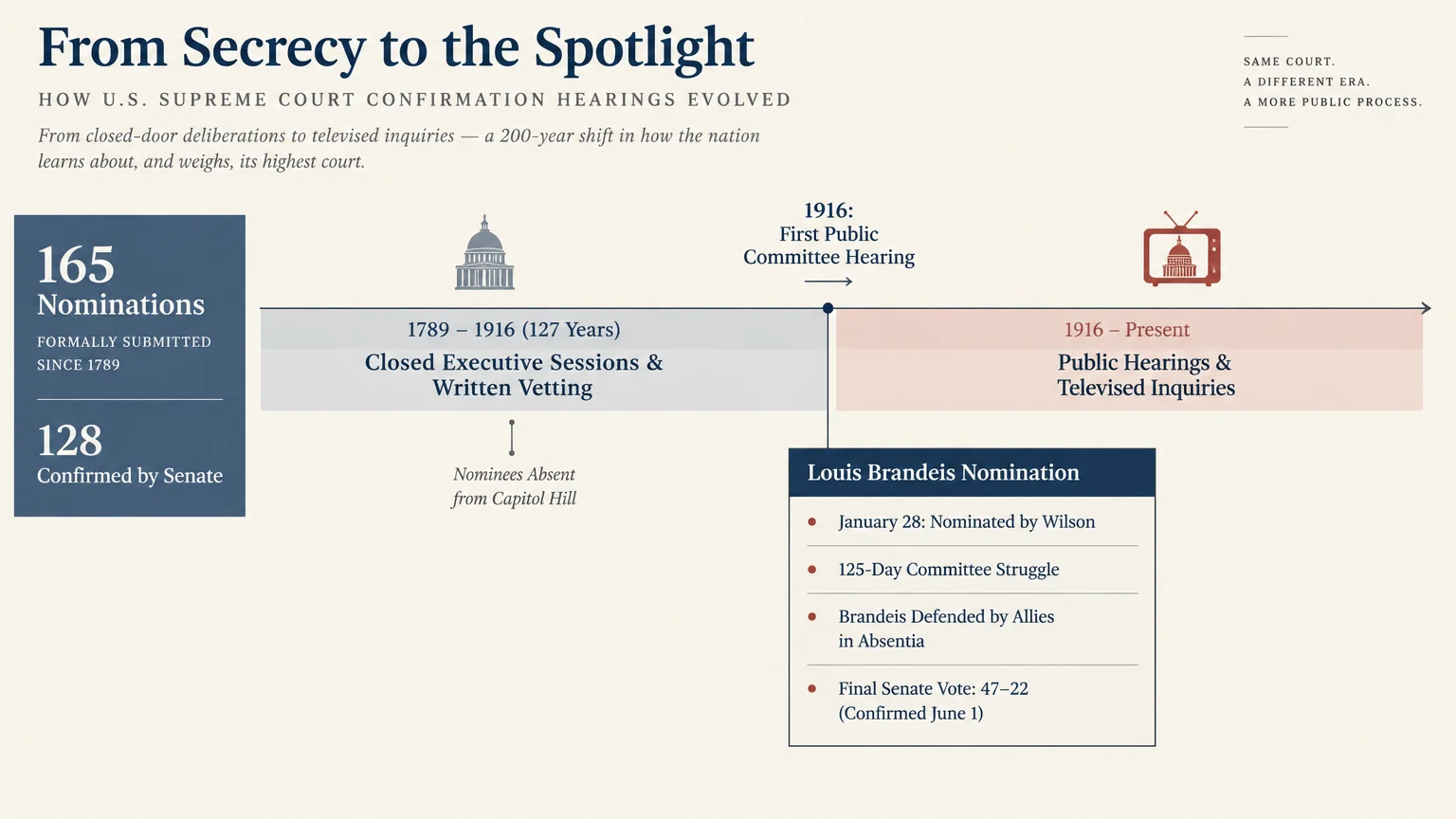
According to the U.S. Senate Historical Office, presidents have formally submitted 165 nominations to the Court since 1789. The Senate has confirmed 128 of those selections.
For the first 127 years of that history, the Senate Judiciary Committee vetted nominees through private meetings, executive sessions, and written documents. Nominees rarely stepped foot near Capitol Hill during the confirmation process.
Early Senates viewed direct questioning as an improper violation of the separation of powers. Lawmakers believed that summoning a judicial candidate for interrogation infringed upon the independence of the judicial branch.
The Library of Congress Supreme Court Nominations Research Guide documents how committee practices adapted to changing media and shifting constitutional conflicts. Public interest and party polarization gradually pushed questioning into the open.
This numbered list identifies nine milestone hearings that created the modern confirmation process. We selected each entry because it introduced an enduring questioning method, a new media format, or a permanent defensive strategy.
As you watch modern confirmation hearings, you will recognize the procedural rules and rhetorical boundaries established during these nine historic confrontations. They explain why senators probe constitutional philosophy and why nominees deflect controversial questions.
Louis Brandeis (1916)
President Woodrow Wilson nominated progressive attorney Louis Brandeis on January 28, 1916. The nomination triggered intense opposition from corporate leaders and the American Bar Association, prompting the Senate Judiciary Committee to take an unprecedented procedural step.
For the first time in American history, the committee conducted public confirmation hearings on a judicial nominee. Between February 9 and March 15, 1916, a three-member subcommittee heard testimony from dozens of witnesses debating Brandeis’s antitrust advocacy and legal ethics.
A popular myth claims Brandeis testified publicly to defend his progressive record, but the committee record reveals otherwise. Brandeis never appeared in person, choosing instead to let allies coordinate his defense while remaining at his Boston law office.
After a grueling 125-day struggle, the full Senate confirmed Brandeis on June 1, 1916, by a vote of 47–22. This epic battle established public committee hearings as a legitimate tool for investigating judicial nominees.
- Nomination Date: January 28, 1916 (Woodrow Wilson)
- Final Senate Vote: 47–22 on June 1, 1916
- Procedural Legacy: Created the first public Senate confirmation hearing for a Supreme Court nominee.
Harlan Fiske Stone (1925)
President Calvin Coolidge nominated Attorney General Harlan Fiske Stone on January 5, 1925. Opposition surfaced rapidly when Montana Senator Burton K.
Wheeler accused Stone’s Department of Justice of prosecuting him for political retaliation.
To resolve the dispute, the Senate voted to recommit the nomination back to the Judiciary Committee on January 26, 1925. Stone then took the bold, unprecedented step of offering to answer Wheeler’s charges in person.
On January 21, 1925, Stone became the first Supreme Court nominee to appear personally before the Senate Judiciary Committee. He testified in a closed executive session, calmly explaining his department’s actions and answering direct inquiries from committee members.
The Senate confirmed Stone on February 5, 1925, by a decisive 71–6 roll-call vote. His appearance proved that personal testimony could disarm hostile charges, breaking the century-old taboo against nominees speaking for themselves.
- Nomination Date: January 5, 1925 (Calvin Coolidge)
- Final Senate Vote: 71–6 on February 5, 1925
- Procedural Legacy: Marked the first time a nominee testified in person before the Senate Judiciary Committee.
Felix Frankfurter (1939)
President Franklin D. Roosevelt nominated Harvard Law professor Felix Frankfurter on January 5, 1939.
This nomination occurred shortly after the 1937 Hugo Black scandal, where Black won confirmation without hearings before journalists revealed his former Ku Klux Klan membership.
Determined to prevent another vetting embarrassment, the Senate Judiciary Committee invited Frankfurter to address allegations regarding his progressive affiliations and foreign birth. Conservative opponents demanded an opportunity to interrogate the prominent legal scholar directly.
On January 12, 1939, Frankfurter became the first nominee to undergo open, public questioning before the Senate Judiciary Committee. Accompanied by future Secretary of State Dean Acheson as counsel, Frankfurter testified publicly while refusing to discuss pending legal controversies.
The Senate confirmed Frankfurter unanimously by voice vote on January 17, 1939. His appearance established the model of open, uninhibited public questioning that defines modern committee inquiries.
- Nomination Date: January 5, 1939 (Franklin D. Roosevelt)
- Final Senate Vote: Confirmed by voice vote on January 17, 1939
- Procedural Legacy: Established open, public committee questioning of a nominee before the press and public.
John Marshall Harlan II (1955)
President Dwight D. Eisenhower nominated John Marshall Harlan II on January 10, 1955, following an initial submission in late 1954.
The nomination reached the Senate shortly after the Supreme Court issued its landmark desegregation ruling in Brown v. Board of Education.
Southern segregationist senators attempted to stall the nomination, using Harlan’s February 24–25, 1955 hearings to challenge federal judicial supremacy. Committee members interrogated Harlan rigorously about states’ rights, school desegregation, and international treaties.
Harlan answered inquiries courteously while defending the separation of powers and judicial independence. The Senate confirmed Harlan on March 16, 1955, by a 71–11 roll call, with opposition concentrated among Southern Democrats.
According to the Senate Judiciary Committee Historical Records, Harlan’s hearing set a permanent procedural mandate. Every Supreme Court nominee who has received a hearing since 1955 has been required to testify in person.
- Nomination Date: January 10, 1955 (Dwight D. Eisenhower)
- Final Senate Vote: 71–11 on March 16, 1955
- Procedural Legacy: Made in-person nominee testimony a mandatory, routine requirement for all subsequent nominees.
Thurgood Marshall (1967)
President Lyndon B. Johnson nominated Solicitor General Thurgood Marshall on June 13, 1967, selecting the first African American to serve on the high court.
Southern segregationist senators immediately mounted an exhaustive, multi-day cross-examination.
The Judiciary Committee questioned Marshall across five contentious days: July 13, 14, 18, 19, and 24, 1967. Senator Strom Thurmond famously subjected Marshall to over 60 intricate historical questions concerning the 1860s drafting of the Fourteenth Amendment.
Senators also pressed Marshall aggressively on civil rights protests and landmark Warren Court criminal procedure decisions, including Miranda v. Arizona. Marshall defended his legal record with composure, demonstrating deep command of statutory and constitutional law.
On August 30, 1967, the full Senate confirmed Marshall by a vote of 69–11. This marathon interrogation transformed confirmation hearings into extended constitutional debates focused on judicial philosophy and precedent.
- Nomination Date: June 13, 1967 (Lyndon B. Johnson)
- Final Senate Vote: 69–11 on August 30, 1967
- Procedural Legacy: Introduced grueling, multi-day constitutional cross-examinations designed to test a nominee’s doctrine.
Abe Fortas (1968)
President Lyndon B. Johnson nominated sitting Associate Justice Abe Fortas on June 26, 1968, to succeed Earl Warren as Chief Justice.
The proceeding marked the first time senators extensively questioned an active justice seeking elevation.
During four days of testimony in July 1968, senators interrogated Fortas on the Warren Court’s liberal rulings on criminal justice and obscenity. Senators also investigated Fortas’s confidential policy advising to President Johnson while serving on the bench.
The committee uncovered that Fortas accepted a privately funded $15,000 speaking fee to teach a summer seminar at American University. This financial disclosure fueled bipartisan ethical concerns and damaged his standing on the Senate floor.
When a cloture vote to break a filibuster failed 45–43 on October 1, 1968, Fortas asked Johnson to withdraw his nomination. The hearings established that sitting justices face rigorous scrutiny over past decisions and financial ethics.
- Nomination Date: June 26, 1968 (Lyndon B. Johnson)
- Final Senate Outcome: Nomination withdrawn on October 4, 1968, after failed 45–43 cloture vote
- Procedural Legacy: Established senatorial questioning into sitting justices’ prior rulings, outside finances, and ethical standards.
Sandra Day O’Connor (1981)
President Ronald Reagan nominated Arizona appellate judge Sandra Day O’Connor on August 19, 1981, fulfilling his campaign pledge to appoint the first female justice. The historic nomination attracted unprecedented national and global press attention.
From September 9 to 11, 1981, the Senate Judiciary Committee permitted live television cameras into the hearing room for the first time. The broadcast transformed confirmation hearings into a gavel-to-gavel televised spectacle for millions of viewers.
Senators questioned O’Connor extensively on contentious legal issues, including abortion rights, capital punishment, and the Equal Rights Amendment. Aware of the cameras, O’Connor carefully deflected theoretical inquiries by emphasizing judicial restraint and statutory analysis.
The Senate confirmed O’Connor unanimously by a 99–0 vote on September 21, 1981. The introduction of live television permanently altered committee behavior, turning questioning into a choreographed public performance for voters back home.
- Nomination Date: August 19, 1981 (Ronald Reagan)
- Final Senate Vote: 99–0 on September 21, 1981
- Procedural Legacy: Established live, gavel-to-gavel television coverage, turning confirmation hearings into public political theater.
Robert Bork (1987)
President Ronald Reagan nominated federal appeals judge Robert Bork on July 1, 1987, to replace moderate swing justice Lewis Powell. Bork brought a voluminous record of academic writings advocating originalism and criticizing decades of high court jurisprudence.
Over five days of televised testimony in September 1987, senators engaged Bork in an exhaustive intellectual debate. Unlike modern nominees, Bork candidly defended his views, discussing specific cases and philosophical disagreements with prior rulings.
Bork openly criticized the landmark ruling in Griswold v. Connecticut, rejecting the constitutional right to privacy as unmoored from the text. His candid answers provided political opponents with clear soundbites to mobilize nationwide opposition campaigns.
On October 23, 1987, the Senate rejected Bork by a 42–58 margin, the largest defeat in modern history. The hearing established the phenomenon known as “Borking” and taught future nominees to conceal their constitutional inclinations.
- Nomination Date: July 1, 1987 (Ronald Reagan)
- Final Senate Vote: Rejected 42–58 on October 23, 1987
- Procedural Legacy: Demonstrated the immense political danger of candidly answering theoretical and philosophical questions.
Ruth Bader Ginsburg (1993)
President Bill Clinton nominated federal appellate judge Ruth Bader Ginsburg on June 22, 1993. Her confirmation arrived shortly after the rancorous 1991 hearings for Clarence Thomas, which featured explosive televised testimony regarding personal misconduct allegations.
Mindful of both the Thomas controversies and Robert Bork’s defeat, Ginsburg adopted a disciplined defensive strategy during her July 20–23, 1993 testimony. She established strict boundaries regarding what questions she would answer.
Ginsburg told senators she would offer “no hints, no forecasts, no previews” on pending legal controversies or hypothetical constitutional questions. She discussed her past litigation for gender equality while steadfastly refusing to pre-judge future cases.
The Senate confirmed Ginsburg by a 96–3 vote on August 3, 1993. Her posture established the enduring “Ginsburg Rule,” providing the modern playbook that judicial nominees across both political parties rely upon today.
- Nomination Date: June 22, 1993 (Bill Clinton)
- Final Senate Vote: 96–3 on August 3, 1993
- Procedural Legacy: Formalized the “Ginsburg Rule” against previewing rulings on hypothetical or future cases.
| Nominee (Year) | Nominating President | Hearing Innovation | Final Senate Outcome | Lasting Procedural Impact |
|---|---|---|---|---|
| Louis Brandeis (1916) | Woodrow Wilson | First public committee hearing | Confirmed 47–22 | Allowed public witness testimony on nominee qualifications. |
| Harlan Fiske Stone (1925) | Calvin Coolidge | First in-person testimony (closed session) | Confirmed 71–6 | Proved personal appearances could resolve political charges. |
| Felix Frankfurter (1939) | Franklin D. Roosevelt | First public in-person questioning | Confirmed by voice vote | Established open questioning of nominees before reporters. |
| John Marshall Harlan II (1955) | Dwight D. Eisenhower | Questioning made mandatory routine | Confirmed 71–11 | Required every subsequent nominee to testify in person. |
| Thurgood Marshall (1967) | Lyndon B. Johnson | Extended multi-day grilling | Confirmed 69–11 | Turned hearings into detailed constitutional cross-examinations. |
| Abe Fortas (1968) | Lyndon B. Johnson | Sitting justice questioned on ethics | Withdrawn after 45–43 cloture fail | Subjected sitting justices to intense financial and ethical review. |
| Sandra Day O’Connor (1981) | Ronald Reagan | First live televised broadcast | Confirmed 99–0 | Transformed proceedings into live national political theater. |
| Robert Bork (1987) | Ronald Reagan | Deep paper-trail interrogation | Rejected 42–58 | Taught nominees that intellectual candor invites political defeat. |
| Ruth Bader Ginsburg (1993) | Bill Clinton | Formalization of the “Ginsburg Rule” | Confirmed 96–3 | Codified nominee refusals to answer hypothetical rulings. |
What These Confirmation Milestones Mean for Modern Hearings
These nine hearings document a fundamental transformation in how the American republic selects its highest judges. What began as a secretive, closed-door evaluation of personal integrity has evolved into a broadcast constitutional seminar.
According to the Congressional Research Service, the confirmation timeline from nomination to final Senate floor vote has averaged approximately 55 days since the mid-1950s. That window allows committee staff to examine thousands of pages of records.
When you watch confirmation hearings today, you are observing a forum built for public communication rather than private deliberation. Senators rarely attempt to persuade the nominee; instead, they use their questioning time to address voters directly.
The modern process operates in permanent tension between senatorial inquiry and judicial discretion. Nominees rely heavily on the Ginsburg Rule to avoid making commitments, while senators search through every written article and bench ruling to unearth clues.
To prepare for this cross-examination, contemporary administrations subject nominees to intensive practice sessions known as murder boards. Legal advisers pepper the nominee with hostile questions for weeks, drilling them to answer without revealing predictive views.
Hearings have also expanded beyond legal doctrine into intensive reviews of personal conduct. Clarence Thomas faced explosive televised hearings on sexual harassment allegations in 1991, an ordeal repeated during Brett Kavanaugh’s 2018 confirmation before his 50–48 vote.
The stakes of these hearings escalated sharply on April 6, 2017, when the Senate voted 52–48 to alter its precedents. That move eliminated the 60-vote filibuster threshold for Supreme Court nominations, reducing cloture to a simple majority.
That rule change paved the way for Neil Gorsuch’s 54–45 confirmation in 2017 and shaped subsequent proceedings, including Ketanji Brown Jackson’s 53–47 confirmation on April 7, 2022. Partisan majorities can now confirm justices without minority party votes.
When you evaluate future confirmation hearings, listen closely to how senators frame their questions around past precedents. You will see how nominees use careful evasion techniques perfected over the last century.
Frequently Asked Questions About Supreme Court Confirmation Hearings
Can a Supreme Court nominee legally refuse to answer a senator’s question?
Yes, nominees can decline to answer questions, and they routinely do so under the Ginsburg Rule. The Code of Conduct for United States Judges prohibits judicial candidates from making commitments on cases likely to come before them.
Senators have no legal mechanism to force an answer beyond threatening to vote against confirmation. Nominees calculate that evading a controversial question is far safer than alienating senators or giving opponents fuel for opposition campaigns.
When did in-person nominee testimony become a mandatory Senate requirement?
Mandatory nominee questioning began in 1955 with the confirmation of John Marshall Harlan II. Before that hearing, nominees testified only sporadically, with most evaluations occurring through written submissions or witness statements.
Since Harlan’s 1955 appearance, the Senate Judiciary Committee has required every Supreme Court nominee who received a hearing to testify in person. The practice is now an entrenched constitutional custom that neither party dares abandon.
How did the Senate filibuster rule change for Supreme Court nominees?
Prior to April 2017, Senate rules required a three-fifths supermajority—typically 60 votes—to invoke cloture and end debate on a Supreme Court nomination. This threshold forced presidents to seek bipartisan consensus.
On April 6, 2017, the Senate invoked the nuclear option by a 52–48 vote, establishing that a simple majority of 51 votes can end debate. This procedural shift enables a unified Senate majority party to confirm justices without minority support.
Who was the last Supreme Court nominee rejected on the Senate floor?
The last nominee rejected by a full Senate floor vote was Robert Bork on October 23, 1987, by a 42–58 margin. His rejection demonstrated the political perils of engaging in substantive ideological debates during televised hearings.
While later nominations like Harriet Miers in 2005 were withdrawn prior to a vote, no nominee since Bork has faced formal floor defeat. Bork’s rejection permanently altered how nominees prepare for committee questioning.




