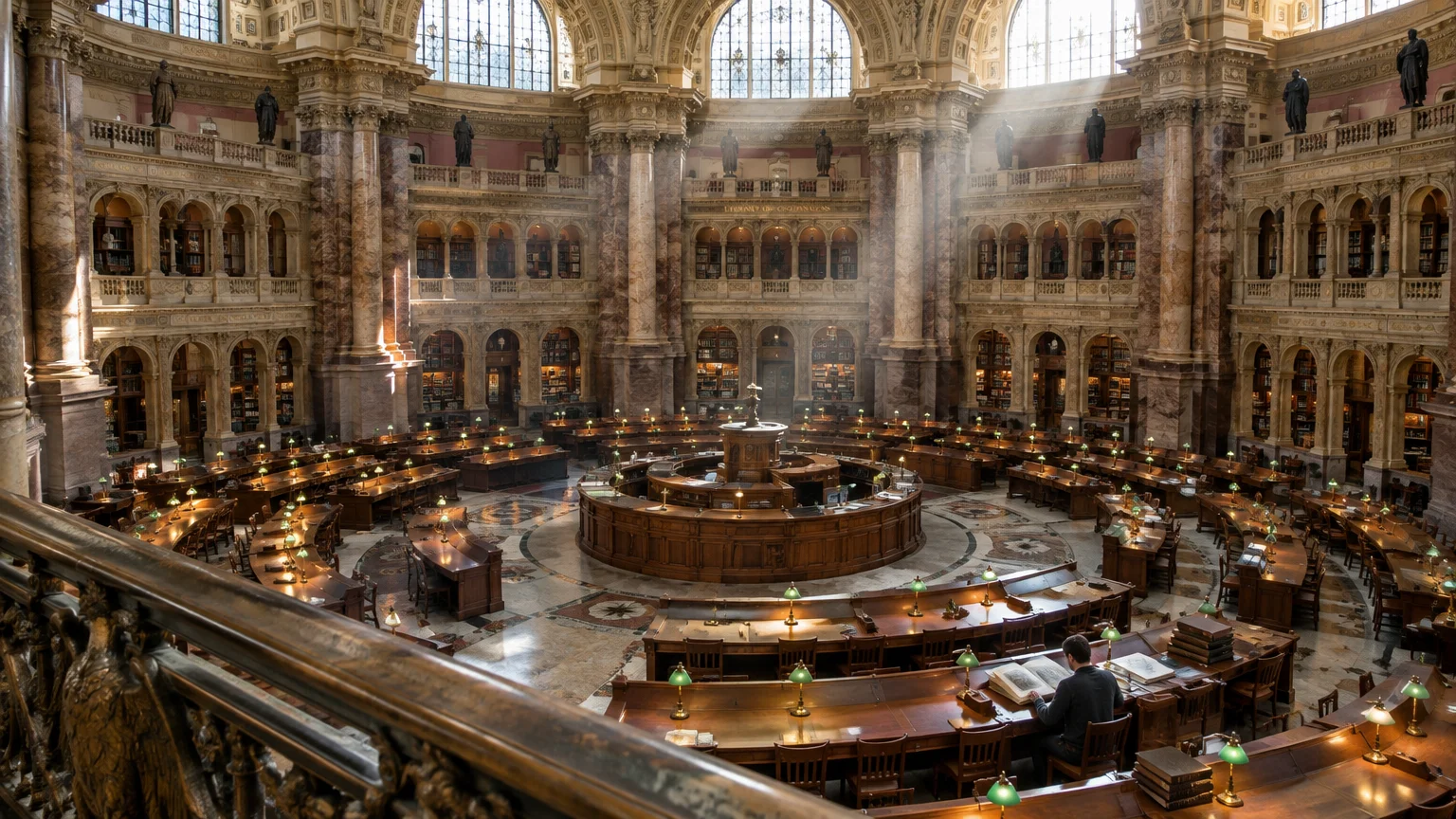
When federal lawmakers debate intricate statutory changes, they do not rely on partisan think tanks or corporate lobbyists for baseline facts. Instead, you can trace their primary legal, economic, and policy analyses directly to the Library of Congress.
Housed on Capitol Hill, the institution provides objective research through the Congressional Research Service to help members evaluate bills before voting. Understanding how this federal agency operates reveals how Congress maintains legislative independence.
From its founding in 1800 to modern digital operations, the Library provides indispensable institutional memory for American self-governance. Here is how this sprawling research apparatus briefs lawmakers on the nation’s most pressing public policy questions.
The Evolution of Legislative Research: Selection Criteria and Historical Scope
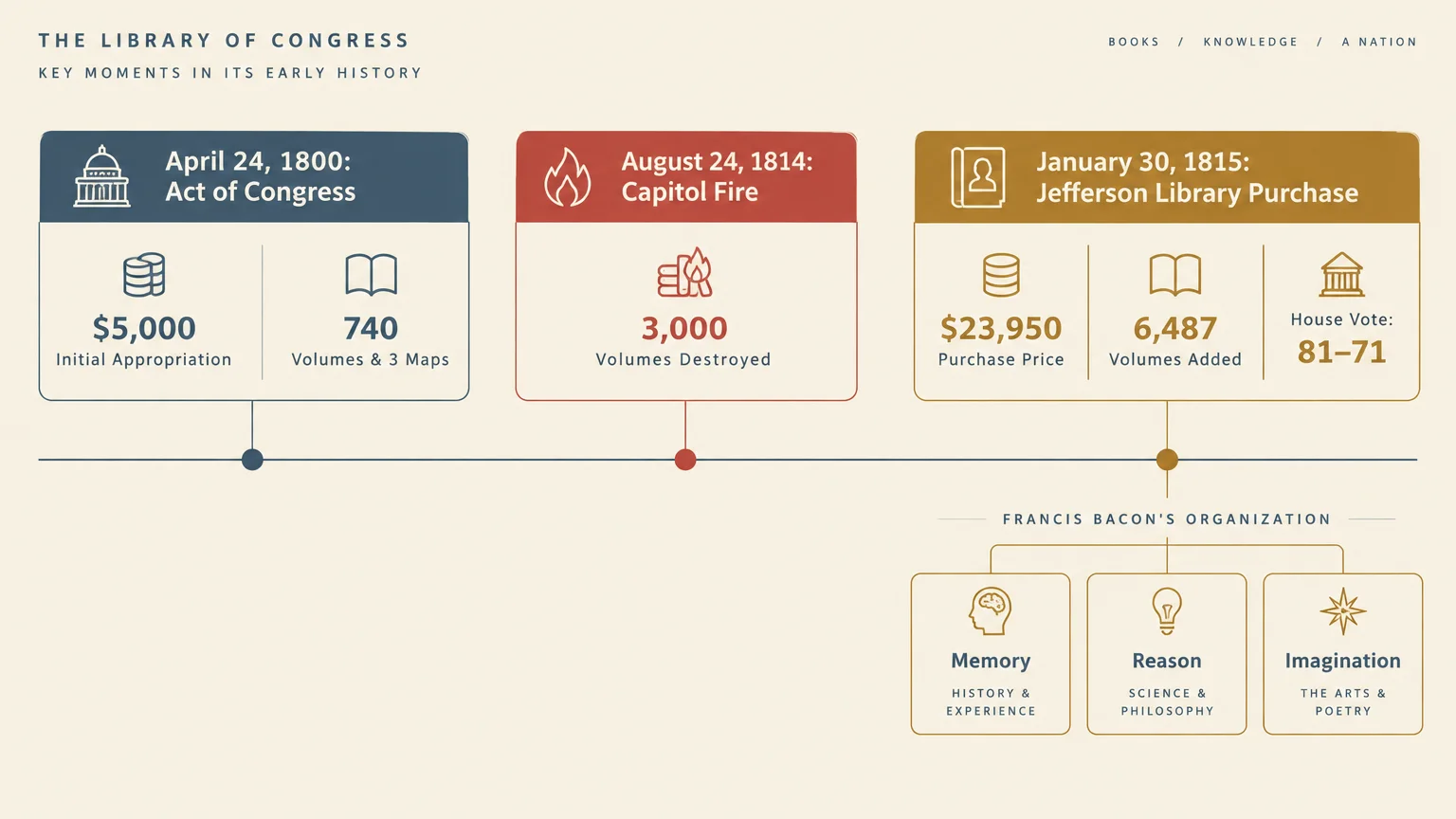
This explainer traces how an initial $5,000 reference collection evolved into the world’s preeminent legislative research institution. Our editorial team selected each milestone by examining statutory enactments, congressional records, and official institutional operating guidelines.
The timeline covers key moments from the Library’s founding on April 24, 1800, through its operational status on April 23, 2026. Every entry highlights a documented turning point that altered how Congress gathers facts or exercises oversight.
You will explore how catastrophic fires, major reorganizations, and modern transparency mandates transformed congressional inquiry. These historical developments explain how the modern legislative branch secures reliable data before casting roll-call votes.
The Act of April 24, 1800 Established the First Congressional Reference Library
President John Adams created the Library of Congress on April 24, 1800, when he signed legislation moving the federal government from Philadelphia to Washington, D.C. The statute established a dedicated reference repository for federal lawmakers.
Section 5 of the Statutes at Large appropriated $5,000 “for the purchase of such books as may be necessary for the use of Congress.” The law directed the government to house the books inside the United States Capitol.
The original collection contained 740 volumes and three maps purchased from London booksellers Cadell and Davies. Lawmakers stored these initial materials inside a small consultation room within the unfinished Capitol building.
By establishing this collection, Congress asserted that an independent legislature requires direct access to legal texts, treatises, and gazettes. You can trace the modern architecture of congressional policy briefings directly to this modest 1800 statutory allocation.
Thomas Jefferson’s Personal Library Replaced the War of 1812 Losses
On August 24, 1814, British troops invaded Washington and set fire to the Capitol, destroying the original 3,000-volume congressional library. This wartime loss left lawmakers without the foundational legal authorities necessary to govern the nation.
Retired President Thomas Jefferson offered his personal Monticello library to Congress as a comprehensive replacement. He noted that his diverse collection spanned science, philosophy, and classical history alongside standard statecraft and law.
On January 30, 1815, President James Madison signed an act authorizing the purchase of Jefferson’s 6,487 volumes for $23,950. The House approved the measure in a narrow 81–71 vote amid opposition from Federalists who criticized the purchase of foreign-language literature.
Jefferson organized the collection using Francis Bacon’s divisions of human knowledge: Memory, Reason, and Imagination. As detailed in the Library of Congress historical archives, this purchase transformed a narrow parliamentary shelf into a universal research library.
The 1851 Christmas Eve Fire Prompted Fireproof Architecture and Modern Shelving
A second catastrophic fire struck the Library of Congress on the morning of December 24, 1851. An accidental chimney flue blaze tore through the Capitol’s central interior room, gutting the core collection.
The blaze destroyed approximately 35,000 of the Library’s 55,000 volumes. The disaster consumed roughly two-thirds of the original books that Congress had purchased from Thomas Jefferson in 1815.
Congress responded swiftly by passing an emergency appropriation of $72,500 on March 19, 1852, to rebuild the interior chamber. Architect of the Capitol Thomas U.
Walter designed a revolutionary, non-combustible main hall made entirely of ornate cast iron.
Lawmakers also appropriated $75,000 to replace the lost historical volumes. This reconstruction proved that Congress regarded its research library as an indispensable permanent arm of constitutional governance rather than a disposable office amenity.
Strict On-Site Access Rules Restrict Off-Premises Book Borrowing
A widespread public misconception suggests that any American citizen can check out books from the Library of Congress. The institution actually operates as a closed-stack, on-site reference repository to safeguard rare historical holdings.
Anyone aged 16 or older can obtain a free Reader Identification Card by presenting a valid government-issued photo identification. You can then request, examine, and photograph millions of volumes within 21 specialized reading rooms across Capitol Hill.
These facilities span the Thomas Jefferson Building, the John Adams Building, and the James Madison Memorial Building. However, researchers cannot remove materials from the complex under any circumstances.
Federal law restricts off-premises borrowing privileges exclusively to Members of Congress, federal judges, Supreme Court Justices, and designated executive officials. Strict physical custody ensures that vital legal sources remain immediately available when congressional committees draft legislation.
Statutory Mandates Established and Expanded the Congressional Research Service
Congress established the Legislative Reference Service (LRS) on July 16, 1914, following a campaign led by progressive Wisconsin Senator Robert M. La Follette Sr. Lawmakers created the service to counter the growing influence of specialized industry lobbyists.
The Legislative Reorganization Act of 1946 subsequently expanded the research staff and authorized the agency to hire senior subject-matter specialists. This statute ensured that congressional committees could access independent expertise during legislative drafting.
Congress fundamentally revamped the agency through the Legislative Reorganization Act of 1970, codified at 2 U.S.C. § 166. The statute officially renamed the body the Congressional Research Service (CRS) and broadened its analytical mission.
The 1970 law directed CRS to provide completely objective, non-partisan policy research to lawmakers of both parties. By statute, the service maintains strict institutional confidentiality regarding all private congressional consultations.
Five Specialized Divisions Manage Over 75,000 Annual Congressional Inquiries
Operating with an annual budget of roughly $133.6 million to $140 million, CRS employs approximately 600 dedicated staff members. This roster includes more than 400 policy analysts, constitutional attorneys, and subject-matter information specialists.
Under the leadership of Director Dr. Karen E. Donfried and Deputy Director T.J.
Halstead, CRS structures its staff into five specialized research divisions. These units mirror the complex jurisdiction of congressional standing committees.
- American Law Division
- Domestic Social Policy Division
- Foreign Affairs, Defense, and Trade Division
- Government and Finance Division
- Resources, Science, and Industry Division
Together, these divisions resolve more than 75,000 customized, confidential requests from congressional offices each year. Analysts supply hard data and statutory history while consciously refraining from advocating for any specific legislative outcome.
Lawmakers Rely on Distinct Briefing Formats from Sidebars to In Focus
CRS tailors its written research products to accommodate the rapid pace of legislative floor debates and committee markups. When lawmakers need actionable insights, they choose from standardized formats designed for varying levels of detail.
For high-level overviews, analysts publish “In Focus” briefs—concise, two-page executive summaries detailing emergent policy questions. Members read these tightly edited products when preparing for floor votes on tight legislative schedules.
Attorneys in the American Law Division author “Legal Sidebars” to explain active federal court litigation and constitutional doctrines. These analyses clarify how judicial decisions might impact federal statutes or ongoing committee oversight investigations.
When staff members require comprehensive statutory reviews, CRS prepares exhaustive research reports spanning dozens of pages. Analysts also provide private, off-the-record consultations and confidential policy memorandums prepared exclusively for a single requesting member.
The Consolidated Appropriations Act of 2018 Opened Reports to the Public
Between 1952 and 2018, federal policy restricted CRS reports from direct public distribution. Citizens could only view these taxpayer-funded analyses if individual lawmakers released them or third-party advocacy groups leaked copies online.
Section 201 of the Consolidated Appropriations Act of 2018 (Public Law 115-141) dismantled this access barrier. The statute ordered the Library to build an accessible digital portal containing all active, non-confidential research reports.
You can now search and download thousands of objective policy documents through the official CRS Reports public database. The platform publishes standardized reports, In Focus briefs, and Legal Sidebars as soon as analysts release them to Congress.
The 2018 law carefully preserved the confidentiality of private, custom memorandums prepared for individual lawmakers. This statutory balance protects the private deliberative process while giving the public access to identical baseline policy research.
Copyright Administration and Statutory Succession Anchor Library Operations
The Library of Congress performs crucial federal functions beyond direct legislative research. On July 8, 1870, Congress centralized copyright registration within the Library, requiring applicants to submit physical deposit copies of their works.
Today, the U.S. Copyright Office processes more than 424,000 registrations annually. These mandatory copyright deposits supply thousands of items to the Library’s intake, which receives approximately 15,000 items each working day.
The Library also operates the National Library Service for the Blind and Print Disabled, circulating over 22 million braille and audio items annually. Today, the institution holds more than 181 million items on approximately 838 miles of shelving.
Institutional continuity remains governed by strict federal statute. Following the dismissal of Librarian Dr. Carla Hayden on May 8, 2025, Principal Deputy Librarian Robert Randolph Newlen assumed leadership under 2 U.S.C. § 136.
When the executive branch attempted to place Deputy Attorney General Todd Blanche in the position, congressional authorities held to statutory succession rules. Consequently, Newlen continues to serve as the recognized Acting Librarian of Congress.
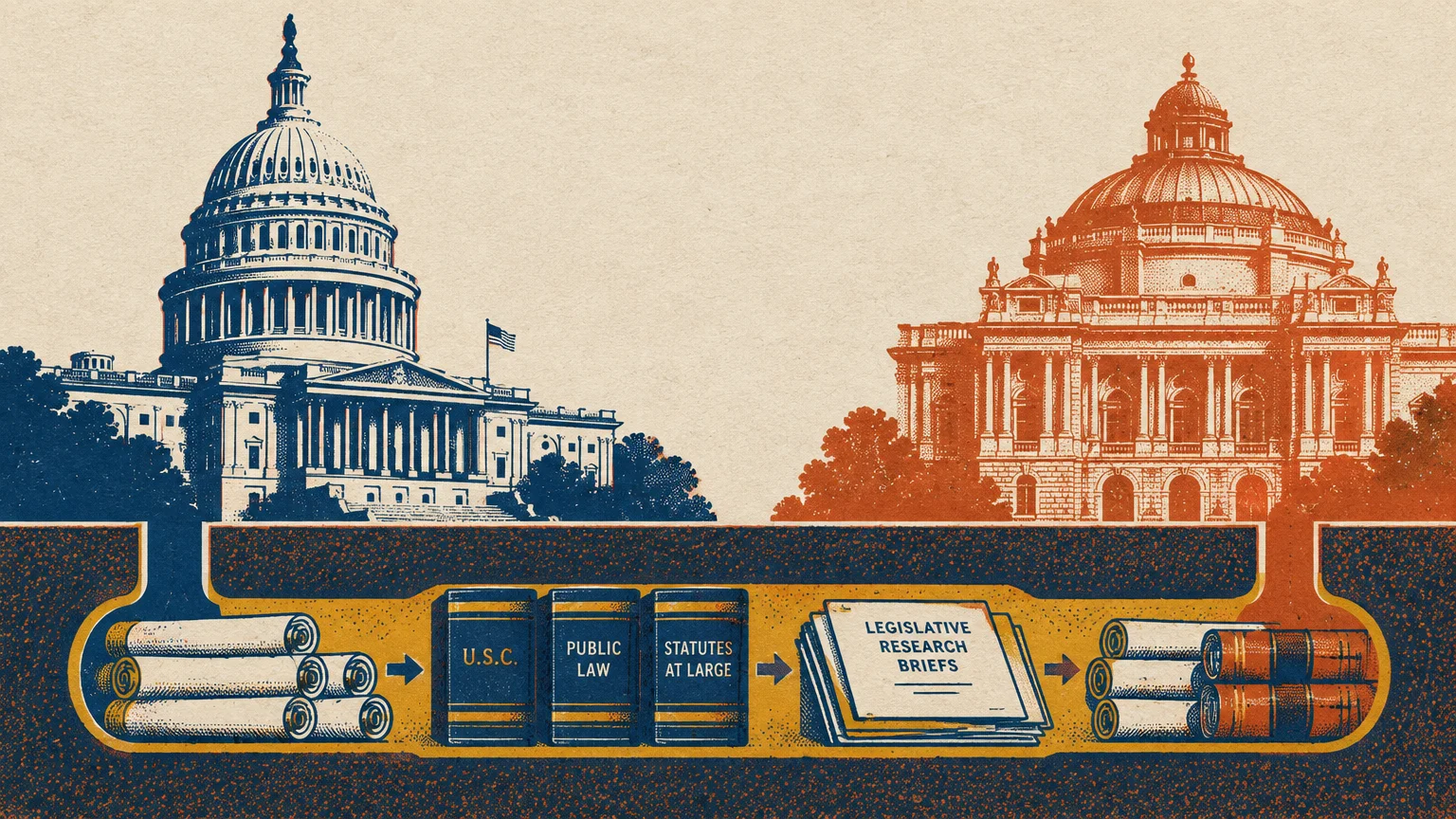
Statutory Milestones in the Growth of Congressional Research
The following table illustrates the primary legislative authorities that established, restructured, and reformed the Library of Congress and its non-partisan research operations.
| Statute / Enactment | Date | Primary Legal Authority | Key Institutional Function |
|---|---|---|---|
| Act of April 24, 1800 | April 24, 1800 | 2 Stat. 55 | Appropriated $5,000 for congressional reference books in the Capitol. |
| Act of January 30, 1815 | January 30, 1815 | 3 Stat. 195 | Purchased Thomas Jefferson’s 6,487-volume library for $23,950. |
| Copyright Act of 1870 | July 8, 1870 | 16 Stat. 198 | Centralized federal copyright deposits inside the Library of Congress. |
| Legislative Appropriations Act | July 16, 1914 | 38 Stat. 458 | Created the Legislative Reference Service within the Library. |
| Legislative Reorganization Act | October 26, 1970 | 2 U.S.C. § 166 | Renamed LRS to CRS and expanded its analytical research mandate. |
| Consolidated Appropriations Act | March 23, 2018 | P.L. 115-141 | Mandated public website access to non-confidential CRS reports. |
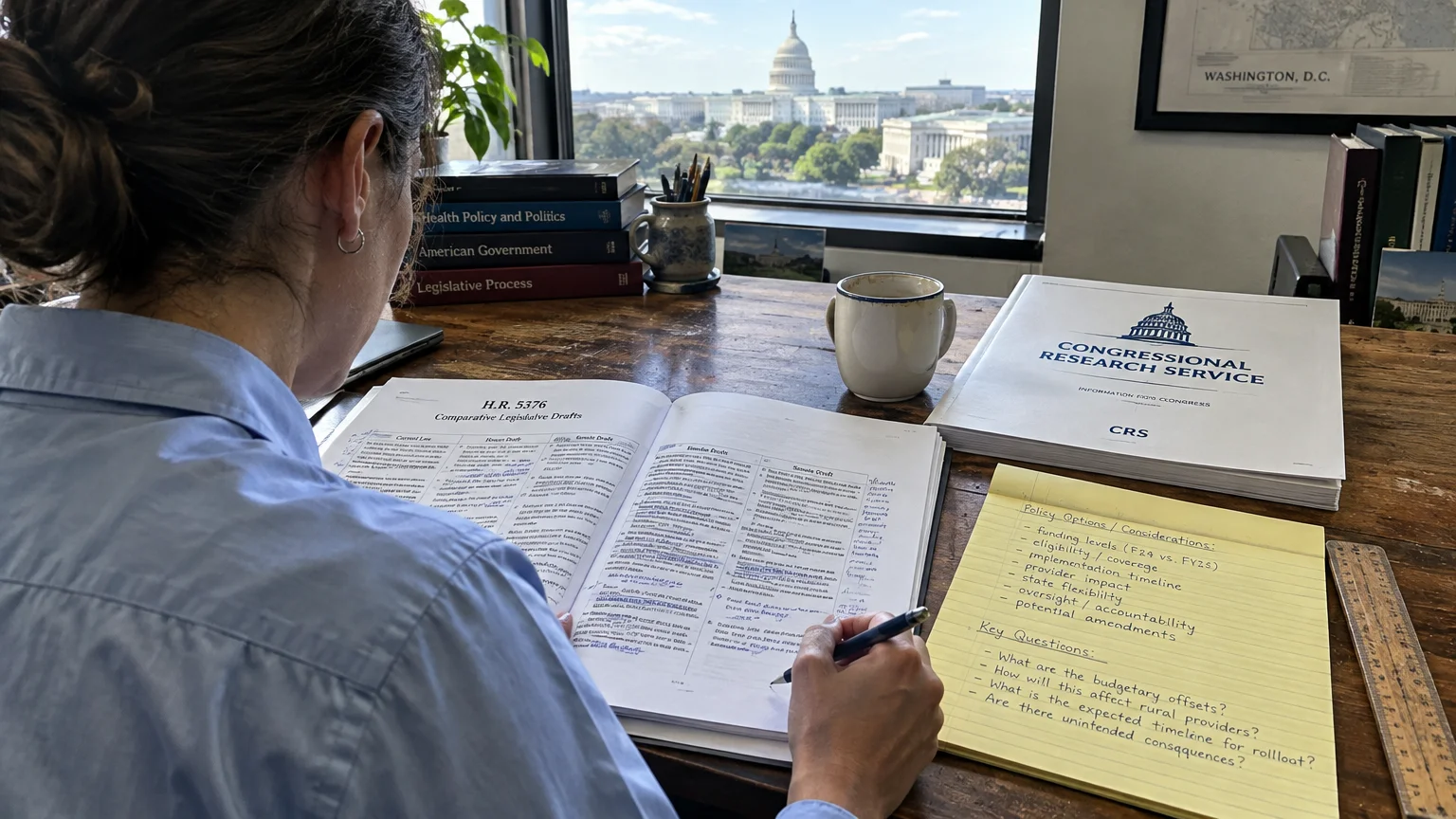
How Non-Partisan Legislative Research Protects Institutional Independence
Article I of the United States Constitution vests all federal legislative powers in a bicameral Congress. To exercise this authority effectively, lawmakers must make informed judgments without depending exclusively on executive branch data.
Executive agencies naturally produce research that supports the sitting administration’s regulatory goals and policy agendas. Similarly, private lobbying firms and specialized advocacy groups circulate analyses designed to advance private commercial interests.
The Congressional Research Service counterbalances these external pressures by functioning as an institutional analytical filter. When a committee reviews complex statutory language, CRS analysts provide objective breakdowns of constitutional constraints and economic trade-offs.
This independence directly strengthens congressional oversight. Lawmakers can evaluate federal agency performance, assess budgetary requests, and question executive officials using data verified by their own non-partisan researchers.
Public access to these materials further enhances democratic accountability across the federal system. When you read a CRS report, you review the exact same non-partisan briefing materials that inform congressional votes.
Frequently Asked Questions About the Library of Congress and CRS
Can everyday citizens submit research requests directly to CRS?
No, CRS does not accept research requests or inquiries directly from the general public. Federal law under 2 U.S.C. § 166 restricts the agency’s work exclusively to Members of Congress, committees, and congressional staff.
However, you can freely read all standardized, non-confidential research reports via the official crsreports.congress.gov digital archive. Everyday researchers can also access the Library of Congress’s general collections directly by visiting the reading rooms in Washington.
How does CRS maintain neutrality when members request partisan arguments?
When lawmakers ask for policy briefings, CRS analysts frame their responses around documented facts, statutory history, and established legal precedents. They routinely outline the strongest arguments on both sides of a contested legislative debate.
Agency guidelines strictly prohibit staff analysts from recommending legislation or drafting partisan talking points. While analysts assist offices with policy assessments, they never advise a member on how to cast a vote.
Why are custom memorandums excluded from the public CRS website?
Congress exempts custom research memorandums from public disclosure to safeguard the confidential deliberative process of individual lawmakers. Members frequently test novel statutory concepts or probe oversight vulnerabilities during early legislative drafting.
If the law required immediate disclosure of every inquiry, lawmakers would stop consulting CRS specialists during private bill development. Standardized, non-confidential reports that provide broad background knowledge remain the only documents posted online.
What prevents the executive branch from directing CRS research?
CRS operates entirely within the legislative branch under the administrative umbrella of the Library of Congress. The executive branch holds no statutory authority over CRS research priorities, personnel evaluations, or analytical conclusions.
This legal separation ensures that analysts answer solely to the constitutional needs of the Senate and House. Even during contentious inter-branch disputes, the agency’s statutory mandate under 2 U.S.C. § 166 guarantees independent legislative support.




