You will not find the number nine anywhere in Article III of the U.S. Constitution. The Framers left the size of the Supreme Court entirely to Congress, allowing lawmakers to expand or shrink the bench for policy and politics.
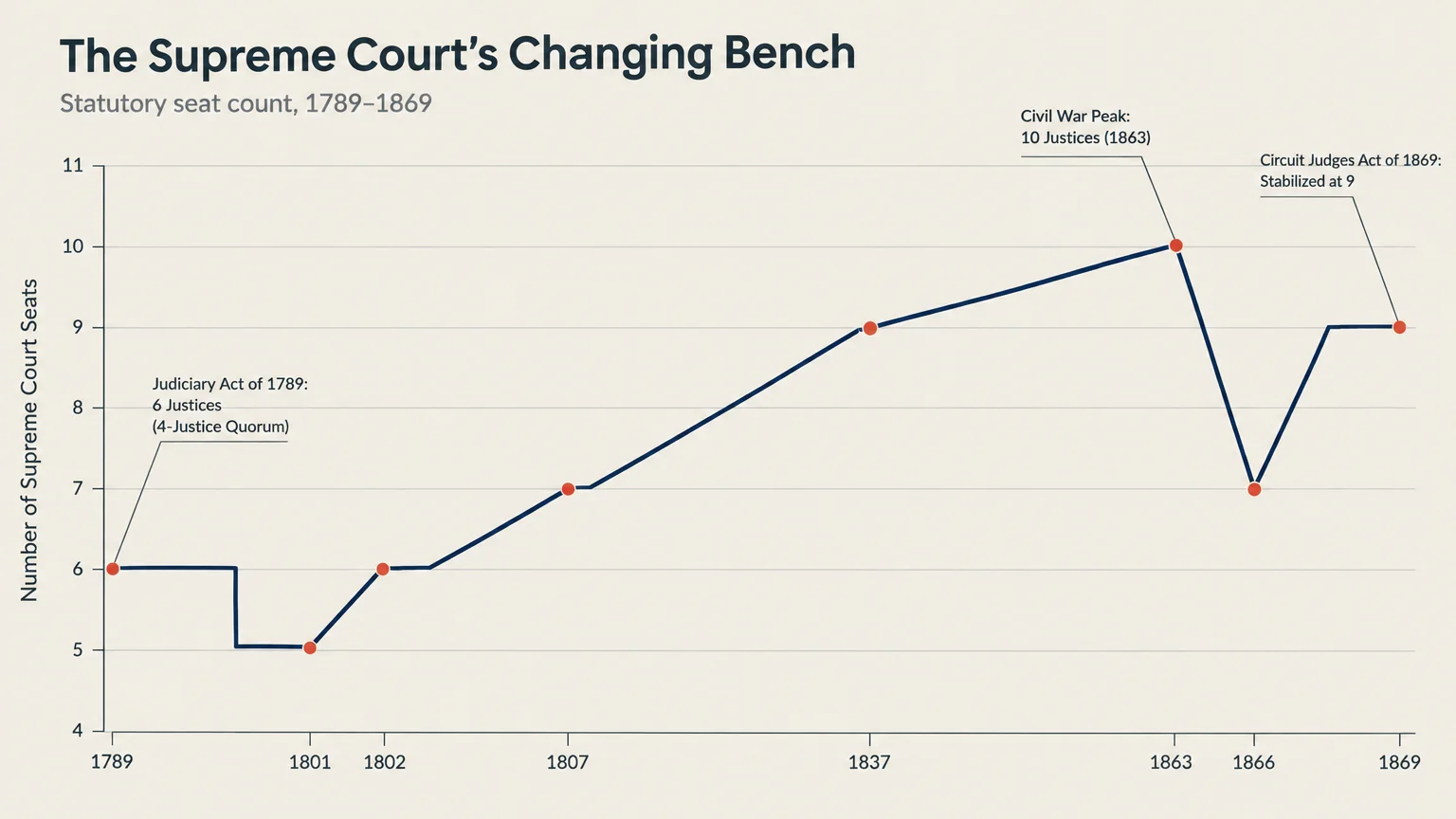
Between 1789 and 1869, the federal bench underwent seven distinct statutory structural shifts. The number of seats swung from six down to five, climbed to ten during the Civil War, and finally stabilized.
Knowing how lawmakers reshaped the high court clarifies modern debates over court reform. Here is how Congress repeatedly altered the bench before locking in nine justices 157 years ago.
How Congress Governed the Size of the Supreme Court
Article III, Section 1 establishes “one supreme Court,” but it specifies neither judicial qualifications nor bench size. Under the Necessary and Proper Clause, Congress exercises full constitutional authority to create, eliminate, and fund federal judgeships.
Our editorial team analyzed federal statutes from 1789 to 1869 using public records from the Federal Judicial Center. Over those eighty years, lawmakers restructured the high court to manage territorial expansion and political crises.
Throughout the nineteenth century, circuit riding tied the Court’s size directly to national geography. Congress required sitting justices to travel across regional circuits to preside over local trials alongside district judges.
As you trace these statutory changes, you will see how party realignments repeatedly transformed the bench. Partisan majorities regularly expanded seats to confirm loyal jurists or eliminated seats to deny opposing presidents new appointments.
Official records from the Supreme Court of the United States confirm that 116 individuals have served on the bench across American history. Understanding these shifts helps you evaluate today’s institutional debates.
If you follow modern proposals to restructure the judiciary, you must recognize that Congress holds explicit authority under Article I to modify court architecture. Reviewing past statutory changes gives you the factual context to evaluate modern legislative debates.
Judiciary Act of 1789
President George Washington signed the Judiciary Act of 1789 into law on September 24, 1789. The foundational statute organized the federal court system and set the initial Supreme Court bench at six justices.
Section 1 of the act mandated a Chief Justice and five Associate Justices. The law established that four justices constituted a quorum necessary to conduct official business.
Senator Oliver Ellsworth of Connecticut served as the primary author of the legislation. The Senate approved the measure by a 14–6 roll call on July 17, 1789.
The House of Representatives passed the bill without a recorded roll call on September 17, 1789. Lawmakers designed the bench size around administrative necessity rather than partisan division.
Congress divided the thirteen states into three judicial circuits: Eastern, Middle, and Southern. Each circuit court required two traveling Supreme Court justices to preside alongside one local federal district judge.
An even number of six justices allowed two jurists to cover each geographic region simultaneously. This grueling obligation became known across the legal profession as riding circuit.
The high court convened for its inaugural session on February 2, 1790. The justices met at the Royal Exchange building on Broad Street in New York City.
Washington nominated John Jay as the first Chief Justice alongside five associate jurists. Only three justices arrived for the opening day, forcing an adjournment until a four-justice quorum assembled the following morning.
The 1789 statute also established the first judicial compensation rates. Chief Justice Jay received an annual salary of $4,000, while Associate Justices received $3,500.
You can inspect the statutory language in Volume 1, page 73 of the United States Statutes at Large through the Library of Congress. This baseline established judicial operations for the new nation.
Judiciary Act of 1801
Outgoing President John Adams signed the Judiciary Act of 1801 on February 13, 1801. Popularly known as the “Midnight Judges Act,” the statute altered the federal judiciary during an intense partisan transition.
The legislation emerged from a lame-duck Federalist Congress following the election of 1800. Federalists had lost the presidency and congressional control to Thomas Jefferson and his Democratic-Republican allies.
The House passed the legislation by a 51–43 vote on January 20, 1801. The Senate approved the bill on February 7, 1801, with a 16–11 roll call.
Section 3 of the act reduced the Supreme Court from six justices down to five. Lawmakers scheduled this reduction to take effect upon the next vacancy on the bench.
Federalists publicly argued that an odd number of justices would prevent tied decisions. Their primary private motivation, however, was denying incoming President Jefferson an early opportunity to fill a vacant seat.
The statute also relieved Supreme Court justices of their exhausting circuit-riding responsibilities. It created six new circuit courts staffed by sixteen permanent, dedicated circuit judges.
Adams quickly nominated loyal Federalists to these newly created judgeships before leaving office on March 4, 1801. Jefferson viewed these late appointments as an attempt to entrench defeated Federalists inside the judicial branch.
The partisan fallout from the 1801 act triggered the landmark 1803 decision in Marbury v. Madison. William Marbury filed suit after incoming Secretary of State James Madison withheld his judicial commission.
Because no justice died or retired during those weeks, the bench never physically dropped to five members. Jefferson’s congressional allies swiftly intervened after taking power in March 1801.
On March 8, 1802, Congress enacted the Repeal Act, nullifying the 1801 legislation. A companion measure, the Judiciary Act of April 29, 1802, permanently restored the six-justice bench and reinstated circuit riding.
Seventh Circuit Act of 1807
President Thomas Jefferson signed the Seventh Circuit Act into law on February 24, 1807. The statute expanded the Supreme Court from six to seven members.
Rapid settlement across the Appalachian Mountains drove the legislative reform. Settlers in frontier states overwhelmed local dockets with complex land-grant, boundary, and property title disputes.
The House of Representatives passed the bill on February 13, 1807, by a wide 82–26 vote. The Senate subsequently approved the measure without a recorded roll call.
The statute created a new Seventh Circuit encompassing Ohio, Kentucky, and Tennessee. It mandated that the president appoint an additional associate justice specifically assigned to live in and manage those western districts.
Circuit riding still required high court jurists to travel hundreds of miles over rugged wilderness trails. Adding a resident western judge ensured local federal courts operated without overburdening eastern justices.
On February 28, 1807, Jefferson nominated Kentucky appellate judge Thomas Todd to the new seventh seat. The Senate confirmed Todd by voice vote on March 2, 1807.
Todd’s appointment established the western frontier’s influence in federal jurisprudence. His circuit duties required him to hold court across hundreds of miles of sparsely settled wilderness twice each year.
Todd brought deep familiarity with Kentucky land law to the national bench. He routinely traveled over one thousand miles each year on horseback to conduct his circuit court responsibilities.
As documented in research published by the Congressional Research Service, this enactment confirmed that bench size directly tracked territorial expansion. Adding circuits required adding justices.
The 1807 act gave western settlers equal legal representation in federal jurisprudence. It established a structural precedent that guided court expansions for the next six decades.
Eighth and Ninth Circuits Act of 1837
On March 3, 1837, President Andrew Jackson signed the Eighth and Ninth Circuits Act into law. Jackson completed the measure on his final full day in the White House.
The statute increased the Supreme Court from seven to nine justices. This represented the largest single expansion of the high court bench up to that point.
Western and southern states had demanded expanded federal judicial representation for nearly two decades. Admitting new states like Indiana, Illinois, Alabama, Missouri, and Arkansas left vast regions without federal circuit courts.
The Senate passed the legislation by a 22–19 vote on February 15, 1837. The House approved the bill on March 2, 1837, following vigorous floor debates.
Chapter 34 of Volume 5 of the Statutes at Large organized two new judicial jurisdictions. The Eighth and Ninth Circuits encompassed Kentucky, Tennessee, Missouri, Alabama, Louisiana, Mississippi, and Arkansas.
Jackson immediately sent two nominations to the Senate on March 3, 1837. He selected John Catron of Tennessee and William Smith of Alabama for the newly created seats.
The Senate confirmed Catron on March 8, 1837, but Smith declined his commission. Incoming President Martin Van Buren filled the remaining vacancy by nominating John McKinley of Alabama.
The two new seats gave newly appointed Chief Justice Roger B. Taney a dependable five-justice agrarian majority.
This shifting coalition altered commercial law and broadened states’ rights across several landmark opinions.
The 1837 expansion cemented Jacksonian Democratic legal philosophies on the bench. It shifted the geographic balance of power toward southern and western agrarian states, diluting northeastern commercial influence.
This nine-justice configuration endured for twenty-six years. It handled defining constitutional crises throughout the antebellum era, including the Dred Scott decision in 1857.
Tenth Circuit Act of 1863
President Abraham Lincoln signed the Tenth Circuit Act into law on March 3, 1863. This wartime measure increased the Supreme Court to ten justices, its all-time historical peak.
The act established a new Tenth Circuit consisting of California and Oregon. Congress later added the newly admitted state of Nevada to this vast Pacific jurisdiction in 1865.
The rapid economic development of the Pacific Coast had created serious legal backlogs. Isolated western litigants lacked a practical mechanism for federal appeals without undertaking arduous journeys across the continent.
Complex land titles derived from original Mexican land grants required specialized local judicial review. Furthermore, explosive Gold Rush mining claims demanded an experienced western jurist on the Supreme Court bench.
The legislation passed the House without a roll call on February 27, 1863. The Senate concurred on March 2, 1863, clearing the bill for Lincoln’s signature.
Political and constitutional calculations also drove Lincoln and congressional Republicans to expand the Court. They needed to ensure the administration maintained a reliable pro-Union majority during crucial wartime challenges.
The high court was actively reviewing presidential emergency war measures, including the naval blockade of southern ports in the Prize Cases. Adding a tenth seat provided vital protection against hostile rulings.
Just days after Lincoln signed the act, the Supreme Court upheld his naval blockade by a razor-thin 5–4 vote in the Prize Cases. Field’s arrival secured that pro-Union majority for the remainder of the conflict.
Lincoln nominated California Supreme Court Chief Justice Stephen J. Field on March 6, 1863.
Field was a pro-Union War Democrat whose selection demonstrated broad national unity.
The Senate confirmed Field unanimously on March 16, 1863. Field went on to serve on the Supreme Court for thirty-four years, authoring major constitutional doctrines on economic liberty.
Judicial Circuits Act of 1866
On July 23, 1866, Congress enacted the Judicial Circuits Act, drastically altering the federal judiciary during Reconstruction. The statute ordered the Supreme Court to shrink from ten justices down to seven.
Sponsored by Senator James Harlan of Iowa, the measure passed the Senate 33–7 on July 10, 1866. The House approved the bill on July 18 by a 78–41 roll-call tally.
The law reduced the bench through natural attrition rather than direct removal. It provided that whenever a vacancy occurred, no replacement could be appointed until only seven jurists remained.
Chief Justice Salmon P. Chase privately supported the downsizing effort.
Chase believed that fewer justices would allow Congress to raise judicial salaries and streamline bloated regional circuits.
Radical Republicans in Congress harbored far more partisan objectives. They deeply distrusted President Andrew Johnson, who had succeeded Lincoln following his assassination in April 1865.
Johnson fiercely opposed congressional plans for Southern Reconstruction and civil rights legislation for formerly enslaved Americans. Lawmakers resolved to prevent Johnson from appointing conservative justices who might invalidate Reconstruction laws.
The legislative maneuver reflected the escalating conflict that culminated in Johnson’s 1868 impeachment trial. By stripping Johnson of judicial appointments, lawmakers neutralized his influence over federal courts before attempting his removal.
The practical effect occurred almost immediately. Justice John Catron had died in May 1865, and Johnson had nominated Attorney General Henry Stanbery to replace him in April 1866.
The Senate refused to vote on Stanbery’s nomination, allowing the 1866 act to eliminate Catron’s vacant seat. When Justice James M.
Wayne died in July 1867, his seat vanished as well.
Records maintained by the U.S. House of Representatives Historical Highlights show the bench fell to eight members in practice. It never reached seven before Congress intervened again.
Judiciary Act of 1869
President Ulysses S. Grant signed the Judiciary Act of 1869 into law on April 10, 1869.
The statute restored the Supreme Court to nine members and established the modern bench structure.
Andrew Johnson had vacated the White House on March 4, 1869. With their political adversary gone, congressional Republicans moved quickly to expand the high court under President Grant.
The Senate passed the measure 39–9 on March 23, 1869. The House concurred on March 29, 1869, by a decisive 99–50 roll call.
The statute took effect on the first Monday of December 1869. It explicitly declared that the Supreme Court of the United States would consist of one Chief Justice and eight Associate Justices.
The act also fixed the quorum at six justices, a threshold that remains federal law under 28 U.S.C. § 1. Today, Section 1 of Title 28 of the United States Code codifies the exact structure created in 1869.
Crucially, the 1869 act reformed the federal judiciary by creating nine separate circuit judgeships. This structural innovation relieved Supreme Court justices from the grueling duty of presiding over regional trials.
The legislation opened an immediate vacancy for Grant to fill. Combined with the planned retirement of Justice Robert C.
Grier, Grant received two high-profile judicial appointments in 1870.
Grant nominated William Strong and Joseph P. Bradley to fill the openings.
These two justices provided the decisive votes to uphold the constitutionality of paper money in the Legal Tender Cases.
Nominations confirmed under this statute are archived by the U.S. Senate Historical Office. This 1869 enactment settled the bench at nine seats, where it has remained for 157 years.
| Statute | Year Signed | President | Bench Size | Core Legislative Goal |
|---|---|---|---|---|
| Judiciary Act of 1789 | 1789 | George Washington | 6 | Organized the initial judicial branch across three circuits. |
| Judiciary Act of 1801 | 1801 | John Adams | 5 | Blocked Jefferson appointments and created circuit courts. |
| Seventh Circuit Act of 1807 | 1807 | Thomas Jefferson | 7 | Added western circuit representation for frontier states. |
| Eighth and Ninth Circuits Act of 1837 | 1837 | Andrew Jackson | 9 | Expanded federal circuit courts into the southern states. |
| Tenth Circuit Act of 1863 | 1863 | Abraham Lincoln | 10 | Formed Pacific circuit and protected pro-Union rulings. |
| Judicial Circuits Act of 1866 | 1866 | Andrew Johnson | 7 (attrition) | Prevented Andrew Johnson from appointing justices. |
| Judiciary Act of 1869 | 1869 | Ulysses S. Grant | 9 | Relieved circuit-riding duties and fixed modern bench size. |
Why the Number Nine Has Endured Since 1869
For the first eighty years under the Constitution, Supreme Court size closely mirrored physical geography. Lawmakers added seats as new states entered the Union to guarantee each circuit received direct high-court oversight.
That geographic link between circuit boundaries and Supreme Court seats dissolved in the late nineteenth century. Congress established independent federal circuit courts of appeals through the landmark Evarts Act of 1891.
Once justices no longer traveled cross-country to conduct trials, geographic justifications for expanding the bench vanished. The number nine transformed from a temporary administrative compromise into a deeply rooted institutional norm.
The durability of this nine-member standard faced its greatest constitutional test in 1937. Frustrated by rulings overturning New Deal economic programs, President Franklin D.
Roosevelt proposed his Judicial Procedures Reform Bill.
Roosevelt sought statutory authority to appoint one new justice for every sitting member over age seventy who refused retirement. The proposal would have allowed Roosevelt to add up to six additional justices, expanding the bench to fifteen.
Historical records from the U.S. Senate Historical Office document that lawmakers strongly resisted the plan. The Senate Judiciary Committee issued an adverse report on June 14, 1937, branding the bill an unconstitutional threat to judicial independence.
The bill failed decisively on the Senate floor in July 1937 when lawmakers voted 70–20 to recommit the measure. Roosevelt’s defeat demonstrated that the public viewed nine justices as an essential constitutional boundary.
Since 1869, Congress has weighed various court reform proposals but has never modified the statutory size. Nine justices remains the structural baseline across every branch of modern American government.
Frequently Asked Questions About Supreme Court Size
Does the U.S. Constitution mandate nine Supreme Court justices?
No, the U.S. Constitution does not mandate any specific number of justices. Article III, Section 1 authorizes “one supreme Court,” but leaves its size and organization entirely to Congress.
The Framers intentionally gave lawmakers flexibility to adjust judicial structures as the nation grew. Congress exercised this constitutional power repeatedly between 1789 and 1869.
Can Congress change the size of the Supreme Court with an ordinary statute?
Yes, Congress can alter the size of the Court by passing a standard legislative bill. The legislation requires approval by a simple majority in both the House and the Senate, followed by the president’s signature.
If the president vetoes the measure, Congress can enact it by overriding the veto with a two-thirds majority in each chamber. In the modern Senate, passing such legislation also requires navigating the sixty-vote filibuster threshold.
You can track current legislative proposals regarding judicial reform by searching active bills on Congress.gov under the jurisdiction of the House and Senate Judiciary Committees.
Why did Congress reduce the Court’s size in 1866 instead of removing Andrew Johnson?
Impeachment requires establishing treason, bribery, or high crimes and misdemeanors, which carried steep constitutional and political obstacles in 1866. Reducing the Court by statute provided a faster, direct legislative check.
By shrinking the bench through natural attrition, Radical Republicans eliminated upcoming vacancies without attempting to fire sitting jurists. This tactical move denied President Johnson appointments while avoiding an immediate constitutional standoff.
What happens when an even-numbered Supreme Court splits in a tie?
When an even-numbered bench splits four to four, the judgment of the lower federal or state court is automatically affirmed. This outcome resolves the specific legal dispute between the immediate litigants.
However, an evenly divided ruling establishes no binding national legal precedent. The underlying constitutional question remains open until a future full bench reviews the issue again.




