You might assume the Constitution always restricted American presidents to eight years in the Oval Office. In reality, the nation relied on an unwritten tradition for over a century until lawmakers ratified the Twenty-Second Amendment in 1951.
The amendment sets hard boundaries on executive power and establishes a strict ten-year ceiling on presidential tenure. It also creates a mechanism for vice-presidential succession that reshapes how long an accidental president can govern.
By understanding these constitutional mechanics, you can evaluate modern debates over term limits, non-consecutive presidencies, and theoretical succession scenarios.
How the Twenty-Second Amendment Structures Presidential Limits
This guide analyzes the six constitutional mechanics, legal standards, and historical applications established by the Twenty-Second Amendment.
Our editorial team examined legislative journals from the 80th Congress, historic succession timelines, and constitutional commentaries to compile these entries.
Each entry details a specific mechanism governing how modern presidents seek, inherit, or yield executive power.
You will discover how unwritten customs became rigid law, how partial terms impact eligibility, and why one constitutional debate remains unsettled.
Codification of the Washington Custom
George Washington established the two-term precedent in September 1796 when he published his Farewell Address and declined a third term.
Thomas Jefferson reinforced this custom in 1807; he warned that unlimited presidential tenure could turn the presidency into a lifetime inheritance.
James Madison and James Monroe honored the same boundary, cementing the eight-year limit as an informal constitutional norm.
Only a few presidents tested the tradition over the next century. Ulysses S.
Grant sought a third non-consecutive nomination at the 1880 Republican National Convention but fell short on the 36th ballot.
Theodore Roosevelt served three and a half years of William McKinley’s unexpired term, won the 1904 election, and later ran unsuccessfully in 1912.
Franklin D. Roosevelt shattered the unwritten rule entirely in 1940.
Facing the Great Depression and World War II, Roosevelt secured a third term and won a fourth in 1944.
Roosevelt’s death on April 12, 1945, after twelve years in office, prompted immediate calls for statutory guardrails.
When Republicans captured both chambers in the 1946 midterm elections, legislative action moved swiftly in the newly convened 80th Congress.
Representative Earl C. Michener introduced House Joint Resolution 27 on January 3, 1947, to formalize term limits.
The House of Representatives passed the measure on February 6, 1947, by a roll-call vote of 285 to 121.
The Senate amended the proposal and passed it on March 12, 1947, by a vote of 59 to 23.
Both chambers resolved their differences on March 21, 1947, and formally submitted the amendment to the states three days later.
Ratification took 1,500 days—nearly four full years. Maine became the first state to ratify on March 31, 1947.
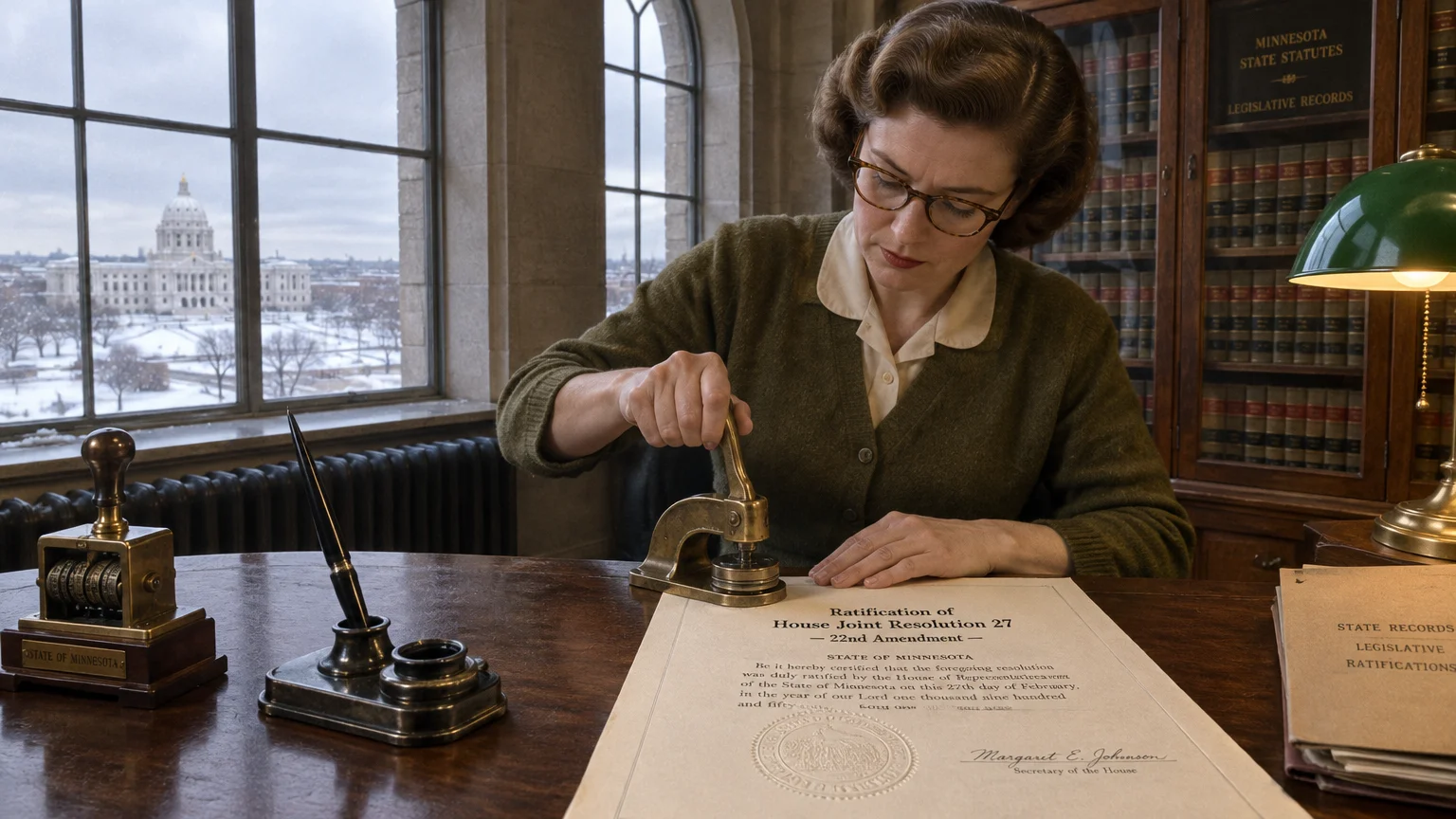
Minnesota provided the decisive 36th ratification on February 27, 1951, meeting the required three-fourths threshold among the 48 states.
You can review the original certified resolution directly through the National Archives milestone documents collection.
The Absolute Two-Election Cap
Section 1 of the amendment establishes a clear numerical barrier: “No person shall be elected to the office of the President more than twice.”
This language focuses strictly on the act of winning presidential elections rather than consecutive service.
A president who serves two consecutive terms, such as Ronald Reagan or Barack Obama, exhausts their eligibility entirely upon completing their second term.
The restriction applies with equal force to non-consecutive presidencies.
In American history, only two presidents have ever served non-consecutive terms in the White House.
Grover Cleveland served as the 22nd president from 1885 to 1889, lost re-election, and returned as the 24th president from 1893 to 1897.
Cleveland governed prior to the Twenty-Second Amendment, meaning constitutional term caps did not limit his political career.
Donald Trump became the second non-consecutive president after winning presidential elections in 2016 and 2024.
Because Trump secured two national presidential victories, Section 1 constitutionally bars him from appearing on the presidential ballot in 2028.
In January 2025, Representative Andy Ogles introduced House Joint Resolution 29 in the 119th Congress.
His proposal sought to amend the Twenty-Second Amendment to permit three terms for presidents who served non-consecutively.
Representative Dan Goldman introduced a competing resolution reaffirming the two-election cap across all scenarios.
Neither measure advanced through the committee process, leaving the original two-election limit fully operative.
You can track resolution text and committee referrals directly on Congress.gov.
The Two-Year Succession Threshold
The Twenty-Second Amendment does more than limit election victories; it also accounts for sudden transfers of executive authority.
When a vice president assumes the presidency, the amendment evaluates how much of their predecessor’s term remains.
The text draws a strict legal dividing line at precisely two years.
Section 1 states that any person who holds the presidency for more than two years of another person’s term may only win one election.
If an inherited term lasts two years and a single day, the successor loses the right to seek two terms of their own.
This cutoff guarantees that an unelected successor cannot leverage the power of incumbency to govern for up to a dozen years.
Gerald Ford provided the clearest modern demonstration of this statutory threshold.
Ford took the oath of office on August 9, 1974, following the resignation of Richard Nixon.
Nixon’s second term had started on January 20, 1973, leaving roughly two years, five months, and eleven days unexpired.
Because Ford served more than two years of Nixon’s term, the Twenty-Second Amendment capped him at one future election.
Ford secured the Republican nomination in 1976 and lost the general election to Jimmy Carter.
Had Ford won that contest, he would have been constitutionally barred from running for re-election in 1980.
You can read the legal analysis of partial-term limits in the Constitution Annotated database.
The Ten-Year Maximum Service Rule
While the amendment restricts long-serving accidental presidents, it also creates an exception that permits a ten-year presidency.
If a successor serves two years or less of an unexpired term, that inherited service does not count against their two-election limit.
The math allows for a two-year inherited tenure followed by two full four-year terms won in national elections.
This ten-year ceiling represents the absolute maximum duration any person can legally serve as president under current constitutional law.
Lyndon B. Johnson demonstrated how this provision operates in a real-world political crisis.
Johnson assumed the presidency on November 22, 1963, following the assassination of John F. Kennedy in Dallas, Texas.
Kennedy’s term had approximately fourteen months remaining when Johnson took the oath of office aboard Air Force One.
Because fourteen months falls well below the two-year statutory threshold, Johnson remained eligible for two full four-year terms.
Johnson won the 1964 presidential election against Barry Goldwater in a historic landslide, securing 486 electoral votes.
When the 1968 presidential election arrived, Johnson possessed full constitutional eligibility to run for another term.
Had he run and won in 1968, his total White House tenure would have spanned nine years and two months.
Johnson entered the 1968 New Hampshire primary, faced strong opposition, and announced his withdrawal on March 31, 1968.
His tenure confirmed that accidental presidents can legally pursue ten years in office if their initial succession occurs late in a term.
A comprehensive examination of these historical tenure rules appears in studies published by the Congressional Research Service.
The Truman Grandfather Clause
When lawmakers in the 80th Congress drafted the Twenty-Second Amendment in 1947, they confronted an immediate political conflict.
Critics accused congressional Republicans of designing the amendment as a posthumous rebuke of Franklin D. Roosevelt and an attack on Harry S.
Truman.
To preserve institutional legitimacy and secure Democratic support, drafters inserted a specific grandfather clause into Section 1.
The clause explicitly exempted “any person holding the office of President when this Article was proposed by the Congress.”
Truman had succeeded to the presidency upon Roosevelt’s death on April 12, 1945.
He served three years and nine months of Roosevelt’s fourth term before winning his own full presidential term in November 1948.
Under the standard succession rules, Truman’s three-plus years of inherited service would have barred him from running in 1952.
The grandfather clause nullified that limitation exclusively for Truman.
When the amendment achieved final state ratification on February 27, 1951, Truman was the only living person exempt from its limits.
Truman took advantage of this exemption and entered the March 1952 New Hampshire Democratic primary.
After losing the primary vote to Tennessee Senator Estes Kefauver, Truman reevaluated his political standing.
On March 29, 1952, Truman delivered a speech at the National Guard Armory in Washington, D.C.
He announced that he would not run for re-election, clearing the path for Adlai Stevenson II to claim the nomination.
You can explore Truman’s speeches and primary campaign papers through the Harry S. Truman Library historical archives.
The Twelfth Amendment Succession Loophole
The most widely debated question surrounding the Twenty-Second Amendment involves an apparent textual loophole regarding executive succession.
The amendment explicitly states that no person can be *elected* president more than twice.
Crucially, the text does not say that a termed-out president is barred from *holding* or *serving in* the office.
Legislative drafting journals confirm that the 80th Congress actively debated this precise distinction in 1947.
The original House version of House Joint Resolution 27 sought to make a two-term president completely “ineligible to hold the office.”
The Senate Judiciary Committee deliberately removed that broad restriction, substituting the narrower prohibition against being elected.
This word choice generated decades of constitutional debate regarding whether a two-term president could serve as vice president.
Theoretical scenarios suggest a two-term president could run for vice president, win, and ascend to the presidency if the incumbent leaves office.
Opponents of this theory point to the final sentence of the Twelfth Amendment, ratified in 1804.
The Twelfth Amendment states: “no person constitutionally ineligible to the office of President shall be eligible to that of Vice-President.”
Textualist scholars argue that because a two-term president remains eligible to *hold* the office, they remain eligible for the vice presidency.
Structuralist scholars counter that the Twelfth Amendment intended complete alignment between presidential and vice-presidential qualifications.
Under the structural view, any person barred from winning a presidential election is constitutionally ineligible for the vice presidency.
The same legal ambiguity extends to legislative succession under the Presidential Succession Act of 1947, codified at 3 U.S.C. § 19.
If a termed-out president became Speaker of the House, could they succeed to the Oval Office during a dual vacancy?
Because no political party has ever tested this succession theory, the Supreme Court has never issued a ruling on the dispute.
| Tenure Rule | Constitutional Provision | Service Threshold | Historical Precedent |
|---|---|---|---|
| Standard Term Cap | 22nd Amendment, Sec. 1 | Two election victories | Barack Obama (completed 8 years) |
| Non-Consecutive Cap | 22nd Amendment, Sec. 1 | Two total elections won | Donald Trump (barred in 2028) |
| Long Succession Limit | 22nd Amendment, Sec. 1 | Over 2 years of inherited term | Gerald Ford (eligible for 1 election) |
| Short Succession Cap | 22nd Amendment, Sec. 1 | 2 years or less inherited | Lyndon B. Johnson (eligible in 1968) |
| Incumbent Exemption | 22nd Amendment, Sec. 1 | Sitting president in March 1947 | Harry S. Truman (eligible in 1952) |
| Succession Eligibility | 12th vs. 22nd Amendment | “Elected” vs. “holding” office | Untested Supreme Court question |
Why the Twenty-Second Amendment Endures in Modern Governance
The Twenty-Second Amendment transformed the presidency from a custom-driven office into an institution governed by rigid mathematical boundaries.
By establishing hard limits on presidential service, the amendment prevents executive power from accumulating indefinitely within a single administration.
This constitutional boundary also introduced a permanent dynamic into American governance: the automatic second-term “lame duck” status.
From the moment a president wins re-election, lawmakers and political rivals understand that executive authority faces an unmovable expiration date.
This dynamic reshapes legislative negotiations, alters party primaries, and shifts political leverage toward Congress during a president’s final years.
Altering or repealing these presidential tenure caps requires meeting the formidable hurdles established by Article V of the Constitution.
An amendment requires approval by a two-thirds supermajority in both chambers of Congress—290 House votes and 67 Senate votes.
Following congressional passage, three-fourths of the states—38 out of 50—must vote to ratify the change.
Despite occasional legislative proposals to alter tenure rules, strong bipartisan public support continues to protect the two-term limit.
The Twenty-Second Amendment remains one of the most durable structural checks on executive power in the American constitutional system.
Frequently Asked Questions About Presidential Term Limits
Can a two-term president run for Vice President?
The text of the Twenty-Second Amendment bars two-term presidents from being *elected* president, but does not explicitly ban them from serving.
However, the Twelfth Amendment establishes that anyone ineligible to the presidency cannot serve as vice president.
Because the Supreme Court has never interpreted this constitutional tension, the question remains an unresolved legal debate.
Could Congress repeal the Twenty-Second Amendment with a simple majority?
Congress cannot alter or repeal any constitutional amendment through ordinary legislation or simple majority votes.
Repealing the amendment requires a new constitutional amendment passed under the demanding procedures of Article V.
This requires a two-thirds vote in both congressional chambers followed by ratification in 38 state legislatures.
Did any president serve more than eight years after 1951?
No president has served more than eight years in the Oval Office since the ratification of the Twenty-Second Amendment.
Lyndon B. Johnson served five years and two months across his inherited tenure and one elected term.
Dwight D. Eisenhower, Ronald Reagan, Bill Clinton, George W.
Bush, and Barack Obama each served exactly eight years.
Does the Twenty-Second Amendment apply to state governors?
The Twenty-Second Amendment applies exclusively to the federal office of the President of the United States.
State constitutions independently establish the term limits, eligibility rules, and succession procedures for their own governors.
Some states enforce strict lifetime limits, others enforce consecutive term limits, and several impose no gubernatorial term limits at all.




