
When federal funding lapses at midnight on October 1, the law halts normal government operations immediately. You face closed agency offices, suspended public services, and mandatory employee furloughs that disrupt daily routines across the nation.
This shutdown process does not stem from political whim; statutory mandates and executive branch legal precedents strictly govern it. The modern framework traces back to nineteenth-century spending curbs and pivotal Department of Justice interpretations.
Understanding these foundational fiscal rules helps you navigate the direct impact of an appropriations impasse. Here is the legal and operational architecture that dictates what closes, what stays open, and why.
The Statutory Framework Governing Federal Funding Lapses
This guide examines the six core statutory and constitutional mechanisms that force federal agencies to halt operations during an appropriations lapse.
Our editorial team selected these rules by analyzing primary documents from the Library of Congress, executive orders, and congressional budget statutes.
The timeline spans founding constitutional principles, nineteenth-century legislative reforms, and executive legal interpretations issued in the early 1980s.
These legal mandates establish strict financial boundaries for every executive branch department. They determine how public money is obligated, who remains on the job, and when employees must stop working.
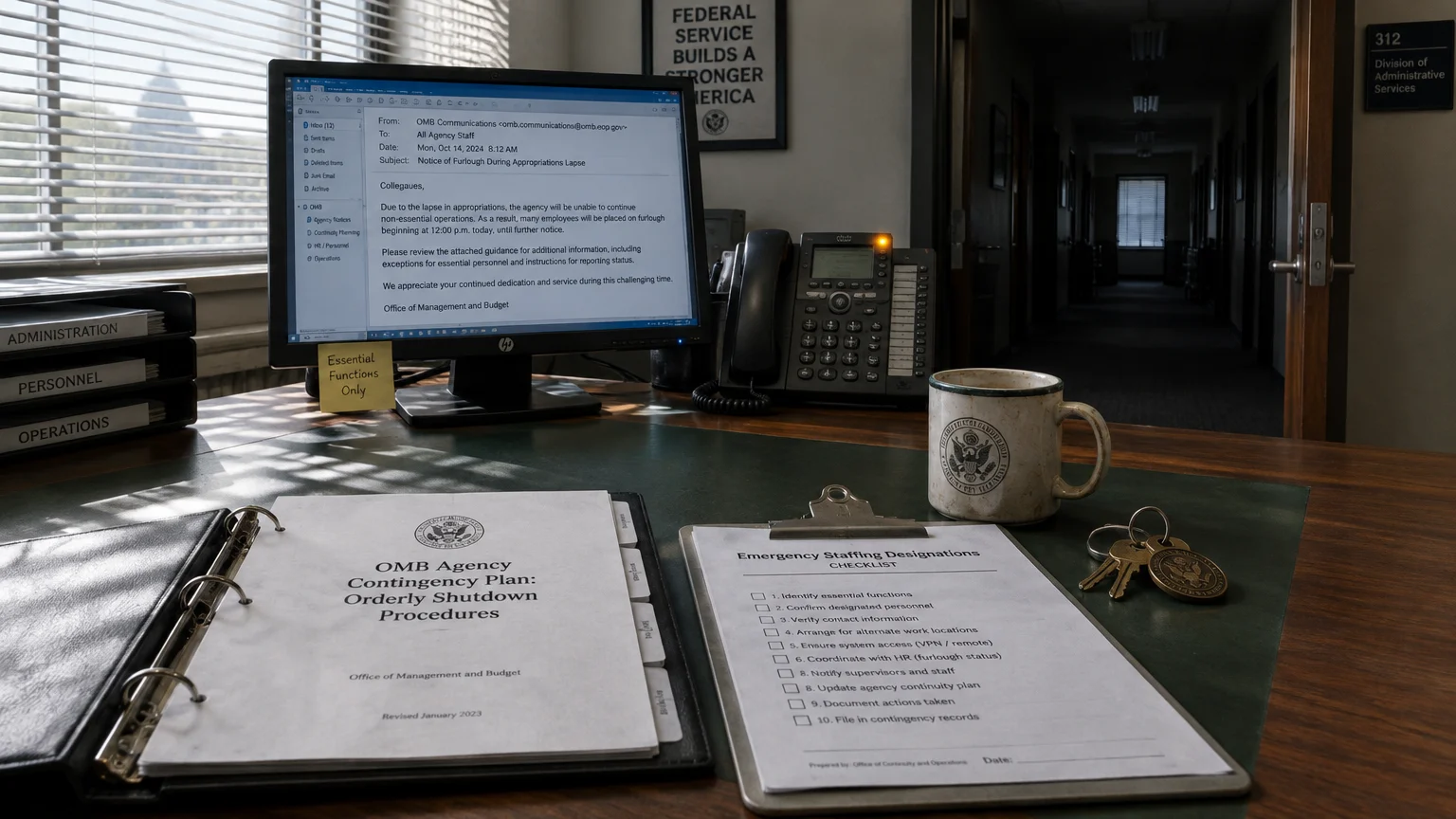
The Office of Management and Budget coordinates these operational shutdowns across all executive agencies. The budget office requires departments to maintain active shutdown playbooks outlining emergency staffing levels.
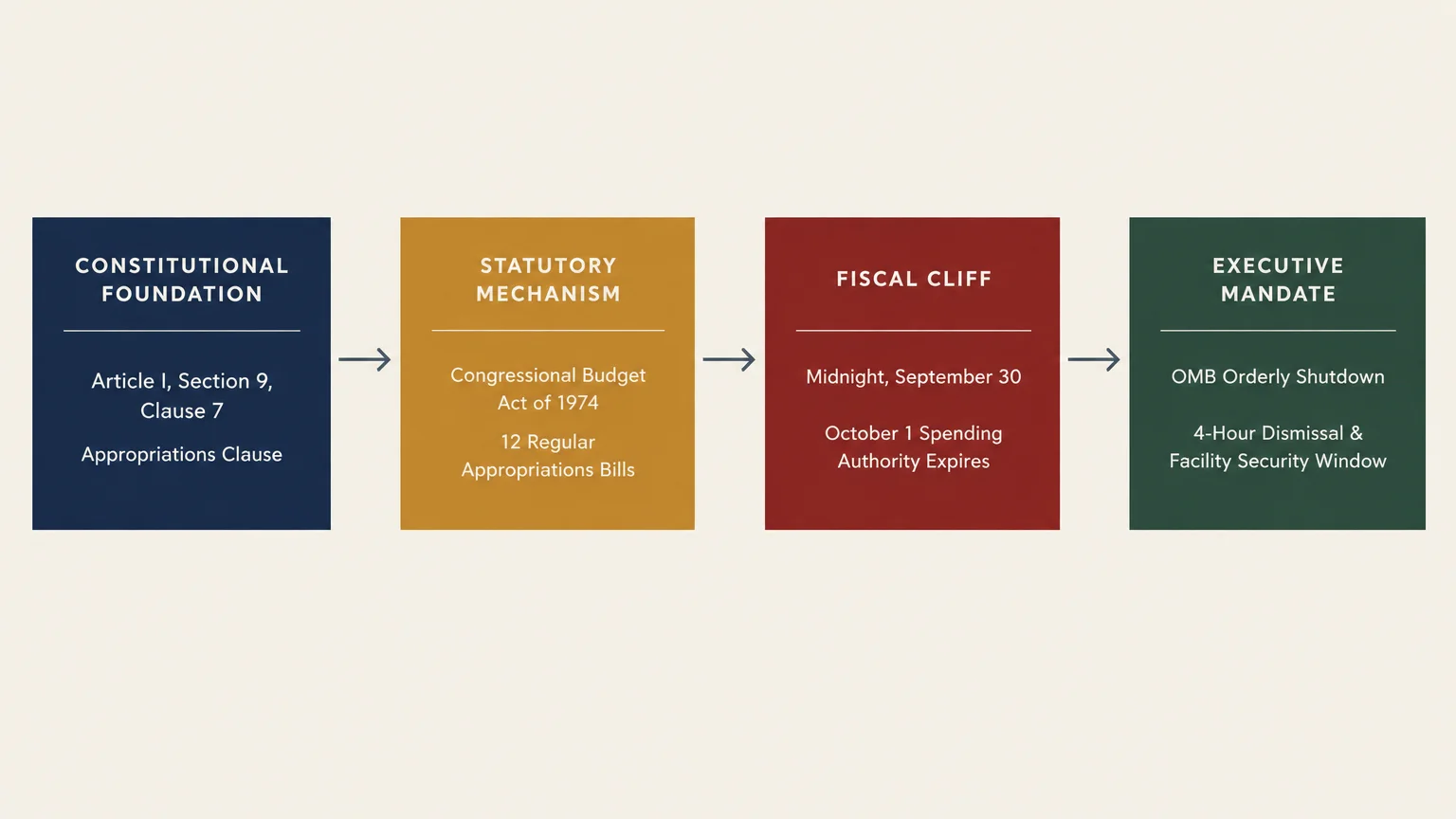
When funding lapses occur, agencies carry out orderly shutdown activities within the first four hours of the workday. Supervisors dismiss furloughed personnel and secure federal facilities.
Whether you work for the federal government or rely on federal programs, these rules govern your experience during a funding lapse.
The Constitutional Mandate for Congressional Appropriations
The fundamental legal trigger for any federal shutdown rests in the text of the United States Constitution. Article I, Section 9, Clause 7 dictates that no money can leave the Treasury without a specific statute authorizing the expenditure.
This principle, known as the Appropriations Clause, grants the exclusive power of the purse to the legislative branch. The executive branch possesses no independent constitutional authority to raise revenue or spend public funds.
Congress exercises this spending control by passing 12 regular appropriations bills each fiscal year. Each bill funds distinct government sectors, ranging from defense and transportation to agriculture and public health.
The Senate Committee on Appropriations and its House counterpart manage these 12 distinct bills. Both chambers must pass identical statutory text before sending the measures to the president.
Under the Congressional Budget and Impoundment Control Act of 1974, the federal fiscal year begins on October 1. Lawmakers must complete all 12 funding measures before midnight on September 30 to avert an operational lapse.
When Congress fails to enact these annual appropriations, statutory spending authority expires across unfunded agencies. The Treasury Department cannot release funds to cover agency expenses without an active legislative appropriation.
To avoid a sudden shutdown, lawmakers often pass a stopgap bill known as a continuing resolution. This temporary measure extends current funding levels for days, weeks, or months while budget negotiations continue.
If lawmakers fail to pass either regular appropriations bills or a continuing resolution, the constitutional spending ban takes effect immediately. Agencies lose the legal authority to obligate funds or conduct normal operations.
This constitutional barrier protects your tax dollars from unauthorized executive spending. However, it also creates an absolute fiscal deadline that triggers nationwide agency closures when budget talks collapse.
You can track whether Congress is meeting its budget deadlines by monitoring roll-call votes on Congress.gov. When deadlines slip, agencies immediately initiate contingency preparations.
The Criminal Strictures of the Antideficiency Act
The primary statutory enforcement tool behind a government shutdown is the Antideficiency Act. Codified at 31 U.S.C. § 1341, this law strictly bars federal officials from spending money Congress has not yet appropriated.
Congress enacted the initial version of the statute on July 12, 1870, to stop agencies from creating unauthorized financial obligations. Nineteenth-century agency chiefs routinely exhausted their annual budgets within months, forcing lawmakers to pass emergency bailouts.
Lawmakers called these manufactured shortfalls “coercive deficiencies” because they stripped Congress of genuine budget control. Congress strengthened the statute in 1884 and added strict criminal penalties in 1905 and 1906.
Under 31 U.S.C. § 1341(a)(1)(A), federal officers may not make or authorize an expenditure or obligation exceeding available appropriations. They are equally prohibited from obligating funds before an appropriation becomes law.
The statute contains severe enforcement mechanisms to ensure compliance among executive managers. Under 31 U.S.C. § 1350, officials who knowingly violate the act face criminal fines and up to two years in federal prison.
Administrative penalties under 31 U.S.C. § 1349 also mandate formal reprimands, suspensions without pay, or permanent termination of employment. These penalties apply even if an official acts with good intentions to preserve public services.
The statute also establishes apportionment rules under 31 U.S.C. § 1512. The Office of Management and Budget divides agency funding into quarterly allocations, preventing agencies from burning through appropriations early in the fiscal year.
Agency leaders must report every Antideficiency Act violation directly to the President, Congress, and the Comptroller General. These formal violation letters become matters of public record.
Because criminal and administrative penalties directly target agency supervisors, managers do not gamble with unauthorized spending. When appropriations expire, officials order immediate work stoppages to protect themselves from legal prosecution.
If you supervise federal employees, you cannot authorize staff to work on credit. Doing so risks administrative removal from your position and personal referral to the Department of Justice.
The Executive Interpretations of the Civiletti Opinions
Although the Antideficiency Act existed for a century, modern government shutdowns only began in 1980. Prior to that year, federal agencies routinely operated during funding gaps under the assumption that Congress would eventually provide funds.
Agencies maintained normal operations while tallying payroll IOUs, treating funding gaps as minor accounting delays rather than legal emergencies. That permissive administrative practice ended abruptly during the Carter administration.
In early 1980, President Jimmy Carter asked Attorney General Benjamin Civiletti for a formal legal interpretation of the Antideficiency Act. Civiletti issued his first landmark formal opinion on April 25, 1980 (43 Op.
Att’y Gen. 224).
Civiletti concluded that the statutory text leaves no room for administrative discretion. He determined that agencies cannot incur any financial obligations or employ personnel during an appropriations lapse.
Under Civiletti’s interpretation, agency heads had to suspend all non-essential operations immediately upon the expiration of funding. This ruling triggered the first modern agency shutdown on May 1, 1980, briefly closing the Federal Trade Commission.
To address widespread administrative confusion, Civiletti issued an expanded follow-up legal opinion on January 16, 1981 (43 Op. Att’y Gen.
289). This second memo clarified what limited activities could legally continue during an active funding gap.
Civiletti established that agencies could expend funds only to conduct an orderly shutdown or preserve essential constitutional functions. The 1981 opinion established the modern architecture of employee furloughs and operational shutdowns.
Assistant Attorney General Walter Dellinger reaffirmed Civiletti’s legal framework in an Office of Legal Counsel memorandum on August 16, 1995. Dellinger confirmed that agencies must maintain strict shutdown protocols during budget stalemates.
Every modern shutdown plan implemented across the executive branch descends directly from these two foundational legal memos. Civiletti transformed the Antideficiency Act from a bookkeeping guideline into a rigid, mandatory operational trigger.
Because of Civiletti’s opinions, funding gaps no longer pass quietly. They instantly transform legislative impasses into physical agency closures visible in your community.
The Emergency Criteria for Excepted Personnel
When an agency shuts down, federal personnel divide into two distinct operational groups: excepted and non-excepted employees. This distinction dictates whether you must report to work during an active funding gap.
The legal foundation for excepted staffing rests in 31 U.S.C. § 1342. This section prohibits agencies from accepting voluntary services, preventing officials from using unpaid volunteers to keep programs running.
The statute provides a narrow exception for cases involving the safety of human life or the protection of property. Following the 1981 Civiletti opinion, Congress amended Section 1342 in 1990 to narrow this emergency threshold further.
The law specifies that emergencies do not include ongoing, regular government functions where suspension would merely disrupt public convenience. The threat to human life or tangible property must be direct, imminent, and severe.
Under Office of Management and Budget Circular No. A-11, Section 124, every federal agency maintains a detailed contingency plan. These documents classify specific job categories as excepted or non-excepted before a shutdown occurs.
Excepted personnel include military service members, federal law enforcement officers, air traffic controllers, and frontline medical staff at veterans’ hospitals. These workers must report to their assigned duties despite missing regular paychecks.
Non-excepted employees receive furlough notices and cannot perform any government duties during the lapse. Furloughed workers cannot legally check government emails, answer official phone calls, or perform uncompensated volunteer labor from home.
Violating these telework and voluntary service bans breaches the Antideficiency Act. Agencies aggressively enforce these prohibitions to prevent employees from inadvertently exposing the department to statutory liability.
If your position is designated non-excepted, your agency will deliver a formal furlough notice via email or Standard Form 50. You must surrender access to government IT networks until funding resumes.
Furloughed federal workers can apply for state unemployment insurance benefits during extended shutdowns. However, state rules typically require employees to repay those benefits once Congress restores retroactive pay.
The Legal Boundary Between Discretionary and Mandatory Spending
A federal government shutdown does not halt every program or function across the federal landscape. A shutdown affects only discretionary spending programs that rely on annual appropriations passed by Congress.
Programs governed by mandatory spending laws continue operating because their funding authority does not expire on September 30. Mandatory programs draw money under permanent statutory formulas codified in substantive federal law.
Social Security represents the largest mandatory program protected from annual funding lapses. Under 42 U.S.C. § 401, the Social Security Administration automatically issues retirement and disability benefit payments without annual congressional action.
Medicare and Medicaid benefits similarly operate under permanent statutory appropriations, ensuring medical providers continue receiving reimbursements. However, administrative offices managing these programs often furlough customer support staff, causing noticeable service backlogs for beneficiaries.
Self-funded federal entities also remain open and fully functional throughout an appropriations lapse. The United States Postal Service operates independently under 39 U.S.C. § 2401, financing daily operations through stamp sales and delivery fees.
Similarly, the United States Citizenship and Immigration Services relies on application fees authorized under 8 U.S.C. § 1356(m). Fee revenue permits the agency to process citizenship petitions and visa renewals without relying on annual tax dollars.
According to analysis from the Congressional Research Service, mandatory outlays and self-funded operations constitute over sixty percent of total annual federal spending.
The Federal Reserve System also functions normally during a shutdown. The central bank funds its operations through interest earnings on securities and assessment fees on member banks, bypassing congressional appropriations entirely.
Veterans Affairs medical centers keep hospital doors open using advance appropriations provided by Congress in previous legislative cycles. However, regional VA benefit offices may suspend walk-in counseling and manual claims processing during prolonged lapses.
When you hear news of a looming shutdown, identify whether your federal service relies on annual appropriations. While regulatory reviews and national parks close, core entitlement benefits and postal deliveries continue without interruption.
The Statutory Safeguards for Worker Pay and Constitutional Salaries
Compensation during a funding lapse follows rigid constitutional and statutory rules. Historically, furloughed employees had to wait for Congress to pass retroactive pay legislation after each individual shutdown ended.
That uncertainty ended when lawmakers passed the Government Employee Fair Treatment Act of 2019 (Pub. L.
116-1). Enacted on January 16, 2019, this statute amended the Antideficiency Act to guarantee automatic back pay.
Codified at 31 U.S.C. § 1341(c), the statute requires the Treasury to compensate both furloughed and excepted employees retroactive to the shutdown’s start date. Agencies must disburse this back pay on the first scheduled pay date following the funding restoration.
While civil servants enjoy guaranteed back pay, elected officials and constitutional officers operate under distinct constitutional compensation clauses. Members of Congress continue receiving their regular $174,000 annual salaries throughout an active shutdown.
Article I, Section 6, Clause 1 guarantees compensation for senators and representatives out of the Treasury. Furthermore, the Twenty-Seventh Amendment prohibits any law from changing congressional compensation until an election of representatives has intervened.
The President of the United States similarly draws an uninterrupted $400,000 salary under Article II, Section 1, Clause 7. That constitutional provision strictly bars Congress from diminishing the chief executive’s pay during an elected term.
Article III federal judges likewise enjoy constitutional protection against salary reductions during their lifetime appointments. These constitutional mandates insulate top officials from immediate personal financial pressure during protracted budget disputes.
Unlike their bosses, congressional staffers do not have constitutional salary protections. Personal and committee staff are subject to executive-style furloughs unless their employing member designates them as essential legislative personnel.
However, millions of private federal contractors enjoy zero back pay protections under federal law. If you work for a service contractor whose site closes during a lapse, the government will not reimburse your lost wages.
If you are a federal employee, review your emergency savings before funding deadlines. While the law guarantees back pay, payroll processing delays can still disrupt your biweekly household cash flow.
| Rule / Legal Mechanism | Controlling Authority | Legal Trigger | Real-World Operational Impact |
|---|---|---|---|
| Constitutional Spending Power | U.S. Const. art. I, § 9, cl. 7 | Annual spending bill expires | Treasury cannot disburse discretionary funds. |
| Antideficiency Act Restrictions | 31 U.S.C. § 1341 | Unappropriated debt incurred | Agencies halt work under threat of criminal penalties. |
| Civiletti Administrative Doctrine | 43 Op. Att’y Gen. 224 & 289 | Executive funding gap begins | Mandates immediate agency closures and furloughs. |
| Emergency Life & Property Rule | 31 U.S.C. § 1342 | Threat to life or assets | Forces excepted personnel to work without current pay. |
| Mandatory vs. Discretionary Split | Social Security Act; 39 U.S.C. § 2401 | Permanent statutory funding base | Benefit checks, Medicare, and mail continue delivery. |
| Permanent Compensation Rules | Pub. L. 116-1; 31 U.S.C. § 1341(c) | Resolution of funding lapse | Mandates full retroactive back pay for civil servants. |
How Legal Precedents Shape Modern Funding Battles
The modern federal shutdown is not an accidental administrative breakdown. It represents the logical result of strict statutory commands colliding with deep legislative disagreements.
Before 1980, an expired appropriation was an inconvenience that agency managers handled with deferred accounting. Benjamin Civiletti’s legal opinions eliminated that administrative flexibility and forced departments to close their doors.
Meanwhile, the Congressional Budget Act created a firm October 1 deadline that turns annual spending into recurring fiscal deadlines. This structural dynamic transformed the routine appropriations process into recurring high-stakes standoffs.
The 35-day partial shutdown between December 22, 2018, and January 25, 2019, illustrated the real-world scale of these rules. That record lapse affected nine executive departments and roughly 800,000 federal workers nationwide.
The Antideficiency Act acts as the strict enforcement engine behind this entire framework. Because agency leaders face possible criminal penalties and dismissal, they enforce shutdown directives with uncompromising precision.
For federal workers, the Government Employee Fair Treatment Act of 2019 provided critical income security by mandating automatic back pay. However, the temporary loss of paychecks during prolonged lapses still strains household finances across the country.
Federal contractors face even steeper hurdles because the law offers them no retroactive compensation for lost hours. Service workers and technical consultants bear the permanent financial brunt of every operational closure.
Financial institutions often offer zero-interest emergency loans to federal workers during active lapses. You should contact your bank or credit union early if funding talks stall on Capitol Hill.
Recognizing how these legal rules interact allows you to prepare effectively for potential lapses. You can anticipate which public services will pause, which benefits will continue, and how your personal finances might be affected.
Frequently Asked Questions About Federal Shutdowns
Can federal employees volunteer to work during a funding lapse?
No, federal employees cannot volunteer to perform official duties during a shutdown. Under 31 U.S.C. § 1342, agencies cannot accept voluntary services outside certified emergencies involving human life or property.
If you are furloughed, you cannot check work emails, draft reports, or answer calls from home. Performing uncompensated work exposes your agency supervisors to direct Antideficiency Act penalties.
Agencies enforce this voluntary services ban strictly to protect workers from wage exploitation. Supervisors face disciplinary suspensions if they permit employees to work off the clock during a funding gap.
Why do members of Congress continue to draw salaries while agencies close?
Members of Congress receive pay during shutdowns because their compensation is shielded by the Constitution. Article I, Section 6, and the Twenty-Seventh Amendment prevent alterations to congressional pay during an active congressional term.
Congress also funded its pay through a permanent, direct appropriation enacted in 1983. Because lawmaker compensation does not depend on the 12 annual appropriations bills, their paychecks arrive on schedule.
While lawmakers cannot constitutionally dock their own salaries during a lapse, several members voluntarily donate their pay to charities. Others request that the Treasury hold their compensation in escrow until funding resumes.
How does a continuing resolution prevent a shutdown from taking effect?
A continuing resolution prevents a shutdown by temporarily extending the prior fiscal year’s funding levels. It acts as an emergency stopgap, providing statutory spending authority for a defined window of time.
Passing a continuing resolution fulfills the constitutional requirement of an appropriation made by law. As long as a continuing resolution remains active, agencies maintain full legal authority to obligate money and pay staff.
Lawmakers frequently rely on multiple consecutive stopgaps to keep agencies open while negotiating full-year budgets. However, operating under short-term resolutions limits an agency’s ability to initiate new programs or sign major contracts.
Do federal contractors receive retroactive compensation when the government reopens?
Federal contractors do not receive automatic back pay under the Government Employee Fair Treatment Act. The 2019 statute protects only direct federal civil servants and military personnel.
Contractors working on fixed-price or hourly support agreements lose income entirely if an agency closes their worksite. Unless contracting firms provide paid administrative leave or Congress passes specific relief, contractor losses remain permanent.
If you work for a federal contractor, review your company’s furlough and paid-time-off policies before September 30. Many contracting firms require employees to exhaust vacation balances during client facility closures.




