
You can trace the operational stability of the modern presidency directly to the Twenty-Fifth Amendment. It provides the legal roadmap when a commander in chief faces a medical emergency or when a vice presidency sits vacant.
While Hollywood scripts often depict dramatic cabinet revolts, reality tells a far more orderly story. Leaders have formally triggered the amendment exactly five times across modern American history.
Every documented use involved filling an empty office or voluntarily passing executive authority during planned medical anesthesia. Understanding these events shows you how constitutional continuity actually works under pressure.

Framing the Twenty-Fifth Amendment: Origins, Mechanics, and Invocations
When delegates drafted the Constitution in 1787, they left a dangerous structural void in executive continuity. Article II, Section 1, Clause 6 stated that presidential powers devolved onto the vice president, but omitted critical procedures.
The original language never explained who possessed the legal power to declare a president disabled. Furthermore, it failed to clarify whether a successor became president or merely exercised acting authority.
This ambiguity created immediate conflict in 1841 when President William Henry Harrison died after just 31 days in office. Vice President John Tyler insisted on taking the presidential oath and title, establishing the enduring Tyler Precedent.
Critics dismissed Tyler as “His Accidency,” arguing he was merely a temporary caretaker. This political friction proved that future successions required unambiguous constitutional text.
The country also lacked any statutory mechanism to replace a vice president who died or vacated office. Prior to 1967, the vice presidency sat entirely empty 16 separate times.
Eight presidents died in office, automatically leaving the vice presidency vacant under the precedent set by John Tyler. Seven vice presidents died during their terms, and John C.
Calhoun resigned in 1832.
Under the Presidential Succession Act of 1947, congressional leaders occupied the immediate line of succession. A sudden vacancy meant that control of the executive branch could abruptly shift across political parties.
Medical emergencies repeatedly exposed these structural vulnerabilities throughout the nineteenth and twentieth centuries. In 1881, President James A.
Garfield lingered for 80 agonizing days after an assassin shot him.
The Cabinet refused to transfer executive powers to Vice President Chester A. Arthur during Garfield’s suffering.
They worried Arthur’s elevation would permanently strip Garfield of his presidency if he recovered.
A far worse crisis unfolded in October 1919 when President Woodrow Wilson suffered a debilitating stroke. The stroke left Wilson paralyzed on his left side and severely impaired his daily physical stamina.
First Lady Edith Wilson and White House physician Cary Grayson concealed the president’s true medical condition. They screened all state papers, effectively governing the executive branch without constitutional sanction or public transparency.
Vice President Thomas R. Marshall refused to intervene without an explicit congressional resolution or court order.
Marshall feared provoking civil conflict or facing accusations of usurpation without explicit constitutional authority.
Three decades later, President Dwight D. Eisenhower suffered three major medical emergencies during his two terms.
Eisenhower experienced a heart attack in 1955, an intestinal surgery in 1956, and a stroke in 1957.
Eisenhower negotiated private administrative pacts with Vice President Richard Nixon to govern during any temporary incapacity. While these letters established practical cooperation, legal experts warned that private contracts could not settle constitutional ambiguities.
The assassination of President John F. Kennedy on November 22, 1963, provided the final impetus for reform.
Following Kennedy’s death, the vice presidency remained vacant for nearly 14 months under President Lyndon B. Johnson.
During that period, the next officials in line were 71-year-old Speaker John McCormack and 86-year-old Senator Carl Hayden. In the Cold War nuclear era, the American public demanded an unbroken chain of executive command.
Senator Birch Bayh of Indiana and Representative Emanuel Celler of New York drafted a comprehensive solution. On January 6, 1965, they introduced Senate Joint Resolution 1 to establish formal succession rules.
As documented by the National Archives Milestone Documents, Congress approved the joint resolution on July 6, 1965. The states ratified the measure on February 10, 1967.
The resulting Twenty-Fifth Amendment establishes four distinct operational sections to maintain uninterrupted executive leadership. Each section addresses a specific constitutional problem that had previously generated governance crises.
Section 1 formally codifies the Tyler Precedent, declaring that the vice president becomes the president upon a vacancy. This rule eliminates all historical debate over whether the successor is merely an acting officer.
Section 2 empowers the president to nominate a vice president whenever that specific office becomes vacant. Both chambers of Congress must confirm the nominee by majority votes before the candidate assumes office.
Section 3 allows a president to transfer executive powers voluntarily during planned medical procedures or acute illnesses. The president simply transmits written declarations to congressional leaders before and after the incapacitating event.
Section 4 provides an emergency involuntary process involving the vice president and a cabinet majority. It remains the most controversial section of the amendment and has never been invoked in American history.
This numbered guide examines the five times executive leaders formally triggered the amendment’s provisions in writing. It excludes informal transfers, such as Ronald Reagan’s 1985 surgery, where the president explicitly disclaimed the amendment.
| Year | Official Involved | Section | Duration / Vote Tally | Operational Outcome |
|---|---|---|---|---|
| 1973 | Gerald Ford | Section 2 | 92–3 Senate, 387–35 House | Confirmed as Vice President |
| 1974 | Nelson Rockefeller | Section 2 | 90–7 Senate, 287–128 House | Confirmed as Vice President |
| 2002 | George W. Bush & Dick Cheney | Section 3 | 2 hours, 15 minutes | Temporary transfer for colonoscopy |
| 2007 | George W. Bush & Dick Cheney | Section 3 | 2 hours, 5 minutes | Temporary transfer for colonoscopy |
| 2021 | Joe Biden & Kamala Harris | Section 3 | 1 hour, 25 minutes | Temporary transfer for colonoscopy |
Gerald Ford Vice Presidential Confirmation
Vice President Spiro Agnew resigned his office on October 10, 1973, following federal criminal bribery charges. His sudden departure created the first vice presidential vacancy since the ratification of the Twenty-Fifth Amendment.
President Richard Nixon invoked Section 2 two days later, nominating House Minority Leader Gerald R. Ford.
Nixon selected Ford specifically because his congressional colleagues respected his personal integrity and bipartisan legislative skill.
The Senate confirmed Ford by a 92–3 vote on November 27, 1973, establishing broad congressional support. The House followed on December 6 with an overwhelming 387–35 roll-call confirmation vote (119 Cong.
Rec. 39900).
According to the Office of the House Historian, Ford took his oath that afternoon. This confirmation proved that Section 2 could function smoothly amid deep partisan division.
Nelson Rockefeller Vice Presidential Confirmation
Richard Nixon resigned the presidency on August 9, 1974, amid the Watergate scandal. Gerald Ford immediately became president under Section 1, which left the vice presidency vacant once again.
President Ford utilized Section 2 on August 20, 1974, by nominating former New York Governor Nelson A. Rockefeller.
Ford sought an experienced administrator with extensive executive experience to help stabilize the executive branch.
As chronicled by Senate Historical Records, lawmakers conducted months of financial reviews before confirming Rockefeller 90–7 on December 10, 1974. The House subsequently approved the nomination 287–128 on December 19.
Rockefeller took the oath of office on December 19, 1974, in the Senate chamber. His swearing-in created the first presidential administration in American history where neither principal executive held an electoral mandate.
George W. Bush Power Transfer to Dick Cheney in 2002
On June 29, 2002, President George W. Bush scheduled a routine screening colonoscopy under anesthesia at Camp David.
Bush decided to transfer executive power formally rather than rely on informal staff agreements.
Bush transmitted formal written declarations under Section 3 to House Speaker Dennis Hastert and Senate President pro tempore Robert Byrd at 7:09 a.m. EDT. This transmission marked the first explicit written activation of Section 3.
Vice President Dick Cheney served as Acting President for two hours and 15 minutes from his residence. Cheney held full constitutional authority, including command of the military and custody of the nuclear launch codes.
At 9:24 a.m. EDT, Bush signed and delivered follow-up letters resuming his constitutional duties. His prompt resumption proved that temporary medical delegations can occur routinely without disrupting the executive branch.
George W. Bush Power Transfer to Dick Cheney in 2007
President George W. Bush invoked Section 3 a second time on July 21, 2007, for another colonoscopy.
The procedure again took place under propofol sedation at the presidential retreat at Camp David.
Bush transmitted his written letters to Speaker Nancy Pelosi and President pro tempore Robert Byrd at 7:16 a.m. EDT. Vice President Cheney assumed the powers and duties of the presidency for two hours and five minutes.
Cheney remained in contact with the White House staff while exercising acting authority from his home in St. Michaels, Maryland. The administration maintained complete operational continuity throughout the brief surgical procedure.
Bush transmitted written notices reclaiming his office at 9:21 a.m. EDT after medical personnel certified his recovery. This second invocation confirmed that Section 3 represents standard executive hygiene rather than a political emergency.
Joe Biden Power Transfer to Kamala Harris in 2021
President Joe Biden invoked Section 3 on November 19, 2021, while undergoing a routine colonoscopy at Walter Reed. Biden followed the administrative precedents established during the Bush administration to ensure constitutional clarity.
Biden delivered written letters to House Speaker Nancy Pelosi and Senate President pro tempore Patrick Leahy at 10:10 a.m. EST. Vice President Kamala Harris immediately assumed the powers and duties of the presidency.
Harris served as Acting President for one hour and 25 minutes while working from her West Wing office. During this period, she held temporary custody of executive branch authorities and defense apparatuses.
Biden signed and transmitted letters resuming his presidential authority at 11:35 a.m. EST. This historical invocation marked the first time a woman held acting presidential power in United States history.
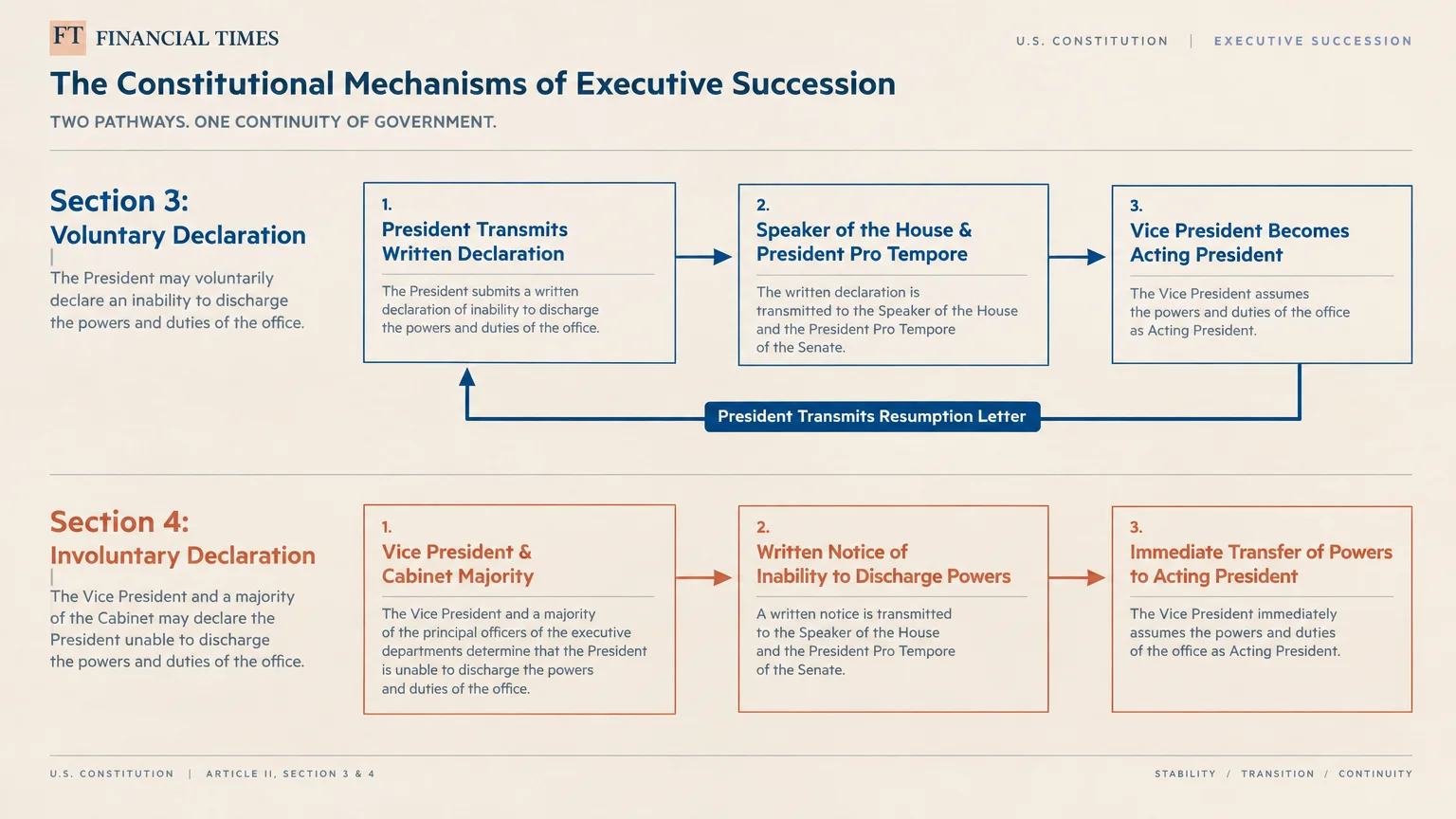
The Constitutional Architecture of Executive Power Transfers
The practical record of the Twenty-Fifth Amendment demonstrates how precise constitutional text prevents administrative disorder. When leaders understand their exact legal roles, transitions occur with quiet administrative efficiency.
Section 2 solved one of the most perilous structural flaws in American governance: the vacant vice presidency. Before 1967, an empty vice presidency left succession to congressional leaders from opposing parties.
The Section 2 process ensures that any replacement vice president receives bipartisan vetting and democratic legitimacy. By requiring majority votes in both chambers, the Constitution forces the president to choose a viable national consensus figure.
This legislative check proved essential during the Watergate crisis. Congress successfully confirmed Gerald Ford and Nelson Rockefeller without triggering constitutional paralysis or partisan breakdowns.
Section 3 serves an equally vital role by normalizing temporary delegations of executive power during planned medical procedures. Modern presidents no longer risk public safety by trying to govern through heavy surgical anesthesia.
The text of Section 3 places absolute initiative in the hands of the sitting commander in chief. The president alone decides when to step aside and when to transmit written notification of recovery.
According to the Constitution Annotated analysis of Section 3, this voluntary structure protects presidential independence. The president retains unilateral authority to resume office immediately upon transmitting the recovery letter.
During these brief transfers, the White House Military Office seamlessly shifts operational communications to the acting president. The military aide carrying the presidential emergency satchel remains alongside the acting executive until power returns.
The Department of Justice Office of Legal Counsel prepares formal memorandums supporting each transfer. These legal instruments ensure that every executive order, veto, or signing statement holds incontestable validity.
In contrast, Section 4 establishes an involuntary removal process designed solely for catastrophic incapacity. The framers intentionally designed Section 4 with rigorous procedural barriers to prevent political usurpation.
A research report from the Congressional Research Service underscores the high constitutional thresholds embedded in Section 4. The vice president and a majority of the Cabinet must initiate the removal process together.
The statutory Cabinet consists of the 15 executive department heads recognized under federal law. Non-statutory cabinet members and executive advisors hold no voting authority in a Section 4 declaration.
If the president contests the declaration of incapacity, Congress must immediately convene within 48 hours to resolve the dispute. Lawmakers then have exactly 21 days to debate and vote on the issue.
To sustain the involuntary transfer of power, both the Senate and the House must vote by two-thirds supermajorities. If either chamber fails to meet that threshold, the president immediately reclaims executive authority.
This two-thirds requirement is higher than the standard required for conviction in a presidential impeachment trial. The framers ensured that no political faction could use Section 4 as a shortcut for impeachment.
Because of these formidable structural hurdles, Section 4 has never been formally invoked in American history. It remains an extreme emergency protocol reserved for comatose or completely incapacitated chief executives.
Understanding these distinct sections protects you from widespread media confusion during political controversies. The public record shows that the amendment operates as a stabilizing safeguard rather than a political weapon.
The five formal invocations highlight an amendment that performs exactly as its congressional authors intended. Through careful statutory design, the Constitution maintains continuous executive governance through every national transition.
Frequently Asked Questions About the Twenty-Fifth Amendment
Did Ronald Reagan formally invoke the Twenty-Fifth Amendment in 1985?
On July 13, 1985, President Ronald Reagan underwent colon cancer surgery at Bethesda Naval Hospital. Reagan signed a letter transferring power to Vice President George H.
W. Bush for seven hours and 54 minutes.
However, Reagan explicitly stated in his letter that he was not formally invoking the Twenty-Fifth Amendment. He cited constitutional ambiguities and argued that the amendment was not intended for brief surgical procedures.
White House counsel Fred Fielding drafted the letter with this disclaimer to avoid setting a rigid precedent. Reagan wanted to preserve presidential discretion rather than create a mandatory rule for minor medical events.
Constitutional scholars classify the 1985 transfer as an informal delegation of power rather than an official Section 3 activation. George W.
Bush later established the first explicit formal precedent in 2002.
Has Section 4 ever been used to strip a president of executive power?
Section 4 has never been formally invoked in United States history. While politicians and legal commentators frequently discuss the provision during contentious political periods, no administration has ever drafted a formal Section 4 declaration.
The framers intended Section 4 solely for severe medical or mental incapacitation, such as a debilitating stroke or coma. They specifically rejected using Section 4 to resolve policy disputes, legislative friction, or administrative incompetence.
During the 1987 transition under Chief of Staff Howard Baker, aides briefly discussed Reagan’s attentiveness before dismissing the idea completely. Baker immediately determined that Reagan remained fully competent and engaged in his duties.
Because invocation requires the vice president’s active leadership and signature, a rogue cabinet cannot act independently against the president. This structural safeguard prevents political coups within the executive branch.
Who counts as the Cabinet when determining a Section 4 majority?
Under Title 5, Section 101 of the U.S. Code, the Cabinet consists of the heads of the 15 executive departments. These department leaders include the Secretaries of State, Defense, the Treasury, and other statutory department heads.
A Section 4 majority requires the written assent of the Vice President and at least eight of these 15 secretaries. White House staff members and agency directors holding cabinet rank cannot vote under Section 4.
The Presidential Succession Act of 1947 establishes the statutory departments eligible for executive succession. Congress has never established an alternative body to replace the Cabinet under Section 4’s enabling clause.
Constitutional scholars continue to debate whether acting department secretaries may legally sign a Section 4 declaration. Most legal analyses conclude that only Senate-confirmed principal officers hold the constitutional standing to strip presidential power.
Can a president immediately reclaim power after delegating it under Section 3?
Yes, a president reclaims full executive power immediately upon transmitting a written declaration of recovery to congressional leaders. The vice president’s acting authority terminates the moment the Speaker and President pro tempore receive the transmittal.
Unlike Section 4, Section 3 requires no medical certifications, congressional hearings, or cabinet votes before the president resumes power. The process rests entirely on the president’s unilateral constitutional judgment.
The White House delivers these physical transmittal letters directly to leadership offices on Capitol Hill via military couriers. Receipt by the presiding officers officially ends the temporary delegation of executive power.
This streamlined mechanism ensures that medical delegations remain brief, voluntary, and free from administrative interference. It encourages chief executives to undergo necessary medical procedures without risking their constitutional authority.




