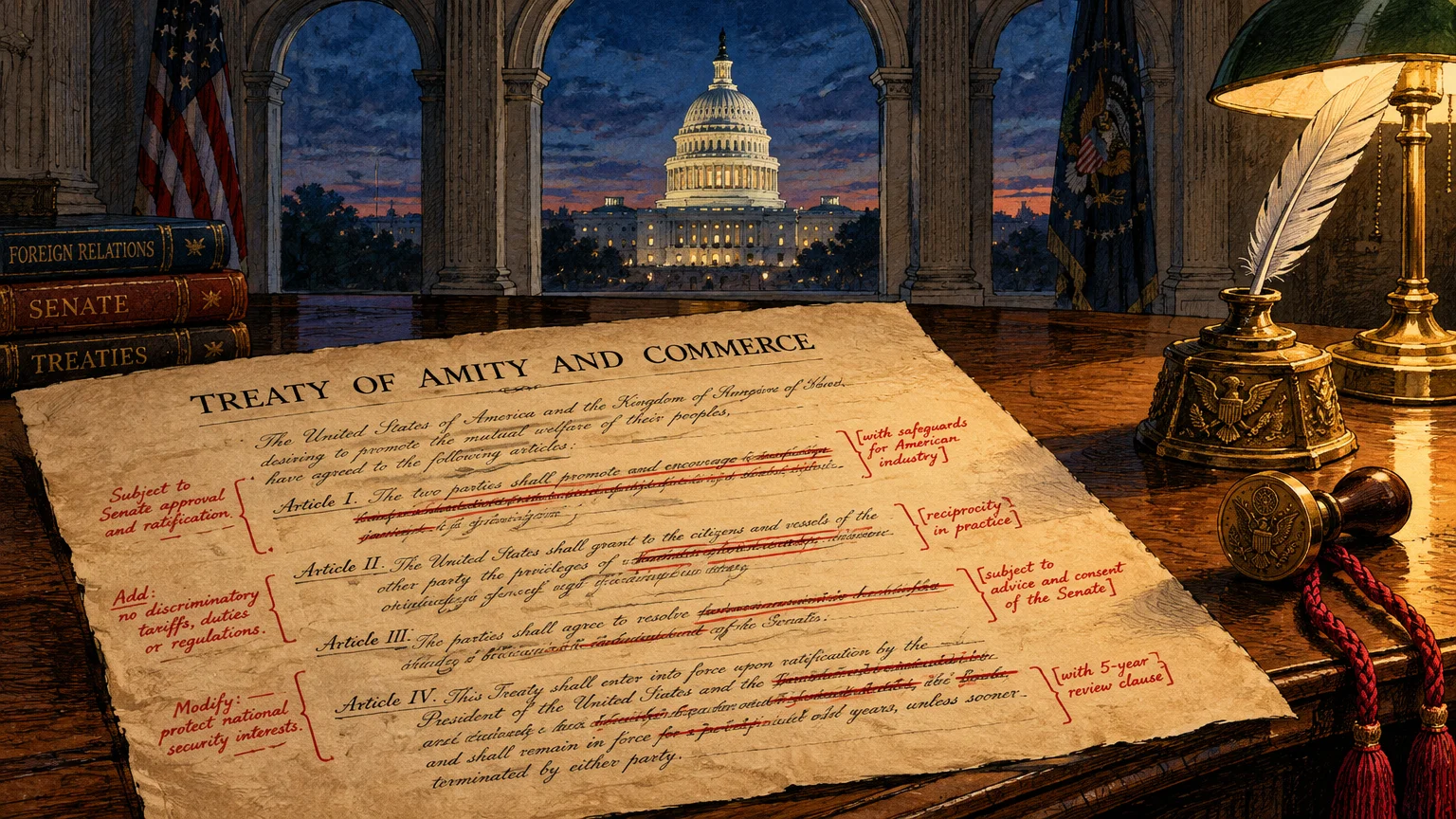
When a president signs an international agreement, American foreign policy is far from settled. The United States Constitution grants the Senate final authority to reshape, stall, or kill any treaty through its Advice and Consent power.
While the Senate has approved more than 1,500 treaties since 1789, it has formally rejected only 22 on the chamber floor. In dozens of other cases, senators heavily altered key terms before granting approval, compelling foreign powers to renegotiate.
Examining these landmark showdowns shows you how Capitol Hill exercises its two-thirds constitutional check against executive overreach.
Advice and Consent Rules Under Article II
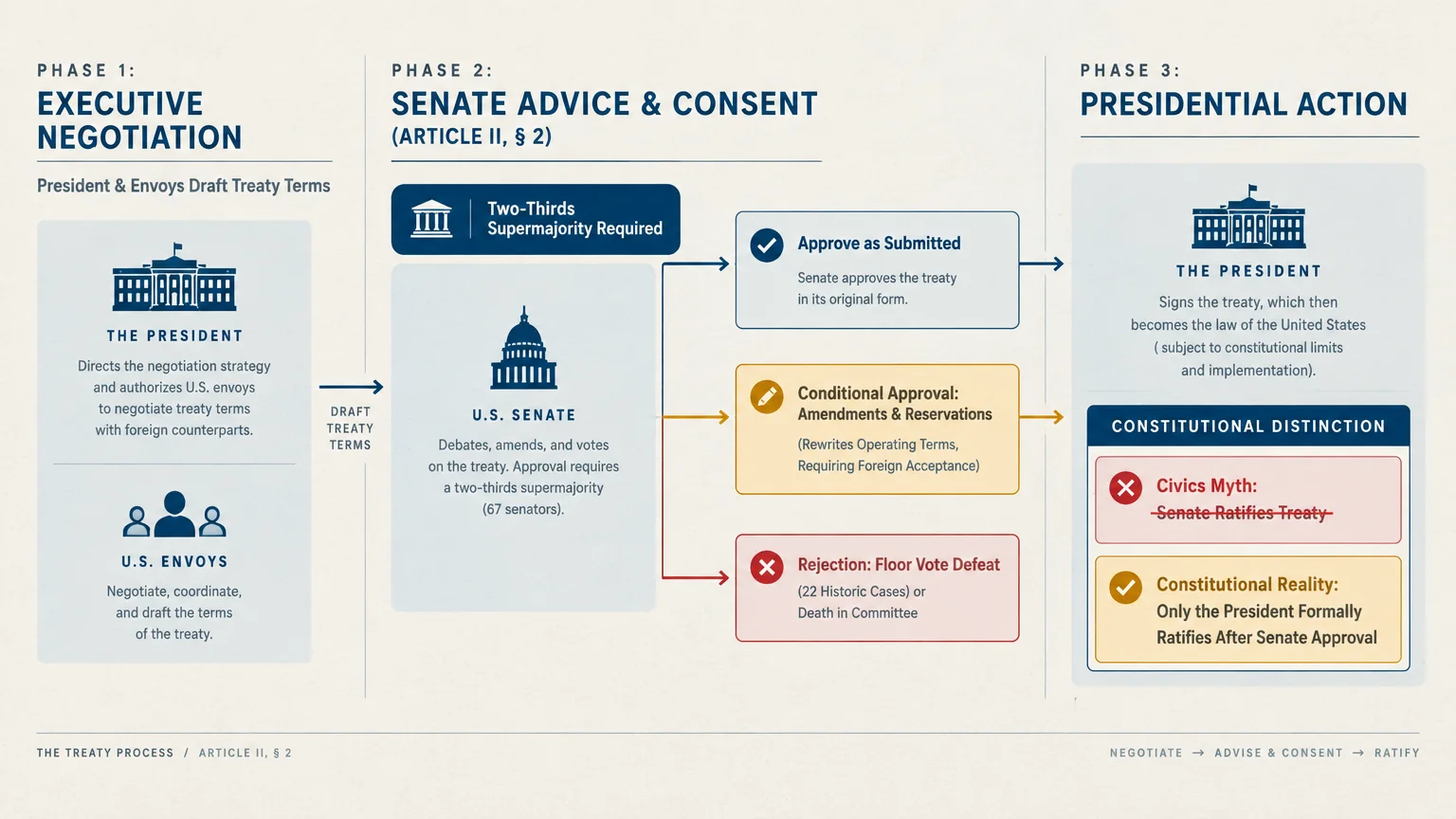
Under Article II, Section 2 of the U.S. Constitution, the president exercises the power to negotiate treaties. However, that authority requires the advice and consent of two-thirds of the senators present.
A common civics myth assumes the Senate ratifies treaties. In statutory and constitutional practice, the Senate never ratifies an international agreement.
Instead, senators vote on a resolution of advice and consent. Only the president formally ratifies a pact after the Senate delivers that required supermajority approval.
According to research from the Congressional Research Service, senators possess significant legal latitude when handling treaties. The chamber can approve a treaty as submitted, attach substantive conditions, or reject it outright.
When senators add amendments or reservations, they effectively rewrite the operating terms. These conditions require the president to secure foreign acceptance before the treaty can take effect.
This curated list highlights 10 landmark treaties spanning from 1795 to 2026. Each entry illustrates how the upper chamber exercised its two-thirds check to reject pacts or force major diplomatic revisions.
According to the U.S. Senate Historical Office, floor rejections remain extraordinarily rare. Dozens of additional pacts simply died in committee without ever facing a recorded floor vote.
The Jay Treaty
Signed with Great Britain on November 19, 1794, the Jay Treaty sought to resolve lingering boundary and commercial disputes from the American Revolution. President George Washington sent Chief Justice John Jay to London to negotiate the pact.
The agreement triggered intense partisan warfare across the United States. Critics condemned the treaty for granting commercial concessions to British merchants while failing to end the impressment of American sailors.
On June 24, 1795, the Senate considered the resolution of advice and consent. The chamber approved the measure by a vote of 20–10, meeting the two-thirds threshold by the narrowest possible margin.
However, the Senate conditioned its approval on a major rewrite of the text. Senators demanded the complete suspension of Article XII, which had placed strict limits on American merchant vessels trading in the British West Indies.
Article XII barred American ships from carrying sugar, coffee, and cotton, severely threatening southern export markets. Lawmakers refused to accept the treaty unless Britain struck those economic restrictions from the agreement.
Washington accepted the Senate’s alteration and submitted the amended treaty to London. The British government accepted the suspension, establishing the enduring precedent of Senate conditional approval.
The controversy also prompted the first invocation of executive privilege. Washington refused to provide the House of Representatives with his negotiation papers, noting that treaty approval belonged exclusively to the Senate.
The Texas Annexation Treaty
On April 12, 1844, the administration of President John Tyler signed a treaty of annexation with the Republic of Texas. The agreement proposed admitting Texas as an American territory.
Under the terms of the treaty, the United States agreed to assume up to $10 million of Texas’s public debt. The proposal immediately reignited bitter sectional debates over the expansion of slavery.
Secretary of State John C. Calhoun deepened the controversy by sending a diplomatic letter defending annexation as a mechanism to protect southern enslavement.
That move alienated northern Whigs and anti-slavery Democrats alike.
On June 8, 1844, the Senate decisively rejected the treaty by a vote of 16–35. The treaty failed to win even a simple majority of the senators present.
Following James K. Polk’s victory in the 1844 presidential election, Tyler pursued an unprecedented procedural workaround.
He urged Congress to annex Texas through a joint resolution rather than a treaty.
Because a joint resolution requires only a simple majority in both chambers, Congress passed the measure easily. Tyler signed the resolution into law on March 1, 1845, three days before leaving office.
This move established a significant constitutional precedent. It proved that an administration could bypass the Senate’s two-thirds treaty threshold by utilizing standard statutory mechanisms.
The Treaty of Guadalupe Hidalgo
Signed on February 2, 1848, the Treaty of Guadalupe Hidalgo officially concluded the Mexican-American War. American diplomat Nicholas Trist negotiated the agreement despite being recalled by President James K.
Polk.
Under the negotiated terms, Mexico ceded 525,000 square miles of territory to the United States, representing approximately 55 percent of its pre-war landmass. In return, Washington agreed to pay Mexico $15 million.
The United States also pledged to assume up to $3.25 million in claims filed by American citizens against Mexico. Despite securing massive territorial expansion, the Senate insisted on altering the pact.
On March 10, 1848, the Senate approved the resolution of ratification by a vote of 38–14. That consent required sweeping changes to the treaty text before transmission back to Mexico City.
Senators voted to completely strike out Article X of the treaty. That critical article had protected the validity of all prior Spanish and Mexican land titles within the ceded territory.
The chamber also altered Article IX, changing the timeline and conditions under which Mexican citizens remaining in the southwest would gain full American citizenship.
Facing American military occupation, the Mexican government reluctantly accepted the Senate’s deletions. The removal of Article X led to protracted legal battles that stripped thousands of Mexican families of their ancestral property.
The Santo Domingo Annexation Treaty
President Ulysses S. Grant championed a treaty signed on November 29, 1869, to annex the Dominican Republic, then known as Santo Domingo.
The pact proposed purchasing the nation for $1.5 million.
Grant envisioned the island as a naval outpost and an overseas refuge for Black Americans fleeing Ku Klux Klan violence in the Reconstruction South. However, critics suspected financial corruption among private land speculators.
Senator Charles Sumner, the powerful Chairman of the Senate Foreign Relations Committee, led the opposition. Sumner delivered passionate speeches calling the annexation an imperialist assault on an independent Caribbean republic.
On June 30, 1870, the Senate voted on the annexation treaty. The chamber deadlocked in a 28–28 tie vote, falling 10 votes short of the required two-thirds majority.
The treaty’s defeat represented a major political blow to Grant’s presidency. In retaliation, Grant’s Senate allies stripped Sumner of his committee chairmanship, deepening divisions within the Republican Party.
The vote effectively halted Reconstruction-era Caribbean expansionism. It demonstrated how an influential committee chairman can mobilize parliamentary opposition to block presidential territorial acquisitions.
The First Hay–Pauncefote Treaty
On February 5, 1900, Secretary of State John Hay and British Ambassador Lord Julian Pauncefote signed a treaty to facilitate construction of a Central American canal. The draft required the canal to remain neutral and unfortified.
The agreement sought to replace the 1850 Clayton-Bulwer Treaty, which had barred either nation from gaining exclusive control over an isthmian waterway. However, American senators demanded complete military control over any new canal.
On December 20, 1900, the Senate approved the treaty by a vote of 55–18. But senators conditioned their approval on the Davis Amendment, which authorized the United States to defend the canal during wartime.
The Senate’s unilateral alterations dismantled the neutrality guarantees Britain had negotiated. The British government refused to accept the rewritten terms, causing the treaty to expire unratified on March 5, 1901.
Hay resumed negotiations with Pauncefote to craft a replacement agreement that satisfied Capitol Hill. The diplomats signed the Second Hay–Pauncefote Treaty on November 18, 1901, explicitly permitting American canal fortification.
With the defense guarantees secured, the Senate approved the second treaty on December 16, 1901, by a 72–6 margin. The vote cleared the path for the construction of the Panama Canal.
The Treaty of Versailles
President Woodrow Wilson spent months in France negotiating the Treaty of Versailles, signed on June 28, 1919. The treaty formally ended World War I and created the League of Nations.
Wilson viewed the League Covenant as essential for preventing future global conflicts. However, he faced resolute resistance from Senate Foreign Relations Committee Chairman Henry Cabot Lodge and a faction of isolationist senators known as “Irreconcilables.”
Lodge attached 14 reservations to the treaty resolution. His conditions targeted Article X of the League Covenant, ensuring that only Congress could deploy American troops to defend other member nations.
Wilson refused to compromise, directing Senate Democrats to reject any treaty that contained Lodge’s reservations. On November 19, 1919, the Senate voted down the treaty with reservations (39–55) and rejected the original text (38–53).
The Senate held its final vote on the treaty with reservations on March 19, 1920. The resolution failed by a vote of 49–35, falling seven votes short of the required two-thirds threshold.
The failure kept the United States out of the League of Nations and severely weakened interwar international diplomacy. Congress officially ended hostilities with Germany through the joint Knox–Porter Resolution in July 1921.
The Protocol of Adherence to the World Court
In January 1935, President Franklin D. Roosevelt urged the Senate to approve American entry into the Permanent Court of International Justice, commonly known as the World Court.
Four consecutive presidents had endorsed membership.
The World Court served as an international judicial body designed to resolve cross-border disputes through legal arbitration. Roosevelt believed adherence represented a modest, non-binding commitment to global stability.
Isolationist senators argued that joining the court would surrender American legal sovereignty and pull the nation into European conflicts. A massive public campaign quickly erupted against the treaty.
Radio broadcaster Father Charles Coughlin delivered impassioned sermons urging millions of listeners to reject the court. Newspaper magnate William Randolph Hearst echoed those warnings, prompting over 40,000 protest telegrams to flood Senate offices.
On January 29, 1935, the Senate voted on the resolution of ratification. The measure received a 52–36 majority but fell seven votes short of the 59 votes needed for two-thirds approval.
The defeat demonstrated the rising influence of national broadcast media on congressional floor votes. It entrenched an isolationist consensus in Congress that produced strict neutrality legislation throughout the late 1930s.
The Torrijos–Carter Panama Canal Treaties
On September 7, 1977, President Jimmy Carter and Panamanian leader Omar Torrijos signed the landmark Panama Canal Treaties. The pacts scheduled the complete transfer of the canal to Panama on December 31, 1999.
The treaties sparked intense public opposition in the United States. Opponents argued that relinquishing control compromised American naval security and surrendered a vital asset built with American capital.
Facing a hostile floor environment, Senate Majority Leader Robert Byrd and Minority Leader Howard Baker negotiated critical amendments to assemble a supermajority. Lawmakers focused particularly on national defense safeguards.
The Senate added the DeConcini Condition, authored by Senator Dennis DeConcini. The condition granted the United States the unilateral right to use military force in Panama to keep the canal open and operational.
To prevent Panamanian leaders from rejecting the modified pact, Byrd crafted an additional reservation clarifying that the United States claimed no right to intervene in Panama’s domestic affairs.
Both treaties cleared the Senate by the exact same 68–32 margin, just one vote over the two-thirds requirement. The Neutrality Treaty passed on March 16, 1978, and the Panama Canal Treaty passed on April 18, 1978.
The Comprehensive Nuclear-Test-Ban Treaty
President Bill Clinton signed the Comprehensive Nuclear-Test-Ban Treaty (CTBT) on September 24, 1996. The international pact prohibited all nuclear weapons test explosions across the globe.
The treaty aimed to halt global nuclear proliferation and preserve existing American nuclear superiority. However, conservative critics argued that the agreement was unverifiable and could jeopardize the safety of the American nuclear stockpile.
Senate Foreign Relations Committee Chairman Jesse Helms held the treaty in committee without hearings for two years. Helms insisted that the administration address separate arms control priorities before moving the test-ban pact.
In October 1999, Senate Republican leadership abruptly brought the treaty to the floor with limited debate. Recognizing they lacked the necessary votes, Clinton and Democratic leaders asked to withdraw the resolution, but Republicans refused.
On October 13, 1999, the Senate decisively rejected the treaty by a vote of 48–51, with one senator voting “present.” The resolution fell 19 votes short of the required two-thirds threshold.
The vote marked the first floor defeat of a major security treaty since the Treaty of Versailles. The United States continues to observe a voluntary testing moratorium without formal treaty ratification.
The Convention on the Rights of Persons with Disabilities
Adopted by the United Nations in 2006, the Convention on the Rights of Persons with Disabilities (CRPD) sought to establish international accessibility standards. The agreement was modeled directly on the 1990 Americans with Disabilities Act.
President Barack Obama signed the treaty on July 30, 2009. Supporters emphasized that ratification would promote disability accommodations worldwide without requiring any changes to American statutory law.
Conservative advocacy groups strongly opposed the convention. Opponents argued that the treaty threatened American legal sovereignty and could empower international bodies to oversee parental rights regarding special-needs homeschooling.
Former Republican Majority Leader Bob Dole, an 89-year-old wounded World War II veteran, appeared on the Senate floor in a wheelchair to urge ratification. Despite his emotional plea, conservative opposition remained steadfast.
On December 4, 2012, the Senate rejected the resolution of advice and consent. The measure failed by a vote of 61–38, falling five votes short of the 66 votes needed for approval.
This roll call stands as the most recent formal floor rejection of a treaty in Senate history. It highlighted the persistent difficulty of approving multilateral conventions in an increasingly polarized legislative environment.
| Treaty | Year | Senate Action | Final Vote | Outcome |
|---|---|---|---|---|
| Jay Treaty | 1795 | Approved with Conditions | 20–10 | Ratified after Article XII suspended |
| Texas Annexation Treaty | 1844 | Rejected on Floor | 16–35 | Annexed via Joint Resolution in 1845 |
| Guadalupe Hidalgo | 1848 | Approved with Rewrites | 38–14 | Article X struck; Article IX amended |
| Santo Domingo Treaty | 1870 | Rejected on Floor | 28–28 | Annexation abandoned |
| First Hay–Pauncefote | 1900 | Approved with Amendment | 55–18 | Britain rejected; treaty expired |
| Treaty of Versailles | 1919–1920 | Rejected on Floor | 49–35 | U.S. stayed out of League of Nations |
| World Court Protocol | 1935 | Rejected on Floor | 52–36 | U.S. adherence defeated |
| Panama Canal Treaties | 1978 | Approved with Conditions | 68–32 | DeConcini Condition added; ratified |
| Nuclear-Test-Ban (CTBT) | 1999 | Rejected on Floor | 48–51 | Voluntary testing moratorium adopted |
| Disabilities Pact (CRPD) | 2012 | Rejected on Floor | 61–38 | Ratification defeated |

How Senate Rejections Shape Modern American Diplomacy
The Senate’s record on treaties demonstrates that the Advice and Consent power serves as an active co-authoring tool rather than a passive stamp. When senators rewrite or reject international pacts, they fundamentally alter American foreign policy.
The constitutional requirement of a two-thirds majority in Article II establishes one of the highest procedural bars in American law. In times of legislative polarization, securing 67 votes for a treaty becomes nearly impossible.
As a result, modern presidents frequently bypass the formal treaty mechanism altogether. Administrations routinely turn to sole executive agreements or congressional-executive agreements to conduct international affairs.
Executive agreements allow presidents to negotiate binding commitments with foreign governments without seeking Senate approval. However, these agreements carry significantly less durability and can be revoked unilaterally by a subsequent administration.
Alternatively, administrations sometimes utilize statutory joint resolutions, as President Tyler did with the annexation of Texas. A joint resolution requires only simple majorities in both chambers, circumventing the two-thirds Senate requirement.
When treaties do reach the Senate floor, lawmakers often rely on reservations, understandings, and declarations. These legal mechanisms enable senators to reshape American obligations without forcing diplomats to reopen full treaty negotiations.
Conditional approvals in pacts like the Jay Treaty and the Panama Canal agreements show how the Senate asserts sovereignty. Foreign capitals must either accept Capitol Hill’s modifications or watch the agreement collapse entirely.
Finally, formal floor rejections represent only the visible peak of Senate treaty resistance. Dozens of negotiated agreements remain permanently dormant in the Senate Foreign Relations Committee without ever receiving a floor vote.
By understanding these constitutional mechanics, you can better analyze contemporary foreign policy debates. The Senate retains substantial institutional power to shape international commitments, preserve federal sovereignty, and check the executive branch.
Frequently Asked Questions About Senate Treaty Action
Does the Senate have the constitutional power to ratify treaties?
No, the Senate does not ratify treaties. Under Article II, Section 2 of the Constitution, the Senate votes on a resolution of advice and consent.
Only the president formally ratifies a treaty after the Senate grants consent. A president may choose not to ratify an agreement even after the Senate approves it.
What happens when a treaty fails to reach the two-thirds threshold?
If a treaty fails to secure two-thirds approval, the resolution of ratification is defeated. The pact cannot take legal effect for the United States.
However, the defeat does not prevent future legislative action. Congress can pursue similar policy goals through statutory means, such as passing a joint resolution by simple majorities.
What is the difference between an amendment and a reservation?
An amendment directly changes the written text of the treaty document itself. Both signatory governments must formally renegotiate or accept text amendments for the pact to enter force.
A reservation limits or alters the legal effect of specific treaty provisions for the United States without modifying the original treaty text. Other nations must still accept or acquiesce to the reservation.
Why do modern presidents rely more on executive agreements than treaties?
Modern presidents rely on executive agreements because assembling a two-thirds Senate supermajority is exceptionally difficult in a polarized political climate. Executive agreements require no Senate consent.
However, executive agreements do not carry the domestic legal authority of a formal treaty. A subsequent president can easily repeal an executive agreement with a single administrative directive.




