When you read a Supreme Court dissent, you are examining an appeal to the intelligence of a future day. A minority justice cannot change the immediate judgment, but their legal reasoning often provides the exact blueprint for reversing bad precedent.
Throughout American constitutional history, solitary objections have repeatedly dismantled established doctrines. Landmark dissents have reshaped individual rights, labor protections, and the boundary lines of government power when later courts adopted their logic.
These ten historic opinions demonstrate how principled legal dissents evolved from rejected minority protests into binding national law. You can trace this constitutional evolution directly through official court records and ratified constitutional amendments.
How Judicial Dissents Shape Constitutional Precedent
When the Supreme Court issues a decision, the majority opinion establishes binding precedent for every federal and state court in the country. Yet the losing justices possess the constitutional prerogative to register their formal objections in written dissents.
Chief Justice Charles Evans Hughes famously characterized a dissent as an appeal to the brooding spirit of the law and the intelligence of a future day. These minority writings preserve vital legal arguments that contemporary majorities reject.
You can see this pattern across more than two centuries of federal jurisprudence. According to the Constitution Annotated Table of Decisions Overruled, the Court has reversed its own precedents in hundreds of decisions since 1789.
This list highlights ten remarkable instances where a dissenting opinion subsequently displaced the majority ruling to become the law of the land. Each entry represents a historic moment when a jurist understood the Constitution better than their contemporaries.
To evaluate these historic rulings, you must examine how the original decisions arose and which mechanisms ultimately overturned them. The legal system utilizes two distinct methods to elevate a rejected dissent into governing constitutional law.
In some circumstances, the American people and Congress overrule flawed judicial rulings through formal constitutional amendments. In other instances, persistent litigation prompts subsequent Supreme Court majorities to adopt the original dissenter’s core reasoning.
These case studies show that constitutional law remains an ongoing dialogue across generations of jurists. You can observe how principled minority arguments consistently outlasted the flawed doctrines they originally challenged.
By understanding these pivotal cases, you gain valuable insight into how modern dissenting opinions may reshape future American jurisprudence. A lonely minority opinion today often serves as the cornerstone of tomorrow’s majority decision.
Chisholm v. Georgia
On February 18, 1793, the Supreme Court delivered its first major constitutional ruling in Chisholm v. Georgia (2 U.S. 419). By a 4–1 vote, the majority ruled that federal courts held jurisdiction over sovereign states sued by out-of-state citizens.
Justice James Iredell cast the solitary dissenting vote against Chief Justice John Jay and the majority. He asserted that sovereign immunity shielded individual states from unconsented private lawsuits under English common law inherited by the American states.
Iredell explained that Article III of the Constitution gave federal courts jurisdiction over state disputes, but did not authorize individuals to seize state treasury funds. His solo dissent created an immediate political backlash among state legislatures facing massive war debts.
Congress responded swiftly by approving the Eleventh Amendment on March 4, 1794, to protect state sovereignty. Ratification concluded on February 7, 1795, stripping federal courts of jurisdiction and transforming Iredell’s solitary dissent into binding constitutional text.
Dred Scott v. Sandford
On March 6, 1857, Chief Justice Roger B. Taney announced the 7–2 decision in Dred Scott v. Sandford (60 U.S. 393).
The Court ruled that Black Americans could not be citizens and held that Congress lacked authority to ban slavery in federal territories.
Justices Benjamin Robbins Curtis and John McLean filed extensive dissents that demolished Taney’s historical claims. Curtis systematically proved that free Black citizens had exercised voting rights in five states when the Founding generation drafted and ratified the Constitution.
Curtis demonstrated that Article IV granted Congress sweeping power to govern federal territories and ban slavery within their borders. Taney’s ruling destroyed sectional compromise, alienated Northern states, and accelerated the nation’s descent into the Civil War.
The nation vindicated Curtis and McLean through constitutional amendment rather than judicial reversal. As shown in the National Archives landmark records on the Fourteenth Amendment, ratification on July 9, 1868, permanently established birthright citizenship, directly repudiating Taney’s opinion.
Plessy v. Ferguson
On May 18, 1896, the Supreme Court decided Plessy v. Ferguson (163 U.S. 537) by a 7–1 vote. The majority upheld Louisiana’s Separate Car Act of 1890, establishing the doctrine of separate but equal under the Fourteenth Amendment.
Justice John Marshall Harlan authored a renowned solo dissent preserved in the Library of Congress U.S. Reports collection. Harlan directly rejected segregation, writing that “our Constitution is color-blind, and neither knows nor tolerates classes among citizens.”
Harlan warned that segregation laws inflicted a badge of servitude upon Black citizens that subverted the Reconstruction Amendments. He predicted that the ruling would generate deep racial antagonism and severely tarnish the Court’s moral authority for generations.
Fifty-eight years later, on May 17, 1954, a unanimous 9–0 Court in Brown v. Board of Education vindicated Harlan’s dissent. Chief Justice Earl Warren declared that separate educational facilities are inherently unequal, striking down state-sponsored racial segregation.
Lochner v. New York
On April 17, 1905, the Supreme Court struck down a state labor reform in Lochner v. New York (198 U.S. 45). In a 5–4 decision, the Court invalidated New York’s Bakeshop Act of 1895, which capped bakery shifts at ten hours daily.
Justice Rufus Peckham held that the statute unconstitutionally interfered with freedom of contract under the Fourteenth Amendment. Justice Oliver Wendell Holmes Jr. wrote a cutting solo dissent, protesting that the majority had substituted its personal economic beliefs for constitutional law.
Holmes famously observed that the Constitution is not intended to embody a particular economic theory, whether of paternalism or of laissez-faire. He insisted that elected state legislatures hold constitutional authority to regulate public health, working hours, and industrial conditions.
The Court adopted Holmes’s deferential approach thirty-two years later on March 29, 1937, in West Coast Hotel Co. v. Parrish (300 U.S. 379). Voting 5–4, the Court upheld Washington State’s minimum wage law, officially ending the Lochner era.
Hammer v. Dagenhart
On June 3, 1918, the Supreme Court struck down federal child labor protections in Hammer v. Dagenhart (247 U.S. 251). By a 5–4 vote, the Court declared the Keating-Owen Child Labor Act of 1916 unconstitutional.
Justice William R. Day ruled that Congress could not use the Commerce Clause to regulate manufacturing, which he deemed a purely local concern.
Justice Oliver Wendell Holmes Jr. dissented, joined by Justices Joseph McKenna, Louis Brandeis, and John Hessin Clarke.
Holmes maintained that congressional authority over interstate commerce is unqualified once manufactured goods cross state boundaries. He argued that states permitting child exploitation should not be permitted to flood national markets with products made under abusive working conditions.
On February 3, 1941, a unanimous 9–0 Court in United States v. Darby (312 U.S. 100) explicitly overruled Hammer. The Court upheld the Fair Labor Standards Act of 1938, fully adopting Holmes’s interpretation of federal commerce power.
Olmstead v. United States
On June 4, 1928, the Supreme Court ruled 5–4 in Olmstead v. United States (277 U.S. 438). The Court affirmed the conviction of a Seattle bootlegger based on evidence federal agents obtained through warrantless wiretapping.
Chief Justice William Howard Taft held that wiretapping did not violate the Fourth Amendment because agents never committed a physical trespass onto private property. Justice Louis Brandeis authored a visionary dissent, arguing that the Constitution must adapt to modern technological realities.
Brandeis declared that the Framers conferred the right to be let alone as the most comprehensive right valued by civilized citizens. He warned that government wiretapping invaded private thoughts and conversations just as dangerously as physical invasions of private homes.
Thirty-nine years later, the Court vindicated Brandeis on December 18, 1967, in Katz v. United States (389 U.S. 347). Voting 7–1, the justices discarded the physical trespass doctrine and ruled that the Fourth Amendment protects people, not places.
Minersville School District v. Gobitis
On June 3, 1940, the Supreme Court decided Minersville School District v. Gobitis (310 U.S. 586) by an 8–1 vote. The Court permitted public schools to compel Jehovah’s Witness children to salute the American flag against their religious beliefs.
Justice Felix Frankfurter wrote that national unity formed the foundation of national security, overriding personal religious objections. Justice Harlan Fiske Stone cast the sole dissenting vote, defending individual conscience and religious freedom against state-mandated political orthodoxy.
Stone insisted that the First Amendment prevents government officials from compelling ideological conformity under penalty of educational expulsion. The ruling triggered nationwide violence against Jehovah’s Witness communities, prompting several justices to reconsider their positions publicly.
On June 14, 1943, the Court overruled Gobitis in West Virginia State Board of Education v. Barnette (319 U.S. 624). Voting 6–3, Justice Robert H.
Jackson declared that no official can prescribe what shall be orthodox in politics, nationalism, or religion.
Betts v. Brady
On June 1, 1942, the Supreme Court ruled 6–3 in Betts v. Brady (316 U.S. 455). The Court held that the Fourteenth Amendment did not require state courts to provide defense counsel to indigent felony defendants.
Justice Owen Roberts wrote that states must supply appointed attorneys only under special circumstances, such as personal illiteracy or capital charges. Justice Hugo Black dissented, joined by Justices William O.
Douglas and Frank Murphy.
Black asserted that denying counsel to an impoverished defendant subjects them to severe systemic bias during trial. He argued that the Sixth Amendment right to counsel should apply directly to all state felony proceedings through the Due Process Clause.
Twenty-one years later, the Court vindicated Black in the Oyez judicial record for Gideon v. Wainwright (372 U.S. 335). On March 18, 1963, a unanimous 9–0 Court overruled Betts, selecting Black to author the majority opinion.
Korematsu v. United States
On December 18, 1944, the Supreme Court decided Korematsu v. United States (323 U.S. 214) by a 6–3 vote. The majority upheld Executive Order 9066, which forced over 120,000 Japanese Americans into wartime internment camps without individual hearings.
Justices Owen Roberts, Frank Murphy, and Robert H. Jackson filed scathing separate dissents against the exclusion order.
Murphy denounced the decision as an overt legalization of racism, while Roberts demonstrated that the government punished citizens without criminal charges.
Jackson warned that ratifying military orders targeting citizens by ancestry establishes a dangerous precedent that lies about like a loaded weapon. He insisted that the judiciary should never validate unconstitutional executive actions under the convenient pretext of military necessity.
The Court formally repudiated the decision on June 26, 2018. Writing for the 5–4 majority in the Supreme Court opinion in Trump v. Hawaii, Chief Justice John Roberts stated that Korematsu was gravely wrong and has no place in law.
Bowers v. Hardwick
On June 30, 1986, the Supreme Court decided Bowers v. Hardwick (478 U.S. 186) by a 5–4 vote. The majority upheld Georgia’s anti-sodomy statute, ruling that the Constitution conferred no fundamental right to engage in consensual adult homosexual intimacy.
Justice Byron White framed the issue narrowly as homosexual sodomy, rejecting claims of constitutional privacy. Justices Harry Blackmun and John Paul Stevens filed powerful dissents, joined by Justices William Brennan and Thurgood Marshall.
Blackmun argued that the case was about the right to be let alone in private residences rather than specific sexual conduct. Stevens noted that Georgia could not criminalize private behavior among some citizens while exempting others without violating equal protection.
Seventeen years later, on June 26, 2003, the Court overruled Bowers in Lawrence v. Texas (539 U.S. 558). Voting 6–3, Justice Anthony Kennedy explicitly cited Stevens’s 1986 dissent, stating that his original analysis should have controlled Bowers.
| Initial Ruling | Initial Vote | Lead Dissenter | Overruling Action | Year Vindicated |
|---|---|---|---|---|
| Chisholm v. Georgia | 4–1 | James Iredell | Eleventh Amendment | 1795 |
| Dred Scott v. Sandford | 7–2 | Benjamin Curtis, John McLean | 13th & 14th Amendments | 1865 / 1868 |
| Plessy v. Ferguson | 7–1 | John Marshall Harlan | Brown v. Board of Education | 1954 |
| Lochner v. New York | 5–4 | Oliver Wendell Holmes Jr. | West Coast Hotel v. Parrish | 1937 |
| Hammer v. Dagenhart | 5–4 | Oliver Wendell Holmes Jr. | United States v. Darby | 1941 |
| Olmstead v. United States | 5–4 | Louis Brandeis | Katz v. United States | 1967 |
| Minersville v. Gobitis | 8–1 | Harlan Fiske Stone | W. Va. Board of Ed. v. Barnette | 1943 |
| Betts v. Brady | 6–3 | Hugo Black | Gideon v. Wainwright | 1963 |
| Korematsu v. United States | 6–3 | Robert Jackson, Frank Murphy | Trump v. Hawaii | 2018 |
| Bowers v. Hardwick | 5–4 | John Paul Stevens, Harry Blackmun | Lawrence v. Texas | 2003 |
The Mechanisms of Constitutional Evolution and Precedent Reversal
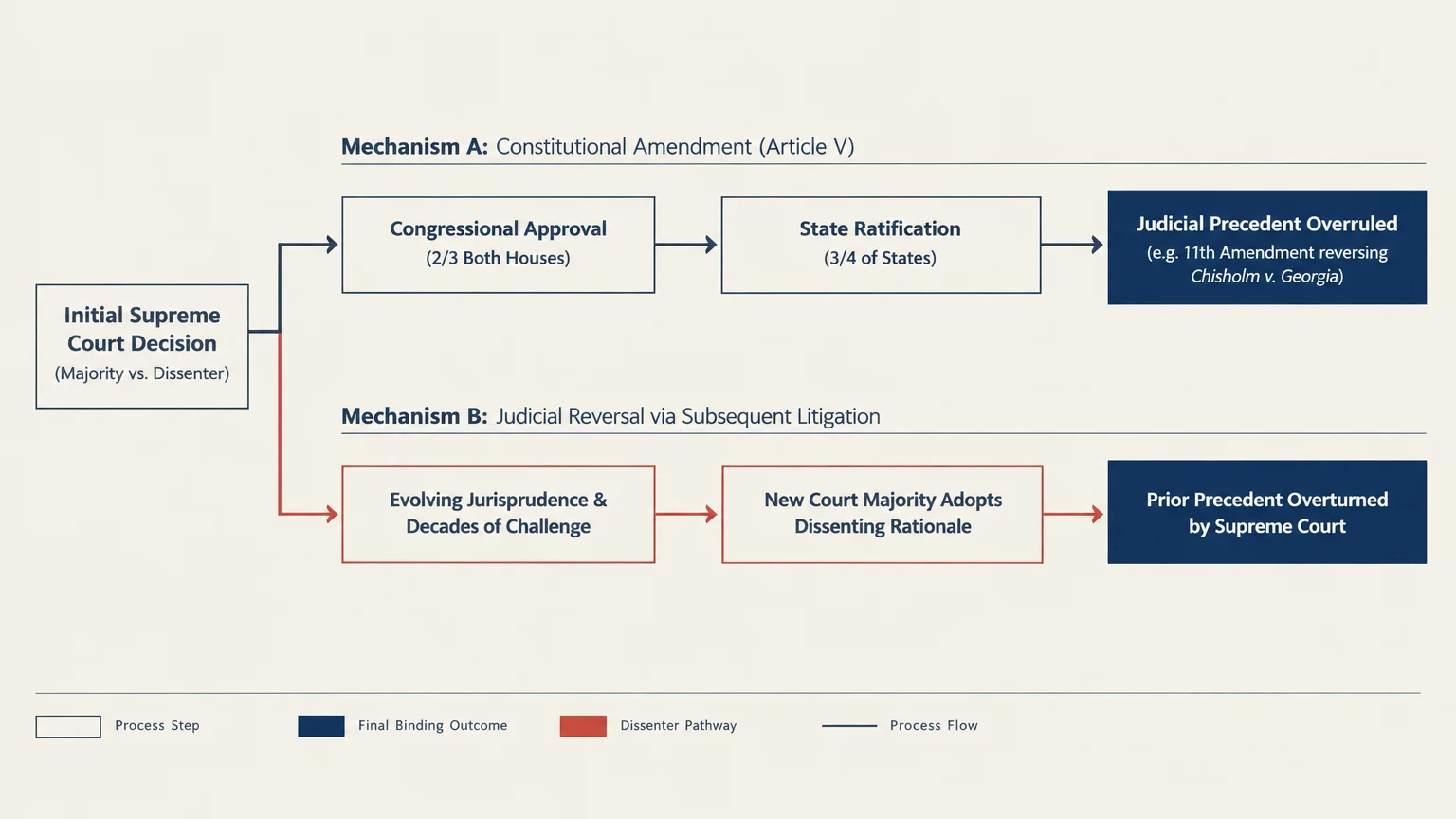
When you examine these ten landmark cases, you uncover the legal machinery that transforms minority dissents into governing law. The American legal framework provides two distinct pathways for overturning flawed Supreme Court precedent.
The first pathway operates through the Article V constitutional amendment process. When the Court issued disastrous rulings in Chisholm and Dred Scott, Congress and the states intervened directly to rewrite constitutional text.
Constitutional amendments require immense political consensus, needing two-thirds approval in Congress and ratification by three-fourths of the states. Consequently, this formal mechanism remains rare in American history.
The second pathway relies on the Supreme Court reevaluating its own decisions under the doctrine of stare decisis. While justices respect precedent to maintain legal stability, they do not treat prior errors as unalterable doctrine.
You can see that major dissents triumph when they expose fatal analytical flaws in majority opinions. Jurists like Holmes and Brandeis showed that rigid judicial theories often failed to accommodate industrial development and advancing technology.
Furthermore, evolving societal standards and constitutional scholarship push future courts to revisit past mistakes. Decades of strategic civil rights litigation turned Harlan’s solitary objection in Plessy into a unanimous majority opinion in Brown.
The speed of judicial reversal varies dramatically depending on legal urgency and public consensus. The Court repudiated Gobitis in just three years, whereas formal repudiation of Korematsu required more than seven decades.
Litigators actively study modern dissenting opinions to identify analytical vulnerabilities in prevailing rulings. When attorneys construct constitutional challenges today, they often build upon arguments crafted by minority justices years earlier.
As you follow ongoing constitutional disputes, remember that today’s dissent may become tomorrow’s binding precedent. Dissents preserve competing constitutional principles, ensuring that the legal system remains open to self-correction over time.
Frequently Asked Questions About Supreme Court Dissents
Does a Supreme Court dissent carry any binding legal authority?
A Supreme Court dissent carries zero binding legal authority in any federal or state jurisdiction. Only the majority opinion establishes binding precedent under the doctrine of stare decisis.
Trial courts and appellate judges must follow the majority ruling regardless of how persuasive a dissent may appear. A dissenting justice cannot prevent the immediate enforcement of the Court’s judgment against the litigants.
However, dissents carry substantial persuasive value for future legal arguments. Litigators frequently cite dissenting opinions in new lawsuits, urging the Court to reconsider unworkable or unjust precedents.
How often does the Supreme Court overrule its own prior decisions?
The Supreme Court overturns its prior rulings relatively infrequently, adhering generally to principles of judicial restraint. Official compilations record fewer than 300 instances of the Court overruling its own precedent since 1789.
The justices apply specific factors before abandoning an established ruling, assessing whether the precedent has proved unworkable in practice. They also consider whether society has developed significant reliance interests based on the original decision.
When a legal doctrine causes widespread confusion or conflicts with broader constitutional principles, the Court demonstrates greater willingness to overrule its past judgment. Justices view self-correction as essential for preserving constitutional integrity.
Can Congress overrule a Supreme Court decision by passing a statute?
Congress can effectively overturn Supreme Court decisions that interpret federal statutes by passing new legislation. When lawmakers disagree with how the Court construed a statute, they simply amend the statutory language to clarify their intent.
However, Congress cannot override the Court’s constitutional interpretations through standard legislative acts. If the Court strikes down a statute on constitutional grounds, regular legislation cannot revive it.
To overcome a constitutional ruling without the Court reversing itself, the nation must adopt a constitutional amendment under Article V. This dual structure prevents Congress from circumventing constitutional boundaries established by the judiciary.
Why do Supreme Court justices publish dissenting opinions instead of remaining silent?
Justices write dissenting opinions to record their principled constitutional objections for the historical record. A dissent holds the majority accountable by forcing the authoring justice to address difficult counterarguments directly.
Dissenting opinions also alert Congress and state legislatures to potential statutory flaws that lawmakers can fix through legislation. When a ruling produces an unintended policy consequence, a dissent often outlines the appropriate legislative remedy.
Most importantly, dissenting justices write for future generations of judges, lawyers, and citizens. By preserving competing legal analyses, dissents provide the intellectual framework necessary for subsequent courts to correct constitutional errors.