You can trace the modern architecture of federal spending, national security, and regulatory law directly to private-sector technology leaders. Understanding how commercial executives shape public operations helps you evaluate current battles over federal procurement and regulatory oversight.
Corporate leaders have crossed the threshold into public governance since the dawn of the Cold War. Their management theories, proprietary software platforms, and lobbying expenditures continually alter how executive agencies spend your tax dollars.
This guide examines seven documented turning points where tech executives and contractors redefined U.S. policy. Each entry provides the statutory records, contract disputes, and agency decisions that govern these public-private partnerships.

Evaluating Public-Private Influence in the Federal Government
This list tracks seven major turning points from 1960 through 2026 where private executives and corporate contractors directly altered federal operations. We selected each entry based on official records, statutory enactments, court dockets, and documented administrative overhauls.
Public policy in the United States does not emerge in an administrative vacuum. Private contractors design defense hardware, maintain federal databases, and advise presidential administrations on bureaucratic efficiency.
To evaluate these relationships objectively, you must examine the underlying procurement laws, executive directives, and agency budgets. Every milestone in this analysis highlights how corporate systems transformed traditional civil service functions.
You can independently verify these developments through the Congressional Record, the Federal Register, and federal court filings. The following case studies illustrate how private corporate practices became permanent instruments of American statecraft.
As you review these milestones, notice the shifting balance of power between public agencies and commercial vendors. The relationship evolved from advisory support into structural codependency across the federal enterprise.
Robert McNamara and Systems Analysis in Defense Procurement
On November 9, 1960, Robert McNamara became the first president of Ford Motor Company from outside the Ford family. Just five weeks later, President-elect John F.
Kennedy recruited him to serve as Secretary of Defense.
McNamara led the Pentagon from January 1961 to February 1968. He brought corporate statistical control methods directly into the military establishment to manage budgets and acquisition programs.
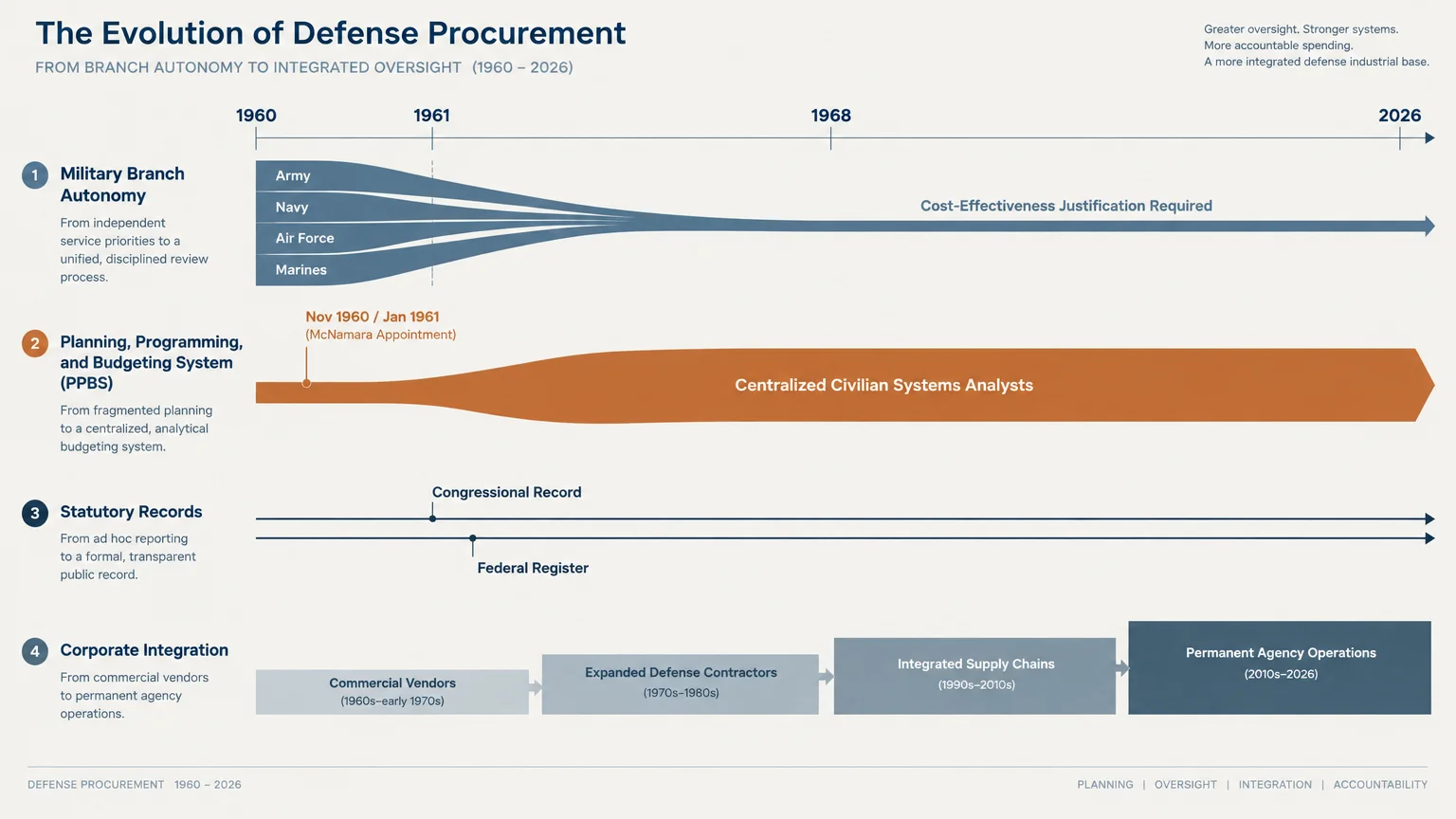
Before McNamara’s appointment, individual military branches lobbied Congress independently for duplicate weapon systems. McNamara centralized control under civilian systems analysts, establishing the Planning, Programming, and Budgeting System (PPBS) to evaluate procurement through quantitative metrics.
This corporate framework required military commanders to justify their hardware requirements using cost-effectiveness data. The reform stripped operational autonomy from traditional brass and concentrated budget authority within civilian secretariats.
You can examine how this systems-analysis approach became standard federal policy in historical executive documents at the American Presidency Project.
Under McNamara’s directive, the Pentagon treated national defense as a unified corporate enterprise. His approach established a model where executive-suite financial metrics dictate military procurement decisions.
Corporate management practices displaced traditional military custom, institutionalizing an analytical standard that federal procurement officers still follow today.
- Established PPBS to govern all military program requests
- Transferred acquisition decisions from uniform officers to civilian analysts
- Applied statistical cost controls to major multi-service contracts
Dwight D. Eisenhower’s Warning on the Scientific-Technological Elite
President Dwight D. Eisenhower delivered his televised farewell address to the nation on January 17, 1961.
The speech established the conceptual benchmark for evaluating federal defense contracting.
Eisenhower famously warned citizens to guard against the acquisition of unwarranted influence by the military-industrial complex. However, he paired that warning with an equally urgent caution regarding research and technology.
He observed that the traditional solitary inventor had been replaced by federally funded research laboratories and corporate task forces. Eisenhower warned that public policy could readily “become the captive of a scientific-technological elite.”
You can inspect the original typed transcript and audio recording of this warning through the National Archives milestone documents collection.
Between 1940 and 1960, federal spending on scientific research grew rapidly, creating an ecosystem of universities, aerospace corporations, and defense vendors. Eisenhower recognized that federal funding could distort academic research and commercial incentives.
His address gave citizens a vocabulary to question whether contractor priorities serve public welfare or corporate balance sheets. His warnings anticipated current debates over artificial intelligence contracts and national intelligence infrastructure.
Eisenhower demonstrated that commercial contracting can quietly reshape democratic decision-making without public legislative debate.
- Identified risks when commercial contractors dominate public research grants
- Anticipated conflicts of interest between private defense firms and national strategy
- Warned that technical complexity could exclude citizens from policy oversight
The HealthCare.gov Tech Surge and the U.S. Digital Service
The federal health insurance exchange website, HealthCare.gov, crashed immediately following its public launch on October 1, 2013. The catastrophic system failure immobilized the signature domestic initiative of the Affordable Care Act.
Traditional federal procurement rules had produced fragmented code across dozens of legacy contracting firms. To rescue the exchange, the Obama administration recruited private-sector Silicon Valley engineers and executives.
Former Google engineer Mikey Dickerson led the emergency “tech surge” that stabilized the federal portal. The team bypassed bureaucratic red tape by implementing commercial agile development, continuous deployment, and open-source software tools.
Following the rescue, the White House institutionalized this private-sector technical brigade on August 11, 2014, by creating the United States Digital Service (USDS).
You can verify the administrative structure and executive scope of the organization in the Federal Register notice establishing the USDS.
The USDS placed commercial technology product managers directly inside major cabinet agencies to rewrite federal software procurement standards. This initiative permanently shifted agency hiring away from legacy defense IT vendors toward modern commercial engineering talent.
By bringing commercial software practices into the Executive Office of the President, this initiative redefined how federal agencies build public-facing services.
- Introduced modern private software sprints into cabinet agency operations
- Reduced agency dependence on slow, multi-year IT contracting conglomerates
- Established a permanent pipeline of commercial tech personnel into government
Commercial Spaceflight Agreements and NASA’s Public-Private Shift
For five decades, NASA relied on cost-plus contracts to develop human spaceflight systems. Under that legacy model, the federal government owned the rockets, while aerospace contractors billed taxpayers for development costs plus guaranteed fees.
Skyrocketing shuttle costs and budgetary constraints forced a radical structural reform. Under the Commercial Orbital Transportation Services (COTS) program and the Commercial Crew Program, NASA abandoned traditional procurement.
The agency utilized Space Act Agreements under Title 51, Section 20113(e) of the U.S. Code to issue fixed-price milestone payments. Private companies like SpaceX and Boeing retained ownership of their spacecraft and sold transportation services back to the government.
Congress codified this public-private partnership framework when it passed the NASA Authorization Act of 2010. You can review the legislative statutory language and committee roll calls on Congress.gov.
The policy shift saved NASA billions of dollars in launch development costs. However, it also shifted critical orbital space infrastructure, launch pads, and astronaut transport capabilities into private corporate hands.
You now rely on private corporations to conduct essential scientific missions and supply the International Space Station. Commercial executives effectively became strategic partners in executing national space policy.
This transition established a procurement precedent that federal agencies now apply to defense satellites, cloud computing, and advanced drone manufacturing.
- Transitioned federal space launches from cost-plus to fixed-price milestone contracts
- Allowed commercial operators to retain proprietary intellectual property and hardware
- Made the federal government a commercial customer rather than an equipment owner
The Pentagon Cloud Procurement Battles from JEDI to JWCC
Modern military operations rely heavily on artificial intelligence, distributed data systems, and real-time cloud computing. In 2018, the Department of Defense launched the Joint Enterprise Defense Infrastructure (JEDI) program to consolidate its enterprise digital infrastructure.
The Pentagon structured JEDI as a single-vendor contract valued at up to $10 billion over ten years. In October 2019, the Department awarded the massive sole-source agreement to Microsoft.
Amazon Web Services immediately challenged the award in the U.S. Court of Federal Claims under Docket Number 19-1796C. Amazon alleged improper political interference by President Donald Trump directed against Amazon founder Jeff Bezos.
Oracle and other tech competitors also mounted legal and regulatory protests under the Competition in Contracting Act. Facing years of litigation, the Pentagon officially canceled the JEDI contract on July 6, 2021.
The defense establishment subsequently abandoned the single-vendor model entirely. On December 7, 2022, the Pentagon awarded the replacement Joint Warfighting Cloud Capability (JWCC) contract, splitting $9 billion among AWS, Microsoft, Google, and Oracle.
This high-stakes corporate contest fundamentally reshaped federal procurement policy. It demonstrated how commercial tech giants can use litigation to force the armed forces to adopt multi-cloud commercial architectures.
The outcome proved that private corporate legal challenges can effectively override executive branch defense acquisition timelines.
- Ended the Pentagon’s single-vendor cloud storage procurement strategy
- Institutionalized multi-cloud commercial architecture across all defense agencies
- Illustrated how commercial bid protests can disrupt cabinet-level defense timelines
Federal Subsidies and Supply Chain Directives via the CHIPS and Infrastructure Acts
Global supply chain disruptions during the early 2020s exposed heavy American reliance on foreign semiconductor manufacturing. In response, corporate technology leaders launched aggressive federal lobbying campaigns to secure direct industrial subsidies.
President Joe Biden signed the Bipartisan Infrastructure Law on November 15, 2021. The statute allocated $65 billion to broadband internet expansion, including $42.45 billion for the Broadband Equity, Access, and Deployment (BEAD) state grant program.
Nine months later, on August 9, 2022, Congress passed the CHIPS and Science Act. You can read the enacted statutory text and voting roll calls on Congress.gov.
The CHIPS legislation authorized $52.7 billion in direct subsidies for domestic semiconductor manufacturing and research. It also created a 25% advanced manufacturing investment tax credit estimated at $24 billion.
Technology companies spent a record $85.6 million on federal lobbying in 2024 to shape these subsidy guidelines, artificial intelligence regulations, and antitrust oversight. Meta alone set a company record by spending $13.8 million on 86 lobbyists during early 2025.
These major legislative packages demonstrated a shift back to active federal industrial policy. Tech executives successfully aligned private corporate expansion with national security and domestic manufacturing priorities.
By securing direct federal capital, private tech manufacturers positioned their commercial operations as vital public utilities.
- Injected over $100 billion of direct public capital into private tech infrastructure
- Created federal domestic manufacturing mandates for advanced microchips
- Accelerated corporate lobbying investments in federal regulatory and tax policymaking
The U.S. DOGE Service Reorganization and Federal Contract Cancellations
During the 2024 presidential campaign, entrepreneur Vivek Ramaswamy and SpaceX and Tesla CEO Elon Musk proposed an outside commission to slash federal spending. President Donald Trump announced the Department of Government Efficiency (DOGE) framework on November 12, 2024.
Ramaswamy stepped down from the project on January 20, 2025, to launch a campaign for Governor of Ohio. That same day, President Trump signed an executive order formally establishing the initiative inside the executive branch.
The executive order restructured the decade-old United States Digital Service, officially renaming it the “U.S. DOGE Service.” Operating as a Senior Advisor without standard Senate confirmation, Musk directed an aggressive operational overhaul of federal agency expenditures.
DOGE analysts reviewed agency databases, targeting programs for immediate termination. The effort canceled over 1,400 federal grants, voided active procurement contracts, and triggered broad workforce reductions across civil service agencies.
The initiative operated under a strict sunset provision. The U.S. DOGE Service formally dissolved on July 4, 2026, reaching its scheduled charter expiration.
This episode marked an unprecedented integration of an active commercial contractor into executive branch governance. It underscored the profound policy leverage that private tech executives can exercise when given direct administrative authority.
The administrative intervention demonstrated how private management theories can rapidly dismantle long-standing federal programs from within.
- Reorganized existing digital civil service personnel under commercial executive oversight
- Terminated more than 1,400 federal grant awards and commercial contracts
- Dissolved on July 4, 2026, after completing its scheduled administrative mandate
Comparing Key Public-Private Policy Milestones
The table below summarizes the key milestones where corporate leadership, commercial disputes, and contractor initiatives transformed federal policy. You can compare the statutory authorities, key personnel, and structural outcomes across each era.
| Era / Initiative | Key Private or Public Figures | Governing Authority | Major Policy Outcome |
|---|---|---|---|
| Defense Systems Analysis (1961) | Robert McNamara | DOD Directive 5010.8 | Centralized military budgeting under corporate data metrics |
| Farewell Address Warning (1961) | Dwight D. Eisenhower | U.S. Presidential Farewell | Defined public oversight standards for federal defense contracting |
| USDS Tech Surge (2013–2014) | Mikey Dickerson | Executive Order Charter | Embedded commercial agile software engineers inside federal agencies |
| Commercial Spaceflight (2010) | Elon Musk, Gwynne Shotwell | 51 U.S.C. § 20113(e) | Replaced cost-plus rockets with fixed-price private flight services |
| Pentagon Cloud (2018–2022) | Jeff Bezos, Satya Nadella | 41 U.S.C. § 3301 | Forced defense agencies to adopt multi-vendor cloud architectures |
| CHIPS & Broadband (2021–2022) | Tech & Telecom Executives | Public Law 117-167 | Subsidized domestic chip fabrication with $52.7 billion in grants |
| U.S. DOGE Service (2025–2026) | Elon Musk, Vivek Ramaswamy | Executive Order Reorganization | Canceled 1,400+ grants and voided contracts prior to July 2026 sunset |

How Tech Procurement Rewrote Federal Governance
When you evaluate these seven milestones collectively, a distinct historical pattern emerges. The federal government has steadily outsourced its core technical competencies to private commercial firms over the last six decades.
In the 1960s, private executives imported statistical management into government agencies while the state retained operational ownership. Today, commercial contractors own the underlying code, cloud servers, and launch vehicles that make federal operations possible.
This evolution fundamentally altered federal procurement regulations. Traditional acquisition relied on rigid cost-plus accounting rules designed to prevent private fraud.
Modern tech leaders successfully pushed agencies toward flexible commercial acquisition pathways. These mechanisms include Other Transaction Authority (OTA) agreements and milestone-based commercial partnerships.
These modern instruments speed up technology adoption across executive departments. However, they also reduce direct congressional visibility into how private contractors spend federal funds.
Campaign finance mechanisms and targeted lobbying amplify this contractor leverage. You can track millions of dollars flowing from commercial tech political action committees through official Federal Election Commission disclosure filings.
Corporate lobbyists directly participate in drafting legislative language for federal grant authorizations, data security standards, and subsidy programs. This dynamic creates a continuous revolving door between Silicon Valley executive suites and cabinet-level advisory roles.
Understanding this structural dynamic empowers you as an informed taxpayer. Whenever an agency announces a major software launch, defense acquisition, or efficiency commission, examine who owns the underlying intellectual property.
Public accountability requires constant vigilance over the commercial entities that execute the sovereign powers of the United States.
Frequently Asked Questions About Private Contractors and Federal Policy
How do federal ethics and conflict-of-interest laws apply to tech executives who advise the president?
Federal ethics standards depend on an individual’s formal employment classification. Full-time civil servants must follow strict financial disclosure rules under Title 18, Section 208 of the U.S. Code.
This statute requires officials to recuse themselves from government matters that directly affect their personal financial holdings or corporate assets. However, tech leaders frequently serve through informal advisory panels or as Special Government Employees (SGEs).
Special Government Employees are subject to modified ethics restrictions that apply only on the specific days they perform government work. Furthermore, outside advisors serving without formal government pay or agency titles may operate entirely outside standard federal conflict-of-interest statutes.
What is the difference between a standard federal contract and an Other Transaction Authority agreement?
Standard federal procurement contracts must strictly follow the Federal Acquisition Regulation (FAR). The FAR requires competitive bidding, audited cost accounting, and public disclosure of contract terms.
In contrast, Other Transaction Authority (OTA) agreements allow agencies to bypass standard procurement statutes under Title 10, Section 4022 of the U.S. Code. Congress originally created OTAs to help defense and space agencies rapidly acquire commercial prototypes from non-traditional contractors.
These agreements operate like private commercial contracts. They provide tech firms greater freedom to negotiate intellectual property rights, fixed milestone payments, and confidential technical specifications.
Can commercial contractors legally make sovereign policy decisions or manage civil service personnel?
Federal law strictly prohibits private contractors from performing “inherently governmental functions.” The Federal Activities Inventory Reform Act of 1998 and OMB Circular A-76 define these sovereign duties.
Inherently governmental functions include determining national defense policy, commanding military forces, authorizing federal spending, and making formal hiring or firing decisions for civil service staff. Contractors may analyze agency data, offer technical recommendations, and operate digital systems.
However, an official government employee with constitutional authority must formally sign every binding grant cancellation, regulatory rule, and agency budget reduction.
Where can you track federal contracting dollars and corporate lobbying disclosures?
You can track all federal contract awards, grants, and direct loans using the official public database at USAspending.gov. The platform allows you to search agency disbursements by company name, congressional district, and procurement classification.
To inspect federal lobbying expenditures, you can search public disclosure reports filed under the Lobbying Disclosure Act of 1995 through the Senate Office of Public Records. The Federal Election Commission provides public records of corporate political action committee contributions and individual executive donations.