
You probably know Sam Houston governed both Tennessee and Texas during his storied career. Yet he is far from the only American leader to build high-level power across state lines.
In total, seven politicians have served as the governor of one state while representing an entirely different state in the United States Congress.
From early nineteenth-century frontier migrations to modern campaigns, these cross-state careers reveal how ambitious leaders leveraged fluid borders and constitutional rules. Here is how each statesman achieved this dual-state milestone.
Criteria for the Dual-State Leadership Record
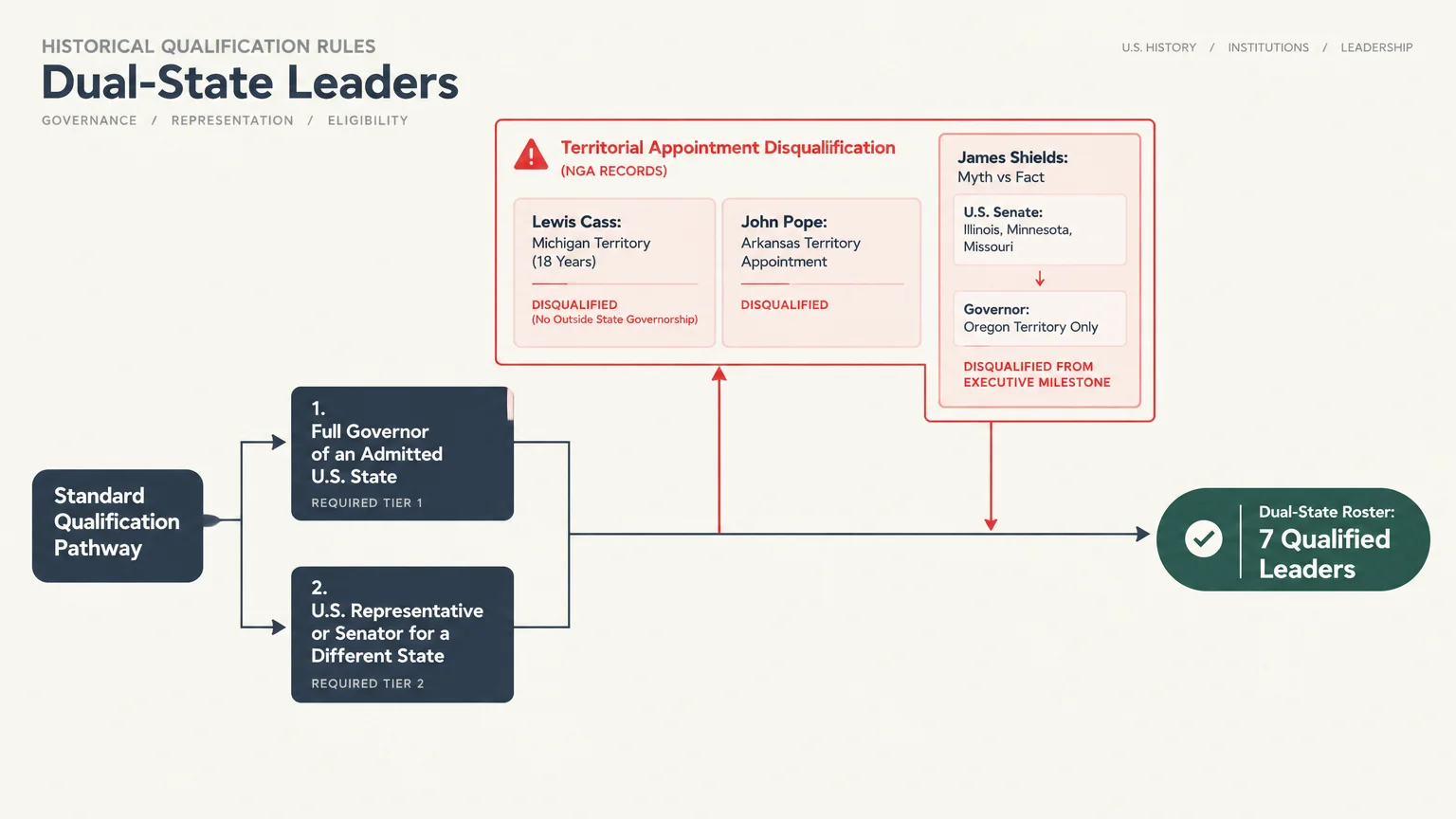
You must understand the exact historical standard required to join this select group of political leaders. Each individual had to win election as a full governor of an admitted U.S. state.
Each figure also had to take a seat representing an entirely different state in either the U.S. House of Representatives or the U.S. Senate.
This strict rule eliminates dozens of prominent nineteenth-century figures who held presidential appointments over frontier lands. Appointed territorial governors do not count as state governors under historical executive records maintained by the National Governors Association.
For example, Michigan political giant Lewis Cass governed the Michigan Territory for eighteen years before representing Michigan in the U.S. Senate. He never governed an admitted state other than Michigan.
Similarly, Kentucky lawmaker John Pope served in both houses of Congress for Kentucky before accepting an appointment as Governor of the Arkansas Territory. He never served as the executive of an admitted state.
A persistent political myth also surrounds James Shields. Shield enthusiasts frequently confuse his legislative resume with an executive career.
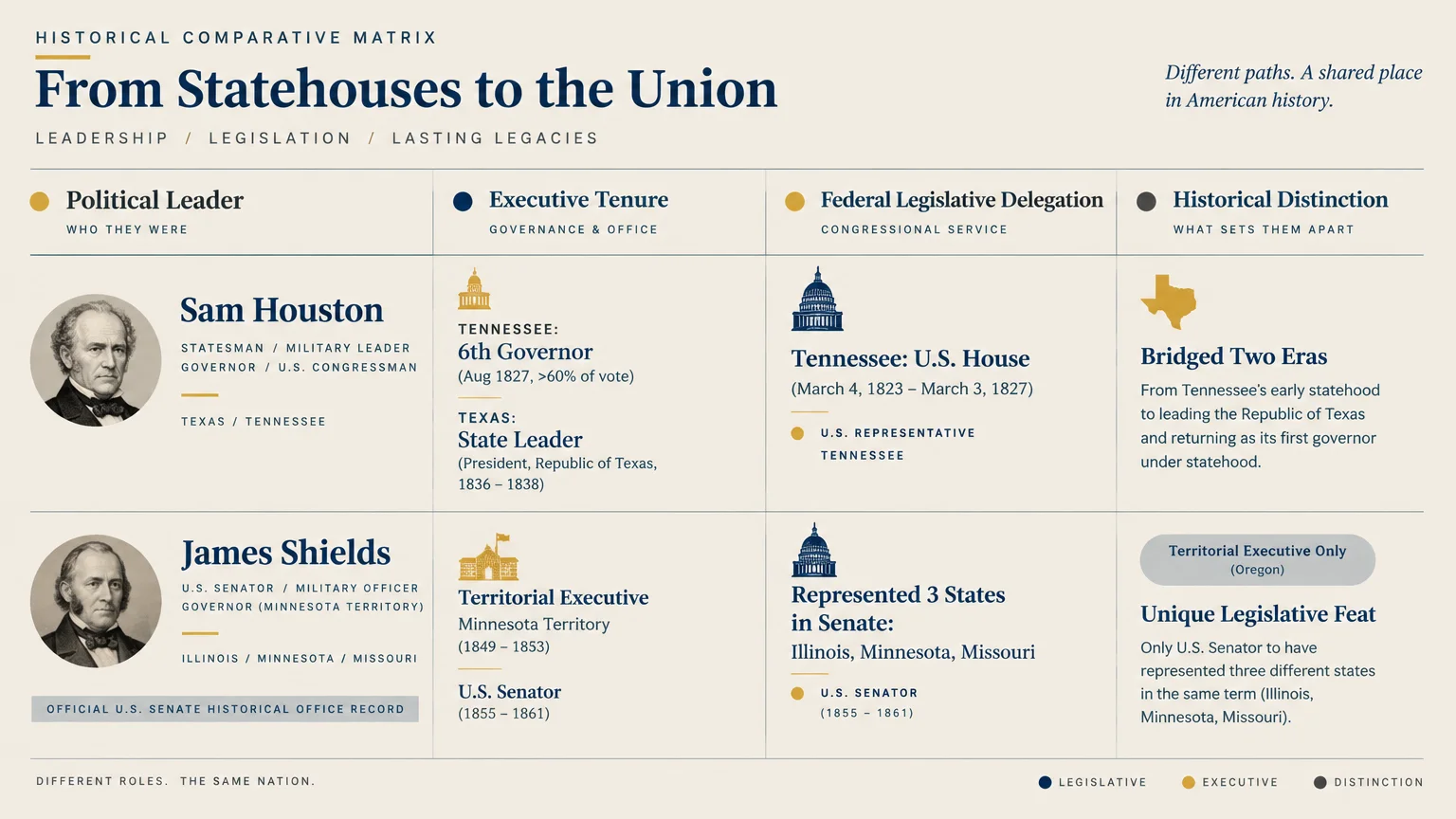
Official records from the U.S. Senate Historical Office confirm Shields is the only person to represent three different states in the Senate: Illinois, Minnesota, and Missouri. Yet Shields only held an appointment as Governor of the Oregon Territory; he never won a state governorship.
Understanding these distinctions requires you to examine the constitutional structure governing political eligibility in America. The U.S. Constitution creates remarkably lenient residency rules for federal legislators.
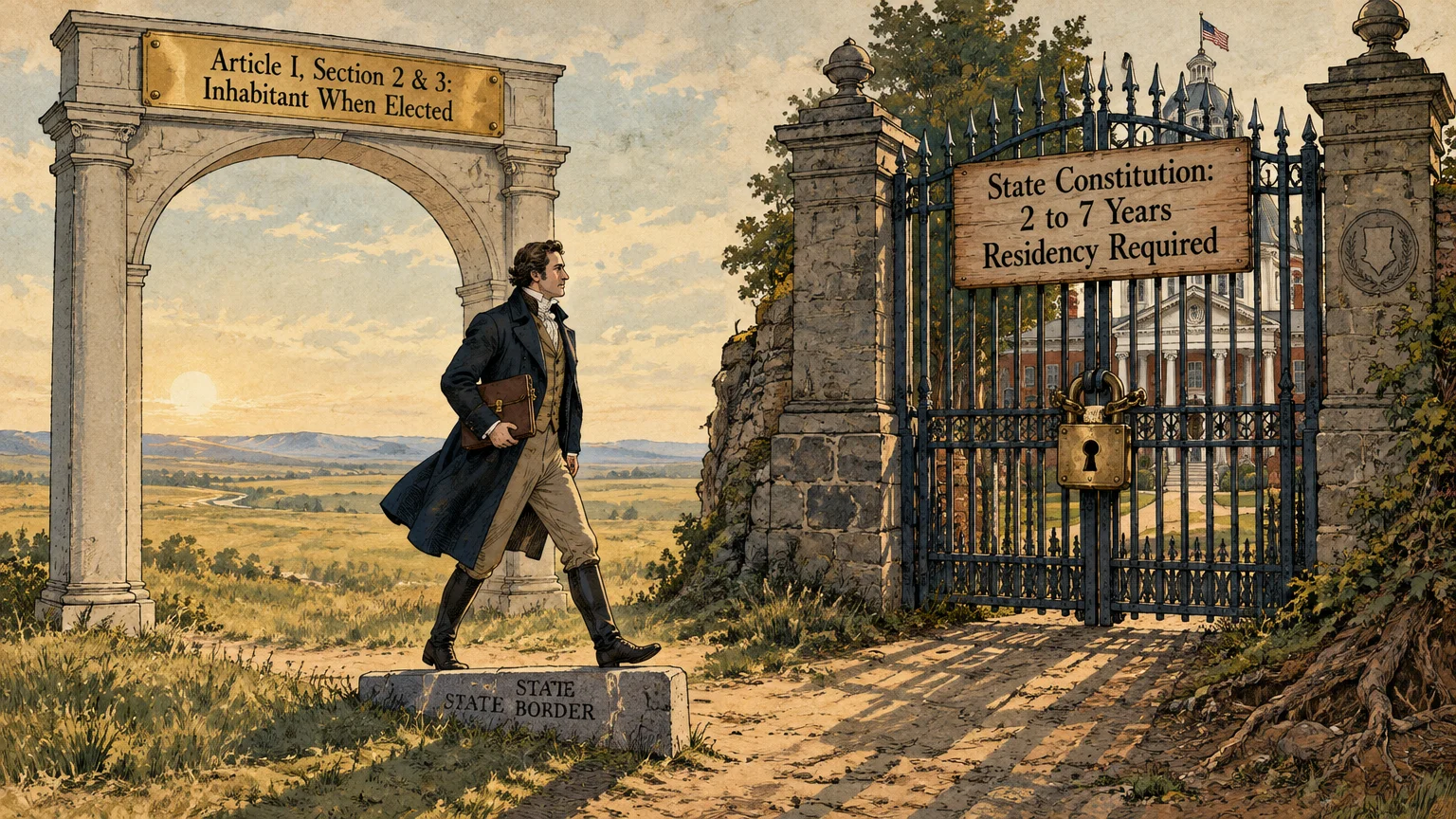
Article I, Section 2 requires House members to be an inhabitant of their state only when elected. Article I, Section 3 applies that exact same minimal standard to senators.
The framers chose not to impose multi-year residency hurdles on congressional candidates. This deliberate omission allowed ambitious politicians to migrate westward and run for federal office almost immediately upon arrival.
By contrast, state constitutions traditionally demand extensive local residency before you can seek gubernatorial office. Most states require candidates to establish residency between two and seven years before election day.
The seven officeholders below mastered both systems. They capitalized on constitutional flexibility and local political opportunities to build durable executive and legislative legacies across state lines.
Sam Houston
You can trace Sam Houston’s historic rise through two different states and an independent republic. He remains the only person in American history to serve as governor of two separate states.
Houston launched his national political career in Tennessee. Voters sent him to the U.S. House of Representatives to serve two terms from March 4, 1823, to March 3, 1827.
Tennessee voters subsequently elected Houston as their sixth governor in August 1827. He won that election with over 60 percent of the vote against Newton Cannon and former governor Willie Blount.
Houston resigned his Tennessee governorship abruptly on April 16, 1829. His departure followed the sudden collapse of his marriage to Eliza Allen and sparked intense public scrutiny.
Houston moved west into Mexican Texas, where he quickly organized local resistance. He took command of the Texian Army and defeated Mexican forces at the Battle of San Jacinto in 1836.
Voters elected Houston as the first and third President of the Republic of Texas. When Texas entered the Union, the state legislature elected him to the U.S. Senate on February 21, 1846.
Houston served Texas in the Senate until March 3, 1859. He vigorously opposed sectional extremism and voted against the Kansas-Nebraska Act of 1854, alienating Southern Democrats.
Houston returned home and ran for Governor of Texas as an independent Unionist in 1859. On August 1, 1859, he defeated incumbent Hardin R.
Runnels by a vote of 36,257 to 27,500.
His second governorship ended in defiance. On March 16, 1861, state authorities ousted Houston after he refused to swear an oath of allegiance to the Confederate States of America.
According to the Biographical Directory of the United States Congress, Houston’s career spanned four distinct executive and legislative roles across two sovereign states.
Mitt Romney
You might view cross-state leadership as an artifact of early westward migration, but Mitt Romney updated the pattern for modern politics. He achieved this dual-state feat across sixteen years.
Romney won the Massachusetts gubernatorial election on November 5, 2002. He defeated Democratic nominee Shannon O’Brien by a margin of 50 percent to 45 percent.
Romney served as the 70th Governor of Massachusetts from January 2, 2003, to January 4, 2007. His administration balanced severe state budget deficits without broad-based tax increases.
His primary executive achievement occurred on April 12, 2006. On that date, Romney signed Chapter 58 of the Acts of 2006, creating near-universal healthcare coverage across Massachusetts.
Romney declined to seek re-election in 2006, focusing instead on national presidential campaigns in 2008 and 2012. After his presidential bids, he established permanent residency in Utah.
When long-serving Utah Senator Orrin Hatch announced his retirement in January 2018, Romney launched a campaign for the open seat. He easily won the Republican nomination at the state convention.
On November 6, 2018, Utah voters elected Romney to the U.S. Senate. He secured 62.6 percent of the statewide vote, defeating Democratic challenger Jenny Wilson.
Romney took the federal oath of office on January 3, 2019. He served a full six-year term on key committees, including the Foreign Relations Committee and the Budget Committee.
Romney declined to seek re-election in 2024, concluding his federal service on January 3, 2025. His retirement marked the end of an extraordinary multi-state career.
Romney remains the only politician to achieve this dual-state governor and senator milestone since the ratification of the Seventeenth Amendment in 1913, which mandated direct senate elections.
William Wyatt Bibb
William Wyatt Bibb carried his early political influence from Georgia into the frontier territory of Alabama. His career path helped shape early southern statehood during the Era of Good Feelings.
Bibb began his federal service representing Georgia in the U.S. House of Representatives. He won a special election to the Ninth Congress, taking his seat on January 26, 1807.
Georgia voters returned Bibb to the House for four consecutive terms. He served in the lower chamber until November 6, 1813, chairing the House Committee on Claims.
The Georgia legislature elevated Bibb to the U.S. Senate in late 1813. He filled the vacancy created when Senator William H.
Crawford accepted an appointment as minister to France.
Bibb’s Senate tenure ended abruptly over voter outrage. He voted for the Compensation Act of 1816, a controversial statute that replaced daily congressional pay with an annual salary.
Facing intense public backlash across Georgia, Bibb resigned his Senate seat on November 9, 1816. His resignation freed him to pursue administrative opportunities in the western territories.
President James Monroe appointed Bibb as the first governor of the newly formed Alabama Territory in March 1817. Bibb established the territorial capital and supervised the drafting of a constitution.
When Alabama gained statehood, voters elected Bibb as their first state governor on September 21, 1819. He defeated William Crawford in a close election, receiving 8,342 votes to 7,140.
Bibb inaugurated the new state government on November 9, 1819. Unfortunately, his executive administration lasted less than a single year.
Bibb suffered severe injuries after falling from his horse during a violent storm. He died on July 10, 1820, at age 38, leaving his brother Thomas to succeed him.
Bibb, Houston, and Romney represent the only three individuals in U.S. history to serve as a state governor of one state and a U.S. Senator for another.
John B. Weller
John B. Weller built an extensive legislative record in Ohio before the Gold Rush pulled him to the Pacific coast.
His political adaptability carried him to executive leadership in California.
Ohio voters sent Weller to the U.S. House of Representatives as a Democrat in 1838. He represented Ohio’s 2nd Congressional District for three consecutive terms from 1839 to 1845.
Weller served as a lieutenant colonel in the Mexican-American War after leaving Congress. His military standing helped him win the Democratic nomination for Governor of Ohio in 1848.
Weller lost the October 1848 Ohio gubernatorial election by an extraordinary margin. Whig candidate Seabury Ford defeated him by just 311 votes out of nearly 300,000 ballots cast.
Following this narrow defeat, President James K. Polk appointed Weller to lead the Mexican Boundary Commission.
Weller relocated west to survey the border created by the Treaty of Guadalupe Hidalgo.
Weller soon established a lucrative legal practice in San Francisco. He quickly emerged as an influential leader within California’s dominant pro-southern Democratic political faction.
On January 30, 1852, the California state legislature elected Weller to the U.S. Senate. He replaced the state’s first federal senator, famed explorer John C.
Frémont.
Weller served California in Washington through March 3, 1857. After failing to win re-election to the Senate, he turned his sights directly on California’s executive branch.
Weller secured the Democratic gubernatorial nomination in 1857. In the general election, he captured 53,122 votes, easily defeating Republican Edward Stanley and American Party nominee George Bowie.
Weller took the oath of office as California’s 5th governor on January 8, 1858. His single term concluded on January 9, 1860, completing a rare cross-continental political transition.
William C. C. Claiborne
William Charles Cole Claiborne entered high-stakes politics at an astonishingly young age. He forged an influential career that stretched from Appalachian Tennessee to deep southern Louisiana.
Tennessee voters elected Claiborne to the U.S. House of Representatives in August 1797. He won the seat vacated by Andrew Jackson, who had been elevated to the Senate.
Claiborne took his seat on November 23, 1797, at just 22 years old. Article I of the Constitution explicitly mandates that House members must be at least 25.
Neither his political opponents nor House leadership challenged his credentials, allowing Claiborne to serve two terms. He ultimately cast Tennessee’s decisive vote for Thomas Jefferson in the tied 1800 presidential election.
Jefferson rewarded Claiborne’s loyalty with high administrative appointments. In May 1801, Jefferson appointed him Governor of the Mississippi Territory, where Claiborne governed until 1803.
Claiborne then supervised the formal transfer of the Louisiana Purchase from French commissioners. Jefferson named him Governor of the newly established Territory of Orleans in December 1803.
Claiborne guided the territory through ethnic tensions, slave rebellions, and the Burr conspiracy. He successfully blended French civil law with traditional American common-law procedures.
When Louisiana entered the Union as the eighteenth state, citizens elected Claiborne as their first governor. He served from April 30, 1812, to December 16, 1816.
During his tenure, Claiborne mobilized the state militia and worked alongside Andrew Jackson during the 1815 Battle of New Orleans. His leadership solidified American control over the Gulf Coast.
On January 13, 1817, the Louisiana state legislature elected Claiborne to the U.S. Senate. He never exercised power in the chamber; he died on November 23, 1817, at age 42.
David Holmes
David Holmes quietly dominated Virginia politics before becoming a foundational figure in Mississippi statehood. His administrative steadiness earned him executive and legislative positions across two distinct regions.
Virginia voters elected Holmes to the U.S. House of Representatives in late 1796. He took his seat on May 15, 1797, representing Virginia’s 2nd Congressional District.
Holmes won re-election to the House five times, serving twelve continuous years until March 3, 1809. During the Tenth Congress, he chaired the influential Committee on Claims.
In 1809, President James Madison appointed Holmes as the fourth territorial governor of Mississippi. Holmes navigated intense diplomatic friction, including the annexation of West Florida in 1810.
When Congress authorized Mississippi to form a state government in 1817, Holmes presided over the constitutional convention. He guided delegates in creating the state’s basic charter.
Mississippi voters elected Holmes unopposed as their first state governor on September 1, 1817. He served in the executive office from October 7, 1817, until January 5, 1820.
Holmes moved directly to federal service when the Mississippi legislature elected him to the U.S. Senate. He took office on August 30, 1820, filling a vacancy caused by Walter Leake’s resignation.
Holmes served in the Senate until September 25, 1825, when he resigned to run for governor again. Mississippi voters elected him as their fifth governor in August 1825.
Holmes took office on January 7, 1826, becoming both the first and fifth governor of the state. Unfortunately, severe physical exhaustion quickly incapacitated him.
Holmes resigned the governorship on July 25, 1826, after serving just six months. He returned to Virginia for medical care, concluding an exceptional cross-state career.
Albion K. Parris
Albion K. Parris turned shifting state borders into a pathway for multi-state governance.
His entire political trajectory was created by the legislative maneuvering behind the Missouri Compromise of 1820.
Massachusetts voters first elected Parris to the U.S. House of Representatives in 1814. He represented Massachusetts’s 20th Congressional District in the Fourteenth and Fifteenth Congresses.
At that time, Massachusetts governed the District of Maine as a non-contiguous northern territory. Parris represented Maine residents while technically serving as a Massachusetts federal lawmaker from 1815 to 1818.
Parris resigned from Congress on February 3, 1818, after accepting an appointment as a federal district judge. He quickly emerged as a leading voice advocating for Maine’s independence from Massachusetts.
Under the Missouri Compromise, Congress admitted Maine as a free state on March 15, 1820. Parris served as a prominent delegate to the convention that drafted Maine’s first constitution.
Maine voters elected Parris as their fifth governor in late 1821. He took office on January 5, 1822, and won four consecutive annual re-elections, serving until January 3, 1827.
Immediately upon leaving the governor’s mansion, the Maine legislature elected Parris to the U.S. Senate. He served in the upper chamber from March 4, 1827, until August 26, 1828.
He resigned from the Senate to accept a seat on the Maine Supreme Judicial Court. Later, he served as Mayor of Portland, Maine, in 1852.
You should note that lawmaker Enoch Lincoln followed an almost identical path. Lincoln succeeded Parris in Massachusetts’s 20th District before serving as Maine’s sixth governor from 1827 to 1829.
Parris and Lincoln demonstrate how boundary redistricting and territorial independence created natural opportunities for politicians to govern across historical state borders.
Historical Comparison of Multi-State Officeholders
You can compare the specific offices, states, and timelines for these seven leaders in the table below. Notice how the nineteenth century dominated these occurrences before Romney’s modern breakthrough.
| Politician | Congressional State & Chamber | Congressional Years | Gubernatorial State | Gubernatorial Years |
|---|---|---|---|---|
| Sam Houston | Tennessee (House), Texas (Senate) | 1823–1827 (TN), 1846–1859 (TX) | Tennessee, Texas | 1827–1829 (TN), 1859–1861 (TX) |
| Mitt Romney | Utah (Senate) | 2019–2025 | Massachusetts | 2003–2007 |
| William Wyatt Bibb | Georgia (House & Senate) | 1807–1813 (House), 1813–1816 (Senate) | Alabama | 1819–1820 |
| John B. Weller | Ohio (House), California (Senate) | 1839–1845 (OH), 1852–1857 (CA) | California | 1858–1860 |
| William C. C. Claiborne | Tennessee (House), Louisiana (Senate) | 1797–1801 (House), 1817 (Senate) | Louisiana | 1812–1816 |
| David Holmes | Virginia (House), Mississippi (Senate) | 1797–1809 (House), 1820–1825 (Senate) | Mississippi | 1817–1820, 1826 |
| Albion K. Parris | Massachusetts (House), Maine (Senate) | 1815–1818 (MA), 1827–1828 (ME) | Maine | 1822–1827 |
Constitutional Mechanics and the Evolution of Cross-State Politics
You might wonder why this cross-state pattern occurred frequently in the early nineteenth century and then largely vanished. The explanation lies in shifting frontier geography and constitutional rules.
During the early 1800s, ambitious leaders constantly relocated westward into developing territories. When these territories gained statehood, they required experienced administrators to build functioning executive institutions.
Veteran congressmen from eastern states possessed legal education, legislative connections, and administrative skill. Frontier populations routinely rewarded these seasoned statesmen with governorships upon statehood.
The constitutional barrier to entering Congress after relocating has always remained exceptionally low. Under the U.S. Constitution, federal candidates must only reside in their new state when elected.
The Supreme Court reaffirmed this principle in the landmark 1995 decision U.S. Term Limits, Inc. v. Thornton. The Court ruled that states cannot impose additional qualifications, such as term limits or durational residency, beyond the text of the Constitution.
In contrast, state constitutions maintained strict residency safeguards for their executive mansions. States routinely required gubernatorial candidates to live within their borders for several consecutive years.
For example, Article II, Section 2 of the California Constitution requires five years of state residency before a governor can take office. The Massachusetts Constitution demands seven years of prior residency.
These divergent rules created an asymmetric barrier to entry. Moving to a new state allowed politicians to run for Congress almost immediately, but seeking a governorship required years of established residency.
The ratification of the Seventeenth Amendment in 1913 also transformed multi-state career incentives. Direct popular elections for senators forced candidates to construct deep grass-roots networks within a single state.
State legislatures no longer selected senators based on political wheeling and dealing. Modern statewide primary campaigns made transplant candidates vulnerable to carpetbagging attacks from homegrown opponents.
Mitt Romney’s election in Utah succeeded because of his unique national profile and existing personal ties to the state. Without that pre-existing connection, achieving statewide victory in a second state remains nearly impossible today.
Frequently Asked Questions About Multi-State Officeholders
Did James Shields serve as an elected state governor?
No, James Shields never served as an elected state governor. While he represented Illinois, Minnesota, and Missouri in the U.S. Senate, his only executive role was an appointment as Governor of the Oregon Territory from 1848 to 1849.
Can you run for the U.S. Senate immediately after moving to a new state?
Yes, you can constitutionally run for the Senate immediately after establishing residence. The U.S. Constitution requires candidates to be inhabitants of their state only at the time of election, without durational waiting periods.
Has any politician ever been elected governor of more than two states?
No, no American politician has ever won election as governor of three different states. Sam Houston remains the only individual in United States history to serve as governor of two separate states: Tennessee and Texas.
Why did early American politicians switch states so frequently?
Early politicians relocated frequently because western expansion created newly formed states that lacked established political dynasties. Seasoned federal officeholders migrated westward to lead new territories and quickly capture newly formed executive offices.



