Only eight lawmakers in American history have held the record for the longest cumulative service in the United States Congress. You can trace the nation’s institutional development by watching how these legislative leaders accumulated seniority across two centuries.
From the founding era to modern times, these members directed powerful committees and shaped landmark statutes. Their careers demonstrate how institutional rules—from committee chairmanships to parliamentary succession—rewarded decades of continuous tenure.
This historical analysis examines each lawmaker who reached Capitol Hill’s career summit, showing you how parliamentary power evolved over 237 years.
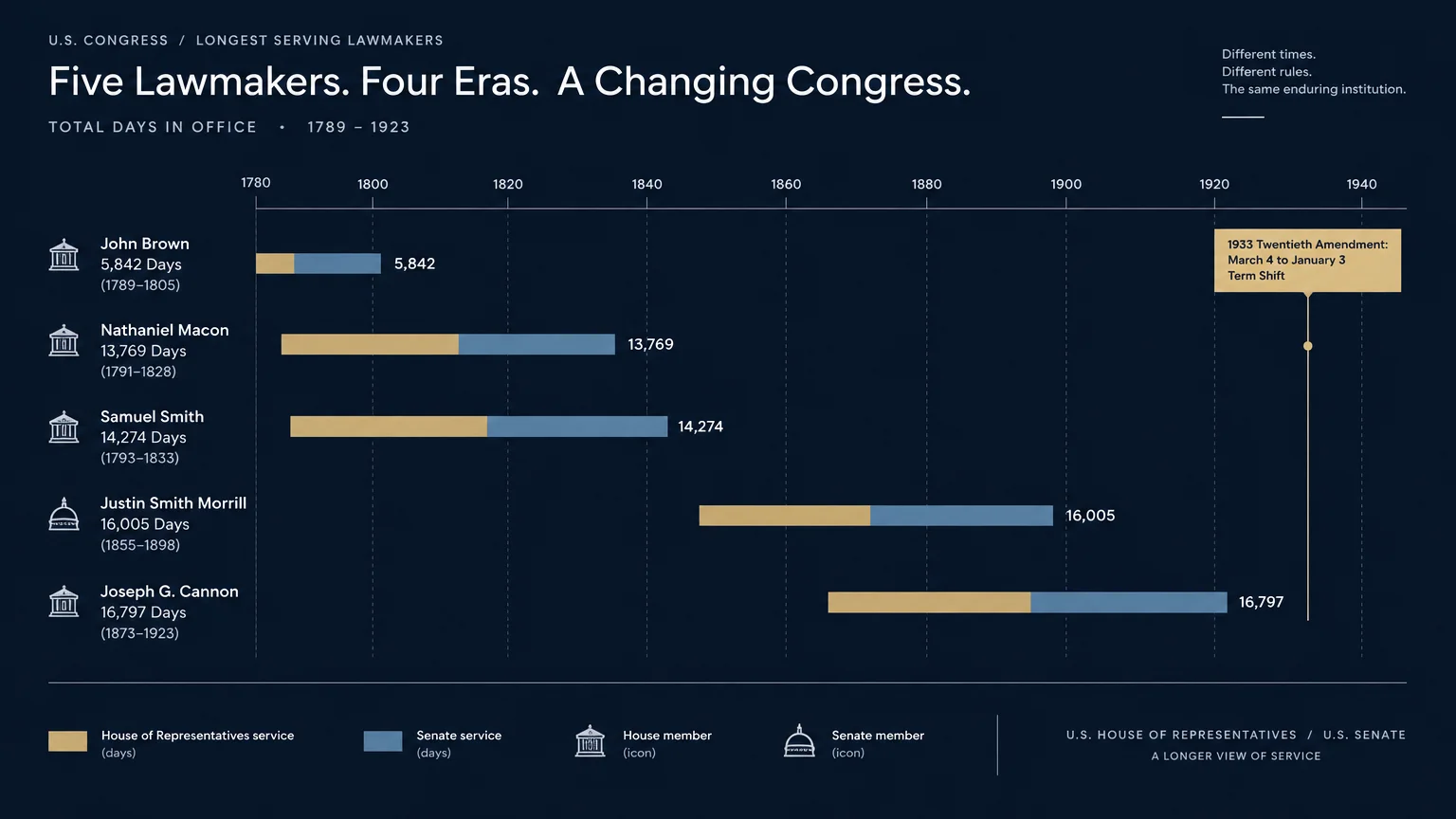
Tracking the Capitol Hill Longevity Record Across Generations
When you evaluate congressional longevity, you measure cumulative calendar days of sworn legislative service across the House and Senate.
This list tracks every individual who held the all-time record for total combined service in the United States Congress since 1789.
Our analysis relies on historical benchmarks documented in Congressional Research Service report R41545, which analyzes career tenures and membership patterns.
To qualify as an overall record holder, a lawmaker had to surpass the previous historical high-water mark for total days in office.
Some members accumulated their days through uninterrupted tenure; others reclaimed seats after election defeats to establish new career milestones.
The calendar mechanics of congressional terms also changed significantly over this historical span.
Prior to the ratification of the Twentieth Amendment in 1933, congressional terms began and ended on March 4.
Modern congressional sessions now convene on January 3, altering the exact day counts accumulated by lawmakers across different historical eras.
Longevity on Capitol Hill carries distinct constitutional responsibilities beyond symbolic prestige.
In the House, the longest-serving member serves as the Dean of the House, administering the oath of office to the newly elected Speaker.
The Office of the Historian of the U.S. House notes that this tradition guarantees institutional continuity during leadership transitions.
In the Senate, seniority traditionally determines the President pro tempore, placing the longest-serving majority senator third in presidential succession under 3 U.S.C. § 19.
The U.S. Senate Historical Office tracks how this custom became standard operating procedure following World War II.
The following comparison table highlights every lawmaker who established an all-time record for combined congressional service.
| Member | Chamber(s) & Party | Total Service Tenure | Total Days | Record Span Held |
|---|---|---|---|---|
| John Brown | House & Senate (Anti-Admin / Dem-Rep) | March 4, 1789 – March 3, 1805 | 5,842 days | 1789 – March 3, 1807 |
| Nathaniel Macon | House & Senate (Dem-Rep) | March 4, 1791 – November 14, 1828 | 13,769 days | March 3, 1807 – October 15, 1831 |
| Samuel Smith | House & Senate (Dem-Rep / Jacksonian) | 1793–1815; 1816–1833 (Non-consecutive) | 14,274 days | October 15, 1831 – April 2, 1894 |
| Justin Smith Morrill | House & Senate (Whig / Republican) | March 4, 1855 – December 28, 1898 | 16,005 days | April 2, 1894 – December 31, 1920 |
| Joseph G. Cannon | House only (Republican) | 1873–1891; 1893–1913; 1915–1923 | 16,797 days | December 31, 1920 – February 14, 1958 |
| Carl Hayden | House & Senate (Democratic) | February 19, 1912 – January 3, 1969 | 20,773 days | February 14, 1958 – November 18, 2009 |
| Robert C. Byrd | House & Senate (Democratic) | January 3, 1953 – June 28, 2010 | 20,995 days | November 18, 2009 – June 6, 2013 |
| John Dingell | House only (Democratic) | December 13, 1955 – January 3, 2015 | 21,571 days | June 6, 2013 – Present |
John Brown
John Brown of Virginia and Kentucky became Capitol Hill’s foundational longevity benchmark by outlasting every other member of the 1st Congress. He entered the House of Representatives on March 4, 1789, representing the frontier District of Kentucky.
When Kentucky achieved statehood under 1 Stat. 189 on June 1, 1792, Brown vacated his House seat and qualified for the Senate on June 18, 1792.
The Annals of Congress, 1st Congress, 1st Session, page 18, records his initial qualification.
Brown accumulated 16 years (5,842 days) of combined service before retiring on March 3, 1805. Because his colleagues from the 1st Congress departed earlier, Brown held the cumulative service record until March 3, 1807.
His peers elected him Senate President pro tempore three separate times, including during the crucial Louisiana Purchase debates in the 8th Congress. His tenure established the earliest precedent for multi-decade legislative leadership in the new federal government.
- Primary chambers: U.S. House of Representatives (1789–1792) and U.S. Senate (1792–1805).
- Key statutory milestone: Guided Kentucky statehood legislation under 1 Stat. 189 through the 1st Congress.
- Institutional leadership: Served as Senate President pro tempore during the 7th and 8th Congresses.
Nathaniel Macon
Nathaniel Macon of North Carolina established the early republic’s standard for legislative endurance by serving 37 years and 255 days (13,769 days). He took his House seat on March 4, 1791, and served continuously until November 14, 1828.
Macon broke John Brown’s record on March 3, 1807, holding the all-time longevity title until October 15, 1831. His uninterrupted tenure record survived even longer, standing unchallenged for 85 years until November 13, 1892.
Macon served as Speaker of the House from 1801 to 1807, as documented in the Annals of Congress, 7th Congress, 1st Session, page 310. He later served as Senate President pro tempore across the 19th and 20th Congresses.
He sponsored Macon’s Bill No. 2, enacted as 2 Stat. 605 on May 1, 1810, which attempted to safeguard American shipping before the War of 1812.
His strict adherence to fiscal austerity defined early Jeffersonian governance on Capitol Hill.
- Primary chambers: U.S. House of Representatives (1791–1815) and U.S. Senate (1815–1828).
- Key statutory milestone: Authored 2 Stat. 605 to navigate British and French maritime trade restrictions.
- Institutional leadership: Presided as Speaker of the House (1801–1807) and Senate President pro tempore (1826–1828).
Samuel Smith
Samuel Smith of Maryland surpassed Nathaniel Macon on October 15, 1831, establishing an all-time record of 39 years and 31 days (14,274 days). Smith held the overall longevity record for more than six decades until April 2, 1894.
Unlike Macon, Smith accumulated his service across non-consecutive stints due to shifts in Maryland’s legislative elections. He served in the House from 1793 to 1815 and 1816 to 1822, alongside Senate service spanning 1803 to 1833.
The Register of Debates, 20th Congress, 1st Session, page 789, documents Smith’s election as Senate President pro tempore on May 15, 1828. He guided Senate proceedings through intense sectional tariff debates and early national banking controversies.
Smith paired his legislative role with military command, directing the defense of Baltimore during the War of 1812 while holding congressional office. His career demonstrated how personal popularity and military leadership protected congressional incumbency during political realignment.
- Primary chambers: U.S. House (1793–1815; 1816–1822) and U.S. Senate (1803–1815; 1822–1833).
- Key statutory milestone: Managed national debt and tariff measures under 4 Stat. 583 as Senate Finance chairman.
- Institutional leadership: Presided as Senate President pro tempore for over seven years across multiple sessions.
Justin Smith Morrill
Justin Smith Morrill of Vermont broke Samuel Smith’s cumulative record on April 2, 1894, serving 43 years and 299 days (16,005 days). He entered the House on March 4, 1855, and died in office as a senator on December 28, 1898.
Morrill held the overall congressional record from April 2, 1894, until December 31, 1920. He also surpassed Nathaniel Macon’s continuous service benchmark on November 13, 1892, retaining that record until December 28, 1950.
Morrill authored the landmark Morrill Land-Grant College Act of 1862, codified at 7 U.S.C. § 301 et seq. The Senate approved the measure 32 to 7 on June 10, 1862, as recorded in the Congressional Globe, 37th Congress, 2nd Session, page 2634.
His statutory initiative funded dozens of public universities across the country through federal land grants. As chairman of the Senate Finance Committee, Morrill shaped national tariff policy throughout the Reconstruction and Gilded Age periods.
- Primary chambers: U.S. House of Representatives (1855–1867) and U.S. Senate (1867–1898).
- Key statutory milestone: Enacted 12 Stat. 503, establishing the nationwide land-grant university system.
- Institutional leadership: Chaired the Senate Committee on Finance across four separate decades.
Joseph G. Cannon
Joseph G. Cannon of Illinois set a new mark of 46 years (16,797 days), surpassing Justin Morrill on December 31, 1920.
Cannon maintained the all-time record until February 14, 1958.
Cannon accumulated his tenure across three non-consecutive House periods: 1873 to 1891, 1893 to 1913, and 1915 to 1923. He never served in the Senate, proving that House longevity alone could capture the national record.
Cannon served as Speaker from 1903 to 1911, centralizing procedural authority over committee assignments and floor business. A bipartisan revolt curtailed his power on March 19, 1910, passing House Resolution 502 by 191 to 156 (Congressional Record, 61st Congress, 2nd Session, page 3436).
That resolution stripped the Speaker of committee appointment powers and expelled him from the Rules Committee. When Cannon retired in 1923, colleagues bestowed upon him the unofficial title “Father of the House.”
- Primary chamber: U.S. House of Representatives exclusively (1873–1891; 1893–1913; 1915–1923).
- Key statutory milestone: Managed federal spending packages under 34 Stat. 697 as House Appropriations Committee chairman.
- Institutional leadership: Presided as Speaker of the House during the 58th through 61st Congresses.
Carl Hayden
Carl Hayden of Arizona became the first person to reach 50 years in Congress, concluding with 56 years and 319 days (20,773 days). He entered the House on February 19, 1912, five days after Arizona statehood.
Hayden surpassed Joseph Cannon’s cumulative record on February 14, 1958, holding the all-time record until November 18, 2009. His entry in the Biographical Directory of the United States Congress catalogs his progression from frontier sheriff to legislative dean.
Hayden served as Senate President pro tempore from 1957 to 1969 while simultaneously chairing the Senate Committee on Appropriations. He leveraged this dual role to control federal funding streams and finance critical water reclamation projects across the American West.
Hayden authored the Colorado River Basin Project Act, enacted under Public Law 90-537 (82 Stat. 885) on September 30, 1968.
The law authorized the Central Arizona Project, achieving his primary legislative objective before his retirement in January 1969.
- Primary chambers: U.S. House of Representatives (1912–1927) and U.S. Senate (1927–1969).
- Key statutory milestone: Secured authorization for the Central Arizona Project under 82 Stat. 885.
- Institutional leadership: Chaired Senate Appropriations and served as Senate President pro tempore (1957–1969).
Robert C. Byrd
Robert C. Byrd of West Virginia surpassed Carl Hayden on November 18, 2009, serving 57 years and 176 days (20,995 days).
Byrd served in the House from 1953 to 1959 and the Senate from 1959 until his death on June 28, 2010.
According to the U.S. Senate Historical Office, Byrd remains the longest-serving senator in American history at 51 years, 5 months, and 26 days. He held the overall Capitol Hill longevity record from November 18, 2009, to June 6, 2013.
Byrd mastered parliamentary procedure, serving as Senate Majority Whip, Majority Leader, Minority Leader, and four-time President pro tempore. On June 21, 2007, he cast his 18,000th roll-call vote on Roll Call Vote No. 220, an unmatched total in Senate history.
Byrd defended congressional prerogatives under Article I of the Constitution, successfully challenging the Line Item Veto Act in Raines v. Byrd, 521 U.S. 811 (1997). His four-volume history of the Senate remains the chamber’s definitive procedural chronicle.
- Primary chambers: U.S. House of Representatives (1953–1959) and U.S. Senate (1959–2010).
- Key statutory milestone: Cast 18,689 career Senate roll-call votes across six decades of floor debate.
- Institutional leadership: Served as Senate Majority Leader and four-time Senate President pro tempore.
John Dingell
John Dingell of Michigan holds the absolute longevity record in congressional history, serving 59 years and 21 days (21,571 days). He won a special election on December 13, 1955, to succeed his late father, and served continuously until January 3, 2015.
Dingell surpassed Robert C. Byrd’s all-time record on June 6, 2013, an accomplishment recognized in the Congressional Record on June 7, 2013.
His record in the Biographical Directory of the United States Congress spans eleven consecutive presidential administrations.
Dingell presided over the House chamber on July 27, 1965, during the adoption of the conference report on the Social Security Amendments of 1965 (Public Law 89-97, 79 Stat. 286).
That vote enacted Medicare, passing 307 to 116 under House Roll Call No. 165.
As chairman of the House Committee on Energy and Commerce, Dingell authored the Clean Air Act Amendments of 1990 (104 Stat. 2399).
He served as Dean of the House from 2007 until his retirement in January 2015.
- Primary chamber: U.S. House of Representatives exclusively (1955–2015).
- Key statutory milestone: Gavelled passage of Medicare under Public Law 89-97 and authored 104 Stat. 2399.
- Institutional leadership: Chaired House Energy and Commerce (1981–1995; 2007–2009) and served as House Dean.
How Seniority Rules Transformed Congressional Power and Leadership
When you examine these eight careers, you observe the transformation of Congress from a part-time legislature into an institutional career track.
In the early 19th century, rapid member turnover dominated Capitol Hill, as representatives frequently rotated out after one or two terms.
Following the 1910 revolt against Speaker Cannon, the House decentralized power away from the Speaker’s dais and into standing committee chairmanships.
Seniority became the automatic mechanism for awarding committee gavels, ensuring that members with safe electoral districts accumulated immense legislative veto power.
Lawmakers like Carl Hayden and Robert C. Byrd utilized this committee-based seniority model to direct hundreds of billions of dollars in federal appropriations.
Under the Legislative Reorganization Act of 1946 (60 Stat. 812), Congress consolidated its committee system, further concentrating authority in the hands of veteran chairmen.
The system also codified leadership traditions that continue to govern Capitol Hill procedures today.
The Dean of the House holds no policy authority, but House customs direct the member to swear in the newly elected Speaker on opening day.
Representative Hal Rogers of Kentucky currently serves as Dean of the House, having taken office on January 3, 1981.
In the Senate, the majority party traditionally elects its most senior member as President pro tempore.
Under the Presidential Succession Act of 1947, codified at 3 U.S.C. § 19, the President pro tempore stands third in presidential succession.
Senator Chuck Grassley of Iowa stands as the longest-serving current member of Congress, having accumulated more than 51 years of combined service since January 3, 1975.
Seniority practices underwent structural revisions in the 1970s, when party caucuses adopted secret-ballot votes to choose committee leaders.
House Republicans added further constraints in 1995 by establishing six-year term limits on committee chairmanships.
Even with those procedural limitations, longevity remains the most reliable pathway to institutional memory, parliamentary leverage, and national policy influence.
Frequently Asked Questions About Congressional Longevity
Who is the longest-serving woman in congressional history?
Representative Marcy Kaptur of Ohio holds the longevity record for a woman in Congress, having served continuously in the House since January 3, 1983.
Kaptur surpassed Senator Barbara Mikulski’s previous record of 40 years on January 3, 2023, and has accumulated over 43 years of continuous legislative service.
How does uninterrupted tenure differ from cumulative service?
Cumulative service combines every calendar day a lawmaker served, regardless of whether election defeats or career breaks interrupted their legislative tenure.
Uninterrupted tenure requires continuous, unbroken service, which disqualifies lawmakers like Samuel Smith and Joseph Cannon from continuous-tenure records.
What official duties belong to the Dean of the House?
The Dean of the House administers the constitutional oath of office to the Speaker of the House after the chamber elects its presiding officer.
Beyond this opening-day constitutional ceremony, the position functions primarily as an honorific designation without formal committee authority or executive privileges.
Who holds the record for the longest service strictly in the Senate?
Senator Robert C. Byrd of West Virginia holds the all-time Senate record, serving 51 years, 5 months, and 26 days from 1959 until 2010.
Carl Hayden ranks second in Senate history with 41 years and 10 months of continuous service in the upper chamber.