You might assume the nation’s top diplomat naturally ascends to the Oval Office. Early American history established that exact pattern, turning the State Department into an undisputed executive training ground.
That clear path vanished after 1856. Over the following seventeen decades, visionary foreign policy leaders repeatedly transformed modern global alliances, borders, and international law without ever capturing the American presidency.
These transformative officials proved that you do not need executive office to leave an enduring mark on world history. Here is how seven remarkable diplomats reshaped global affairs from the cabinet table.
Why the State Department Stopped Producing American Presidents
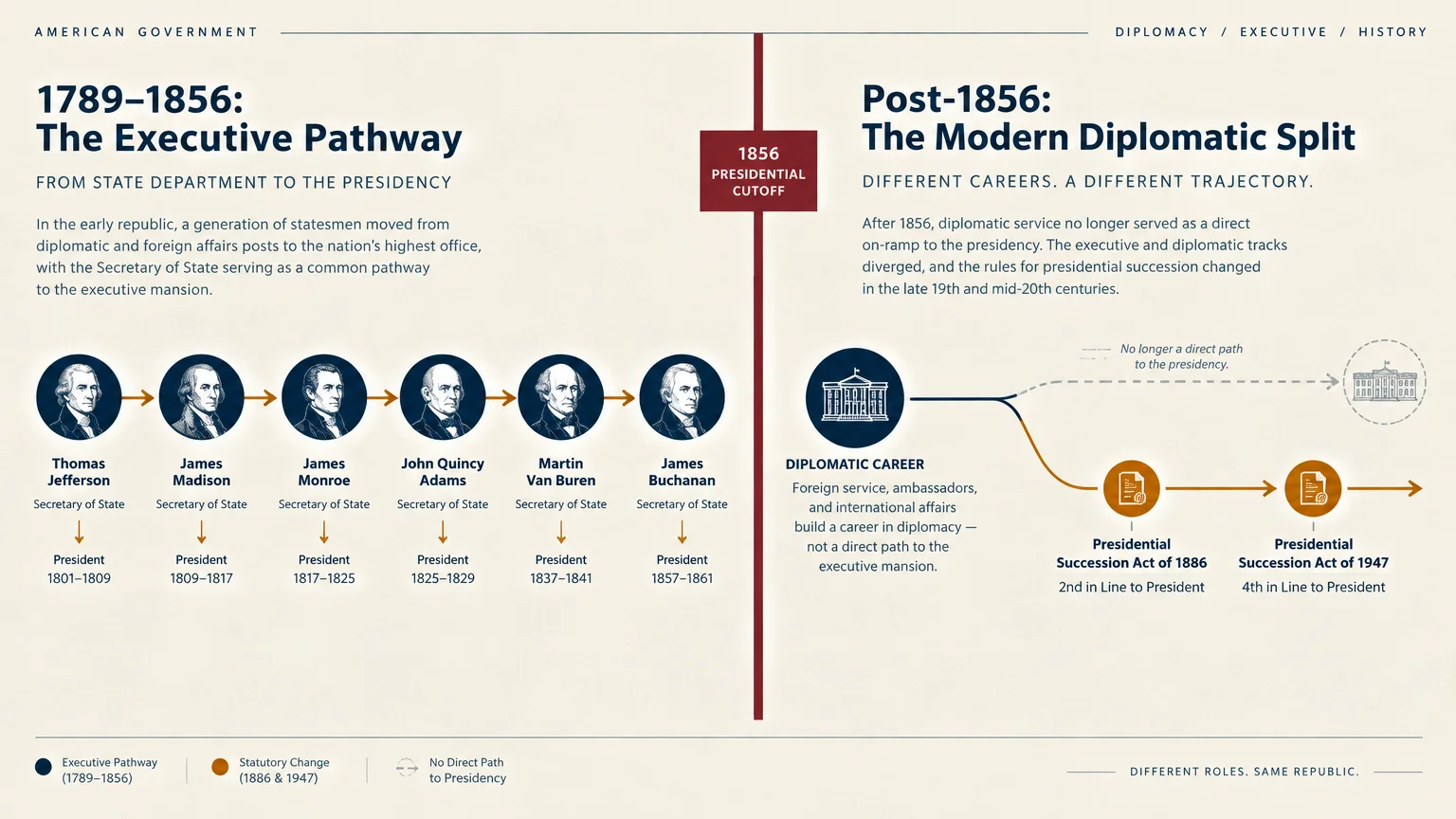
In the early decades of the American republic, the State Department served as the primary launching pad for the presidency. Thomas Jefferson, James Madison, James Monroe, and John Quincy Adams all governed foreign affairs before entering the executive mansion.
Martin Van Buren and James Buchanan later followed that same established course. When Buchanan won the presidential election of 1856, however, that traditional executive pathway abruptly closed.
No sitting or former Secretary of State has won election to the presidency in the seventeen decades since Buchanan took office. Prominent nominees from Henry Clay and Charles Evans Hughes to Hillary Clinton launched major campaigns but fell short.
This enduring drought reflects a profound transformation in how the American political system functions. In early administrations, the Secretary of State operated as the senior cabinet officer overseeing domestic records, patent filings, and foreign correspondence.
As international relations grew more intricate during the late nineteenth and twentieth centuries, the role evolved into a specialized diplomatic post. The skills required to negotiate multilateral treaties rarely aligned with the partisan machinery of modern presidential campaigns.
Statutory changes also shifted the office’s constitutional proximity to executive power. The Presidential Succession Act of 1886 originally placed the Secretary of State directly behind the Vice President.
Congress altered that structure through the Presidential Succession Act of 1947. That statute placed the Speaker of the House and the Senate President pro tempore ahead of the cabinet, moving the Secretary of State to fourth in line.
This list highlights seven extraordinary secretaries who shaped international alliances, territorial boundaries, and post-war orders without ever winning the presidency. Each official was selected for their documented, lasting impact on world history after the 1856 presidential cutoff.
William Henry Seward
You can trace modern American continental boundaries directly to William Henry Seward. He served as Secretary of State from March 5, 1861, to March 4, 1869, under Abraham Lincoln and Andrew Johnson.
Seward entered the cabinet after losing the 1860 Republican presidential nomination to Lincoln in Chicago. He redirected his intense political ambitions toward preserving the Union on the global stage.
During the Civil War, Seward orchestrated delicate diplomatic maneuvers across Europe. He forcefully pressured Great Britain and France to reject diplomatic recognition of the Confederacy, preventing foreign intervention.
On March 30, 1867, Seward achieved his greatest territorial victory by signing the Treaty Concerning the Cession of Russian Possessions with Russian envoy Eduard de Stoeckl.
The United States purchased 586,412 square miles of territory for $7.2 million, or approximately two cents per acre. The Senate ratified the agreement on April 9, 1867, by an overwhelming 37-to-2 roll-call vote.
Skeptics derided the purchase as Seward’s Folly and Johnson’s Polar Bear Garden. History proved Seward right by eliminating Imperial Russia from the continent and unlocking immense strategic wealth.
Historians reviewing the William Henry Seward Papers at the Library of Congress encounter a diplomat who fundamentally transformed American hemispheric power.
Seward survived an assassination attempt on April 14, 1865, by Lewis Powell during Lincoln’s murder. Despite severe stab wounds, he returned to duty to complete his territorial vision.
- Blocked European recognition and naval intervention during the Civil War.
- Negotiated the Alaska Purchase from Russia on March 30, 1867.
- Asserted the Monroe Doctrine to compel French military withdrawal from Mexico.
John Hay
John Hay began his career as Abraham Lincoln’s personal secretary and later became the foremost architect of twentieth-century American globalism. He served as Secretary of State from September 30, 1898, until his death on July 1, 1905.
Hay stepped into cabinet leadership under William McKinley following the Spanish-American War. When McKinley was assassinated in 1901, Theodore Roosevelt retained Hay to steer the nation’s burgeoning global commitments.
Between September 1899 and July 1900, Hay circulated his historic Open Door Notes to London, Berlin, St. Petersburg, Paris, Rome, and Tokyo. These circulars demanded equal commercial access to Chinese ports while preserving China’s administrative integrity.
Hay also removed legal barriers obstructing an American-controlled transit canal across Central America. He negotiated the Hay-Pauncefote Treaty with Great Britain, which the Senate approved 72 to 6 on December 16, 1901.
Following Panama’s declaration of independence from Colombia, Hay acted swiftly to secure construction rights. On November 18, 1903, he signed the Hay-Bunau-Varilla Treaty with Panamanian envoy Philippe Bunau-Varilla.
The treaty granted the United States sovereign control over a ten-mile-wide canal zone in perpetuity. The Senate ratified the convention on February 23, 1904, by a decisive 66-to-14 vote.
Hay never sought the presidency, preferring diplomacy to partisan campaigning. His strategic maneuvers guaranteed American maritime dominance across both the Atlantic and Pacific oceans.
- Established the Open Door Policy across China between 1899 and 1900.
- Abrogated the Clayton-Bulwer Treaty through the 1901 Hay-Pauncefote Treaty.
- Secured sovereign construction rights for the Panama Canal in 1903.
Charles Evans Hughes
Charles Evans Hughes came closer to winning the presidency than any other modern Secretary of State. As the 1916 Republican nominee, he lost to incumbent Woodrow Wilson by just twenty-three electoral votes, finishing with 254 to Wilson’s 277.
President Warren G. Harding appointed Hughes as Secretary of State on March 5, 1921.
Hughes continued in the role under Calvin Coolidge, serving until March 4, 1925.
Hughes confronted an escalating naval arms competition among victorious World War I powers. Rather than pursuing endless naval expansion, he convened the historic Washington Naval Conference in November 1921.
In his opening address, Hughes electrified delegates by detailing exact warship tonnages the major powers should destroy. You can review Hughes’s opening address from November 12, 1921 at the American Presidency Project.
His initiative produced the Five-Power Treaty, signed on February 6, 1922, by the United States, Britain, Japan, France, and Italy. The treaty established a binding capital ship tonnage ratio of 5:5:3:1.75:1.75.
The Senate ratified the Five-Power Treaty on March 29, 1922, by a 67-to-27 vote. The accord marked the first legally binding multinational disarmament treaty in modern history.
Hughes also established professional merit standards within the diplomatic corps through the Rogers Act of 1924. President Herbert Hoover later nominated Hughes as Chief Justice of the United States in 1930.
- Secured 254 electoral votes as the 1916 Republican presidential nominee.
- Negotiated the Five-Power Naval Treaty to halt international battleship building.
- Professionalized American foreign diplomacy under the landmark Rogers Act of 1924.
Cordell Hull
Cordell Hull holds the record as the longest-serving Secretary of State in United States history. Appointed by Franklin D.
Roosevelt on March 4, 1933, he led the State Department for 4,289 days until November 30, 1944.
Hull prioritized trade liberalization to dismantle the high tariff barriers erected during the Great Depression. He personally drafted and championed the Reciprocal Tariff Act of 1934 (Public Law 73-316).
That statute revolutionized American commercial policy by authorizing the president to negotiate tariff reductions without seeking individual treaty approval from Congress. Hull successfully negotiated reciprocal trade agreements with twenty-nine countries.
During World War II, Hull dedicated his remaining strength to preventing future global conflicts. He directed the bipartisan planning committees that designed the charter for an international peacekeeping organization.
You can review these institutional origins in the United Nations Charter drafting process records at the National Archives. President Roosevelt formally hailed Hull as the Father of the United Nations.
Hull resigned due to failing health in late 1944, months before the San Francisco Conference. The Nobel Committee awarded Hull the 1945 Nobel Peace Prize for his foundational work establishing the United Nations.
- Served nearly twelve consecutive years as Secretary of State under Franklin D. Roosevelt.
- Instituted modern reciprocal trade policy through the Reciprocal Tariff Act of 1934.
- Earned the 1945 Nobel Peace Prize as Father of the United Nations.
George C. Marshall
George C. Marshall transitioned seamlessly from commanding the Allied victory in World War II to restructuring European geopolitics.
President Harry S. Truman appointed Marshall as Secretary of State on January 21, 1947.
Postwar Western Europe faced catastrophic economic paralysis, industrial destruction, and famine by the winter of 1947. Marshall warned that widespread misery would drive vulnerable European populations toward Soviet-backed totalitarian communism.
In a concise address at Harvard University on June 5, 1947, Marshall proposed massive American economic assistance. He insisted that European nations unite to devise their own comprehensive recovery blueprint.
Truman signed the European Recovery Program into law on April 3, 1948, under Public Law 80-472. The Senate had endorsed the Marshall Plan on March 13, 1948, by an overwhelming 69-to-17 margin.
You can inspect the statutory details of the Marshall Plan at the National Archives, which authorized over $13 billion in economic reconstruction.
The aid stabilized Western Europe, halted Soviet political expansion, and spurred unprecedented continental economic growth. Marshall received the 1953 Nobel Peace Prize, remaining the only professional military officer to receive that award.
- Proposed the European Recovery Program during his 1947 Harvard University commencement speech.
- Channeled more than $13 billion to restore Western European economies after World War II.
- Won the 1953 Nobel Peace Prize for humanitarian reconstruction and peacebuilding.
Dean Acheson
Dean Acheson succeeded George Marshall on January 21, 1949, serving as Truman’s chief foreign policy strategist until January 20, 1953. He constructed the Western alliance system that successfully contained the Soviet Union for four decades.
Acheson previously assisted in drafting the Truman Doctrine and organizing the Bretton Woods monetary system. As Secretary of State, he prioritized the creation of a permanent transatlantic mutual defense coalition.
His diplomacy culminated on April 4, 1949, with the signing of the North Atlantic Treaty in Washington. The pact united twelve nations under Article 5, establishing that an attack against one constituted an attack against all.
You can examine the ratification proceedings through Senate historical records on the North Atlantic Treaty, which the Senate approved 82 to 13 on July 21, 1949.
In April 1950, Acheson oversaw the completion of National Security Council Paper NSC-68. That landmark document militarized containment policy, recommending substantial increases in American conventional and nuclear defense expenditures.
When North Korean forces crossed the 38th parallel in June 1950, Acheson coordinated swift United Nations military intervention. He designed the framework of modern collective security without ever entering presidential electoral politics.
- Negotiated and finalized the North Atlantic Treaty establishing NATO in 1949.
- Directed the drafting of NSC-68 to establish American Cold War containment strategy.
- Orchestrated United Nations diplomatic backing for the defense of South Korea in 1950.
Henry Kissinger
Henry Kissinger dominated American foreign policy during the Richard Nixon and Gerald Ford administrations. He served as Secretary of State from September 22, 1973, until January 20, 1977.
Unlike other figures on this list, constitutional law barred Kissinger from ever seeking the White House. Because he was born in Fürth, Germany, Article II, Section 1, Clause 5 disqualified him from executive office.
Kissinger served simultaneously as National Security Advisor and Secretary of State from 1973 to 1975. He pursued realpolitik, prioritizing strategic balance of power over ideological competition.
In 1971, Kissinger conducted clandestine meetings in Beijing that prepared President Nixon’s historic 1972 visit to China. This opening exploited the Sino-Soviet split and recalibrated global geopolitics.
He also negotiated the Strategic Arms Limitation Talks (SALT I) agreement and the Anti-Ballistic Missile Treaty in 1972. Those landmark accords curbed the nuclear arms competition between Washington and Moscow.
Kissinger negotiated the Paris Peace Accords on January 27, 1973, to terminate American military participation in Vietnam. For this achievement, he was awarded the 1973 Nobel Peace Prize.
Following the 1973 Arab-Israeli War, Kissinger pioneered shuttle diplomacy across Middle Eastern capitals, securing military disengagement pacts. Kissinger died on November 29, 2023, at age 100, leaving an unmatched record of diplomatic influence.
- Orchestrated the 1972 diplomatic rapprochement with the People’s Republic of China.
- Concluded the 1972 Strategic Arms Limitation Treaty (SALT I) with the Soviet Union.
- Conducted shuttle diplomacy to broker disengagement agreements after the 1973 Yom Kippur War.
| Diplomat | Tenure | Appointing President | Primary Landmark Action | Key Vote or Status |
|---|---|---|---|---|
| William H. Seward | 1861–1869 | A. Lincoln, A. Johnson | Alaska Purchase Treaty | Senate ratified 37–2 |
| John Hay | 1898–1905 | W. McKinley, T. Roosevelt | Panama Canal Treaties | Senate ratified 66–14 |
| Charles E. Hughes | 1921–1925 | W. Harding, C. Coolidge | Five-Power Naval Treaty | Senate ratified 67–27 |
| Cordell Hull | 1933–1944 | F.D. Roosevelt | United Nations Blueprint | 1945 Nobel Peace Prize |
| George C. Marshall | 1947–1949 | H. Truman | Marshall Plan Assistance | Senate approved 69–17 |
| Dean Acheson | 1949–1953 | H. Truman | North Atlantic Treaty (NATO) | Senate ratified 82–13 |
| Henry Kissinger | 1973–1977 | R. Nixon, G. Ford | SALT I & China Opening | 1973 Nobel Peace Prize |
The Modern Separation of Diplomatic Expertise and Presidential Politics
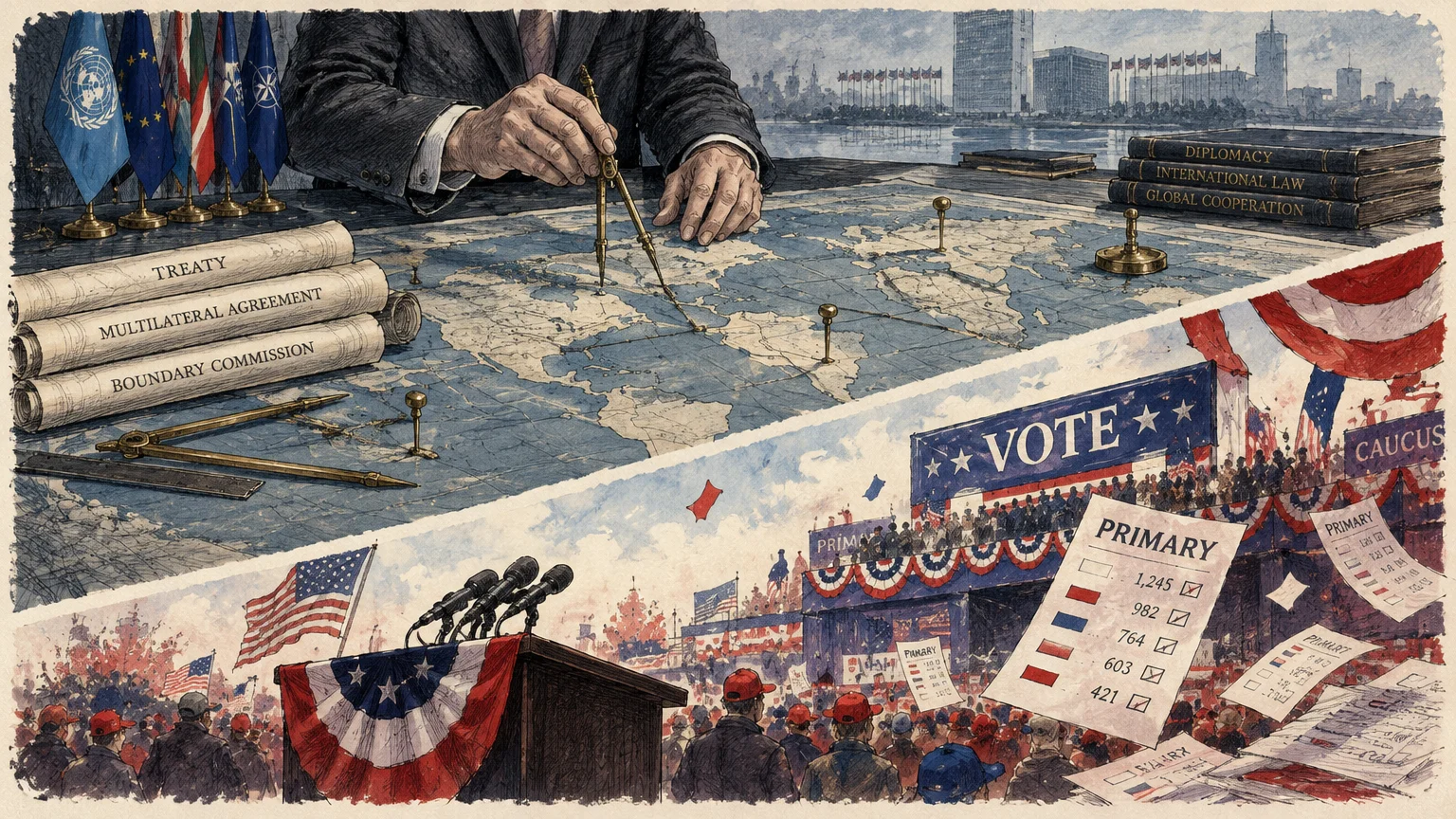
The divergence between the State Department and presidential campaigns reflects fundamental shifts in American electoral politics. In the nineteenth century, party bosses and legislative caucuses selected nominees in smoke-filled rooms.
Under that older caucus model, seasoned administrative experience and diplomatic gravitas served as primary qualifications. Secretaries of State routinely emerged as consensus party leaders who understood executive administration.
The emergence of primary elections in the twentieth century transformed party nominations into popular electoral contests. Modern campaigns reward charismatic communicators, populist appeals, and domestic economic promises rather than diplomatic subtlety.
International diplomacy inherently requires painful compromises, secret negotiations, and concessions to foreign powers. Those very compromises provide opposing candidates with potent ammunition during partisan primary and general election campaigns.
When officials like Charles Evans Hughes in 1916 or Hillary Clinton in 2016 ran for president, their foreign policy records attracted intense domestic scrutiny. Complex diplomatic engagements often conflict with populist domestic sentiments.
Executive structure also altered the Secretary’s standing through the Presidential Succession Act of 1947. By positioning congressional leaders ahead of cabinet officers, Congress affirmed that legislative mandates carry greater succession priority than appointed cabinet status.
Today, the Secretary of State stands fourth in the presidential line of succession behind the Vice President, Speaker of the House, and President pro tempore of the Senate. Marco Rubio serves as the 72nd Secretary of State following his confirmation in January 2025.
While the office no longer acts as a direct presidential stepping stone, its occupant commands unparalleled geopolitical influence. History demonstrates that shaping international orders often leaves a deeper global legacy than winning electoral campaigns.
Frequently Asked Questions About Secretaries of State and the Presidency
Which Secretaries of State were elected President of the United States?
Exactly six Secretaries of State have won the presidency: Thomas Jefferson, James Madison, James Monroe, John Quincy Adams, Martin Van Buren, and James Buchanan. All six achieved election between 1800 and 1856.
No Secretary of State has won the presidency since James Buchanan was elected in 1856, marking a drought spanning nearly seventeen decades.
Why did the Secretary of State position stop serving as a direct path to the presidency?
The transition from legislative caucuses to popular primary elections fundamentally shifted how parties select presidential nominees. Primaries favor domestic political figures, governors, and senators over appointed foreign policy specialists.
Diplomatic agreements also require international concessions that often prove controversial with domestic voters during heated campaigns. Officials who negotiate foreign treaties accumulate political liabilities that domestic rivals easily exploit.
Where does the Secretary of State rank in the presidential line of succession?
The Secretary of State ranks fourth in the presidential line of succession under the Presidential Succession Act of 1947. The office sits behind the Vice President, the Speaker of the House, and the Senate President pro tempore.
The Secretary remains the highest-ranking cabinet officer in the statutory line of succession.
Can a foreign-born Secretary of State succeed to the presidency?
No, a foreign-born Secretary cannot assume the presidency through statutory succession. Article II, Section 1, Clause 5 of the Constitution requires the President to be a natural-born citizen.
Under Title 3, Section 19(e) of the United States Code, any cabinet official who is constitutionally ineligible is bypassed in the line of succession. This statutory exclusion applied to foreign-born secretaries like Henry Kissinger and Madeleine Albright.