When you examine how power flows through Capitol Hill, you quickly discover that the Speaker of the House controls the federal legislative docket. Seven leaders held the gavel longer than anyone else, fundamentally redefining American governance through parliamentary discipline, committee restructuring, and raw political negotiation.
Their tenures shaped national policy from the War of 1812 to modern economic reforms. Understanding how these seven lawmakers managed fractious majorities helps you anticipate how modern legislative leaders direct floor debates and enforce caucus unity.
This guide tracks their official cumulative time in office, their signature procedural maneuvers, and the institutional reforms that shaped their reigns.
Measuring House Leadership Across Two Centuries
Article I, Section 2, Clause 5 of the U.S. Constitution creates the office of Speaker without defining its day-to-day administrative powers. The modern speakership developed through two centuries of political struggle, institutional friction, and procedural experimentation.
Official tenure calculations from the Office of the Historian measure cumulative service rather than raw calendar time. This standard accounts for non-consecutive appointments and distinct legislative sessions.
Before the Twentieth Amendment took effect in 1933, Congress adjourned for extended intervals between annual sessions. Consequently, antebellum leaders often accumulated fewer calendar days in active session than modern Speakers serving identical numbers of Congresses.
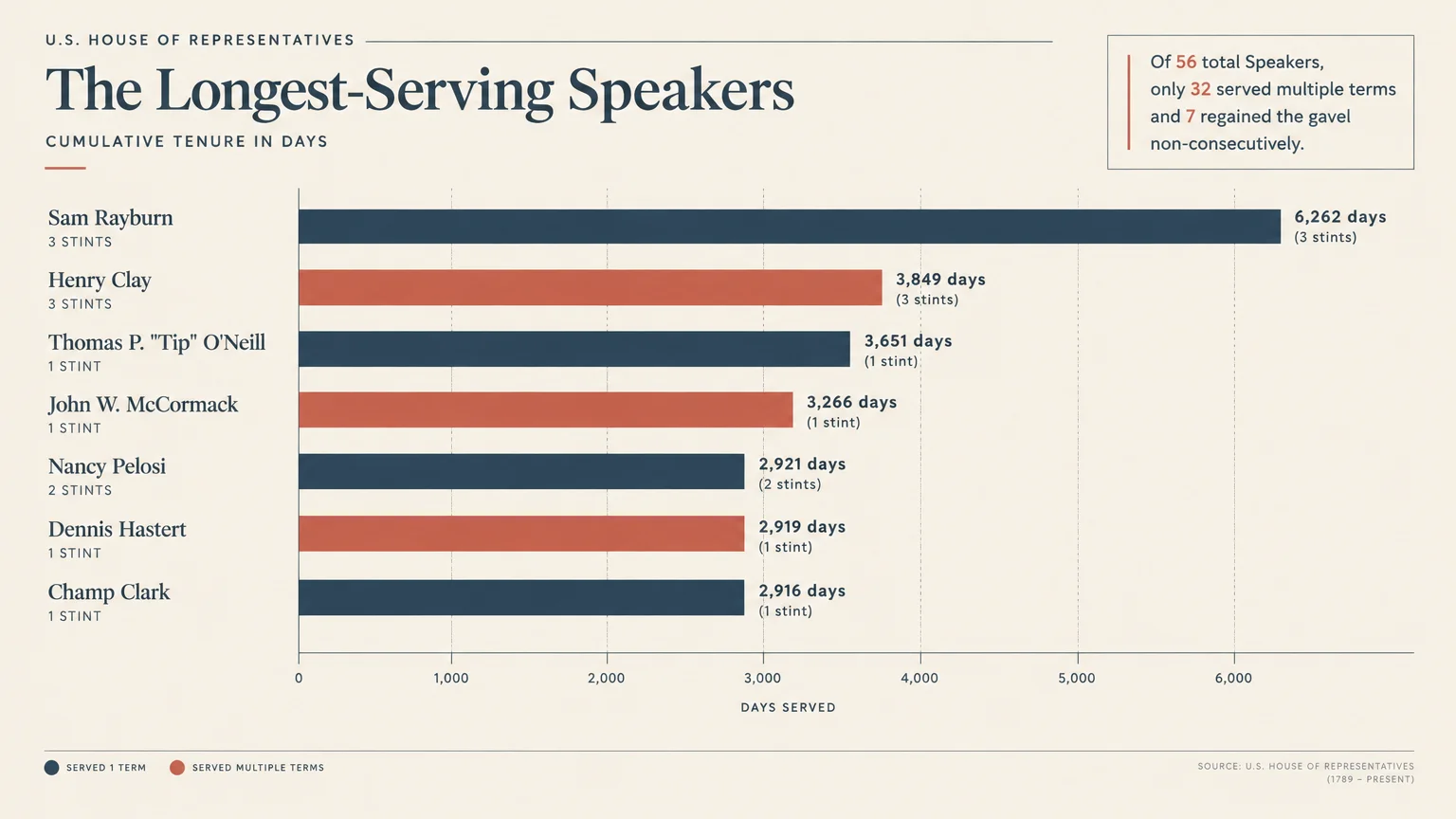
Of the 56 individuals who have served as Speaker of the House as of October 6, 2025, only 32 held the office for multiple terms. Just seven individuals regained the gavel across non-consecutive periods.
The Congressional Research Service identifies the Speaker as a presiding constitutional officer, an institutional administrator, and a partisan leader. You must balance all three roles to evaluate their historical effectiveness.
The seven longest-serving Speakers governed through drastically different institutional arrangements. Some exercised autocratic committee control, while others relied on personal diplomacy or decentralized party caucuses.
| Speaker | Party | State | Cumulative Days | Stints | Key Procedural Legacy |
|---|---|---|---|---|---|
| Sam Rayburn | Democratic | Texas | 6,262 | 3 | Rules Committee expansion (1961) |
| Henry Clay | Democratic-Republican | Kentucky | 3,849 | 3 | Partisan legislative agenda setting |
| Thomas P. “Tip” O’Neill | Democratic | Massachusetts | 3,651 | 1 | Longest unbroken tenure; C-SPAN launch |
| John W. McCormack | Democratic | Massachusetts | 3,266 | 1 | Great Society floor management |
| Nancy Pelosi | Democratic | California | 2,921 | 2 | Iron caucus discipline; major healthcare reform |
| Dennis Hastert | Republican | Illinois | 2,919 | 1 | Informal Majority of the Majority doctrine |
| Champ Clark | Democratic | Missouri | 2,916 | 1 | Post-Cannon decentralized caucus governance |
Sam Rayburn
Sam Rayburn of Texas holds the all-time record for House leadership, accumulating 17 years and 53 days in the chair across three separate tenures. He served from 1940 to 1947, 1949 to 1953, and 1955 until his death in 1961.
Known widely as “Mr. Sam,” Rayburn famously observed that he served with eight U.S. presidents, never under them. You can examine his congressional career through records preserved by the Office of the Historian.
Rayburn favored personal persuasion over formal coercion. He maintained order through his informal “Board of Education,” an after-hours Capitol gathering where key committee chairs resolved differences over drinks and candid conversation.
He routinely advised incoming lawmakers that successful legislating required deference to leadership. His famous maxim instructed freshmen representatives that to get along, you must go along.
His greatest parliamentary test came in January 1961. The conservative coalition, led by Rules Committee Chairman Howard W.
Smith of Virginia, routinely killed civil rights and welfare legislation before floor consideration.
Rayburn introduced House Resolution 127 to enlarge the Rules Committee from 12 to 15 members. This move allowed leadership to break the conservative blockade by adding reliable loyalists.
On January 31, 1961, Rayburn took to the House well to plead for committee reform. The House adopted the resolution by a narrow 217–212 vote, clearing the path for President John F.
Kennedy’s New Frontier agenda.
Rayburn proved that informal personal relationships could maintain party unity across deep geographic and ideological divisions.
- Preserved coalition leverage by bridging northern liberals and southern conservatives.
- Expanded the Rules Committee to break entrenched committee chair vetoes.
- Demonstrated that late-career procedural reform can unlock delayed presidential agendas.
Henry Clay
Henry Clay of Kentucky held the gavel for 10 years and 196 days across three non-consecutive stints between 1811 and 1825. He accumulated 3,849 total days in the chair.
House members elected Clay as Speaker on his very first day in the chamber on November 4, 1811. He defeated Federalist Timothy Pitkin by a vote of 75 to 38.
Before Clay took office, previous Speakers acted as neutral, British-style parliamentary referees. Clay revolutionized the position by transforming it into an assertive post of partisan leadership.
You can trace his national influence through the Biographical Directory of the United States Congress. Clay led the aggressive young faction known as the “War Hawks.”
Clay used his appointment powers to stack the Foreign Relations and Naval Committees with political allies. This aggressive maneuvers pressured President James Madison into declaring the War of 1812 against Great Britain.
He also mastered parliamentary floor control by using the previous question motion to shut down filibusters. This tactic silenced obstructionist opponents like Representative John Randolph of Roanoke.
In 1820, Clay deployed procedural divisions to engineer the Missouri Compromise. By voting on sectional measures separately, he secured Maine’s admission as a free state and Missouri’s entry as a slave state.
Clay established the enduring precedent that a Speaker should direct national policy rather than simply preside over floor debates.
- Transformed the speakership from an impartial moderator into an agenda-setting partisan powerhouse.
- Utilized committee appointment authority to direct legislative outcomes on war and national expansion.
- Pioneered floor procedures that curbed minority obstruction during contentious sectional crises.
Thomas P. “Tip” O’Neill
Thomas P. “Tip” O’Neill Jr. of Massachusetts served as Speaker from January 4, 1977, to January 3, 1987. His tenure spanned 9 years and 364 days, totaling 3,651 cumulative days.
O’Neill holds the institutional record for the longest continuous, uninterrupted speakership in American history. He managed Democratic majorities across five consecutive Congresses.
He popularized the enduring political aphorism that all politics is local. O’Neill believed constituent service formed the bedrock of durable congressional authority.
On March 19, 1979, O’Neill fundamentally transformed legislative transparency by permitting live gavel-to-gavel television broadcasts of House floor proceedings via C-SPAN. This decision permanently altered how members communicated with voters.
During the 1980s, O’Neill operated as the chief national foil to President Ronald Reagan’s conservative fiscal policies. He defended the domestic social safety net against sweeping budgetary reductions.
Despite fierce partisan clashes in the media, O’Neill maintained a collegial working relationship with the White House. He negotiated behind closed doors to pass critical bipartisan legislation.
In 1983, O’Neill teamed with Reagan to rescue the national pension system via the Social Security Amendments (Public Law 98-21). The House approved this critical compromise on March 24, 1983, by a 243–102 vote.
He also helped shepherd the bipartisan Tax Reform Act of 1986 through the House, simplifying the federal tax code while maintaining fiscal solvency.
- Maintained the longest continuous speakership in American history through attentive caucus management.
- Modernized legislative visibility by introducing live television coverage of House floor proceedings.
- Forged high-profile bipartisan compromises with a rival executive branch while defending core party priorities.
John W. McCormack
John W. McCormack of Massachusetts served as Speaker from January 10, 1962, until January 3, 1971.
He accumulated 8 years and 344 days across 3,266 official days in office.
McCormack stepped into the leadership vacancy created by Sam Rayburn’s death. He served as an institutional bridge between old-school urban machine politics and modern legislative activism.
Working alongside President Lyndon B. Johnson, McCormack shepherded the most expansive domestic reform package since the New Deal.
He prioritized civil rights and antipoverty measures through relentless procedural tracking.
McCormack guided the landmark Civil Rights Act of 1964 through repeated procedural roadblocks. On February 10, 1964, the House approved the bill by an overwhelming 290–130 vote.
He then steered the Voting Rights Act of 1965 (Public Law 89-110) through final floor passage. He simultaneously orchestrated votes to create Medicare and Medicaid under the Social Security Amendments of 1965.
Unlike his predecessor, McCormack operated under a highly decentralized system that deferred heavily to entrenched, senior committee chairmen. This traditionalist posture eventually sparked rebellion among reformist colleagues.
In 1969, Representative Morris Udall launched an unprecedented challenge against McCormack for the speakership. Although McCormack defeated Udall 178 to 58 in the caucus vote, the challenge exposed growing generational fractures.
McCormack retired in 1971, concluding an era in which party leaders governed alongside autonomous committee barons.
- Constructed the legislative coalitions necessary to pass the Civil Rights Act and Great Society reforms.
- Managed floor procedures by maintaining diplomatic relationships with autonomous southern committee chairs.
- Weathered early caucus revolts that ultimately catalyzed the congressional democratization reforms of the 1970s.
Nancy Pelosi
Nancy Pelosi of California accumulated 7 years and 364 days across two non-consecutive speakerships, totaling 2,921 days. She served from 2007 to 2011 and again from 2019 to 2023.
On January 4, 2007, Pelosi made history by taking the oath of office as the first female Speaker of the House. In 2019, she became the first leader in six decades to reclaim the gavel.
Pelosi established a modern standard for caucus discipline and vote-counting precision. She adhered to an operational rule that leadership should never bring a major bill to the floor without guaranteed passage.
In 2010, Pelosi drove the passage of the Affordable Care Act through intense political turbulence. The House passed the legislation on March 21, 2010, by a razor-thin 219–212 roll call.
During that same Congress, she secured final passage of the Dodd-Frank Wall Street Reform and Consumer Protection Act (Public Law 111-203). This statute fundamentally overhauled federal financial regulations following the 2008 economic collapse.
During her second speakership from 2021 to 2023, Pelosi operated with one of the narrowest majorities in congressional history. Her governing cushion frequently hovered around a slender four-seat margin.
Despite this margin, she enacted the Infrastructure Investment and Jobs Act (Public Law 117-58) and the Inflation Reduction Act of 2022 (Public Law 117-169). She also presided over two impeachments of President Donald Trump.
Pelosi demonstrated how a centralized, disciplined leadership team can achieve sweeping statutory goals even with almost no room for caucus defection.
- Centralized floor scheduling and committee coordination to ensure party loyalty on decisive votes.
- Passed historic healthcare and financial reform measures during moments of immense public controversy.
- Governed successfully with near-record majority margins through relentless, individualized member outreach.
Dennis Hastert
Dennis Hastert of Illinois served as Speaker from January 6, 1999, to January 3, 2007. His tenure lasted 7 years and 359 days, totaling 2,919 cumulative days in office.
Hastert stands as the longest-serving Republican Speaker in American history. He took office as an understated consensus candidate after Newt Gingrich resigned and Bob Livingston withdrew from consideration.
He governed using an informal leadership principle known as the “Hastert Rule.” Under this guideline, the Speaker refuses to schedule a bill for a vote unless a majority of the majority party supports it.
This practice prevented cross-party coalitions of Democrats and moderate Republicans from passing bills over the objections of the conservative base. It solidified party control over the floor schedule.
Hastert relied heavily on Majority Whip and later Majority Leader Tom DeLay to enforce party unity. Together, they executed an aggressive whip operation that minimized floor dissent.
This leadership structure secured passage of President George W. Bush’s signature economic priorities.
The House enacted the Economic Growth and Tax Relief Reconciliation Act of 2001 (Public Law 107-16) to lower federal rates.
On December 13, 2001, Hastert mobilized a 381–41 floor vote to approve the No Child Left Behind Act (Public Law 107-110). He maintained disciplined floor control until Republicans lost the majority in 2006.
Hastert’s legacy institutionalized the practice of governing primarily through partisan majorities rather than seeking broad bipartisan consensus on key procedural votes.
- Established the “majority of the majority” governing standard to protect partisan legislative priorities.
- Built a formidable internal whip operation that enforced caucus compliance on major domestic votes.
- Retained the Republican speakership for four consecutive Congresses during a period of intense polarization.
Champ Clark
Champ Clark of Missouri served as Speaker from April 4, 1911, to March 4, 1919. His four terms spanned 7 years and 357 days, totaling 2,916 cumulative days.
Clark assumed leadership immediately following the historic revolt of March 19, 1910, against Republican Speaker Joseph Cannon. You can review the details of the Revolt Against Speaker Cannon in House records.
During that revolt, a coalition of Democrats and progressive Republicans adopted House Resolution 502 by a 191–156 vote. The resolution stripped the Speaker of Rules Committee membership and removed unilateral committee appointment powers.
When Democrats won the House in the 1910 midterm elections, Clark accepted these structural constraints. Real administrative authority shifted to the Democratic caucus and Ways and Means Committee Chairman Oscar Underwood.
Under this decentralized structure, Clark acted as a collegial presiding officer and party harmonizer. The Democratic caucus met frequently to debate and bind members to legislative positions before floor consideration.
Despite his reduced formal powers, Clark helped enact President Woodrow Wilson’s major “New Freedom” economic reforms. He shepherded the Underwood Tariff Act of 1913 (Public Law 63-16) to lower tariffs.
Clark also secured passage of the Federal Reserve Act (Public Law 63-43) to establish the modern central banking system. However, his relationship with President Wilson fractured sharply during World War I.
Clark fiercely opposed the Selective Service Act of 1917, arguing publicly against mandatory military conscription. This bitter rift highlighted the independence of congressional leadership from presidential control.
- Presided over a newly democratized House after the historic stripping of dictatorial speakership powers.
- Coordinated with caucus committees and powerful committee chairs to enact systemic monetary and tariff legislation.
- Demonstrated the capacity of legislative leaders to break openly with their party’s president on national security policy.
The Evolution of Floor Control and the Legacy of 1910
When you evaluate these seven tenures, you can observe a constant tug-of-war between centralized leadership authority and committee independence. The modern speakership evolved in direct response to internal rebellions against excessive power.
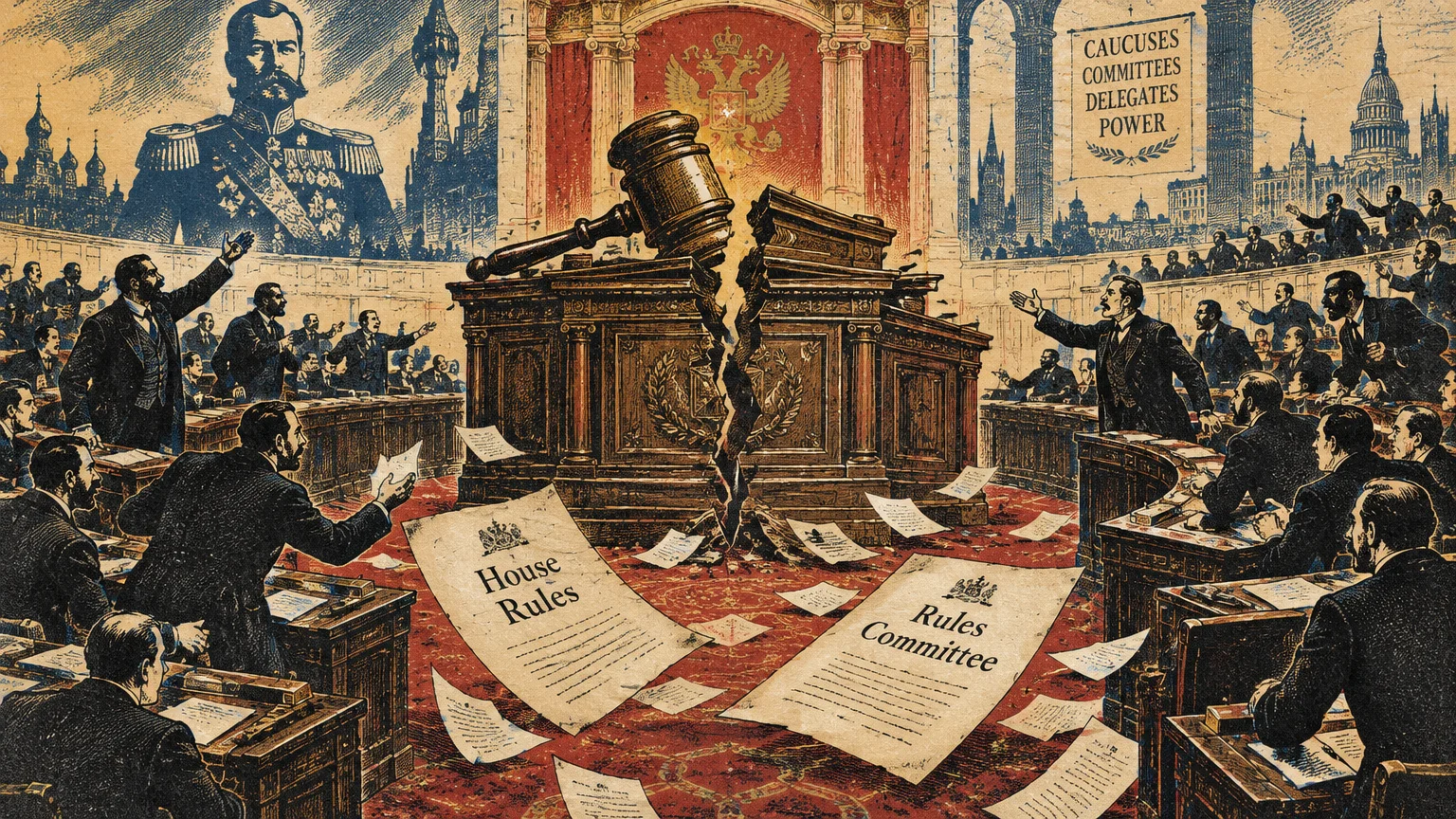
In the late 19th and early 20th centuries, Speakers like Thomas Brackett Reed and Joseph Cannon wielded dictatorial authority. They personally appointed every committee member and chaired the Rules Committee themselves.
The 1910 revolt against Cannon dismantled that imperial structure. It stripped the gavel of its committee appointment monopoly and forced leaders like Champ Clark to govern through caucus negotiation.
Yet decentralization created a new dilemma: the rise of autonomous, conservative committee chairmen. For decades, southern barons used seniority rules to bottle up progressive civil rights bills, frustrating both Sam Rayburn and John McCormack.
The House responded in the 1970s with structural reforms that weakened committee chairs and empowered party leaders once again. The Democratic Caucus transferred committee assignment power to steering panels and gave the Speaker direct influence over Rules Committee appointments.
These post-Watergate adjustments paved the way for modern centralized leaders like Nancy Pelosi and Dennis Hastert. They used floor scheduling and closed rules to enforce strict partisan loyalty on decisive votes.
Today, Speakers must balance this centralized authority against the constant threat of revolt. Contemporary razor-thin majorities grant small dissident factions enormous leverage over the presiding officer.
Understanding these historical shifts helps you analyze how current and future Speakers negotiate factional demands while striving to maintain legislative discipline.
Frequently Asked Questions About House Speakers
Who holds the record for the longest continuous tenure as Speaker?
Thomas P. “Tip” O’Neill Jr. holds the record for the longest unbroken tenure in House history. He presided continuously for 9 years and 364 days from January 4, 1977, to January 3, 1987.
While Sam Rayburn accumulated more total days across his career, his service was interrupted twice when Republicans won House majorities. O’Neill led five consecutive Congresses without interruption.
Does the Constitution require the Speaker to be an elected House member?
Article I, Section 2, Clause 5 states simply that the House of Representatives shall choose their Speaker and other officers. The text does not explicitly mandate that the Speaker must be an elected representative.
However, every Speaker elected across American history has been a sitting member of the House. Choosing an outside figure remains a theoretical possibility that lawmakers have never adopted in practice.
How did the 1910 revolt against Speaker Cannon permanently alter the speakership?
The March 19, 1910 vote on House Resolution 502 permanently removed the Speaker from serving on the House Rules Committee. It also ended the Speaker’s unilateral authority to assign members to standing committees.
This parliamentary revolt transferred committee assignment power to party caucuses and steering committees. The change ended the era of dictatorial “Czar” Speakers and fostered decades of committee autonomy.
What is the Hastert Rule and is it an official House rule?
The Hastert Rule is an informal partisan convention rather than a codified House rule. Under this doctrine, the Speaker refuses to bring legislation to the floor unless supported by a majority of the majority party.
Because it is not an official rule, Speakers can set it aside whenever national emergencies or fiscal deadlines require bipartisan coalitions. Multiple subsequent Speakers have violated the guideline to pass vital spending measures.