
You can trace the foundations of the modern American middle class directly to the transformative veterans legislation passed at the close of World War II. Understanding this landmark law reveals how federal education and housing investments permanently reshaped the nation’s economic landscape.
President Franklin D. Roosevelt signed the Servicemen’s Readjustment Act in 1944 to prevent a catastrophic post-war unemployment crisis.
The legislation transformed millions of returning service members into educated professionals, suburban homeowners, and civic leaders.
This historical guide examines nine key facts about the law’s dramatic legislative passage, widespread economic impact, administrative flaws, and enduring modern legacy.
Evaluating the Legislative Milestones of the 1944 GI Bill
Our editorial team selected these nine milestones by examining the statutory record, congressional voting journals, and historical agency data. Each entry focuses on documented decisions that altered federal policy and national socioeconomic mobility.
You will discover how legislative architects negotiated contentious provisions between January and June of 1944. The historical record reveals how these statutory compromises continue to shape modern veterans benefits.
Every entry includes verified dates, roll-call tallies, public law citations, and verifiable economic data. These facts illuminate the mechanics behind America’s most influential social legislation.
The 1932 Bonus Army March Compelled Congress to Act Early
You must look back to the Great Depression to understand why Congress moved aggressively during World War II. In July 1932, approximately 17,000 World War I veterans marched on Washington, D.C., demanding immediate cash payments for their service certificates.
Federal troops violently cleared the veterans’ encampments along the Anacostia River under the command of General Douglas MacArthur. The resulting political disaster deeply scarred lawmakers and public officials across both parties.
As World War II mobilized more than 16 million Americans, federal planners feared an even greater economic catastrophe. Discharging millions of combat service members simultaneously into an unprepared civilian economy risked triggering a second Great Depression.
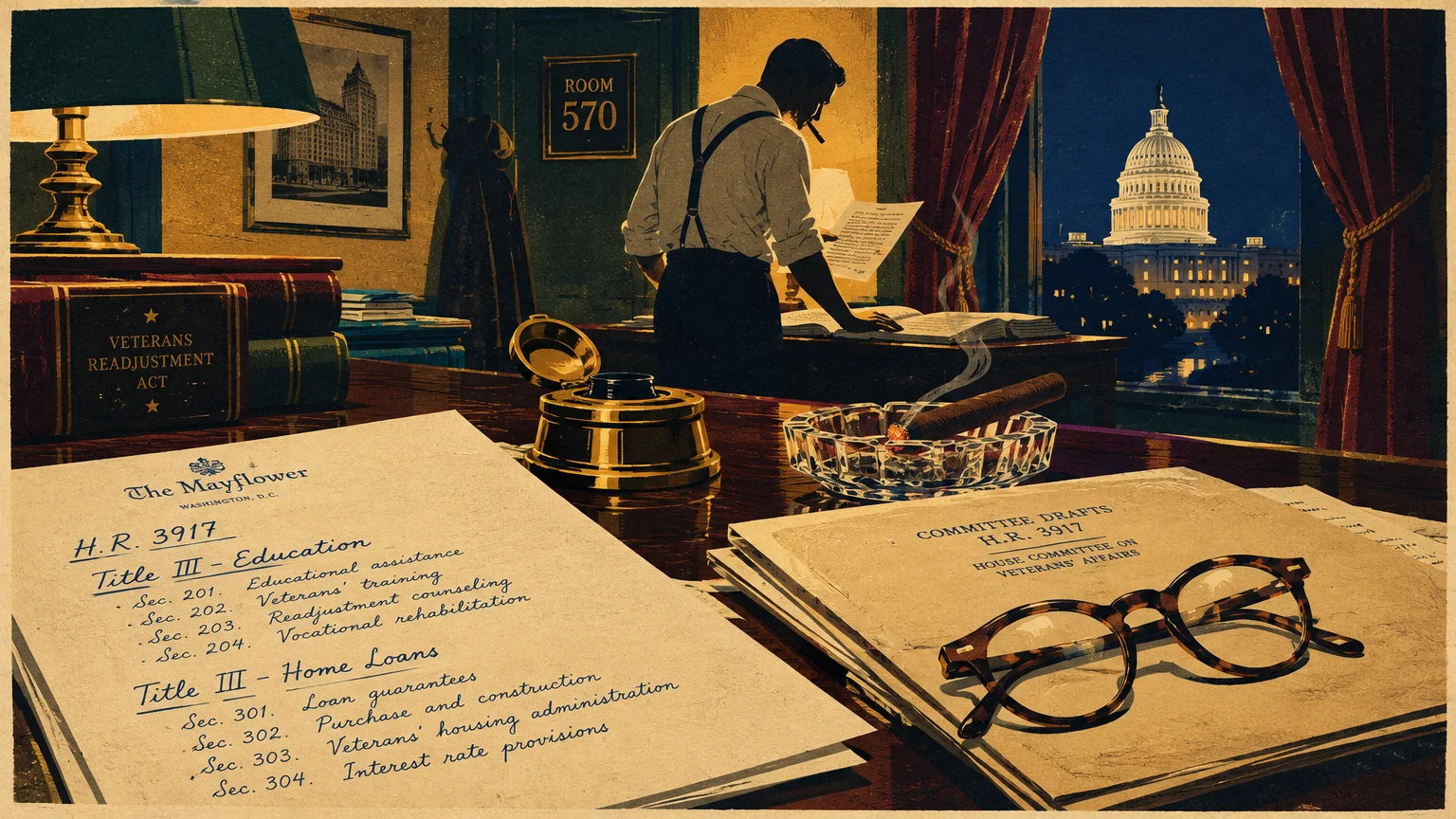
Representative Edith Nourse Rogers of Massachusetts recognized this impending crisis early in the war effort. On January 10, 1944, she introduced H.R.
3917 to establish a comprehensive readjustment program for returning service personnel.
Lawmakers realized that traditional cash bonuses offered only temporary relief to service members. You can see how Congress shifted strategy toward long-term educational investments, low-interest mortgages, and vocational training programs.
This statutory shift replaced reactionary post-war bonuses with proactive social legislation. By building durable economic security for returning troops, Congress prevented massive social instability on American streets.
An American Legion Leader Drafted the Bill on Hotel Stationery
Private advocacy groups, rather than federal agency bureaucrats, authored the foundational text of the GI Bill. The American Legion spearheaded the legislative campaign under the leadership of former Illinois Governor John H.
Stelle.
In January 1944, Stelle assembled an emergency drafting committee inside Room 570 of the Mayflower Hotel in Washington. The committee worked around the clock to create an omnibus support program for returning service members.
Historians at the VA History Office document that Stelle and his team wrote key sections on hotel stationery. They bound together education, medical care, home loans, and unemployment assistance into a single unified bill.
This omnibus structure proved strategically brilliant in navigating congressional committee jurisdictions. Stelle recognized that individual benefit bills would languish in competing subcommittees for months or years.
The Legion orchestrated an unprecedented nationwide public relations campaign to pressure hesitant lawmakers. Millions of letters, telegrams, and radio broadcasts urged citizens to demand immediate action from their representatives.
Their coordinated civic pressure broke administrative resistance within the executive branch. This unified legislative package became the direct blueprint for the final statute enacted by Congress.
An Overnight Dash by Representative John Gibson Broke a Committee Deadlock
The GI Bill nearly collapsed during closed-door conference committee negotiations in early June 1944. A joint House-Senate conference committee deadlocked 3-3 over the bill’s proposed unemployment compensation provisions.
House Committee on World War Veterans’ Legislation Chairman John E. Rankin of Mississippi led the conservative opposition.
Rankin strongly opposed granting $20 weekly unemployment allowances, claiming the benefit encouraged worker absenteeism.
Representative John S. Gibson of Georgia supported the unemployment provisions but had returned home to Douglas, Georgia, due to illness.
Rankin refused to recognize Gibson’s signed proxy statement, causing a complete legislative paralysis.
Committee leaders realized that unless Gibson appeared in person before the June 10 deadline, the conference committee would dissolve without an agreement. American Legion officials and Georgia law enforcement scrambled to locate the ailing congressman.
State police units intercepted Gibson at his rural farm and rushed him to the airport in Waycross, Georgia. Army Air Forces pilots flew Gibson through severe thunderstorms overnight to Washington, D.C.
Gibson arrived at the Capitol building on the morning of June 10, 1944, casting his decisive tie-breaking vote. His dramatic arrival preserved the unemployment title and saved the entire legislative package from collapse.
The Senate adopted the conference report unanimously on June 12, 1944. The House of Representatives followed on June 13 by a decisive vote of 388 to 0.
President Franklin D. Roosevelt signed the Servicemen’s Readjustment Act into law on June 22, 1944, as Public Law 78-346.
You can review the landmark statute in the National Archives milestone record.
Roosevelt highlighted the bill’s transformative promise during his official signing ceremony. You can read his full remarks in the Franklin D. Roosevelt Presidential Library record.
Millions of Veterans Transformed American Higher Education
Before World War II, higher education functioned primarily as an exclusive privilege for affluent American families. Between 1940 and 1944, only 10% to 15% of college-age Americans attended an academic institution.
The 1944 GI Bill dismantled these historic financial barriers for returning service members. Veterans with at least 90 days of active service received up to 48 months of fully funded education.
The Veterans Administration paid up to $500 per year directly to academic institutions for tuition, books, and necessary lab fees. In 1944, this statutory cap easily covered annual tuition at elite private universities like Harvard and Columbia.
The federal government also provided vital living allowances to students. Single veterans received $50 per month, while veterans supporting dependents collected $75 per month.
Veteran enrollments surged dramatically across the country, fundamentally reshaping university campuses. By the peak year of 1947, returning service members accounted for 49% of all U.S. college admissions.
Between 1940 and 1950, the total number of degrees conferred by American universities more than doubled. Universities rapidly constructed quonset huts, expanded lecture halls, and hired thousands of new professors to meet demand.
When the original 1944 bill expired on July 25, 1956, 7.8 million of the nation’s 16 million World War II veterans had used its educational provisions. Roughly 2.2 million entered colleges, 3.5 million enrolled in technical academies, and 2.1 million completed on-the-job training.
The Legislation Sparked the Post-War Suburban Housing Boom
Title III of the 1944 Act revolutionized American residential real estate and homeownership patterns. The law empowered the Veterans Administration to guarantee private mortgage loans without requiring any down payment.
Before this intervention, commercial banks routinely required home buyers to put down 30% to 50% in cash. Mortgages typically lasted only five to ten years before requiring substantial balloon payments.
The GI Bill established 30-year, low-interest, fully amortized mortgages backed by the federal government. This structure allowed average wage earners to purchase homes for less than their monthly apartment rent.
Between 1944 and 1952, the Veterans Administration backed nearly 2.4 million home loans for returning World War II service members. This unprecedented injection of guaranteed credit fueled mass suburban developments across the United States.
Developers like William Levitt transformed empty farmland into massive planned suburban subdivisions, including Levittown, New York. Construction crews utilized assembly-line techniques to erect thousands of affordable single-family homes.
Homeownership rates across the United States climbed from 43.6% in 1940 to 61.9% by 1960. This single statutory provision allowed millions of working-class families to build generational home equity.
Low Unemployment Claims Debunked the “52-20 Club” Stereotype
Congressional opponents originally warned that readjustment allowances would encourage rampant indolence among demobilized troops. Title V of the Act authorized weekly unemployment payments of $20 for up to 52 weeks.
Skeptical commentators mockingly labeled returning soldiers as members of the “52-20 Club.” Conservative critics argued that veterans would idle for an entire year rather than rejoin the industrial workforce.
Subsequent historical data completely disproved these negative predictions. Most service personnel actively sought stable employment or enrolled in full-time educational programs immediately after discharge.
Veterans drew unemployment benefits for an average of only 19 weeks during their transition to civilian life. Less than 20% of the total funds appropriated by Congress for unemployment relief were ever claimed.
The temporary financial cushion allowed workers to secure appropriate career placements rather than taking the first low-wage job available. The program stabilized national purchasing power without depressing civilian labor force participation rates.
Decentralized Administration Denied Equal Benefits to Black Veterans
While the statutory text of the GI Bill contained no racial exclusions, its administrative framework fostered widespread inequality. Southern congressional leaders, led by Representative John Rankin, insisted that local and state authorities administer all benefits.
Rankin designed this decentralized structure to prevent federal agencies from challenging Jim Crow segregation laws. Consequently, state VA offices, commercial mortgage lenders, and segregated universities systematically denied benefits to Black veterans.
Private lenders routinely refused to issue VA-backed mortgages to Black service members seeking homes in suburban developments. Federal housing officials actively supported redlining policies that barred non-white buyers from accumulating suburban property wealth.
Black veterans faced severe discrimination when attempting to use their educational certificates. Segregated white universities across the South rejected all Black applicants, while historically Black colleges suffered from severe overcrowding.
Thousands of Black service members who risked their lives abroad returned home to systemic disenfranchisement. This administrative disparity widened the racial wealth gap during America’s greatest era of middle-class expansion.
You can review detailed enrollment and demographic data in the Congressional Research Service analysis of veterans educational programs. The report outlines historical disparities and congressional reforms across eight decades.
The Law Transformed the National Workforce and Yielded Vast Tax Returns
The 1944 Act produced a dramatic structural shift in the technical composition of the American labor market. By funding professional education, the law transformed thousands of manual laborers into highly skilled specialists.
VA historical records and studies by political scientist Milton Greenberg quantify this massive educational output. The original GI Bill produced 450,000 engineers, 240,000 accountants, 238,000 teachers, 91,000 scientists, 67,000 doctors, and 22,000 dentists.
This massive influx of trained professionals powered American technological supremacy throughout the Cold War and space race. Domestic industries gained an elite workforce that drove corporate innovation, scientific discoveries, and manufacturing dominance.
The economic investment proved extraordinarily profitable for the federal treasury. College-educated veterans earned significantly higher lifetime incomes than their non-educated peers, paying substantially higher income taxes.
Economists calculate that the federal government recouped roughly seven dollars in tax revenue for every dollar spent on veterans’ education. The law demonstrated that federal investments in human capital generate massive long-term fiscal returns.
Modern Legislative Reforms and Supreme Court Rulings Expanded Lifelong Benefits
Congress updated veterans education benefits repeatedly to maintain force readiness in the all-volunteer military era. In 1984, Representative G.V. “Sonny” Montgomery of Mississippi championed legislation establishing the Montgomery GI Bill.
Following the September 11 attacks, Congress enacted the Post-9/11 Veterans Educational Assistance Act of 2008. This landmark overhaul restored comprehensive tuition coverage and introduced a housing allowance linked to local living costs.
On August 16, 2017, the president signed the Harry W. Colmery Veterans Educational Assistance Act. Known widely as the “Forever GI Bill,” the statute eliminated the restrictive 15-year expiration limit for qualifying service members.
Veterans discharged on or after January 1, 2013, can now access their educational benefits throughout their lifetimes. The law also expanded support for science, technology, engineering, and mathematics degrees.
On April 16, 2024, the legal framework expanded further through the landmark Supreme Court decision in Rudisill v. McDonough (No. 22-888). The Court ruled 7-2 that service members with separate qualifying periods of service may access up to 48 months of combined benefits.
The Department of Veterans Affairs updated its administrative systems following the Rudisill decision. The VA automatically evaluates qualifying veterans for additional months of eligibility without requiring complex new paperwork.
For qualifying Post-9/11 beneficiaries, the program covers 100% of net in-state tuition and fees at public universities. Private and foreign school tuition caps reach up to $30,908.34 per academic year.
Eligible veterans studying online receive a monthly housing allowance of $1,261.00. The law also delivers an annual stipend of up to $1,000 to cover required textbooks and supplies.
Comparing Major Iterations of the GI Bill
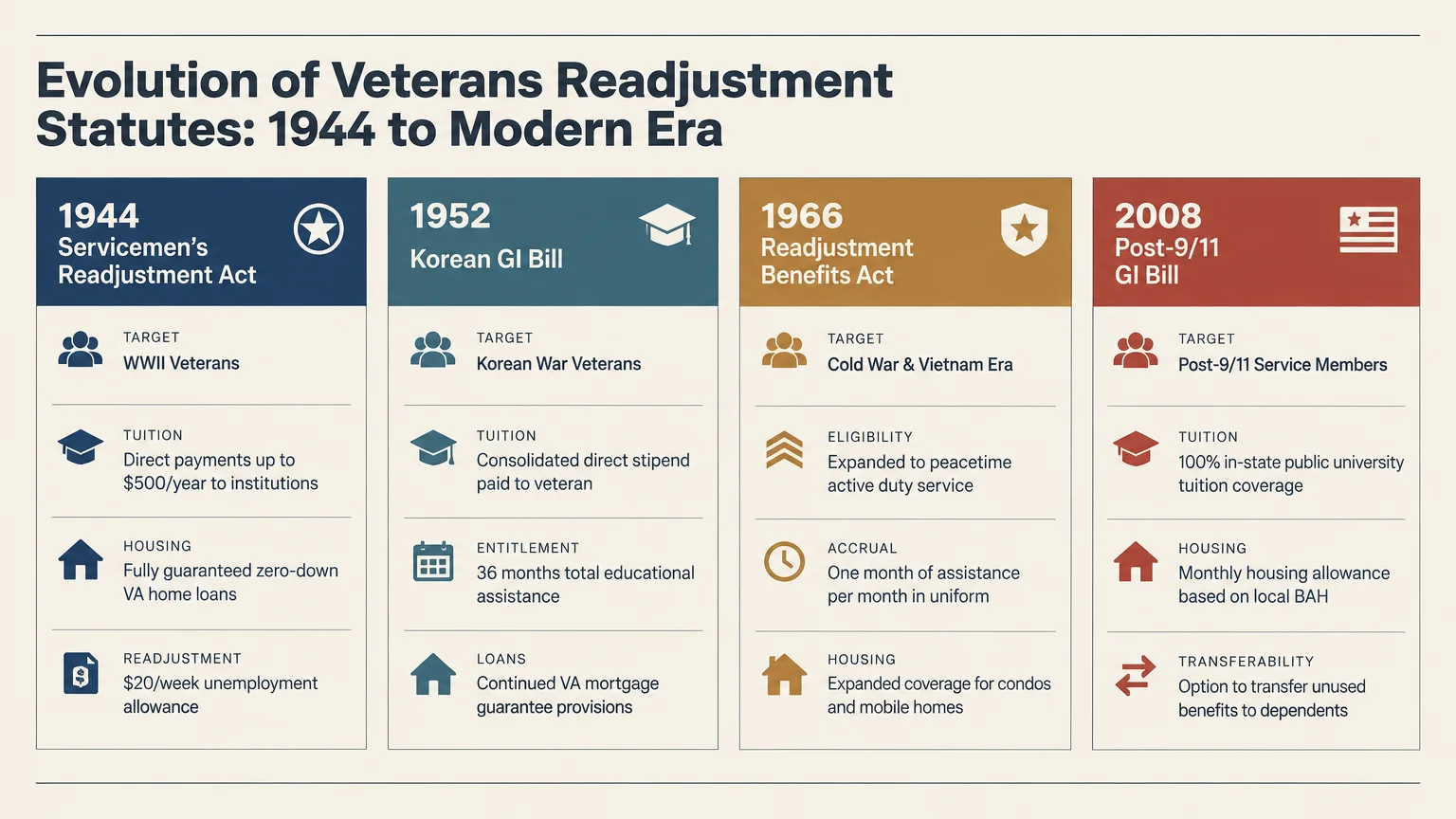
The following table illustrates how Congress structured educational and housing benefits across eight decades of veterans legislation. Use this comparison to track key changes in statutory coverage, benefit duration, and usage limits.
| Legislation | Enactment Date | Education Benefit Cap | Housing / Living Stipend | Statutory Expiration |
|---|---|---|---|---|
| Servicemen’s Readjustment Act | June 22, 1944 | Up to $500/year for 48 months | $50/mo single; $75/mo dependents | Expired July 25, 1956 |
| Montgomery GI Bill | October 19, 1984 | Fixed monthly cash stipend | None (included in cash benefit) | 10 years after discharge |
| Post-9/11 GI Bill | June 30, 2008 | 100% in-state; private capped | E-5 with dependents BAH rate | 15 years for pre-2013 discharges |
| Forever GI Bill (Colmery Act) | August 16, 2017 | 100% in-state; private capped | Campus zip-code BAH or online rate | No expiration (post-2013 discharges) |
How Veterans Legislation Permanently Restructured Federal Policy
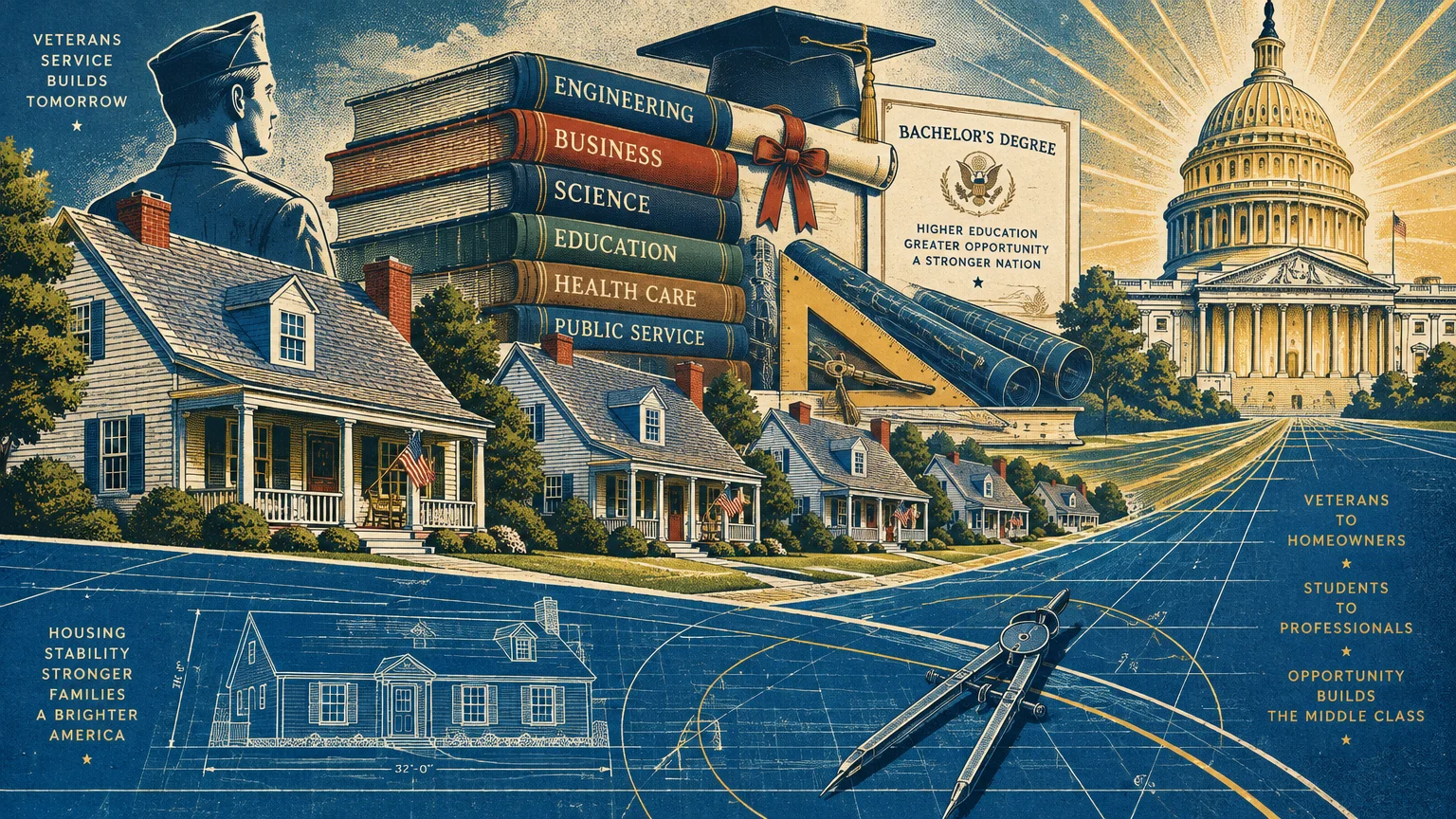
The Servicemen’s Readjustment Act of 1944 fundamentally altered how the American government approaches federal social policy. It transformed the relationship between citizen service and state-sponsored socioeconomic mobility.
Prior to 1944, federal social programs focused primarily on direct relief payments or temporary work relief. The GI Bill proved that strategic investments in higher education, job training, and credit access yield compounding economic growth.
The legislation created the modern American middle class by democratizing homeownership and university education. It demonstrated that government-backed loans could stimulate private capital investment without generating massive loan defaults.
However, the bill’s historical legacy provides a vital lesson in statutory design and administrative oversight. By devolving authority to segregated local boards, Congress allowed systemic discrimination to undermine federal policy goals.
Modern laws like the Forever GI Bill reflect these hard-learned historical lessons. Current statutes establish uniform federal standards, eliminate arbitrary expiration windows, and expand access to lifelong technical training.
If you have military service, you should review your current eligibility through the Department of Veterans Affairs. Knowing your statutory rights ensures you maximize the educational and housing benefits your service earned.
Frequently Asked Questions About GI Bill History and Eligibility
How did the Rudisill v. McDonough Supreme Court ruling expand modern benefits?
The Supreme Court held in April 2024 that veterans with multiple qualifying service periods can use both the Montgomery and Post-9/11 GI Bills. This ruling entitles eligible service members to a combined maximum of 48 months of benefits.
The decision struck down an administrative policy that forced veterans to forfeit Montgomery benefits when switching programs. The VA updated its claims processing to apply these additional months automatically.
What were the original 1944 GI Bill subsistence allowance rates?
The original 1944 statute provided a monthly living allowance of $50 for unmarried veterans enrolled in full-time education. Veterans with one or more dependents received $75 per month.
Congress subsequently raised these rates to help veterans keep pace with post-war consumer inflation. By 1948, monthly allowances increased to $75 for single veterans and up to $120 for veterans with multiple dependents.
Why was the 1944 GI Bill administered at the state and local level?
Southern congressional leaders, led by Representative John Rankin, demanded state-level administration during conference committee negotiations. They sought to preserve local racial segregation laws and maintain regional labor practices.
This decentralized structure allowed local administrators and private lenders to systematically deny benefits to Black veterans. Modern veterans legislation avoids this failure by enforcing centralized, uniform federal standards.
What are the current Post-9/11 GI Bill private tuition caps and online housing rates?
The Post-9/11 GI Bill covers up to $30,908.34 per academic year for private or foreign educational institutions. Public colleges and universities remain fully covered at the in-state tuition rate.
Students enrolled exclusively in online degree programs receive a monthly housing allowance of $1,261.00. Students attending at least one in-person class receive housing allowances based on their campus zip code.



