
You can trace the foundational architecture of American soft power directly to bipartisan Cold War initiatives enacted in 1961. That transformative year produced both the Peace Corps and the United States Agency for International Development.
Understanding these statutory origin stories reveals how executive orders and congressional compromises turned fragmented aid into permanent national policy. Both institutions emerged from fierce debates over national security, humanitarian duty, and diplomatic independence.
By examining primary records from the 87th Congress and the White House, you can evaluate how civilian service became a cornerstone of foreign engagement. Here is the verified statutory history behind these landmark agencies.
Tracking the Cold War Origins of American Civilian Assistance
This list chronicles nine pivotal legislative, executive, and administrative milestones that established America’s civilian foreign aid apparatus between 1957 and late 1961. It also tracks their institutional trajectory through March 2, 2026.
Our editorial team selected these entries by auditing public statutes, executive orders, congressional committee prints, and presidential archives. Each entry highlights a distinct legal mechanism that altered how Washington projected civilian soft power abroad.
Cold War competition with the Soviet Union compelled American policymakers to separate humanitarian modernization from military defense programs. Washington required flexible development instruments that could foster economic self-reliance across newly independent post-colonial states.
You will see how university grassroots activism merged with congressional reform to build enduring federal operations. Every fact relies strictly on public laws, official roll-call tallies, and executive records preserved in the National Archives.
These historical records demonstrate how civilian agencies navigated shifting presidential priorities while maintaining their statutory mandates. By examining these legislative mechanics, you gain practical insights into how modern foreign policy institutions function.
The following entries present the chronological creation of both agencies, highlighting key legal texts, decisive votes, administrative appointments, and long-term organizational evolutions.
Congressional Precursors in the Eighty-Sixth Congress
Popular lore often credits John F. Kennedy with inventing the overseas volunteer corps during his 1960 presidential run.
However, legislative records confirm that congressional Democrats drafted the original statutory framework years before Kennedy adopted the idea.
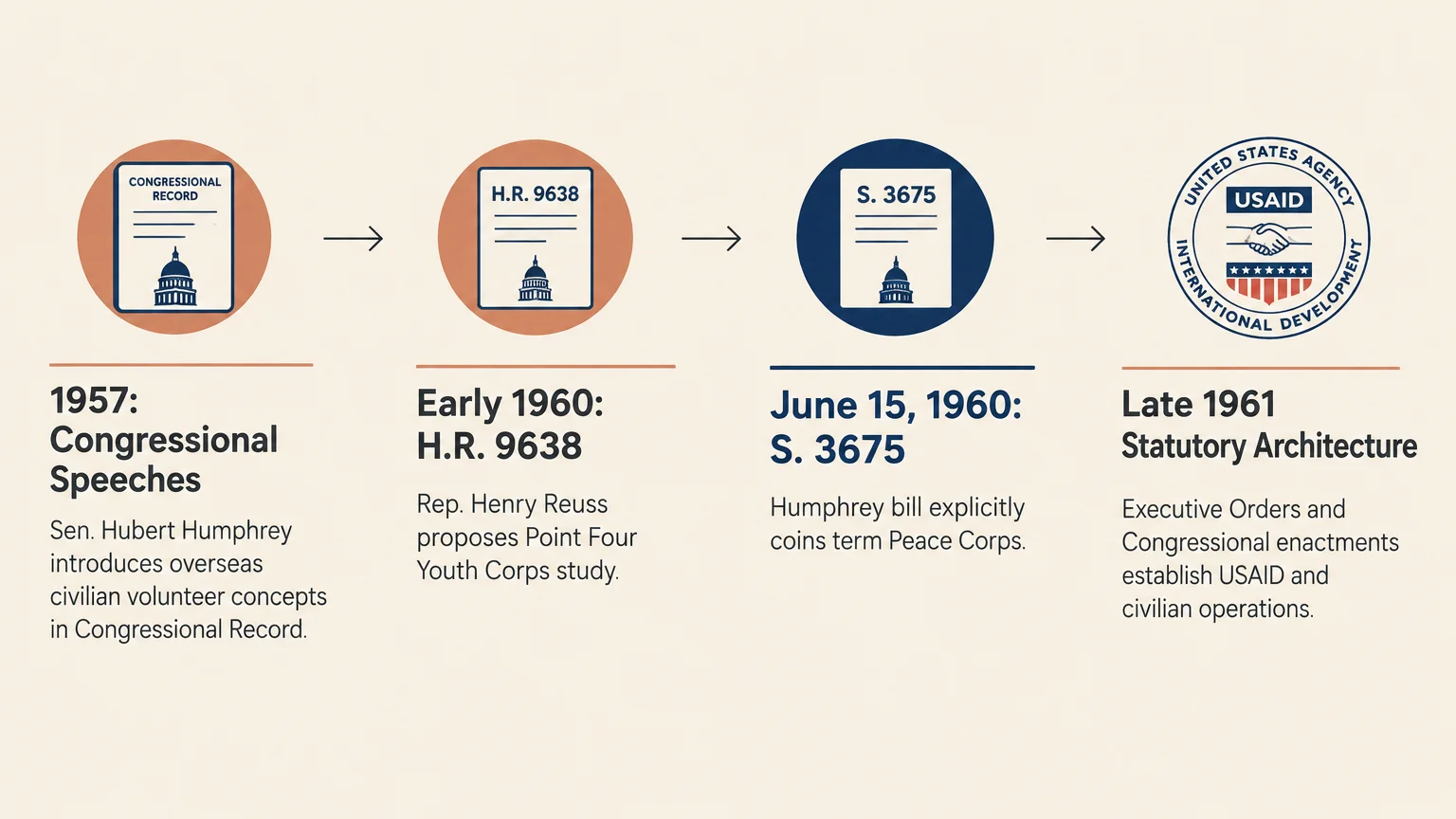
Representative Henry S. Reuss of Wisconsin championed an international volunteer initiative in early 1960.
He introduced H.R. 9638, proposing an official study for a “Point Four Youth Corps” that would send young American technicians abroad.
Senator Hubert H. Humphrey Jr. of Minnesota introduced companion bill S.
3675 on June 15, 1960. Humphrey’s measure explicitly coined the term “Peace Corps” and called for a permanent agency to deploy skilled civilian volunteers.
Humphrey had advocated similar overseas civilian missions in the Congressional Record as early as 1957. These legislative blueprints gave Kennedy’s subsequent campaign staff an operational framework that was already vetted by congressional policy committees.
- S. 3675: Introduced by Senator Hubert Humphrey on June 15, 1960, coining the term “Peace Corps.”
- H.R. 9638: Introduced by Representative Henry Reuss in early 1960 to fund a Point Four Youth Corps study.
- Congressional Record Precedent: Humphrey’s foreign policy speeches establishing civilian volunteer frameworks began in 1957.
The Campaign Challenge at the University of Michigan
The political catalyst that propelled the Peace Corps into national policy occurred spontaneously on the campaign trail. At 2:00 a.m. on October 14, 1960, Senator John F.
Kennedy arrived at the University of Michigan in Ann Arbor.
Speaking to an impromptu gathering of roughly 10,000 university students, Kennedy challenged them to dedicate years of their lives to international service. You can review the speech transcript preserved in the American Presidency Project.
Kennedy asked whether the students would spend their careers working in developing nations across Africa, Asia, and Latin America. The challenge tested whether Americans possessed the discipline and commitment to counter Soviet influence at the grassroots level.
Student organizers Chester Levenberg and Judith Huckins capitalized on the speech by organizing campus petitions that endorsed Kennedy’s proposal. Within days, students collected over 1,000 signatures, proving widespread public appetite for an organized federal service program.
- Event Date and Time: October 14, 1960, at 2:00 a.m. on the Michigan Union steps.
- Crowd Size: Approximately 10,000 university students assembled with less than an hour of advance notice.
- Civic Mobilization: Over 1,000 student petition signatures submitted to the Kennedy campaign within days.
Executive Order 10924 Establishes the Pilot Agency
President Kennedy moved aggressively after his January 1961 inauguration to establish the program without waiting for congressional approval. On March 1, 1961, he signed Executive Order 10924, creating the Peace Corps on a temporary pilot basis.
Kennedy financed this pilot initiative using discretionary contingency funds available under the Mutual Security Act of 1954. He placed the fledgling organization inside the Department of State to provide immediate diplomatic cover and operational infrastructure.
The executive order instructed the agency to recruit, train, and deploy skilled American men and women to interested host countries. It mandated that volunteers serve only upon formal invitation and assist in critical economic and social development projects.
This strategic use of presidential authority bypassed legislative gridlock and allowed organizers to demonstrate real-world results immediately. By acting unilaterally through executive order, Kennedy created operational momentum that forced Congress to take the initiative seriously.
- Executive Action: Executive Order 10924 signed by President Kennedy on March 1, 1961.
- Statutory Funding Source: Discretionary presidential contingency funds authorized under the Mutual Security Act of 1954.
- Administrative Placement: Temporarily housed within the Department of State as an operating agency.
The Shriver Task Force and the First Mission
On March 22, 1961, President Kennedy appointed his energetic brother-in-law, R. Sargent Shriver, as founding Director of the Peace Corps.
Shriver immediately assembled a bipartisan task force comprising business leaders, educators, and civil rights advocates.
Shriver’s task force crafted aggressive operational standards to dispel criticisms that the corps would become an undisciplined haven for draft evaders. The team partnered with American universities to design rigorous physical conditioning and intensive foreign-language training.
On August 28, 1961, President Kennedy hosted a White House Rose Garden ceremony to send off the first 80 selected volunteers. Kennedy praised their personal commitment and described them as representative ambassadors of democratic values.
Two days later, on August 30, 1961, 51 American volunteer teachers landed in Accra, Ghana, to begin secondary-school assignments. This historic arrival marked the formal commencement of on-the-ground overseas service under Shriver’s administrative leadership.
- Leadership Appointment: R. Sargent Shriver named founding Director on March 22, 1961.
- Rose Garden Ceremony: President Kennedy hosted the first 80 departing volunteers on August 28, 1961.
- First Overseas Deployment: 51 teachers arrived in Accra, Ghana, on August 30, 1961.
Codification under the Peace Corps Act of 1961
Executive authority launched the pilot project, but long-term survival required permanent statutory authorization and direct appropriations from Congress. The Kennedy administration transmitted legislative text to Capitol Hill, initiating extensive hearings across the House and Senate.
Congress responded with strong bipartisan support, passing the Peace Corps Act (Public Law 87-293). Kennedy signed the landmark legislation into law on September 22, 1961, codifying the agency at 22 U.S.C. § 2501.
The statute established three enduring mandates: providing trained personnel, promoting mutual understanding of Americans abroad, and educating Americans about foreign cultures. Lawmakers appropriated $40 million to finance agency operations for fiscal year 1962.
By the close of 1961, roughly 900 volunteers were actively serving across 16 partner nations. Agency ranks expanded continuously throughout the decade, reaching an all-time peak of approximately 15,000 active volunteers in 1966.
- Statutory Enactment: Public Law 87-293 (75 Stat. 612), signed into law on September 22, 1961.
- Codified Mandate: Enacted under Title 22, Section 2501 of the United States Code.
- Initial Growth: Appropriated $40 million for 1962, funding 900 volunteers across 16 countries.
The Foreign Assistance Act Reorganizes Post-War Aid
While the Peace Corps mobilized individual citizens, the Kennedy administration confronted an unwieldy, fragmented apparatus of federal foreign aid. America’s overseas assistance programs had splintered across multiple bureaucratic fiefdoms since the 1947 Marshall Plan.
President Truman’s 1949 Point Four Program and the Mutual Security Act of 1954 routinely mixed economic assistance with military hardware transfers. Kennedy argued that treating economic aid as a byproduct of military defense undermined long-term developmental progress.
Congress resolved this policy dilemma by passing the Foreign Assistance Act of 1961 (Public Law 87-195). Kennedy signed the sweeping statute on Labor Day, September 4, 1961, formally repealing the outdated Mutual Security Act.
The new statute established a strict statutory division between military weapon sales and civilian economic development. Detailed diplomatic records in the Department of State Foreign Relations series show how this reform prioritized multi-year economic planning.
- Enabling Statute: Public Law 87-195 (75 Stat. 424), enacted on September 4, 1961.
- Structural Reform: Repealed the Mutual Security Act of 1954 and segregated military from civilian aid.
- Diplomatic Strategy: Shifted foreign development policy toward multi-year country planning compacts.
Executive Order 10973 Formally Establishes USAID
The Foreign Assistance Act provided statutory authority for agency reorganization, but it left the administrative structure to presidential discretion. On November 3, 1961, President Kennedy executed this mandate by signing Executive Order 10973.
This landmark order formally created the United States Agency for International Development (USAID) within the State Department. USAID absorbed the existing International Cooperation Administration and took charge of the Development Loan Fund’s capital assets.
The executive order also incorporated related foreign economic activities from the Export-Import Bank and the Food for Peace program. President Dwight D.
Eisenhower had originally initiated Food for Peace under Public Law 480 in 1954.
This consolidation created a single federal agency responsible for administering non-military technical aid, agricultural surplus distribution, and capital loans. It established regional geographic bureaus designed to coordinate unified country-specific economic assistance strategies.
- Executive Instrument: Executive Order 10973 signed by President Kennedy on November 3, 1961.
- Consolidated Entities: Merged the International Cooperation Administration and Development Loan Fund into USAID.
- Program Integration: Absorbed agricultural surplus distribution from the 1954 Food for Peace program (PL-480).
Fowler Hamilton’s Mandate and Early Administration
Launching USAID required an administrative leader with deep executive experience in international commerce and federal administrative law. President Kennedy selected Fowler Hamilton, a prominent Wall Street attorney and former director of the Foreign Operations Administration.
Hamilton took the oath of office as the first Administrator of USAID in October 1961. He immediately undertook the complex task of merging thousands of dispersed overseas civil servants into a unified personnel system.
Under Hamilton’s leadership, USAID introduced strict accounting protocols and performance-based criteria for long-term development loans. His team prioritized high-impact investments in agricultural productivity, transportation networks, and public health initiatives across developing nations.
Hamilton’s administrative tenure established the durable principle that civilian foreign assistance should focus on measurable socio-economic progress. His operational framework guided American bilateral development assistance programs throughout the height of the Cold War.
- Inaugural Leadership: Fowler Hamilton sworn in as the first USAID Administrator in October 1961.
- Administrative Reorganization: Integrated fragmented civil service personnel into a single foreign assistance roster.
- Financial Protocols: Instituted performance-based capital loans and rigorous development project audits.
Institutional Divergence and Twenty-First Century Restructuring
Although both agencies originated during the 1961 Cold War reforms, their structural trajectories diverged substantially over subsequent decades. The Peace Corps pursued full administrative autonomy to protect its volunteer mission from geopolitical foreign policy conflicts.
Congress originally placed the Peace Corps inside the State Department and later transferred it to ACTION in 1971. In 1981, lawmakers passed legislation establishing the Peace Corps as a completely independent executive branch agency.
Conversely, USAID experienced profound institutional contraction between January 2025 and March 2026. Executive directives cancelled roughly 83% to 90% of active USAID assistance awards, terminating approximately 6,780 of 7,510 contracts totaling $79.1 billion.
USAID’s global workforce plummeted from roughly 13,600 to 241 by April 2025, and on July 1, 2025, remaining operations merged into the State Department. Meanwhile, the independent Peace Corps marked its 65th anniversary on March 2, 2026, operating in over 60 countries under Acting Director Richard E.
Swarttz.
- Peace Corps Independence: Separated from the State Department and ACTION as an independent agency in 1981.
- USAID Dissolution: 83% to 90% of awards terminated, with remaining active programs absorbed into State on July 1, 2025.
- Status as of March 2, 2026: Peace Corps marks its 65th anniversary led by Acting Director Richard E. Swarttz.
| Agency / Component | First Executive Order | Enabling Statute | Initial Leader | Key Operational Mandate |
|---|---|---|---|---|
| Peace Corps (Pilot) | Executive Order 10924 (March 1, 1961) | Mutual Security Act of 1954 (Contingency Funds) | R. Sargent Shriver (Director) | Trained volunteer deployment upon host nation request |
| Peace Corps (Permanent) | Executive Order 11041 (August 6, 1962) | Peace Corps Act of 1961 (Public Law 87-293) | R. Sargent Shriver (Director) | Grassroots service, cross-cultural diplomacy, education |
| USAID (Consolidated) | Executive Order 10973 (November 3, 1961) | Foreign Assistance Act of 1961 (Public Law 87-195) | Fowler Hamilton (Administrator) | Long-term capital loans, grants, and technical assistance |
| Point Four Youth Corps | None (Congressional Study) | Mutual Security Act Amendment of 1960 | Henry S. Reuss (Representative) | Preliminary feasibility study for civilian youth corps |
| Development Loan Fund | Executive Order 10575 (Precursor) | Mutual Security Act of 1957 | Dempster McIntosh (Manager) | Bilateral sovereign loans for strategic infrastructure |
| Food for Peace (PL-480) | Executive Order 10560 (Eisenhower) | Agricultural Trade Act of 1954 (PL 83-480) | George McGovern (Director, 1961) | Distribution of American agricultural surpluses abroad |
| Technical Cooperation | Executive Order 10458 (Precursor) | Act for International Development of 1950 | Henry G. Bennett (Administrator) | Truman Point Four sharing of scientific and technical skills |
| ACTION Agency Merger | Executive Order 11603 (Nixon) | Reorganization Plan No. 1 of 1971 | Joseph Blatchford (Director) | Consolidated domestic and international volunteer corps |
| Independent Agency Status | Executive Order 12137 (Amended) | International Security Act of 1981 (PL 97-113) | Loret Miller Ruppe (Director) | Full administrative autonomy for the Peace Corps |

How Cold War Foreign Assistance Shaped American Governance
The concurrent founding of the Peace Corps and USAID marked a permanent transition in American foreign policy design. Policymakers recognized that military defense alliances alone could not guarantee stability across newly decolonized and developing nations.
By coupling people-to-people volunteerism with large-scale economic capital financing, Washington created a multi-tiered civilian soft-power structure. This approach addressed both grassroots human needs and national infrastructural modernization simultaneously.
Statutory mechanics ultimately determined how each agency evolved through decades of shifting geopolitical doctrine. The Peace Corps Act strictly separated volunteers from diplomatic advocacy and intelligence operations, safeguarding the agency’s non-partisan credibility.
In contrast, USAID remained closely tied to the Department of State and formal national security policy. Because Congress separated military and economic aid under Public Law 87-195, non-military foreign assistance remained highly vulnerable to executive reorganizations.
The sweeping structural changes enacted between 2025 and early 2026 demonstrated the durability of statutory independence versus agency placement. While USAID was absorbed into the State Department hierarchy, the statutory independence of the Peace Corps preserved its separate identity.
You can trace current legislative debates over foreign assistance directly back to the statutory bargains struck in 1961. The structural laws enacted by the 87th Congress continue to define how American soft power operates abroad.
Frequently Asked Questions About Cold War Foreign Aid
Did John F. Kennedy invent the concept of the Peace Corps?
No, congressional lawmakers developed and introduced the civilian volunteer corps framework before Kennedy’s presidential campaign adopted it. Representative Henry Reuss and Senator Hubert Humphrey drafted foundational Point Four Youth Corps bills between 1957 and 1960.
Senator Humphrey’s June 1960 legislation, S. 3675, officially coined the name “Peace Corps” in statutory drafting.
Kennedy recognized the political appeal of the idea and used his national platform to mobilize public enthusiasm.
Kennedy’s crucial contribution was rapid executive execution following his inauguration. He directed Sargent Shriver’s task force to convert congressional concepts into an operational pilot program within weeks.
What was the main operational difference between the Peace Corps and USAID?
The Peace Corps deployed individual American civilian volunteers to live and work alongside local citizens in host communities. Volunteers worked primarily as secondary-school teachers, agricultural extension workers, and community health organizers without diplomatic status.
In contrast, USAID managed official government-to-government bilateral capital loans, technical grants, and major infrastructure projects. USAID programs were administered by professional foreign service officers and directly served broader United States diplomatic and economic strategies.
The Peace Corps explicitly prohibited its volunteers from participating in intelligence activities or political advocacy. USAID operated under the foreign policy guidance of the Secretary of State as a formal development agency.
Why did Congress pass the Foreign Assistance Act of 1961?
Congress passed the Foreign Assistance Act of 1961 to reform fragmented post-war aid programs that had accumulated since 1947. Earlier laws, such as the Mutual Security Act of 1954, intermingled non-military economic development with military weapon transfers.
This intermingling created administrative confusion and caused developing nations to view American humanitarian initiatives with suspicion. Lawmakers wanted a clean separation between lethal defense sales and non-military development assistance.
The 1961 statute created statutory authority for multi-year economic planning and unified country-level assistance budgets. This legislative overhaul enabled President Kennedy to consolidate multiple development offices under USAID later that year.
What is the operational status of USAID and the Peace Corps as of 2026?
As of March 2, 2026, the Peace Corps remains an active and independent executive branch agency. Under Acting Director Richard E.
Swarttz, the agency operates in more than 60 countries and is celebrating its 65th anniversary.
In contrast, USAID underwent massive reductions between January 2025 and early 2026, terminating 83% to 90% of its assistance awards. Its remaining active programs were absorbed directly into the Department of State on July 1, 2025.
Because Congress established USAID as an independent statutory agency in 1998, the agency technically still exists on paper. However, its standalone operations have ceased, and its remaining development functions are managed directly by State Department personnel.



