
When you examine how Washington, D.C. operates today, you encounter a capital city built outside any sovereign state. The Residence Act of 1790 established this unique jurisdiction, defining the boundaries of federal power.
President George Washington signed the landmark legislation on July 16, 1790. The statute settled an intense dispute between Northern and Southern states over regional influence and Revolutionary War debts.
Understanding the statutory mechanics behind this compromise helps you navigate modern debates over local autonomy and congressional oversight. Six specific statutory rules dictated how the permanent seat of government took shape.
Statutory Mechanics of the 1790 Residence Act
The formal title of the statute reads An Act for establishing the temporary and permanent seat of the Government of the United States. Passed as 1 Stat.
130, this legislation created a framework that separated the national capital from state control.
Lawmakers drafted the Residence Act to fulfill the Constitution’s Enclave Clause in Article I, Section 8, Clause 17. That clause empowered Congress to exercise exclusive legislation over a district ceded by particular states.
Our editorial team analyzed original legislative records to isolate the operational rules that built the capital. We examined the Library of Congress Residence Act records, early congressional floor tallies, and subsequent federal statutes.
These primary documents reveal a calculated political compromise designed to balance regional factions. Northern creditors and Southern agrarians traded fiscal policy for geographical placement.
Each rule below highlights a specific statutory mandate from the 1790 act and its 1791 revision. Together, they demonstrate how federal administrators acquired land, financed construction, and managed local governance.
Geographic Boundaries and the Ten Miles Square Cap
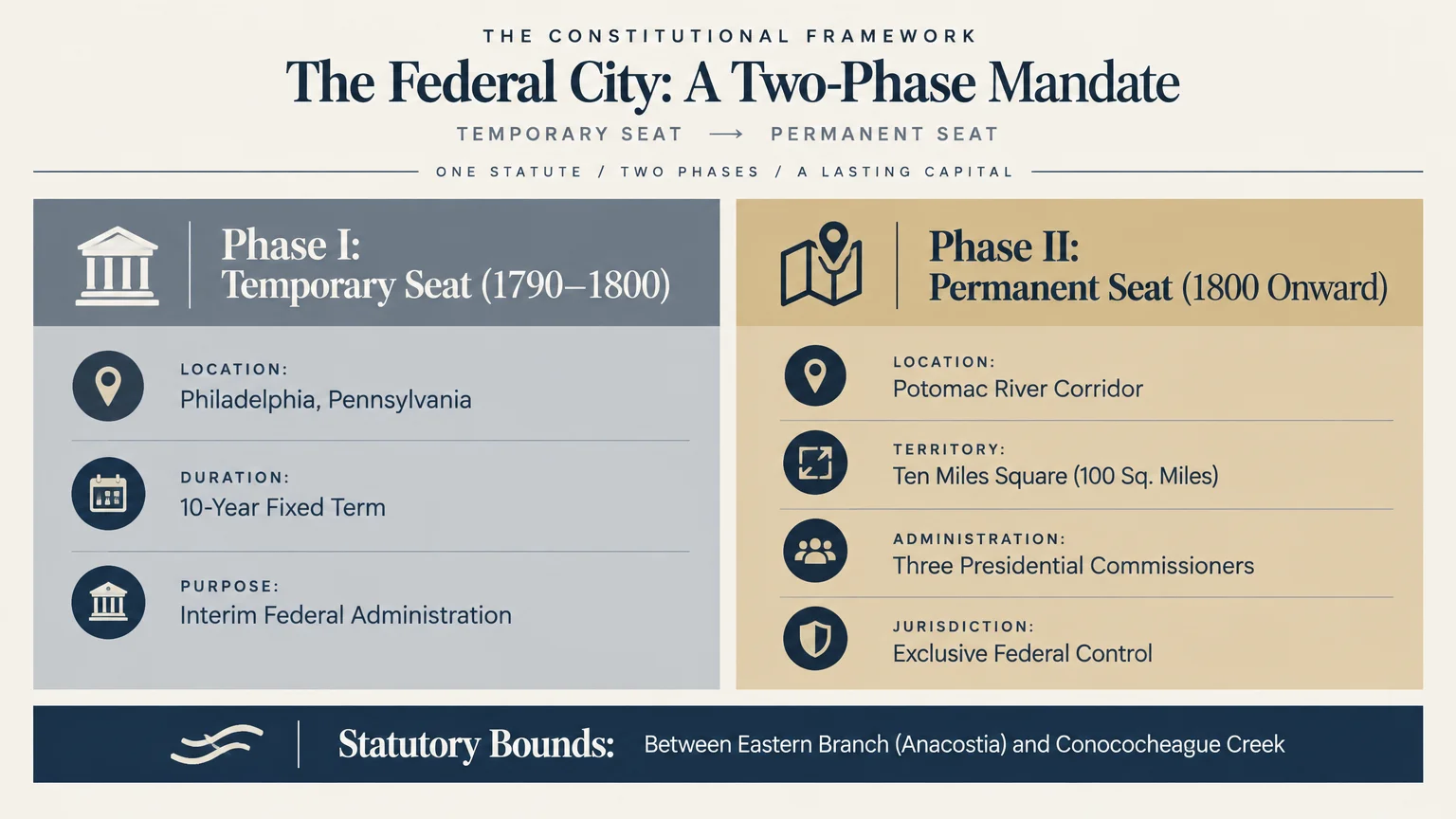
Section 1 of the Residence Act restricted the capital district to a tract of land not exceeding ten miles square. This statutory limit created a maximum territorial footprint of 100 square miles.
The statute mandated that surveyors locate the district along the Potomac River. Specifically, Congress ordered the site placed between the mouths of the Eastern Branch and the Conococheague Creek.
The Eastern Branch is known today as the Anacostia River. The Conococheague Creek enters the Potomac roughly 70 miles upstream near Williamsport, Maryland.
This wide statutory window gave the executive branch room to maneuver while keeping the capital firmly within the upper South. Southern leaders demanded this placement to secure federal proximity to agrarian economies.
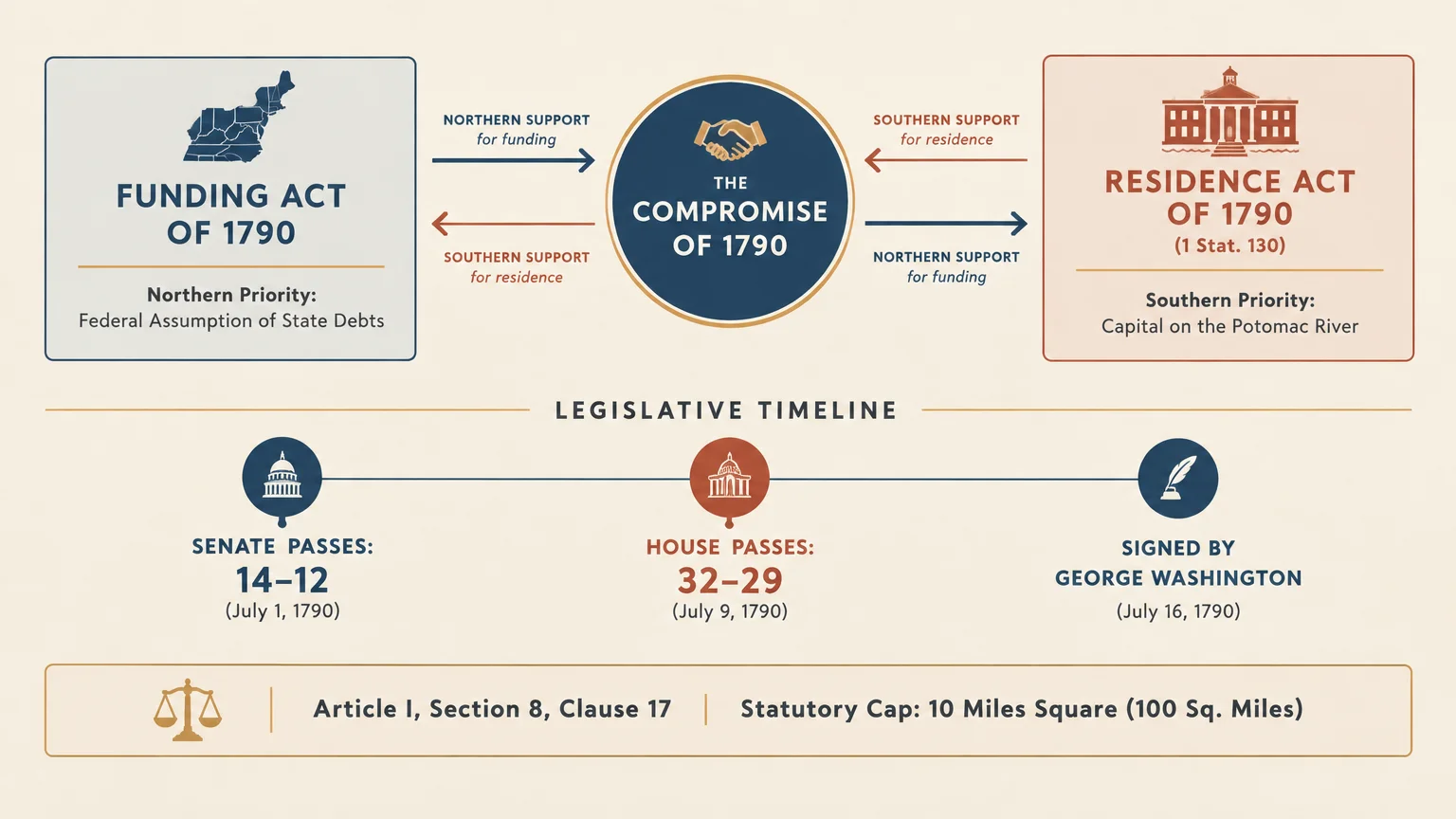
The legislative deal succeeded only because Alexander Hamilton, Thomas Jefferson, and James Madison brokered the Compromise of 1790. Hamilton wanted federal assumption of state Revolutionary War debts through his Funding Act of 1790.
Southern delegates had already paid off much of their wartime debt and initially resisted Hamilton’s plan. In exchange for Southern votes supporting debt assumption, Northern delegates agreed to place the permanent capital on the Potomac.
The legislative tallies reflected sharp sectional divides. The Senate passed the Residence Act by a narrow 14–12 vote on July 1, 1790.
The House of Representatives followed on July 9, 1790, approving the bill by a 32–29 margin. President George Washington signed 1 Stat.
130 into law one week later on July 16, 1790.
Presidential Authority for Exact Site Selection and Boundary Expansion
While Congress defined the broad geographic window along the Potomac, Section 1 granted President Washington sole authority to select the exact location. This executive discretion allowed Washington to evaluate navigation points and topography.
On January 24, 1791, President Washington issued a presidential proclamation announcing his selected site. He chose the southernmost portion of the permitted zone, positioning the district at the confluence of the Potomac and the Eastern Branch.
This choice created an immediate legal obstacle. Washington wanted the federal district to incorporate the thriving port town of Alexandria, Virginia, located just south of the Eastern Branch.
Because Alexandria fell outside the statutory boundary line established in July 1790, the President lacked legal authority to include it. Washington asked Congress to amend the statute to expand the district’s permissible southern reach.
Congress responded swiftly to the President’s request. Lawmakers enacted an amendatory statute on March 3, 1791, codified at 1 Stat.
214.
The amendment permitted the President to include territory below the Eastern Branch and encompass Alexandria within the ten-mile square. You can review the legislative pathway in the House historical records on the Residence Act.
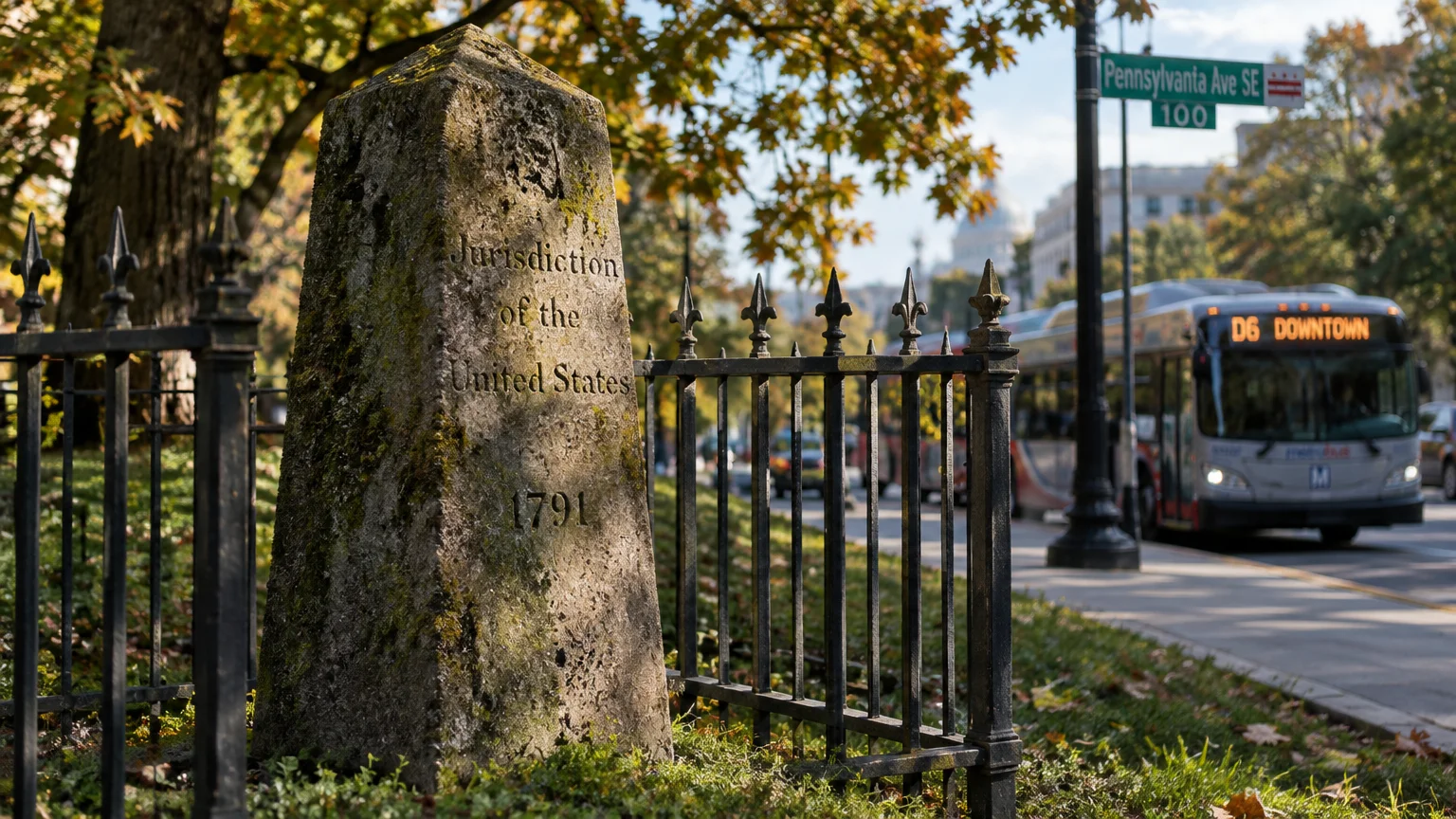
With legal authority secured, Washington dispatched surveyor Andrew Ellicott and astronomer Benjamin Banneker to survey the 100-square-mile perimeter. The survey team placed forty sandstone boundary markers around the diagonal square bordering Maryland and Virginia.
The final boundary encompassed roughly 69 square miles ceded by Maryland and 31 square miles ceded by Virginia. This presidential action finalized the capital’s geographic footprint for the next five decades.
Executive Governance Through a Three-Commissioner Board
Section 2 of the Residence Act established the administrative governance model for the new federal territory. The statute authorized the President to appoint three commissioners to manage local operations.
Congress empowered these commissioners to survey the district, define city boundaries, and oversee construction of federal facilities. The statute required a quorum of at least two commissioners to take official action.
President Washington appointed three trusted allies: former Maryland governor Thomas Johnson, Maryland congressman Daniel Carroll, and Virginia physician David Stuart. You can inspect their original administrative proceedings in the National Archives Records of the District of Columbia.
The commissioners held sweeping executive powers over the undeveloped tract. On September 9, 1791, the board officially named the federal district the “Territory of Columbia” and the municipal jurisdiction the “City of Washington.”
The board also managed complex real estate agreements with local landowners. The commissioners convinced nineteen primary proprietors to convey half their buildable land to the government to support municipal development.
This governance model placed the commissioners in frequent conflict with urban designer Pierre Charles L’Enfant. L’Enfant envisioned grand boulevards and public plazas, but he repeatedly refused to submit his designs to the board’s fiscal oversight.
When L’Enfant demolished a private manor built inside a projected street corridor without commissioner approval, Washington backed his administrative board. Washington dismissed L’Enfant in early 1792, establishing the primacy of statutory civil administration over artistic vision.
This board ran the territory until Congress passed the District of Columbia Organic Act of 1801. That subsequent statute replaced the original commissioners with direct congressional oversight and a federally appointed municipal mayor.
Public Building Mandates Restricted to the Maryland Shoreline
Section 3 of the Residence Act directed the commissioners to provide suitable buildings for Congress, the President, and federal departments. However, the statute placed an explicit geographic constraint on where those structures could sit.
Congress required the commissioners to erect all public buildings strictly on the eastern side of the Potomac River. This mandate meant the modern Capitol and White House could only rise within Maryland’s ceded territory.
When Congress amended the Residence Act on March 3, 1791, lawmakers reinforced this restriction. The amendment explicitly prohibited the erection of public buildings on the newly incorporated Virginia side of the river.
Lawmakers inserted this restriction to prevent real estate speculation from favoring Virginia landowners. It also assured Maryland delegates that their state’s territorial sacrifice would yield the capital’s core economic engine.
This statutory restriction had profound long-term consequences for the Virginia portion of the district. The towns of Alexandria and modern Arlington County received no federal office construction or direct government employment.
Virginia residents inside the district faced economic stagnation while enduring federal taxation without congressional voting representation. Local merchants also worried that Northern members of Congress would eventually abolish Alexandria’s lucrative slave market.
These compounding economic and political grievances culminated in a petition for retrocession. In 1846, Congress enacted 9 Stat.
35, returning Virginia’s 31-square-mile parcel back to the Commonwealth of Virginia.
The 1846 retrocession shrank the nation’s capital from its original 100-square-mile square to its modern boundary of roughly 68 square miles. The statutory preference for the Maryland shore directly triggered this territorial reduction.
Prohibition of Federal Tax Funding for Capital Construction
Modern infrastructure projects rely on direct congressional appropriations, but Section 4 of the Residence Act prohibited that practice. Congress refused to allocate any federal tax dollars to buy land or build government offices.
Instead, the statute authorized the President solely to accept grants of money to finance the national capital. The entire enterprise depended on state contributions and speculative real estate sales.
Individual states stepped forward to fund the project. The General Assembly of Virginia contributed a cash grant of $120,000, while the Maryland legislature provided $72,000.
To generate additional capital, the three commissioners divided government-owned land into thousands of private residential lots. They attempted to sell these parcels at public auctions in 1791, 1792, and 1793.
Public auction revenues fell far short of construction estimates. In December 1793, the commissioners signed a massive syndicate contract with private speculators James Greenleaf, Robert Morris, and John Nicholson.
The syndicate agreed to purchase 6,000 public lots at a discounted rate, promising to build dozens of brick homes each year. However, the speculators overextended their investments and defaulted on their payments, ultimately landing in debtors’ prison.
This speculative collapse pushed capital construction to the brink of financial insolvency. With buildings unfinished and the 1800 moving deadline approaching, the commissioners turned back to Maryland for emergency loans.
Maryland granted additional loans totaling $200,000 in United States stock between 1796 and 1799. Without state grants and private land financing, federal construction would have collapsed before the government relocated.
Decade-Long Pennsylvania Interim and State Law Continuity
Section 5 of the Residence Act addressed the immediate challenge of where the federal government would convene during construction. Lawmakers established Philadelphia, Pennsylvania, as the nation’s temporary capital for a strict ten-year period.
The statute mandated that the federal government move from New York City to Philadelphia before the first Monday in December 1790. Congress met at Philadelphia’s Congress Hall throughout the 1790s.
Section 5 required the executive branch to coordinate the final relocation to the Potomac by the first Monday in December 1800. This fixed statutory sunset gave the commissioners exactly ten years to survey, plan, and build the capital city.
During this decade-long transition, Congress faced a jurisdictional vacuum. The Constitution granted Congress exclusive authority over the future district, but Congress had not yet enacted a federal municipal legal code.
Section 1 solved this jurisdictional problem through a continuity clause. The statute directed that the laws of Maryland and Virginia would continue to operate within their respective ceded portions until the federal relocation occurred.
Under this statutory rule, citizens living in Georgetown remained subject to Maryland statutory law and state courts. Citizens living in Alexandria remained governed by Virginia law and Virginia judges.
This dual legal system persisted until Congress officially convened in the permanent capital on December 1, 1800. On February 27, 1801, Congress enacted the District of Columbia Organic Act (2 Stat.
103).
The 1801 Organic Act formally assumed exclusive federal jurisdiction over the territory, dividing it into Washington County and Alexandria County. At that exact moment, residents lost their voting representation in Maryland, Virginia, and the United States Congress.
Comparing the 1790 Residence Act Operational Framework
The statutory mechanisms of the Residence Act balanced immediate political trade-offs against permanent administrative structures. The following table summarizes how each primary rule functioned and influenced modern capital governance.
| Operational Rule | Statutory Citation | Primary Mandate | Long-Term Impact |
|---|---|---|---|
| Boundary Limits | Section 1 (1 Stat. 130) | Capped district at 100 square miles on the Potomac River. | Fixed capital location between Northern and Southern states. |
| Site Selection | Section 1 & 1 Stat. 214 | Empowered President to select site and expand south. | Incorporated Alexandria, Virginia, into the federal square. |
| Commission Board | Section 2 (1 Stat. 130) | Created three-member presidential board to run city. | Established administrative precedent over design and planning. |
| Eastern Shoreline | Section 3 (1 Stat. 130) | Confined federal public buildings to Maryland side. | Prompted Alexandria economic slump and 1846 retrocession. |
| Zero Appropriations | Section 4 (1 Stat. 130) | Funded project through state grants and land sales. | Triggered private real estate speculation and cash shortfalls. |
| Interim Governance | Sections 1 & 5 (1 Stat. 130) | Made Philadelphia capital until Dec 1800 under state laws. | Preserved legal order until 1801 Organic Act took effect. |
How the 1790 Framework Affects Modern Capital Governance
The operational rules established in 1790 continue to shape the political realities you see in Washington, D.C. today. The fundamental principle of federal exclusivity created an ongoing constitutional tension between congressional oversight and municipal self-government.
When the 1846 retrocession returned Virginia’s 31 square miles, it dismantled the original diamond perimeter designed by Washington and Ellicott. That transfer left the capital with its current 68.3-square-mile footprint, entirely composed of former Maryland territory.
Constitutional debates over that territorial change resurface regularly in Congress. In 2026, Representative Richard McCormick introduced the Make DC Square Again Act, arguing that the 1846 retrocession violated Article I, Section 8, Clause 17.
McCormick’s bill contended that the Residence Act and the Constitution prohibited returning ceded territory without a constitutional amendment. While the measure faced steep legislative resistance, it illustrated how the 1790 statutory foundation remains active in contemporary policy debates.
For more than a century after the 1801 Organic Act, local district residents had no vote for President or Congress. Reformers slowly expanded local political rights during the twentieth century.
The 23rd Amendment to the United States Constitution, ratified in 1961, granted district residents three electoral votes in presidential elections. In 1970, Congress enacted legislation providing the district with a single, non-voting delegate in the House of Representatives.
The most substantial change to local governance occurred with the passage of the District of Columbia Home Rule Act of 1973. Codified as Public Law 93-198, this statute established an elected mayor and a 13-member Council of the District of Columbia.
However, the Home Rule Act preserves the ultimate supremacy established under the 1790 framework. Congress retains the constitutional authority to review, amend, or veto any legislation enacted by the local district government.
Under Section 602 of the Home Rule Act, all local bills face a mandatory congressional review period before taking effect. Congress can pass a joint resolution of disapproval to block local enactments.
Furthermore, Congress exercises control over the city’s municipal budget through the annual federal appropriations process. This fiscal review directly reflects the congressional supremacy first outlined in the Residence Act.
When you evaluate modern debates over D.C. statehood or voting rights, you are examining the direct descendants of the 1790 statutory compromise. The operational rules written by the First Congress established a system where national authority permanently supersedes local sovereignty.
Frequently Asked Questions About the Residence Act of 1790
Why did Alexander Hamilton and Thomas Jefferson strike a deal over the capital location?
Hamilton needed Southern votes in Congress to pass his debt assumption plan, which consolidated state Revolutionary War debts under the federal government. Jefferson and Madison agreed to deliver Southern votes in exchange for placing the permanent capital on the Potomac River.
This compromise resolved a legislative deadlock that threatened to dissolve the First Congress. Both sides achieved their primary goals through the simultaneous passage of the Funding Act of 1790 and the Residence Act of 1790.
Why is Washington, D.C. not a state today?
The framers designed the capital to operate outside any state to prevent any single state government from exercising undue influence over federal operations. They remembered the 1783 Pennsylvania Mutiny, when angry soldiers surrounded Congress and state authorities refused to intervene.
Article I, Section 8, Clause 17 of the Constitution empowered Congress to govern the capital district directly. Altering this structure requires either a constitutional amendment or federal legislation that reduces the federal enclave while admitting the remaining residential areas as a new state.
Why did Virginia take back its portion of the original federal district?
Congress passed the Retrocession Act of 1846 to return roughly 31 square miles to Virginia after local residents petitioned to leave the district. The Residence Act had banned federal public buildings on the Virginia side, leaving Alexandria and Arlington economically neglected.
Alexandria merchants also feared that growing abolitionist sentiment in Congress would shut down their local slave-trading businesses. Returning the land to Virginia restored the citizens’ state voting rights and protected their local commerce under Virginia law.
Can Congress still overturn local laws passed in Washington, D.C.?
Yes, Congress retains ultimate legislative authority over Washington, D.C. under the Constitution’s Enclave Clause and the Home Rule Act of 1973. Every council-passed bill must undergo a mandatory congressional review period of 30 or 60 legislative days before becoming law.
If Congress passes a joint resolution of disapproval and the President signs it, the local law is nullified. Congress can also attach legislative riders to federal appropriations bills that block the district from spending local tax dollars on specific policies.



