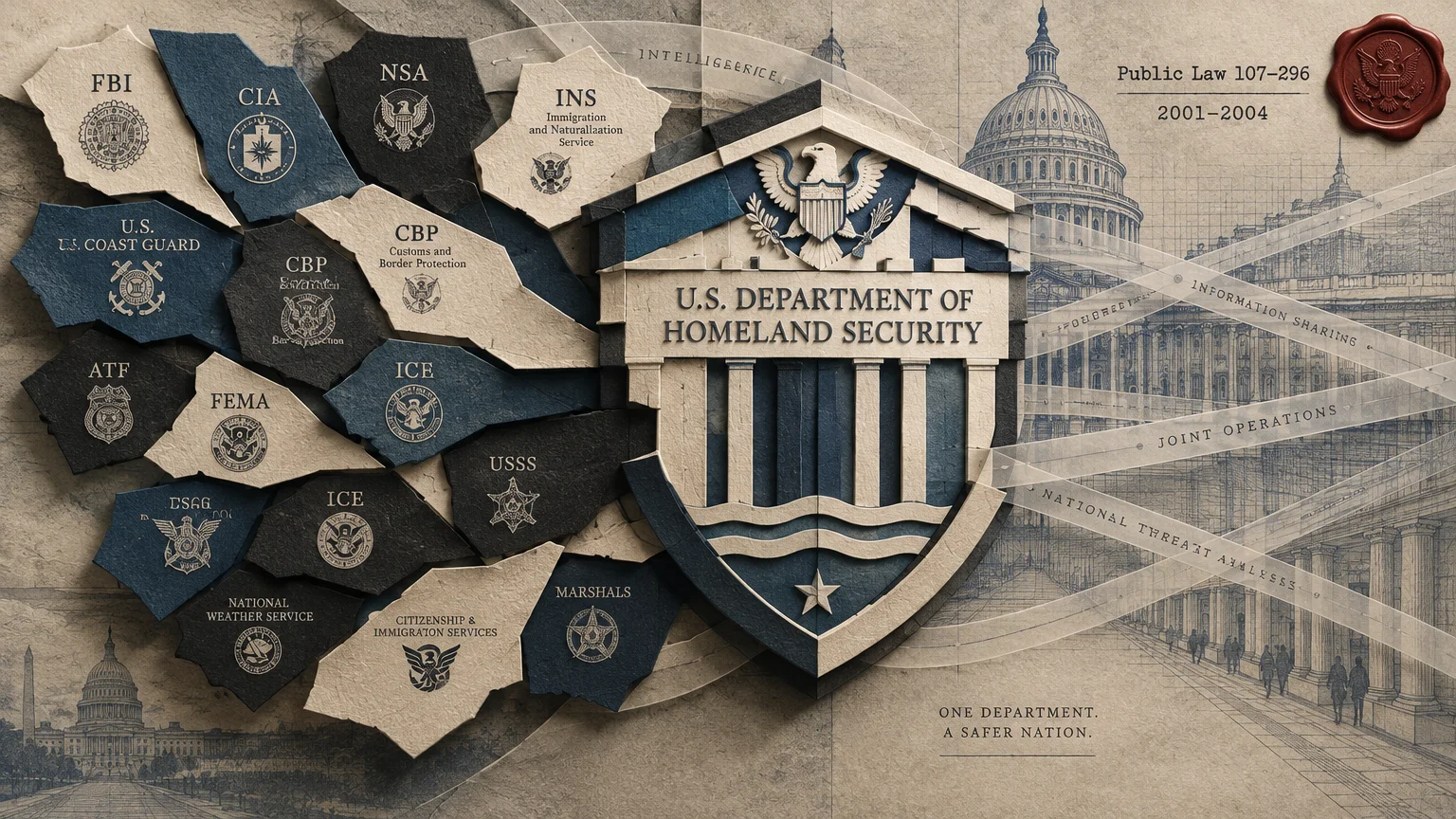
You navigate an American national security architecture fundamentally shaped by the legislative reaction to September 11, 2001. Between 2001 and 2004, Congress enacted sweeping statutory mandates that dismantled century-old agency structures and centralized counterterrorism authority.
These historic statutes merged 22 disparate agencies into a single Cabinet department and restructured the intelligence community under a single presidential adviser. You can trace modern domestic surveillance rules, federalized airport checkpoints, and interagency intelligence coordination directly to these laws.
This guide examines the ten decisive structural reforms authorized by Congress in this pivotal four-year era. Understanding these statutory shifts enables you to assess how the federal government balances domestic defense, interagency coordination, and constitutional liberties today.

Parameters of the Post-9/11 National Security Reorganization
Between October 2001 and December 2004, Congress passed four landmark statutes that reorganized the executive branch. You can evaluate modern federal authority by understanding how lawmakers responded to the systemic failures identified after September 11.
This analysis focuses exclusively on permanent structural reorganizations rather than temporary emergency declarations. We evaluate institutional changes that abolished legacy agencies, created Cabinet departments, reallocated statutory oversight, or altered procedural barriers between foreign and domestic investigations.
Our editorial team reviewed the legislative record across four core statutes enacted during the 107th and 108th Congresses. You will find verified vote counts, public law citations, and statutory sections from primary government records.
These primary sources include congressional roll calls, Government Accountability Office transition audits, and the final findings of the 9/11 Commission. Each entry highlights how Congress modified administrative authority to prevent future intelligence silos.
You should note that our review reflects the federal architecture as of September 11, 2025. We track both the durable structural agencies operating today and the controversial emergency authorities that Congress subsequently modified or allowed to expire.
Understanding these statutory baselines helps you navigate the complex jurisdictional boundaries dividing modern national security agencies. The following ten entries represent the most consequential institutional shifts authorized by federal law.
Creation of the Department of Homeland Security
On November 25, 2002, President George W. Bush signed the Homeland Security Act of 2002 into law as Public Law 107–296.
The House passed the legislation 295–132, and the Senate followed with a 90–9 vote.
The statute initiated the largest federal operational reorganization since the National Security Act of 1947. When the department formally opened on March 1, 2003, it consolidated 22 separate federal agencies and offices under a single Cabinet-level secretary.
You encounter this consolidated framework today in the third-largest Cabinet agency, which employs more than 240,000 personnel. Congress designed this massive structure to unify national border protection, disaster response, transportation oversight, and critical infrastructure security.
Before this merger, uncoordinated federal programs handled parallel threats without a centralized reporting chain. As documented by House historical records, lawmakers centralized domestic security to eliminate bureaucratic rivalries between competing departments.
- Consolidated 22 distinct federal agencies under a single Cabinet secretary on March 1, 2003.
- Established statutory directorates for border security, emergency preparedness, and critical infrastructure analysis.
- Unified federal incident command systems for natural disasters and hostile domestic attacks.
When you interact with maritime patrols, airport security, or federal disaster declarations, you engage with this unified department. The restructuring permanently realigned domestic incident management under executive leadership.
Establishment of the Office of the Director of National Intelligence
On December 17, 2004, Congress enacted the Intelligence Reform and Terrorism Prevention Act (IRTPA), designated as Public Law 108–458. The legislation responded directly to recommendations issued by the National Commission on Terrorist Attacks Upon the United States.
Section 1011 of IRTPA created the Office of the Director of National Intelligence (ODNI) to manage the entire intelligence enterprise. Prior to this enactment, the Director of Central Intelligence simultaneously ran the CIA and loosely coordinated peer agencies.
IRTPA abolished that dual leadership arrangement and stripped the CIA director of community-wide authority. You now have a Senate-confirmed Director of National Intelligence serving as the principal intelligence adviser to the President and the National Security Council.
The Director of National Intelligence oversees the National Intelligence Program budget and integrates 18 community components. This supervisory scope expanded from 16 agencies in 2004 to 18 following the integration of the U.S. Space Force intelligence element.
- Abolished the historic dual role of Director of Central Intelligence.
- Consolidated budgetary oversight across the multi-agency National Intelligence Program.
- Established community-wide analytic integrity standards to prevent politicized intelligence assessments.
If you evaluate executive intelligence summaries today, the DNI oversees their daily synthesis. This structure ensures that no single intelligence agency monopolizes analytical briefings delivered to the Oval Office.
Dismantling of the Foreign Intelligence and Criminal Surveillance Firewall
On October 26, 2001, President Bush signed the USA PATRIOT Act, enacted as Public Law 107–56. The House approved the measure 357–66, while the Senate passed it 98–1 according to Senate roll-call records.
Section 218 altered a foundational principle of the Foreign Intelligence Surveillance Act of 1978. Lawmakers lowered the legal standard for foreign intelligence surveillance from “the purpose” to “a significant purpose” of an investigation.
This statutory shift dismantled what investigators colloquially called “the wall.” Previously, strict administrative rules and judicial interpretations blocked intelligence officers from sharing electronic intercepts and counterintelligence data with federal criminal prosecutors.
The 9/11 Commission Report documented how this division prevented FBI criminal investigators from tracking known hijackers inside the country before the attacks. Section 218 enabled joint analytical operations between counterterrorism squads and federal prosecutors.
- Amended FISA Section 104 to require foreign intelligence gathering as a significant rather than exclusive purpose.
- Authorized criminal prosecutors to advise intelligence personnel on targeting hostile foreign agents.
- Established statutory procedures for unmasking and disseminating intelligence intercepts to criminal investigators.
You should note a vital distinction between these coordination mandates and temporary surveillance tools. While Section 215 bulk metadata collection expired on March 15, 2020, Section 218 permanently restructured interagency coordination under FISA.
Creation of the Transportation Security Administration
Congress federalized commercial aviation security on November 19, 2001, by enacting the Aviation and Transportation Security Act (ATSA). Public Law 107–71 established the Transportation Security Administration (TSA) to govern civil aviation defense.
Prior to ATSA, individual commercial airlines contracted screening responsibilities to private security firms under Federal Aviation Administration guidelines. ATSA replaced this decentralized commercial model with a uniformed, federalized workforce subject to statutory law enforcement requirements.
A common misconception suggests that Congress created the TSA inside the Department of Homeland Security. In reality, lawmakers first housed the agency within the Department of Transportation before transferring it to DHS on March 1, 2003.
ATSA mandated 100 percent screening of checked luggage, reinforced commercial aircraft cockpit doors, and deployed federal air marshals across passenger flights. The statute placed direct federal control over passenger checkpoints across more than 400 commercial airports.
- Transferred airport passenger screening from private airline contractors to a federal civil service workforce.
- Mandated explosive detection screening for 100 percent of checked commercial baggage.
- Expanded the Federal Air Marshal Service into a permanent covert flight deployment program.
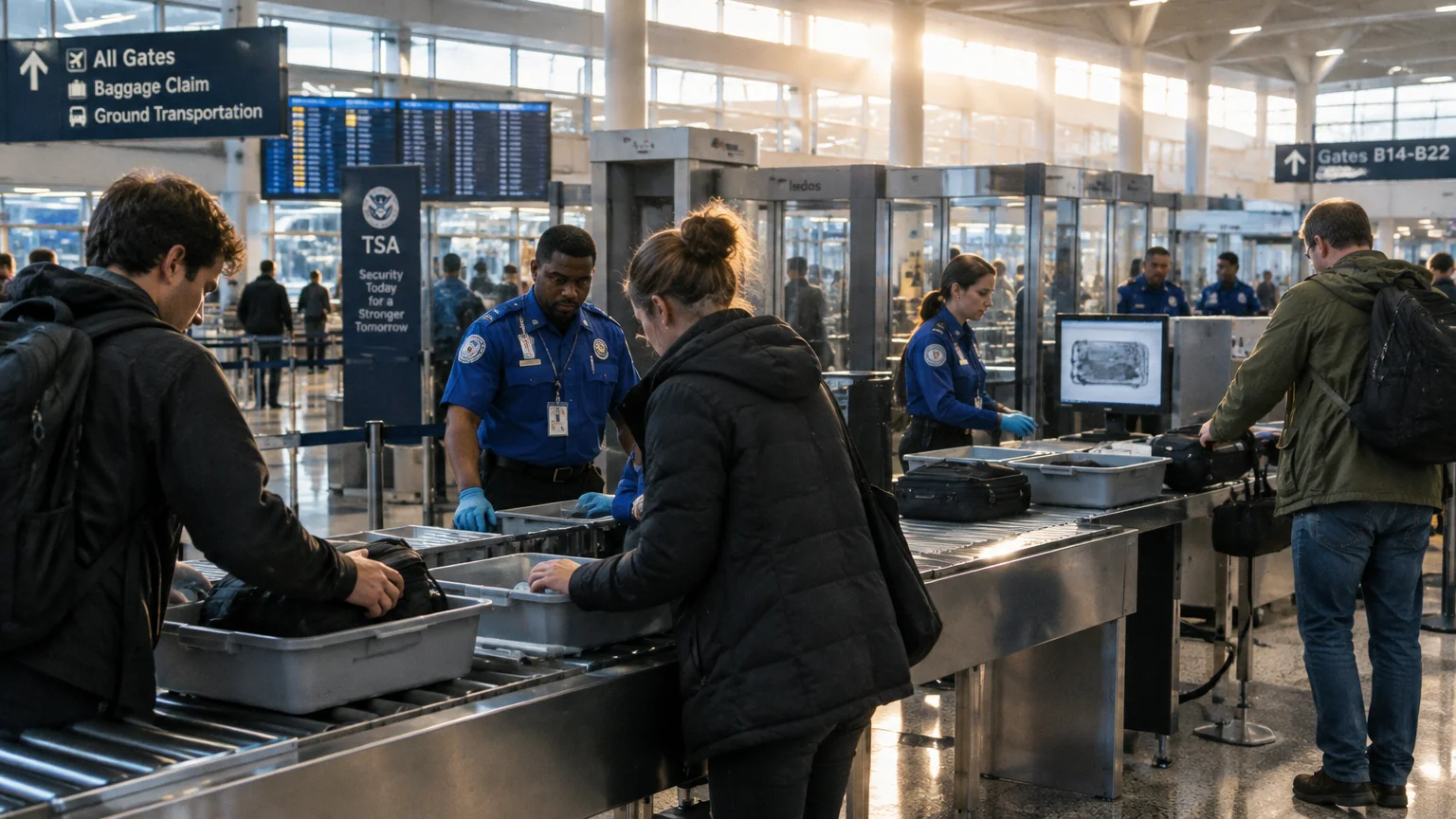
When you pass through airport screening today, you operate under federal administrative regulations established by ATSA. The law transformed airport security from a commercial vendor cost into an essential sovereign defense operation.
Dissolution of the INS and Tripartite Border Security Realignment
The Homeland Security Act of 2002 dissolved the Immigration and Naturalization Service (INS), which had operated within the Department of Justice since 1940. Section 471 of Public Law 107–296 formally abolished the legacy agency on March 1, 2003.
Congress also abolished the historic United States Customs Service, which had operated inside the Department of the Treasury since 1789. Lawmakers then combined and divided these personnel into three distinct agencies within DHS.
This reorganization established U.S. Customs and Border Protection (CBP) to manage border stations and ports of entry. It created U.S. Immigration and Customs Enforcement (ICE) to handle interior investigations and removals.
Lawmakers also established U.S. Citizenship and Immigration Services (USCIS) as an independent agency dedicated exclusively to processing benefit applications, visas, and naturalization petitions. This separation isolated administrative immigration benefits from armed enforcement operations.
- Abolished the INS and the U.S. Customs Service on March 1, 2003.
- Divided immigration functions into distinct border enforcement (CBP) and interior investigation (ICE) agencies.
- Created USCIS to prevent backlogs and isolate adjudications from armed border operations.
By separating these mandates, Congress aimed to resolve systemic management conflicts that historically plagued the INS. When you apply for immigration benefits or cross international borders, you navigate agencies forged by this tripartite split.
Formation of the National Counterterrorism Center
Section 1021 of the Intelligence Reform and Terrorism Prevention Act of 2004 established the National Counterterrorism Center (NCTC). The statute codified and expanded the interim Terrorist Threat Integration Center created by executive order in 2003.
Located under the administrative oversight of the ODNI, the NCTC functions as the primary organization for analyzing terrorism intelligence. Congress gave the center statutory authority to integrate foreign and domestic intelligence gathered across the federal government.
The NCTC maintains the federal government’s centralized database of known and suspected international terrorists. Analysts from the CIA, FBI, Department of Defense, and DHS work side-by-side inside the facility to synthesize intelligence streams.
Beyond intelligence analysis, the director of the NCTC conducts strategic operational planning for counterterrorism missions across federal agencies. However, the statute explicitly prohibits the NCTC from directly executing tactical field operations or domestic law enforcement arrests.
- Established a multi-agency fusion hub integrating foreign and domestic counterterrorism intelligence.
- Centralized the federal government’s consolidated terrorist identification database.
- Authorized interagency strategic planning while barring personnel from direct domestic arrests.
You see the practical impact of this reform in unified federal watchlist management and joint threat assessments. The structure prevents individual agencies from withholding terrorist profiles from community partners.
Statutory Elevation of the Financial Crimes Enforcement Network
Title III of the USA PATRIOT Act systematically restructured federal authorities targeting terrorist financing and money laundering. Section 361 formally established the Financial Crimes Enforcement Network (FinCEN) as a statutory bureau within the Department of the Treasury.
Treasury Secretary Nicholas Brady originally created FinCEN by administrative order in April 1990. Public Law 107–56 elevated the entity into permanent statutory law, expanding its regulatory authority across the American banking system.
The statute empowered FinCEN to enforce Bank Secrecy Act regulations, aggregate suspicious transaction data, and oversee anti-money laundering compliance. Congress mandated that domestic financial institutions implement rigorous customer identification and beneficial ownership verification procedures.
FinCEN connects financial industry disclosures with federal counterterrorism investigators and international tracking networks. Investigators use this financial intelligence to trace funding conduits used by foreign hostile actors and transnational criminal groups.
- Elevated FinCEN from an administrative office to an official statutory bureau within the Treasury Department.
- Mandated rigorous customer due diligence rules for domestic and international financial accounts.
- Integrated commercial banking Suspicious Activity Reports into federal counterterrorism investigations.
When your commercial bank requests corporate documentation or verifies wire transfers, it complies with anti-money laundering frameworks expanded by Title III. This statutory elevation turned commercial banks into front-line monitors against illicit financing.
Consolidation of the FBI National Security Branch
In response to IRTPA mandates and presidential directives, the Federal Bureau of Investigation restructured its internal operations in September 2005. The bureau consolidated its Counterterrorism Division, Counterintelligence Division, and Directorate of Intelligence into the unified National Security Branch (NSB).
In July 2006, the FBI further integrated its newly formed Weapons of Mass Destruction Directorate into this unified operational branch. This structural overhaul dismantled internal walls that traditionally prioritized criminal casework over intelligence analysis.
The restructuring established a specialized intelligence cadre of professional analysts operating alongside traditional special agents. This reform implemented core 9/11 Commission recommendations directing domestic law enforcement to operate as an intelligence-driven security agency.
The Executive Assistant Director of the NSB reports directly to the FBI Director while coordinating operational priorities with the DNI. This dual accountability integrates domestic investigative operations into national intelligence collection priorities.
- Unified counterterrorism, counterintelligence, and weapons of mass destruction directorates under single leadership.
- Created a formal intelligence career track within the bureau to elevate strategic analysis.
- Integrated FBI operational task forces directly into the broader intelligence community architecture.
You benefit from this reform through enhanced federal coordination with state and local Joint Terrorism Task Forces. The reorganization transformed how domestic law enforcement uncovers threats before criminal acts take place.
Relocation and Division of Historical Treasury and Transportation Agencies
The Homeland Security Act moved several storied federal agencies outside their historic parent departments to unify domestic response systems. Section 821 transferred the United States Secret Service from the Department of the Treasury to DHS.
The Secret Service had operated inside the Treasury Department since its creation in 1865, originally combating post-Civil War counterfeiting. The 2002 law reassigned its dual missions of presidential protection and financial infrastructure security under the homeland security umbrella.
Congress simultaneously transferred the United States Coast Guard from the Department of Transportation to DHS under Section 888. The Coast Guard preserved its status as an armed military branch while executing maritime border and port security mandates.
The same legislation moved the Bureau of Alcohol, Tobacco, and Firearms (ATF) from Treasury to the Department of Justice. Congress split the agency, creating the Alcohol and Tobacco Tax and Trade Bureau (TTB) within Treasury to retain revenue duties.
- Transferred the U.S. Secret Service to DHS after 137 years within the Treasury Department.
- Reassigned the U.S. Coast Guard from Transportation to DHS while protecting its military service status.
- Moved ATF law enforcement to the Justice Department while retaining tax collection functions inside Treasury.
These transfers realigned legacy law enforcement agencies around post-9/11 functional priorities rather than historical revenue collection. You now observe these agencies coordinating directly through unified executive security protocols.
Establishment of the Privacy and Civil Liberties Oversight Board
Section 1061 of IRTPA created the Privacy and Civil Liberties Oversight Board (PCLOB) to evaluate executive counterterrorism programs. Congress established the panel to balance aggressive surveillance expansion with statutory constitutional safeguards.
The 9/11 Commission recommended creating an independent board to reassure the public that executive agencies would not abuse enhanced counterterrorism powers. The initial statute placed the board within the Executive Office of the President.
In 2007, Congress enacted the Implementing Recommendations of the 9/11 Commission Act, Public Law 110–53, converting PCLOB into a fully independent executive agency. The five-member bipartisan board requires presidential appointment and Senate confirmation.
The PCLOB conducts detailed statutory reviews of foreign intelligence collection, executive wiretapping, and data-sharing operations. Its unclassified analytical reports inform congressional oversight committees on the civil liberty impacts of federal surveillance.
- Created a statutory watchdog to review counterterrorism policies against constitutional privacy protections.
- Structured the panel with bipartisan membership requiring presidential nomination and Senate confirmation.
- Empowered the board to access classified agency records and issue public transparency assessments.
If you scrutinize how the executive branch conducts national security programs, PCLOB functions as an institutional watchdog. Its oversight ensures ongoing public transparency across traditionally classified national security initiatives.
| Structural Reform | Authorizing Statute | Enactment Date | Legacy Department | Current Operational Status |
|---|---|---|---|---|
| Department of Homeland Security | Homeland Security Act (Pub. L. 107–296) | Nov 25, 2002 | 22 Disparate Agencies | Active (240,000+ staff) |
| Director of National Intelligence | IRTPA of 2004 (Pub. L. 108–458) | Dec 17, 2004 | DCI / CIA Leadership | Active (18 IC agencies) |
| FISA Firewall Removal | USA PATRIOT Act (Pub. L. 107–56) | Oct 26, 2001 | FISA Administrative Wall | Permanent Statutory Law |
| Transportation Security Admin | ATSA of 2001 (Pub. L. 107–71) | Nov 19, 2001 | DOT / Private Contractors | Active under DHS |
| CBP, ICE, USCIS Creation | Homeland Security Act (Pub. L. 107–296) | Nov 25, 2002 | INS (DOJ) & Customs (Treasury) | Active under DHS |
| National Counterterrorism Center | IRTPA of 2004 (Pub. L. 108–458) | Dec 17, 2004 | TTIC (Executive Order) | Active under ODNI |
| FinCEN Statutory Elevation | USA PATRIOT Act (Pub. L. 107–56) | Oct 26, 2001 | Treasury Admin Office | Active Treasury Bureau |
| FBI National Security Branch | IRTPA Directives / Executive Action | Sept 12, 2005 | Divided FBI Divisions | Active FBI Branch |
| Secret Service & Coast Guard Move | Homeland Security Act (Pub. L. 107–296) | Nov 25, 2002 | Treasury & Transportation | Active under DHS |
| PCLOB Oversight Board | IRTPA of 2004 (Pub. L. 108–458) | Dec 17, 2004 | None (New Statutory Board) | Active Independent Agency |
How Post-9/11 Reorganizations Reshaped Federal Power and Everyday Oversight
Post-9/11 structural reforms systematically replaced decentralized bureaucratic operations with centralized analytical and operational hierarchies. Congress dismantled long-standing statutory barriers to facilitate real-time intelligence sharing between foreign spies and domestic criminal prosecutors.
This legislative pattern concentrated executive authority across the Department of Homeland Security and the Office of the Director of National Intelligence. These two apex institutions now govern operational decisions that previously belonged to dozens of independent agencies.
The statutory changes also reshaped federal procurement, information architecture, and personnel management across civilian and military sectors. Agencies that previously operated under distinct statutory mandates now align their operational strategies around integrated threat lists.
The reorganization expanded federal statutory authority into commercial markets and routine daily travel. You witness this reach at airport checkpoints, international border terminals, and during routine banking transactions subject to financial surveillance.
Congress enacted these changes to address the failure of intelligence agencies to connect analytical clues before September 11. However, centralizing this power raised complex legal questions regarding government surveillance and constitutional privacy protections.
While lawmakers unified intelligence operations, they also established institutional checks like the Privacy and Civil Liberties Oversight Board. These balances ensure ongoing legislative and public review of programs operating under executive secrecy.
You must recognize that Congress permanently altered the structure of the federal administrative state. The post-9/11 framework remains the operational foundation for American counterterrorism, border security, and national defense.
Frequently Asked Questions About Post-9/11 Structural Reforms
Did the USA PATRIOT Act create the Department of Homeland Security?
No, the USA PATRIOT Act did not create DHS. Congress passed the USA PATRIOT Act in October 2001 to expand surveillance and counterterrorism authorities.
Congress created the Department of Homeland Security thirteen months later under the Homeland Security Act of November 2002. DHS officially opened its doors as a consolidated Cabinet department on March 1, 2003.
Why did Congress strip the CIA Director of Intelligence Community leadership?
Before 2004, the Director of Central Intelligence led both the CIA and the broader intelligence community. The 9/11 Commission found that this dual role caused institutional conflicts of interest and neglected interagency coordination.
By enacting IRTPA, Congress established the Director of National Intelligence to oversee all 18 intelligence agencies without running any single organization. This structural separation ensured objective analytical synthesis across the entire intelligence community.
Is the entire USA PATRIOT Act still in effect today?
Most structural reforms, such as FinCEN’s bureau status and information-sharing rules, remain permanent law. However, several controversial surveillance provisions have expired or changed under subsequent statutes.
Congress replaced bulk telephone metadata collection under Section 215 via the USA FREEDOM Act in 2015. Furthermore, Section 215 authority officially lapsed on March 15, 2020, after Congress declined to reauthorize it.
How did post-9/11 legislation change the FBI’s core mission?
Historically, the FBI operated primarily as a reactive federal law enforcement agency focused on solving crimes after they occurred. Post-9/11 reforms mandated that the bureau transform into an intelligence-driven agency focused on threat prevention.
By establishing the National Security Branch in 2005, the FBI combined counterterrorism, counterintelligence, and analysis under unified management. This structure ensures field offices share investigative intelligence directly with the broader intelligence community.



