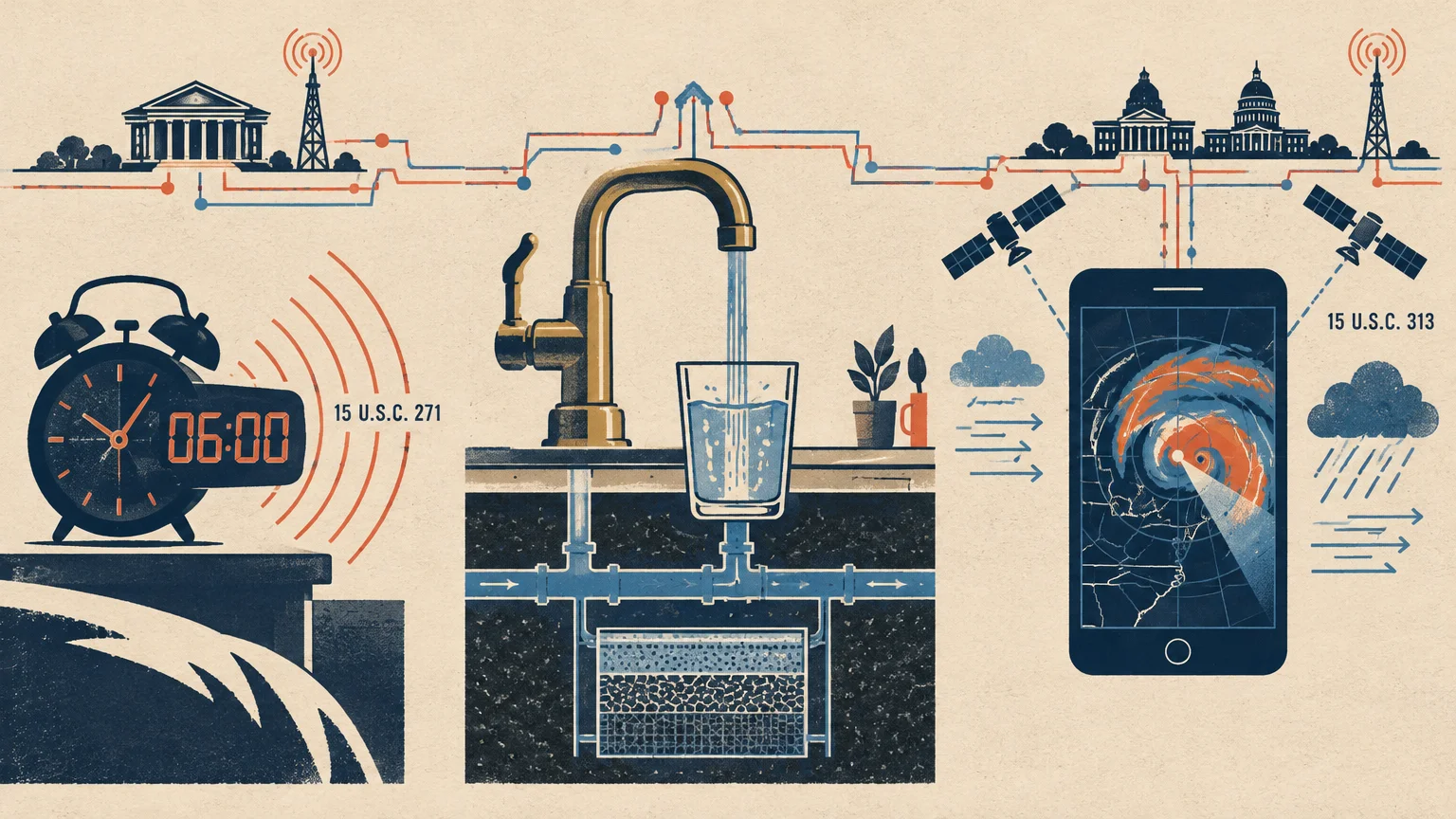
Every time your smartphone updates its lock-screen clock, your kitchen tap runs clean water, or you check tomorrow’s local weather forecast, you use federal administrative services. These routine daily transactions connect your household directly to public administration.
Most citizens think of the federal government only during tax season or presidential elections. In reality, statutory oversight quietly governs your morning grocery run, your daily commute, and your bank deposits.
Understanding these public agencies reveals how federal statutes protect your money, secure your food, and stabilize your physical infrastructure every single week.

How Statutory Mandates Shape Your Daily Routine
Federal administrative authority rarely appears as an abstract bureaucracy in your everyday life. Instead, federal agencies operate behind the scenes through specific statutory mandates passed by Congress and signed into law.
To identify the ten entities featured here, our editorial team evaluated three clear criteria based on the public record. We examined daily consumer touchpoints, direct statutory responsibilities under the United States Code, and uncredited private-sector data integrations.
Each selected agency operates a public service that you likely encounter every single week without direct awareness. These interactions occur when you purchase groceries, turn on your kitchen tap, check a smartphone app, or deposit a paycheck.
The following profiles detail the legislative origin of each agency, its governing statutes, and the concrete mechanisms that safeguard your household. You will also discover actionable methods to track public data and utilize these taxpayer-funded resources directly.
National Institute of Standards and Technology
Congress founded the agency as the National Bureau of Standards on March 3, 1901, through Chapter 872 of the 56th Congress (31 Stat. 1449).
Lawmakers enacted the measure to replace conflicting state-level measurement systems with standardized physical metrics.
Today, NIST operates the Internet Time Service from its physical laboratories in Boulder, Colorado. Operating since 1993, this digital network synchronizes consumer electronics and municipal servers against coordinated atomic time standards.
The agency’s atomic-clock servers process roughly 1 million timing requests per second, totaling about 80 billion synchronization requests daily. Your smartphone, home router, laptop, and smart thermostat ping these federal servers automatically throughout the week.
You can verify your local clock accuracy by checking NIST’s public web application at time.gov. This synchronization keeps your financial stock trades, two-factor authentication tokens, and calendar alarms operating without digital time drift.
- Statutory Authority: 15 U.S.C. 271 et seq.
- Daily Service: Automated device clock synchronization via atomic-scale time servers.
- Actionable Step: Calibrate your household electronics against the official federal clock feed at time.gov.
National Weather Service
President Ulysses S. Grant signed a joint congressional resolution establishing a federal weather service on February 9, 1870 (16 Stat.
369). Congress later codified civilian meteorological responsibilities under the Organic Act of October 1, 1890 (26 Stat.
653).
Now operating within the National Oceanic and Atmospheric Administration under 15 U.S.C. 313, the agency manages 122 Weather Forecast Offices nationwide.
Regional field meteorologists gather 6.3 billion physical atmospheric observations each day to build predictive models.
The service issues approximately 1.5 million forecasts and 50,000 hazardous weather warnings each year into the public domain. Commercial smartphone applications and broadcast stations package this taxpayer-funded data for free without building independent satellite constellations.
You can bypass ad-supported weather platforms by entering your postal code directly at weather.gov. This open portal delivers unedited radar scans, marine forecasts, and severe thunderstorm alerts straight from local public forecasters.
- Statutory Authority: 15 U.S.C. 313.
- Daily Service: Public atmospheric modeling and severe weather alert broadcasts.
- Actionable Step: Access localized, ad-free radar alerts and emergency warnings directly through weather.gov.
Federal Deposit Insurance Corporation
Congress passed the Banking Act of 1933 on June 16, 1933, creating the FDIC under 12 U.S.C. 1811 to end widespread panic.
The House approved the conference report by voice vote following the collapse of thousands of commercial banks.
The agency automatically insures consumer deposits up to $250,000 per depositor, per insured institution, for each qualifying ownership category. This statutory protection covers over $9.7 trillion in balances across the commercial banking system.
Since federal deposit coverage began on January 1, 1934, no depositor has lost a single penny of insured money. Every time you deposit a paycheck or maintain a checking balance, federal backing secures your capital.
You can verify your bank’s insurance standing and evaluate multi-account family limits using the FDIC’s online EDIE tool. Structuring accounts between individual, joint, and retirement categories allows you to preserve complete statutory protection.
- Statutory Authority: 12 U.S.C. 1811 et seq.
- Daily Service: Solvency guarantees for household checking, savings, and certificate accounts.
- Actionable Step: Check your financial institution’s charter and calculate coverage using the FDIC BankFind portal.
Food and Drug Administration
President Theodore Roosevelt signed the Pure Food and Drugs Act on June 30, 1906 (34 Stat. 768) after nationwide food processing scandals.
Congress modernized this authority by enacting the Federal Food, Drug, and Cosmetic Act of 1938 (52 Stat. 1040).
Codified under 21 U.S.C. 301, the agency regulates roughly 80% of the American food supply, encompassing dairy, bottled water, snacks, and produce.
It also oversees over-the-counter pain relievers, cosmetics, contact lenses, and prescription pharmaceuticals.
Every time you examine a standardized Nutrition Facts label or verify an expiration date, you rely on FDA regulatory requirements. The agency’s field inspectors audit manufacturing plants to block adulterated goods and verify chemical additives.
You can track nationwide food recalls and product safety warnings through the FDA’s public safety alert registry. Cross-referencing grocery pantry packaging against this database protects your family during regional bacterial contamination events.
- Statutory Authority: 21 U.S.C. 301 et seq.
- Daily Service: Labeling standards and safety audits for packaged groceries and over-the-counter medicines.
- Actionable Step: Search active recall bulletins by batch lot numbers using the FDA’s online portal.
Federal Aviation Administration
President Dwight D. Eisenhower signed the Federal Aviation Act on August 23, 1958 (72 Stat.
731), establishing an independent civilian aviation body. The Senate approved the measure by voice vote to address growing commercial congestion and fatal mid-air disasters.
The agency’s Air Traffic Organization operates under 49 U.S.C. 40101, guiding 44,360 average daily flights across 19,482 domestic airports.
This continuous network manages over 16.1 million flights every year, safely directing more than 3 million daily passengers.
Even when you do not board a flight, FAA controllers guide air routes for express cargo freight haulers. Your next-day shipping purchases and vital medical deliveries move along federally separated flight paths every single night.
You can monitor national airspace conditions and ground stops in real time through nasstatus.faa.gov before traveling. Tracking these systemwide operational slowdowns helps you anticipate commercial flight delays and package delivery interruptions.
- Statutory Authority: 49 U.S.C. 40101 et seq.
- Daily Service: Air traffic control routing for passenger travel and overnight package cargo.
- Actionable Step: Check airport ground delay programs via nasstatus.faa.gov to plan travel schedules.
United States Geological Survey
Congress established the agency on March 3, 1879, through the Sundry Civil Appropriation Act (20 Stat. 394). The legislation directed the Department of the Interior to classify public lands and study national mineral resources.
Today, the agency functions under 43 U.S.C. 31, operating thousands of streamgages along rivers, municipal aqueducts, and drainage basins.
Regional water boards and civil engineers rely on these stream monitoring telemetry feeds to manage drinking reservoirs.
The agency’s National Earthquake Information Center continuously tracks seismic ground motion, providing real-time data to municipal infrastructure operators. USGS elevation mappings and hydrological surveys also provide the spatial baseline for cellular network planning and highway design.
You can inspect local river discharge rates and groundwater trends through the USGS WaterWatch mapping portal. Reviewing these sensor readings gives your household advance warning of flash floods before regional drainage networks fail.
- Statutory Authority: 43 U.S.C. 31 et seq.
- Daily Service: Real-time river streamgage tracking, seismic observation, and topographical cartography.
- Actionable Step: Review neighborhood flood sensor levels and regional earthquake data at waterwatch.usgs.gov.
National Park Service
President Woodrow Wilson signed the National Park Service Organic Act on August 25, 1916 (39 Stat. 535).
The statute organized dozens of disconnected national parks and monuments into a coordinated civilian preservation agency.
Codified at 54 U.S.C. 100101, the bureau administers hundreds of historic trails, suburban parkways, urban recreation lands, and national monuments.
Millions of urban commuters travel across federal parkway roads, including the Clara Barton Parkway, during weekly commutes.
The bureau also maintains the National Register of Historic Places and directs municipal historic preservation grant frameworks nationwide. These federal standards shape zoning codes, protect architectural landmarks, and preserve public urban green corridors in local communities.
You can download the official NPS App to explore public historic battlefields and scenic walking trails near your home. The platform details seasonal pass programs, volunteer events, and toll-free recreational access across every state.
- Statutory Authority: 54 U.S.C. 100101 et seq.
- Daily Service: Maintenance of urban commuter parkways, national memorials, and historic greenways.
- Actionable Step: Locate local historic districts and recreational open space through the official NPS App.
Food Safety and Inspection Service
Congress passed the Federal Meat Inspection Act on June 30, 1906 (34 Stat. 674), requiring mandatory veterinary inspections for livestock.
Lawmakers later enacted the Poultry Products Inspection Act of 1957 (71 Stat. 441) to cover domestic poultry processing.
Codified under 21 U.S.C. 451 and 601 within the Department of Agriculture, the agency oversees commercial meat, poultry, and egg items.
Federal inspectors certified 107.1 billion pounds of red meat and poultry under mandatory slaughter oversight during 2025.
Unlike the FDA’s periodic facility reviews, FSIS personnel maintain a continuous physical presence inside domestic slaughter and processing facilities. Every commercial cut of pork, turkey, beef, and chicken must receive an official stamp before retail sale.
You can locate the circular USDA inspection seal on meat packaging to find the processor’s unique establishment number. Searching that number in the online FSIS directory verifies where your meat was packaged and confirms current sanitation status.
- Statutory Authority: 21 U.S.C. 451 et seq.; 21 U.S.C. 601 et seq.
- Daily Service: Continuous on-site inspection and safety certification of raw meats and poultry.
- Actionable Step: Check the establishment number inside the USDA mark to trace meat packaging facilities.
Environmental Protection Agency
President Richard Nixon established the agency through Reorganization Plan No. 3 on December 2, 1970 (84 Stat. 2086).
On December 16, 1974, President Gerald Ford signed the Safe Drinking Water Act into law (88 Stat. 1660).
Under 42 U.S.C. 300f, the agency establishes mandatory chemical and microbial limits for over 90 contaminants in municipal water supplies.
These federal safety requirements protect consumers across more than 148,000 public water utility systems nationwide.
The agency also enforces fuel formulation rules at commercial gas stations and calculates the fuel economy numbers displayed on new car stickers. Federal environmental parameters govern the clean air around your highway commute and the water flowing from your sink.
You can request an annual Consumer Confidence Report directly from your local municipal water utility to evaluate lead, nitrate, and chlorine levels. Public utilities must publish these water quality testing records by July 1 each year under federal guidelines.
- Statutory Authority: 42 U.S.C. 300f et seq.
- Daily Service: Setting enforceable tap water quality limits and monitoring automobile emissions.
- Actionable Step: Read your local water utility’s Consumer Confidence Report to verify contaminant levels.
Federal Reserve System
Congress passed the Federal Reserve Act on December 23, 1913 (38 Stat. 251), creating twelve regional Reserve Banks under central board governance.
The Senate approved the conference report by a 43-25 roll-call tally to stabilize the banking system.
Codified under 12 U.S.C. 221, the central bank operates the operational infrastructure that clears electronic payments across domestic financial institutions.
Every employer payroll direct deposit and recurring utility payment moves through the Federal Reserve’s Automated Clearinghouse (FedACH) system.
The agency also manages the FedNow Service, an instant payment railway launched in July 2023 for immediate interbank money transfers. This clearing network operates twenty-four hours a day, processing personal settlements and bill distributions within seconds.
You can avoid overdraft charges and late penalties by reviewing your financial institution’s daily ACH clearing cutoff windows. Aligning your automated bill debits with known Federal Reserve settlement schedules ensures your account balances remain positive.
- Statutory Authority: 12 U.S.C. 221 et seq.
- Daily Service: Operating interbank clearinghouses for direct deposits, instant payments, and wire transfers.
- Actionable Step: Align monthly recurring bill payments with your bank’s ACH processing windows.

Comparing Everyday Federal Agencies Across Statutes and Public Touchpoints
The table below outlines the founding year, primary statutory authority, routine touchpoint, and practical consumer resource for each agency profile above.
| Agency | Year | Statutory Authority | Routine Civilian Touchpoint | Public Consumer Resource |
|---|---|---|---|---|
| NIST | 1901 | 15 U.S.C. 271 | Automated device clock syncing | time.gov clock portal |
| NWS | 1870 | 15 U.S.C. 313 | Smartphone app forecasts & radar | weather.gov localized data |
| FDIC | 1933 | 12 U.S.C. 1811 | Checking & savings bank insurance | EDIE coverage tool |
| FDA | 1906 | 21 U.S.C. 301 | Grocery labels & OTC medicine | Food safety recall registry |
| FAA | 1958 | 49 U.S.C. 40101 | Commercial travel & air parcel cargo | nasstatus.faa.gov system map |
| USGS | 1879 | 43 U.S.C. 31 | River flood streamgages & maps | WaterWatch data feed |
| NPS | 1916 | 54 U.S.C. 100101 | Urban commuter parkways & trails | Official NPS App |
| FSIS | 1906 | 21 U.S.C. 601 | Meat & poultry slaughter inspection | FSIS packaging directory |
| EPA | 1970 | 42 U.S.C. 300f | Municipal tap water standards | Consumer Confidence Reports |
| Federal Reserve | 1913 | 12 U.S.C. 221 | Paycheck direct deposit clearing | FedACH settlement schedule |
These ten agencies demonstrate how public administration evolved from basic territorial mapping into an interconnected public safety framework. Congress established these institutions across different centuries to resolve specific commercial, health, and economic vulnerabilities.
Rather than inventing separate proprietary systems, private enterprise relies on these federal foundations to conduct daily business. Weather companies, grocery chains, commercial air carriers, and private banks build consumer services on top of federal infrastructure.
This statutory architecture operates largely out of sight because its primary objective is consistency and risk prevention. You rarely notice federal standards when meat is wholesome, tap water is drinkable, or bank deposits remain solvent.
When regulatory oversight fails or budgets contract, disruptions immediately ripple across private commerce. Flight ground delays, contaminated food recalls, and water boil advisories quickly reveal how dependent modern routines are on federal operational capacity.
Exercising your rights as an informed citizen involves more than voting in biennial federal elections. By accessing open government tools, monitoring public reports, and utilizing federal safety databases, you take ownership of these public investments.
Frequently Asked Questions About Daily Federal Agency Interactions
Why do commercial smartphone apps rely on federal data instead of private sources?
Private technology companies rely on federal agencies because building independent monitoring systems requires prohibitive capital investment. Operating national radar grids, ocean buoys, and atomic clocks demands billions of dollars in permanent maintenance.
Federal open data laws require agencies like NOAA and NIST to release scientific data into the public domain without licensing charges. Private corporations repackage these publicly funded data streams into commercial user interfaces.
How can you tell if the FDA or USDA inspects a specific food item?
The division of authority depends primarily on the food category and ingredient composition. The USDA’s Food Safety and Inspection Service regulates meat, poultry, and processed egg products under strict continuous on-site inspection.
The FDA regulates roughly 80% of all other food items, including whole seafood, dairy, fresh produce, and packaged snacks. You can identify USDA-regulated goods by finding the circular inspection shield containing an establishment number.
What happens to your insured bank deposits if an insured bank fails?
If an FDIC-insured institution closes, the agency typically resolves the failure over a single weekend to prevent consumer disruption. Regulators arrange an acquisition by a healthy institution or issue direct reimbursement checks within days.
Your funds remain insured up to the $250,000 statutory limit per depositor for each legal account ownership category. No account holder has ever lost insured money due to an FDIC bank failure since 1934.
Where can you find free, real-time safety alerts from federal agencies?
You can access centralized safety advisories across federal agencies through dedicated online public portals without commercial paywalls. Platforms like recalls.gov aggregate safety alerts from the FDA, USDA, and Consumer Product Safety Commission into one searchable index.
For environmental and infrastructure safety, you can bookmark weather.gov for severe storms and waterwatch.usgs.gov for river flood monitoring. These direct digital streams deliver critical warnings without promotional marketing or subscription fees.



