When you examine how modern commanders-in-chief govern, their internal dress codes and West Wing protocols reveal how they exercise executive authority. Every president sets distinct decorum rules that balance symbolic dignity with practical operations.
These procedural choices affect presidential staff, Cabinet officials, visiting foreign dignitaries, and permanent residence personnel. They shape daily working life behind closed executive doors.
From ceremonial uniforms to disputed coat requirements, documented archival records detail how executive expectations evolve across changing administrations. Here is the verified record of nine modern protocol policies.
Standards of West Wing Decorum Across Modern Presidencies
You can trace modern executive protocol across six decades of archival records. These procedures govern dress codes, ceremonial music, and staff decorum inside the executive complex.
Our editorial team selected these nine cases based on confirmed documentation from presidential libraries, government archives, and contemporaneous executive orders.
The executive branch maintains broad legal latitude to set workplace standards inside the Executive Residence and West Wing. Presidents personally dictate how formal their workplace remains.
While campaign folklore often exaggerates these rules, actual administrative records reveal a mix of rigid traditions and sudden reversals.
These nine protocol policies illustrate how incoming presidents use everyday workplace rules to project administrative tone and political discipline.
Ceremonial Secret Service Uniforms Under Nixon
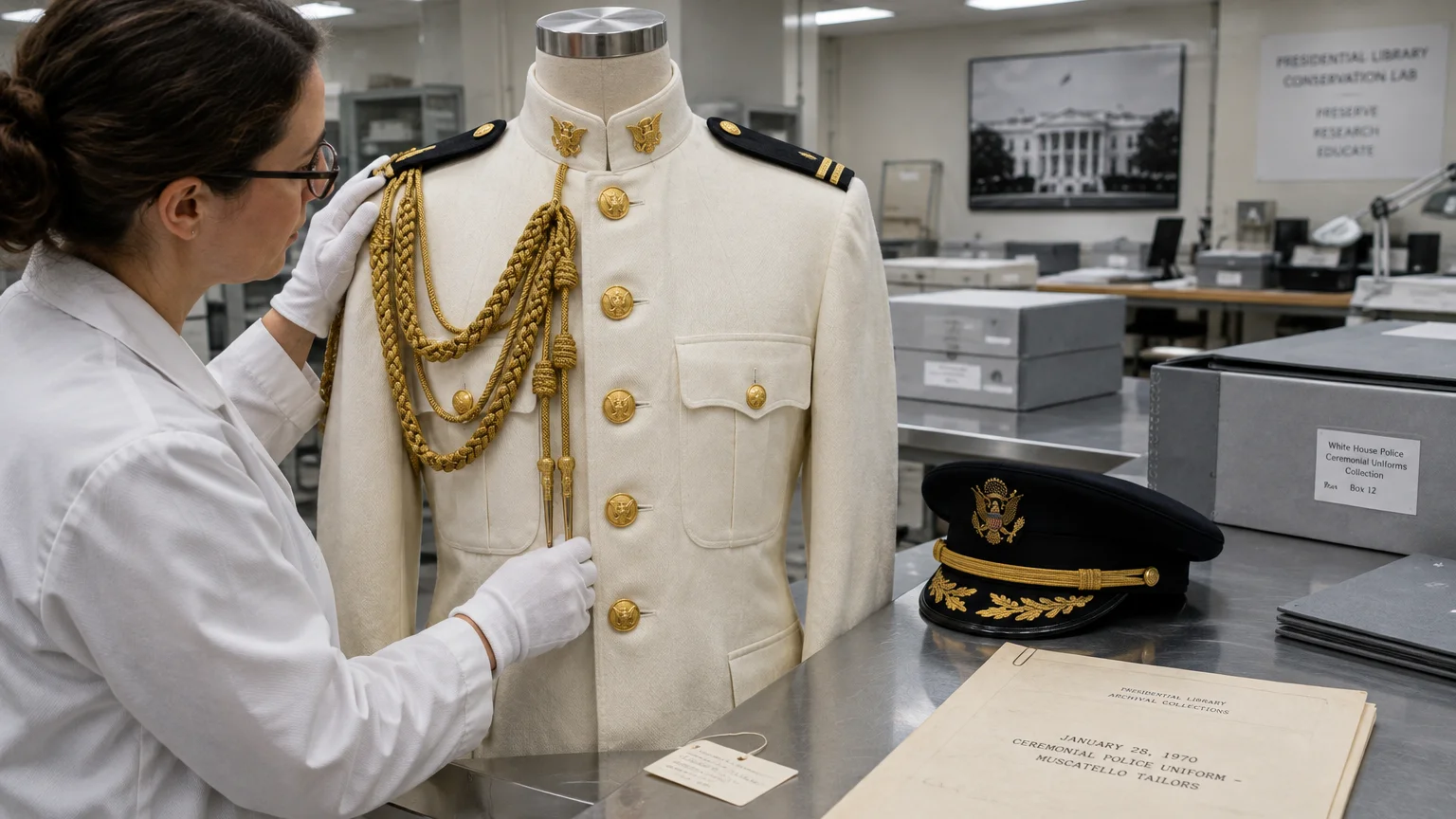
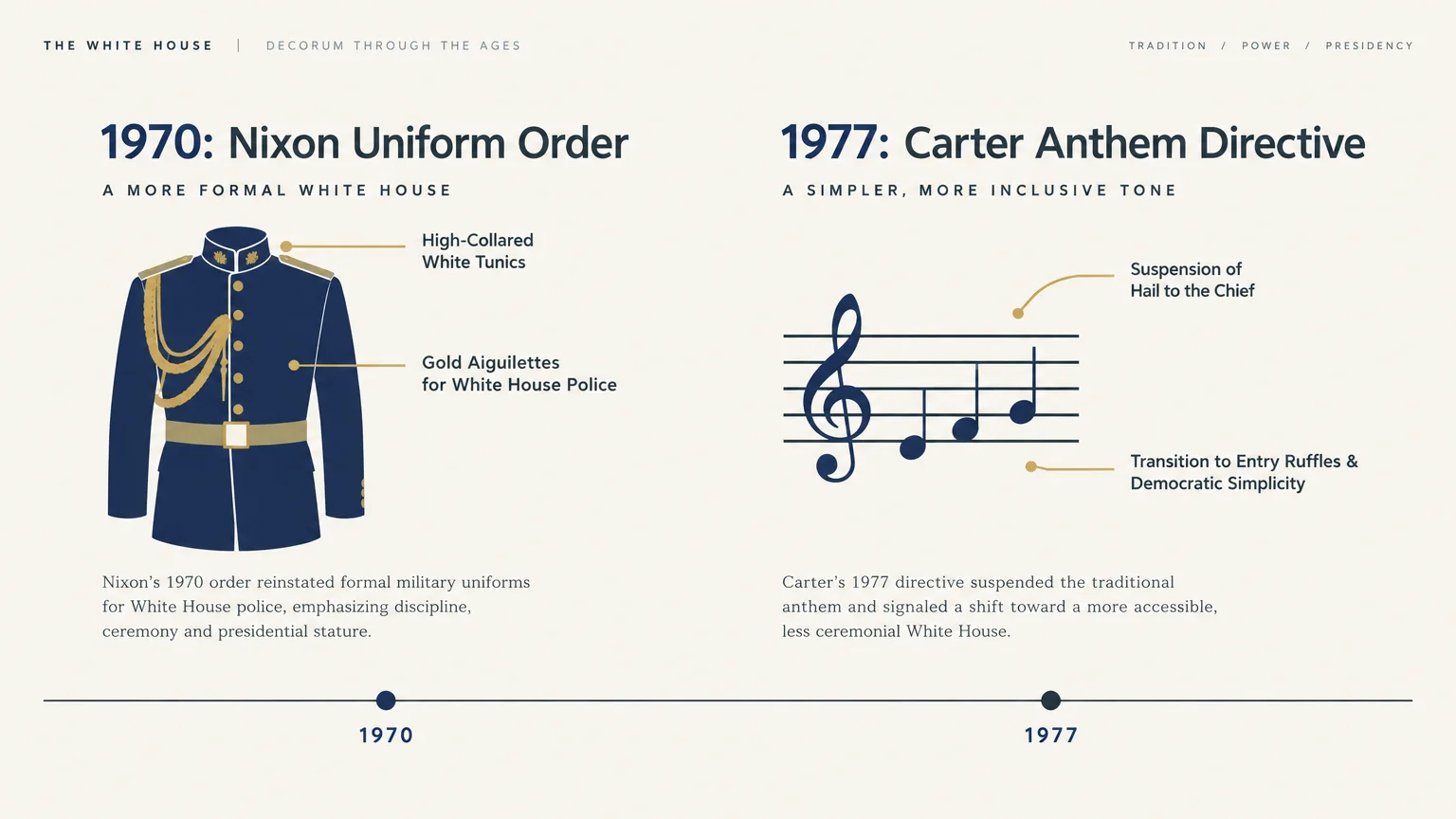
President Richard Nixon introduced ceremonial uniforms for the White House Police Force on January 28, 1970. The public debut occurred during an official state visit by British Prime Minister Harold Wilson.
Nixon drew inspiration from European palace guards he observed during his 1969 tour of western capitals. He wanted a more formal visual presence to honor visiting heads of state.
He ordered Washington tailor Jimmie Muscatello to design the outfits. The resulting garments featured high-collared white tunics, gold aiguillettes, and black plastic hats reminiscent of classic European military headwear.
Contemporary press reports and congressional critics quickly mocked the garments. Editorial writers described the outfits as imperial regalia and unfavorably compared the officers to foreign palace guards or movie ushers.
Officers reported severe practical discomfort while performing protective duties in the stiff, heavy tunics. The administration scaled back their use to rare international visits before quietly shelving them.
In 1980, the federal government officially declared the uniforms surplus property. The General Services Administration sold the entire inventory to Iowa’s Meriden-Cleghorn High School marching band for roughly $5 per coat.
You can review official remarks from that state arrival via the American Presidency Project. The incident remains a textbook study in the public limits of executive pageantry.
Suspension of the Presidential Anthem Under Carter
President Jimmy Carter altered musical protocol immediately upon taking the oath of office in January 1977. He ordered military service bands to suspend the routine playing of “Hail to the Chief.”
The Department of Defense officially designated the nineteenth-century anthem as the president’s tribute song in 1954. Carter, however, sought to eliminate imperial trappings following the political fallout of Watergate and the Vietnam War.
He directed ceremonial units to replace the historic anthem with standard entry ruffles and general musical flourishes. He walked down Pennsylvania Avenue during his inauguration to visually emphasize administrative simplicity.
Public reaction proved mixed, with many citizens feeling the absence diminished traditional executive stature. Military veterans and civic groups voiced frustration that a foundational executive ceremony had been cast aside.
Carter recognized that abandoning the historic composition drew more controversy than it prevented. He eventually relented later in his term, allowing service bands to resume the anthem for state arrivals and major public ceremonies.
Historical summaries compiled by the White House Historical Association confirm that modern presidents maintain complete personal control over executive entrance fanfare.
Skirt and Hosiery Mandate for Female West Wing Staff
West Wing employment guidelines under President Ronald Reagan and President George H.W. Bush required female personnel to wear skirts or dresses.
West Wing managers strictly enforced hosiery as part of the daily dress standard.
Supervisors applied this unwritten code rigorously across administrative offices. Staff assistants and press aides faced administrative reprimands or were sent home to change if they reported to work wearing pantsuits.
The policy aligned with conservative corporate standards of the 1980s, but it remained active in the executive mansion longer than in the corporate world. Administrators believed traditional attire preserved executive authority.
The twelve-year protocol ended abruptly on January 20, 1993, when Bill Clinton took office. Incoming White House Press Secretary Dee Dee Myers entered the West Wing wearing a tailored pantsuit.
Myers later confirmed that freezing Washington weather motivated her wardrobe choice on Inauguration Day. Her attire established an immediate precedent, permanently ending the prohibition against slacks for female West Wing personnel.
The quiet shift demonstrated how incoming senior staff can instantly alter long-standing personnel customs without issuing formal executive memos.
The Weekend Exception to Reagan’s Oval Office Suit Standard
A persistent political myth claims Ronald Reagan never entered the Oval Office without a tailored jacket and necktie. Commentators frequently repeat this story as proof of unmatched institutional deference.
Public speakers like Michael Reagan in 1998 and Howard Schultz in 2019 popularized the claim that the 40th president observed an unbroken dress requirement. Administrative records reveal a more nuanced reality.
Reagan certainly enforced a formal suit-and-tie mandate during standard weekday business hours. He expected visiting officials, congressional leaders, and West Wing aides to match his formal presentation.
Archival records preserved by the Ronald Reagan Presidential Library reveal that Reagan routinely relaxed this standard during off-hours. Contact sheets document the president working on weekends in casual attire.
Photographers captured Reagan at the Resolute Desk wearing open-collar flannels, short-sleeve polo shirts, and athletic sweatsuits during weekend emergencies. These photos disprove claims of an absolute, 24-hour coat mandate.
Reagan separated weekday executive theater from the practical realities of off-hours crisis management. You can see through his record that comfort often took precedence when public cameras were absent.
George W. Bush’s Oval Office Coat-and-Tie Directive
President George W. Bush established a formal dress requirement for the Oval Office on his first full business day in January 2001.
He ordered that all male aides and visitors wear suits and ties before crossing the threshold.
Bush introduced the mandate to establish an intentional cultural contrast with the Clinton administration’s casual work habits. Bush also prohibited staff from wearing denim jeans anywhere in the West Wing.
Former Chief of Staff Andrew Card frequently asserted to the media that Bush never removed his jacket inside the Oval Office. Archival photography, however, documents early exceptions to this narrative.
A White House photograph dated January 22, 2001—two days after his first inauguration—shows Bush working in his shirtsleeves. He is pictured conferring over paperwork at the Resolute Desk alongside Staff Secretary Harriet Miers.
You can examine these administrative guidelines through records preserved at the George W. Bush Presidential Library. The archival record confirms that operational demands occasionally outweighed symbolic rules.
Despite minor exceptions, the administration strictly enforced the jacket mandate for outside visitors and staff. The policy remained a hallmark of Bush’s executive branding for eight years.
Entrance Gate Postings Banning Casual Footwear and Denim
In late July 2005, the Bush administration posted physical dress code notices at visitor, press, and staff entrances. The printed signs explicitly warned visitors against entering the complex in casual attire.
The directive followed public controversy when members of the championship Northwestern University women’s lacrosse team visited the White House. Several athletes wore casual flip-flops with their formal sundresses to the official photo-op.
The footwear choice ignited widespread public debate over executive decorum. The administration responded by posting formal dress notices across the northwest and southwest entry gates.
The notices banned shorts, miniskirts, T-shirts, tank tops, denim, and sneakers. The printed signs concluded with an unmistakable boldfaced admonition: “NO FLIP FLOPS.”
Secret Service officers and executive entrance staff received instructions to turn away visitors whose clothing violated the published terms. Tour groups, corporate leaders, and visiting athletes had to adjust their attire accordingly.
This episode stands as the only documented instance in modern history where White House management codified footwear restrictions on physical checkpoint placards.
The Transition to Working Shirtsleeves Under Obama
President Barack Obama rescinded the mandatory jacket rule inside the Oval Office on his first full business day in office. On January 21, 2009, Chief Official White House Photographer Pete Souza photographed Obama working in shirtsleeves.
Senior adviser David Axelrod told reporters that the Hawaiian-born president kept the Oval Office thermostat exceptionally high. Axelrod joked publicly that the room was so warm you could grow orchids inside.
The elevated indoor temperature made heavy suit jackets impractical during long working sessions. The president routinely removed his coat upon entering the executive office to work comfortably.
Obama also permitted senior aides to adopt business casual attire during weekend shifts and late-night legislative negotiations. Aides wore open-collar shirts and sweaters during informal internal meetings.
The administration maintained strict formalwear standards for public ceremonies, televised addresses, and foreign diplomatic summits. Obama balanced personal working comfort in private with traditional pageantry in public.
This operational shift permanently normalized shirtsleeve diplomacy for subsequent modern executives. It proved that administrative discipline does not depend on continuous formal outerwear.
Residence Butler Attire Revision Under Michelle Obama
First Lady Michelle Obama instituted a major operational change within the Executive Residence staff upon moving into the White House in 2009. She eliminated the mandatory full-time tuxedo dress code for residential butlers.
Prior administrations required residence butlers to perform all daily duties wearing formal black evening tuxedos. These tasks included serving family meals, dusting furniture, and running daytime errands.
Obama explained her administrative reasoning in her May 2020 documentary film Becoming. She focused on the psychological impact the environment would have on her young daughters, Malia and Sasha.
The residence staff consisted largely of older African American and Latino men. The First Lady expressed concern over her daughters growing up seeing men of color serve them in evening wear every morning.
Under the revised protocol, butlers shifted to business-casual daytime attire, including pressed khaki slacks and collared polo shirts. Staff wore tuxedos solely for official state dinners and ceremonial receptions.
The change updated a century-old residential practice. It modernised the private quarters while protecting the personal perspective of young children growing up in the public eye.
Formal Attire Enforcement and Diplomatic Dress Revisions
In February 2017, viral media reports alleged that the Trump administration instituted an internal rule requiring female aides to “dress like women.” Fact-checkers at Snopes evaluated the reporting on February 3, 2017.
The reporting originated from campaign-era anecdotes regarding Donald Trump’s personal preference for traditional business aesthetics. The administration, however, never codified an official policy banning women from wearing slacks.
Female West Wing officials, including senior advisers and cabinet secretaries, routinely wore pantsuits during daily operations. The viral claim remained an internet rumor rather than a verified personnel rule.
Executive decorum returned to international headlines during Trump’s second term in early 2025. Observers noted Ukrainian President Volodymyr Zelenskyy wearing military-style casual apparel in the Oval Office, while adviser Elon Musk attended a high-level briefing in a T-shirt.
White House Press Secretary Karoline Leavitt formally addressed executive dress standards during a press briefing on March 5, 2025. She stated that while guests receive latitude, the administration expects high decorum from executive personnel.
In April 2026, the administration updated the Foreign Affairs Manual to mandate strict “Business Formal” attire for all American diplomats. The policy formally reversed flexible, hybrid dress guidelines established during the Biden administration.
Summary of Modern Executive Protocol Policies
This table compares the nine documented protocol and dress standards instituted by modern administrations, tracking their practical enforcement and operational longevity.
| Administration | Policy Focus | Year Initiated | Current Operating Status |
|---|---|---|---|
| Nixon | Ceremonial Police Uniforms | 1970 | Rescinded and liquidated in 1980 |
| Carter | Suspension of “Hail to the Chief” | 1977 | Reversed; anthem restored |
| Reagan / Bush | Prohibition on Slacks for Women | 1981 | Definitively ended in January 1993 |
| Reagan | Oval Office Suit-and-Tie Norm | 1981 | Maintained weekdays; relaxed weekends |
| G.W. Bush | Day-One Coat-and-Tie Mandate | 2001 | Rescinded by executive successor |
| G.W. Bush | Public “No Flip-Flops” Gate Signs | 2005 | Enforced on permanent tourist guidance |
| Obama | Oval Office Shirtsleeves Policy | 2009 | Remains common presidential practice |
| M. Obama | Residence Butler Attire Overhaul | 2009 | Permanent standard for private quarters |
| Trump (Term 2) | Diplomatic Business Formal Update | 2026 | Active across Foreign Affairs Manual |
How Presidential Protocol Reflects Executive Governance
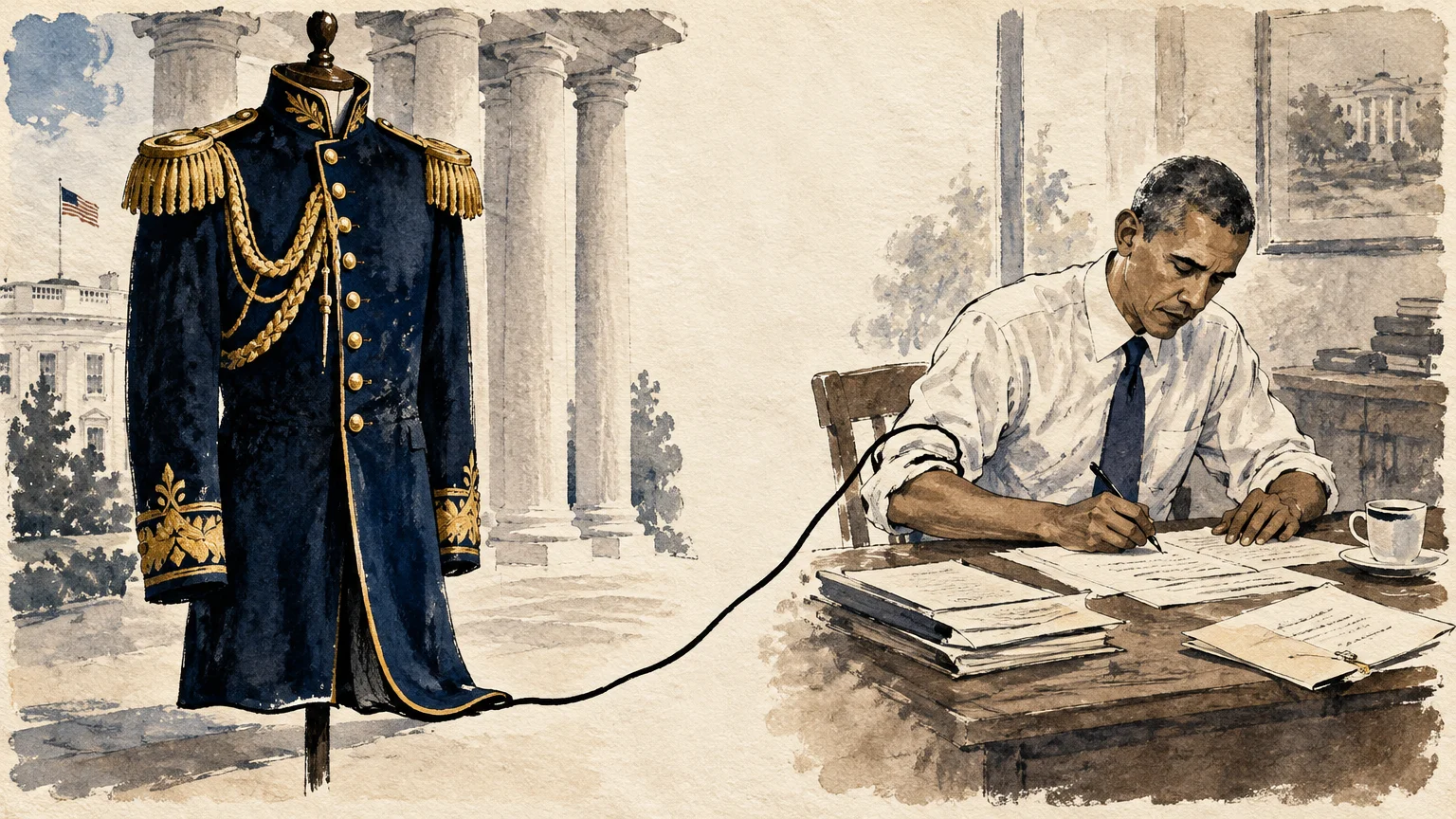
When you evaluate executive protocol across decades, dress codes function as an extension of a president’s administrative philosophy. Protocols establish an unspoken institutional tone across the federal bureaucracy.
Presidents possess broad constitutional authority to set the rules for their personal office space. The West Wing is not governed by conventional civil service dress standards.
When Richard Nixon introduced ceremonial tunics, he attempted to elevate the visual stature of the presidency to match European royal traditions. The resulting backlash illustrated how strongly Americans resist monarchical imagery.
Jimmy Carter moved in the opposite direction by removing ceremonial music. He discovered that the American public expects a certain degree of solemnity and grandeur from its head of state.
The shift from George W. Bush’s formal coat mandate to Barack Obama’s working shirtsleeves highlights how modern workplaces balance formality with personal comfort.
Both approaches achieved specific administrative goals.
Similarly, Michelle Obama’s reform of butler uniforms demonstrated how an administration can adapt historic executive traditions to reflect contemporary American social values. Her directive prioritized human dignity over inherited Victorian practices.
The 2026 update to diplomatic dress codes confirms that visual presentation remains an active foreign policy consideration. What officials wear inside diplomatic corridors directly communicates national intent.
Executive protocol is never accidental. Every decision, from a gate sign to an open collar, tells you how an administration views its relationship to power, dignity, and the American public.
Frequently Asked Questions About White House Dress Codes
Can a president legally fire a staff member for violating a dress code?
Yes. West Wing political appointees serve at the pleasure of the president under Title 3 of the United States Code.
They do not enjoy the same civil service procedural protections as career federal employees. A president or chief of staff can dismiss political aides immediately for failing to follow executive decorum rules.
Does the Constitution mandate a specific dress code for the Oval Office?
No. The United States Constitution establishes operational duties, qualifications, and core executive powers in Article II.
It contains zero language regarding personal attire, office etiquette, or ceremonial decorum. Every sitting president creates, enforces, or abandons internal office rules at their personal discretion.
Are White House tour guests legally required to follow posted dress guidelines?
The Secret Service and White House Visitors Office retain legal authority to deny entry to anyone who violates facility security or decorum policies.
While wearing casual clothes is not a criminal violation, personnel at security checkpoints will turn away visitors who fail to comply with posted entry standards.
How does the White House handle foreign leaders who do not wear business suits?
The Chief of Protocol coordinates with foreign embassies well before state visits to establish mutually respectful wardrobe parameters.
Foreign dignitaries frequently wear traditional cultural garments, military uniforms, or indigenous attire. The White House honors these garments as appropriate formal attire for international state ceremonies.