When you hear headlines about interest rates, you might wonder whether the White House or Congress dictates those financial choices. By design, the Federal Reserve operates as an independent central bank shielded from short-term electoral politics.
Congress established the Fed to steer borrowing costs and stabilize commercial lenders under explicit statutory mandates. Federal law simultaneously bars the central bank from spending taxpayer revenue or rescuing favored private corporations.
Understanding these legal boundaries helps you distinguish between campaign rhetoric and binding federal authority. Here is what the central bank actually does under the public record, alongside the powers Congress explicitly denied it.
Statutory Authority and the Architecture of Modern Central Banking
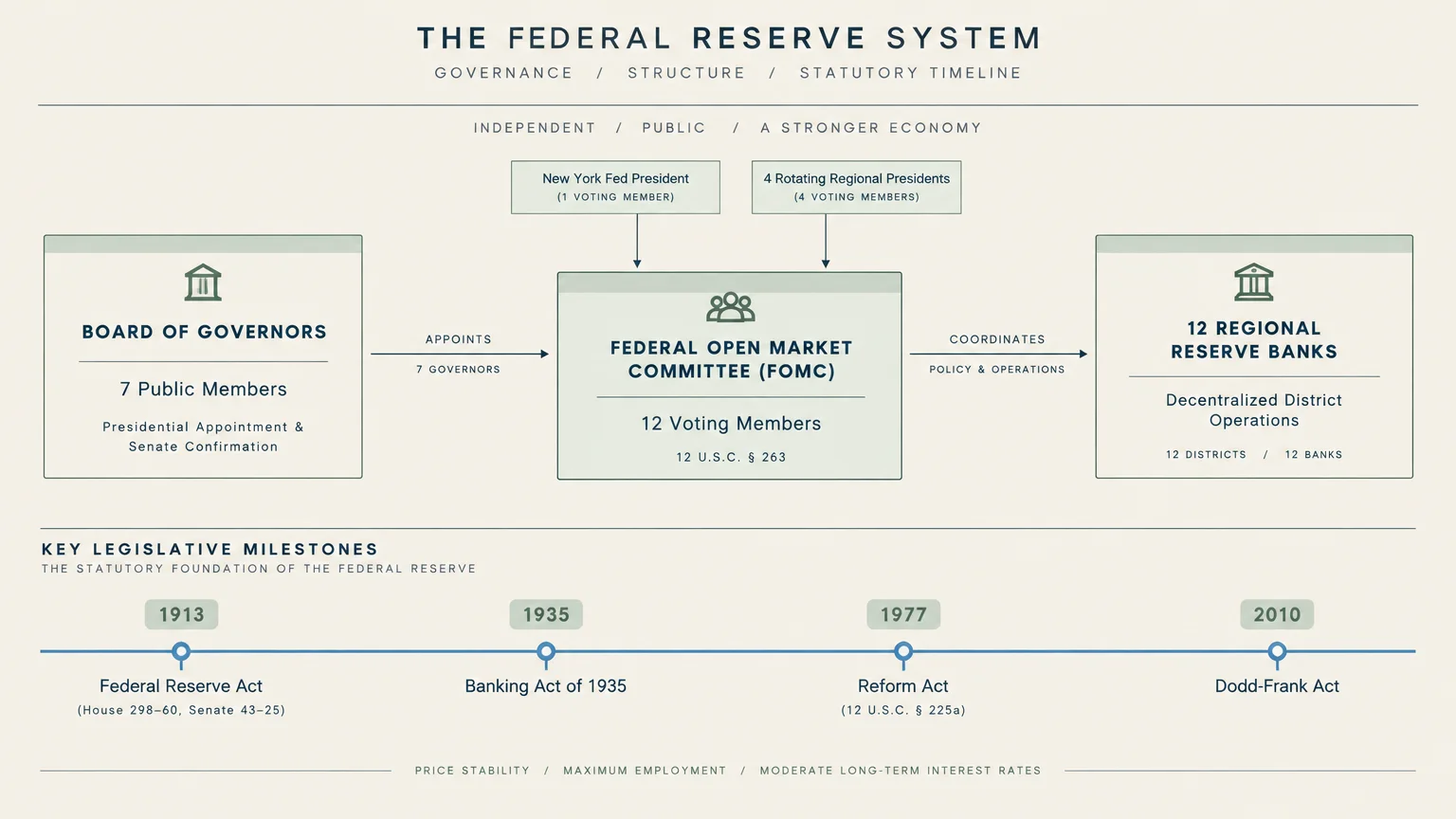
Congress created the Federal Reserve System by passing the Federal Reserve Act on December 23, 1913. President Woodrow Wilson signed the bill following a 298–60 roll call in the House and a 43–25 vote in the Senate.
The legislation established a hybrid federal structure combining a central public Board of Governors with twelve regional Reserve Banks. Lawmakers intentionally insulated monetary policy from daily partisan politics to protect long-term economic stability.
Over the following century, Congress repeatedly adjusted this balance of authority through major statutory overhauls. Landmark enactments include the Banking Act of 1935, the Federal Reserve Reform Act of 1977, and the Dodd-Frank Act of 2010.
These statutory amendments defined the Fed’s responsibilities while establishing firm legal boundaries on central bank interventions. When you examine these statutes, you discover clear limits designed to prevent executive or financial overreach.
This guide analyzes nine core operational powers alongside four explicit statutory prohibitions grounded in federal law. Each entry details the governing statute, roll-call tallies, and practical consequences for your personal finances.
Setting the Target Range for the Federal Funds Rate
The Federal Open Market Committee convenes eight regularly scheduled meetings each year to establish the target range for the federal funds rate. This policy benchmark dictates overnight interbank lending rates and anchors borrowing costs across the economy.
Section 12A of the Federal Reserve Act (12 U.S.C. § 263) establishes the statutory framework for the twelve-member voting committee. The committee comprises the seven governors, the New York Fed president, and four rotating regional Reserve Bank presidents.
To keep the effective federal funds rate inside its target band, the Fed adjusts the Interest on Reserve Balances rate. You can examine this operational system in the Congressional Research Service report on Fed independence.
These policy decisions take effect immediately upon public release without requiring approval or review from the White House. This legal insulation ensures that rate decisions respond to measurable macroeconomic data rather than upcoming election campaigns.
Pursuing the Statutory Dual Mandate
Congress formally codified the Federal Reserve’s core economic objectives through the Federal Reserve Reform Act of 1977. Lawmakers embedded these mandates directly into Section 2A of the Federal Reserve Act (12 U.S.C. § 225a).
The statute directs the Board and the FOMC to promote maximum employment, stable prices, and moderate long-term interest rates. Economists and policymakers describe maximum employment and stable prices as the central bank’s statutory “dual mandate.”
Congress reinforced these national goals by passing the Full Employment and Balanced Growth Act of 1978, sponsored by Representative Augustus Hawkins. The House approved the compromise legislation by a 252–158 roll call.
To translate this legislative mandate into practice, the FOMC targets a 2% annual inflation rate over the longer run. The committee measures this rate using the Personal Consumption Expenditures price index to gauge price stability.
Conducting Supervisory Bank Stress Tests
Following the 2008 banking crisis, Congress created mandatory supervisory stress tests to assess whether major financial institutions can survive severe downturns. The Fed conducts these annual examinations under Section 165 of the Dodd-Frank Act (12 U.S.C. § 5365).
Lawmakers passed the Dodd-Frank Wall Street Reform and Consumer Protection Act in July 2010 following a 60–39 Senate confirmation vote. The statute requires rigorous scenario testing for institutions with $100 billion or more in assets.
During these stress tests, examiners simulate severe global market shocks, sharp real estate crashes, and spikes in unemployment. The Fed models whether each bank’s capital reserves would remain above statutory minimums during these distressed scenarios.
The central bank uses these quantitative results to establish each institution’s Stress Capital Buffer. This regulatory mechanism directly prevents commercial lenders from distributing capital to shareholders if their loss reserves fall below required thresholds.
Supplying Physical Currency to Depository Institutions
Although popular culture often depicts the Federal Reserve operating printing presses, federal law assigns currency production to the Treasury Department. Section 16 of the Federal Reserve Act (12 U.S.C. § 411) governs the issuance of Federal Reserve notes.
Each year, the Board of Governors projects how much physical cash the public and commercial banks will demand. The Board then submits an official print order to the Treasury’s Bureau of Engraving and Printing.
The central bank orders billions of physical notes annually, paying the Treasury only the direct cost of paper, ink, and manufacturing. These freshly minted notes replace worn or mutilated currency that regional Reserve Banks retire from circulation.
Once the Bureau delivers the notes, the twelve regional Reserve Banks distribute cash directly to depository institutions. This logistics pipeline guarantees that you can withdraw physical currency from bank branches and automated teller machines whenever needed.
Operating Wholesale and Instant Interbank Payment Rails
The Federal Reserve maintains the core electronic payment infrastructure that connects the American banking system. Congress authorized these operational services and fee structures through the Monetary Control Act of 1980 (12 U.S.C. § 248a).
Through the Fedwire Funds Service, commercial lenders settle high-value transactions with immediate, irrevocable finality. This wholesale platform processes trillions of dollars every business day to clear interbank transfers, corporate transactions, and financial settlements.
To accelerate consumer and business payments, the Federal Reserve launched the FedNow Service as an instant gross-settlement engine. Over 1,900 participating financial institutions now utilize this federal infrastructure to settle domestic transactions in real time.
The Fed set a default transaction ceiling of $10 million for FedNow transfers. This modern payment rail allows you to send and receive funds immediately across participating financial institutions, twenty-four hours a day.
Serving as the Fiscal Agent for the United States Treasury
Under Section 15 of the Federal Reserve Act (12 U.S.C. § 391), regional Reserve Banks serve as fiscal agents and depositories of the United States. In this statutory role, the central bank maintains the federal government’s primary operating bank account.
The Treasury General Account at the Federal Reserve Bank of New York collects federal taxes, customs duties, and borrowing proceeds. When you receive a federal tax refund or federal benefit, the Treasury disburses the funds through this account.
Regional Reserve Banks also conduct competitive auctions of marketable Treasury bills, notes, and bonds. Reserve Bank technicians manage the electronic systems that process bids from primary dealers to finance federal debt obligations.
This agency relationship does not grant the Fed authority over government spending priorities. The central bank acts purely as an operational administrator executing transactions directed by the Treasury under laws enacted by Congress.
Providing Emergency Liquidity Through the Discount Window
When commercial banks face temporary liquidity shortfalls, they can borrow directly from the central bank. Section 10B of the Federal Reserve Act (12 U.S.C. § 347b) authorizes this lending facility, known formally as the Discount Window.
Congress created the Discount Window to prevent temporary liquidity crunches from snowballing into catastrophic banking panics. Depository institutions must post sound collateral, such as Treasury securities or commercial loans, to secure these short-term cash advances.
The Fed structures this lending through three distinct tiers: primary credit, secondary credit, and seasonal credit. Primary credit provides short-term funding to financially sound institutions at a rate set slightly above the federal funds target band.
By serving as an emergency lender of last resort, the Fed stabilizes credit markets during periods of broad financial strain. This liquidity backstop protects your bank deposits from sudden cash-flow disruptions in the interbank market.
Supervising Bank Holding Companies and State Member Banks
Beyond monetary policy, the Federal Reserve functions as a primary regulatory supervisor for thousands of financial organizations. Congress codified these supervisory powers under the Bank Holding Company Act of 1956 (12 U.S.C. § 1841) and Section 9 of the Federal Reserve Act.
The Fed supervises all bank holding companies, savings and loan holding companies, and state-chartered commercial banks that choose System membership. Examiners evaluate capital adequacy, operational integrity, and compliance with federal consumer lending regulations.
The Board of Governors enforces regulatory capital rules, including Regulation Q, to ensure that institutions maintain sufficient equity. Central bank supervisors conduct regular examinations to prevent executives from exposing customer deposits to excessive balance-sheet risk.
When institutions violate statutory standards, the Fed can issue formal enforcement actions, impose civil fines, or remove corporate executives. This supervision protects your deposits by enforcing strict safety-and-soundness standards across the commercial banking system.
Establishing Mandatory Bank Reserve Ratios
Section 19 of the Federal Reserve Act (12 U.S.C. § 461) empowers the Board of Governors to establish bank reserve requirements. Under Regulation D, the Fed historically required lenders to hold cash reserves against transaction accounts.
On March 15, 2020, the Board eliminated mandatory reserve minimums by lowering ratios to 0% across all deposit brackets. The change was published in the Federal Register notice on Regulation D, effective March 26, 2020.
This policy shift removed the requirement for depository institutions to sequester billions of dollars in idle, non-interest-earning accounts. Instead, the central bank transitioned permanently to an ample-reserves operating environment.
The Fed now manages short-term rates by paying interest on balances that commercial banks choose to hold at regional Reserve Banks. This system gives your bank more operational liquidity while preserving the central bank’s control over interest rates.
Directly Purchasing Debt from the United States Treasury
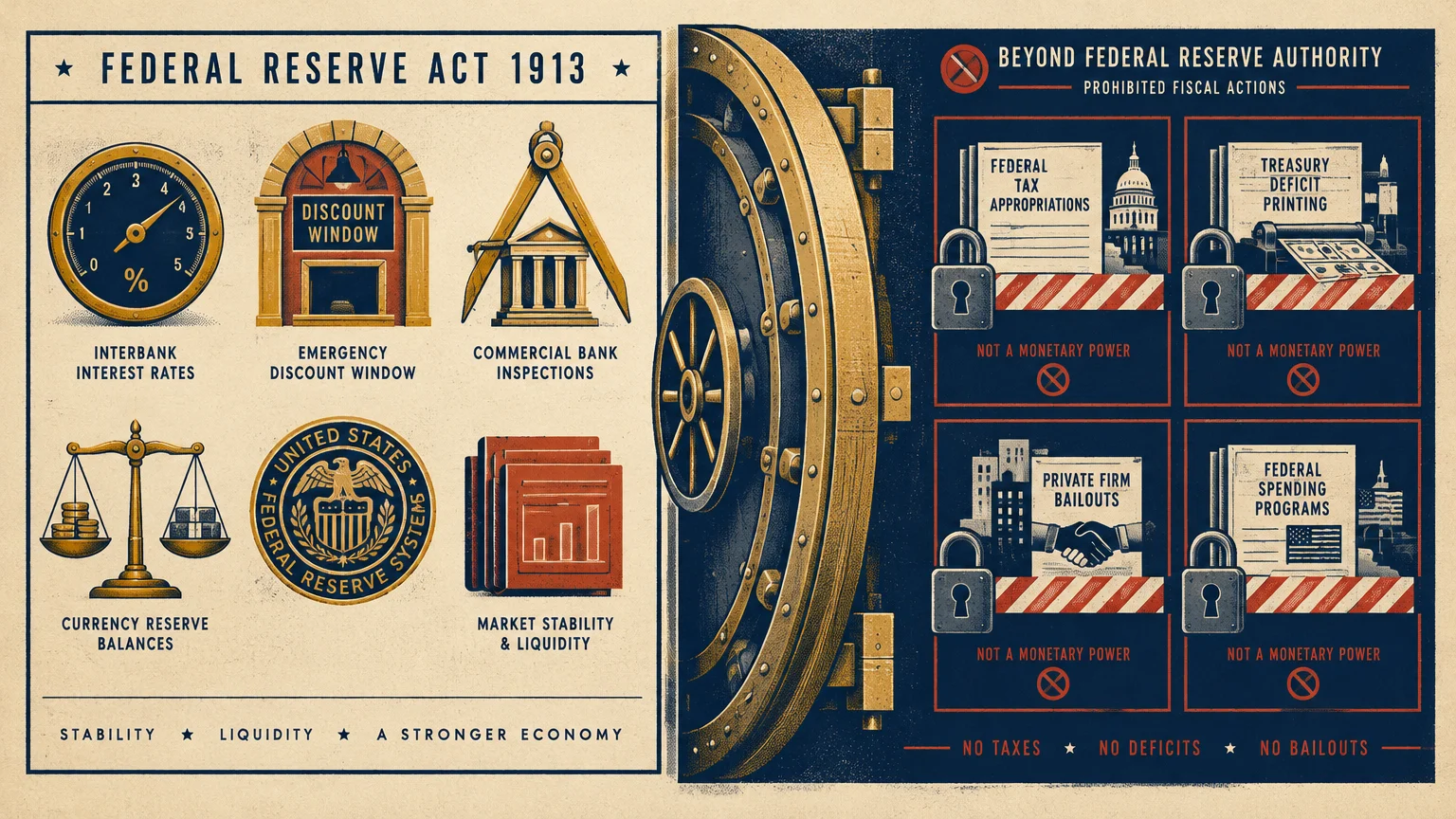
A common misconception asserts that the Federal Reserve can print money to buy government bonds directly from the Treasury. Section 14(b) of the Federal Reserve Act (12 U.S.C. § 355) strictly prohibits direct primary-market bond purchases.
Congress originally provided limited direct-purchase authority during the Second World War to help finance urgent wartime expenditures. However, lawmakers allowed that statutory direct-borrowing authority to expire permanently on June 8, 1981, under Public Law 96-161.
Under current law, the central bank may only purchase and sell government obligations on the secondary open market. It conducts transactions exclusively through competitive bidding with private broker-dealers at prevailing market prices.
This statutory limitation prevents the White House and Congress from forcing the Fed to finance federal budget shortfalls directly. If market demand for government debt weakens, the Fed cannot intervene by purchasing bonds at initial Treasury auctions.
Bailing Out Individual Insolvent Private Corporations
During the 2008 financial crisis, the Federal Reserve invoked Section 13(3) of the Federal Reserve Act to bail out individual distressed corporations. These controversial transactions included targeted financial rescues for Bear Stearns and American International Group.
Congress responded by outlawing single-firm emergency bailouts under Section 1101 of the Dodd-Frank Act of 2010. The amended statute restricts emergency lending strictly to programs or facilities with “broad-based eligibility.”
Federal law now explicitly prohibits any emergency lending program designed to rescue an individual failing company or prevent its bankruptcy. The Fed cannot craft narrow loan terms to shield a specific private lender or hedge fund from insolvency.
Additionally, the Board cannot launch any emergency lending facility without prior written authorization from the Secretary of the Treasury. This statutory barrier ensures that unelected central bankers cannot unilaterally deploy public credit to rescue favored private corporations.
Levying Taxes or Enacting Federal Spending Bills
The Federal Reserve possesses no constitutional or statutory authority over national fiscal policy. Article I, Section 8, Clause 1 of the U.S. Constitution reserves the power to lay and collect taxes solely to Congress.
Furthermore, Article I, Section 9, Clause 7 dictates that public funds can only be drawn pursuant to appropriations made by law. The Fed cannot adjust income tax rates, enact corporate levies, or fund congressional budget appropriations.
The central bank cannot issue stimulus checks to consumers or unilaterally adjust the federal statutory debt limit. Those fiscal decisions require legislation drafted by lawmakers, passed by both chambers of Congress, and signed by the President.
While the Fed influences the economy by altering the cost of credit, elected officials decide how public revenue is collected and spent. Maintaining this boundary protects taxpayers from unelected officials exercising legislative taxation powers.
Retaining Commercial Profits Without Treasury Remittance
Conspiracy theories often allege that the Federal Reserve operates as a private syndicate designed to distribute commercial profits to Wall Street banks. Section 7 of the Federal Reserve Act (12 U.S.C. § 289) directly refutes that claim.
Commercial banks must buy non-transferable stock in regional Reserve Banks, but this stock confers zero ownership or managerial control. Under the Fixing America’s Surface Transportation Act, dividends for large institutions cannot exceed the 10-year Treasury yield or 6%.
Federal statute mandates that all net earnings generated by regional Reserve Banks after expenses must be remitted to the U.S. Treasury. The Fed transfers these funds directly into the Treasury’s general fund for public use.
When operational expenses exceed net interest earnings, the Fed accumulates a statutory “deferred asset” rather than collecting taxpayer bailouts. The central bank must eliminate this accounting deficit entirely before resuming remittances to the federal government.

How Institutional Independence Shapes Everyday American Borrowing
The statutory architecture governing the Federal Reserve creates a deliberate separation between the creation of money and the spending of tax dollars. Congress recognized that letting politicians manipulate interest rates during election years triggers severe inflationary cycles.
To safeguard central bank independence, Section 10 of the Federal Reserve Act establishes staggered 14-year terms for members of the Board of Governors. The President appoints governors with Senate confirmation, but cannot remove them over monetary policy disputes.
Reviewing Senate confirmation procedures under Article II confirms that governors serve overlapping terms that bridge multiple presidential administrations. While the Chair serves a four-year leadership term, statutory removal requires demonstrating legal “cause,” such as criminal misconduct.
This institutional structure ensures that when the FOMC alters the federal funds target band, its votes reflect economic assessments rather than political pressure. Your mortgage rates, business loans, and savings yields depend directly on these independent, statutory determinations.
At the same time, explicit statutory prohibitions prevent the Fed from exceeding its delegated authority. By denying the central bank the power to tax, spend, or rescue single corporations, Congress retains ultimate democratic control over the nation’s financial system.
| Function or Limitation | Statutory Authority | Governing Mechanism | Direct Public Impact |
|---|---|---|---|
| Target Interest Rates | 12 U.S.C. § 263 | FOMC policy vote | Sets borrowing costs |
| Dual Mandate | 12 U.S.C. § 225a | 2% inflation target | Stabilizes purchasing power |
| Bank Stress Tests | 12 U.S.C. § 5365 | Supervisory modeling | Protects customer deposits |
| Currency Supply | 12 U.S.C. § 411 | Annual print orders | Supplies physical cash |
| Payment Processing | 12 U.S.C. § 248a | Fedwire and FedNow | Enables instant transfers |
| Treasury Fiscal Agent | 12 U.S.C. § 391 | General Account operations | Processes tax refunds |
| Discount Window | 12 U.S.C. § 347b | Collateralized advances | Prevents banking panics |
| Bank Supervision | 12 U.S.C. § 1841 | Safety examinations | Enforces capital adequacy |
| Reserve Requirements | 12 U.S.C. § 461 | Regulation D parameters | Manages system liquidity |
| Direct Debt Purchases | 12 U.S.C. § 355 | Secondary trading only | Bars deficit monetization |
| Single-Firm Bailouts | 12 U.S.C. § 343 | Broad eligibility rules | Prohibits corporate rescues |
| Fiscal Policy / Taxes | U.S. Constitution | Article I legislative power | Restricts taxation to Congress |
| Surplus Profit Storage | 12 U.S.C. § 289 | Treasury net remittances | Returns profits to public |
Frequently Asked Questions About Federal Reserve Authority
Can the President Fire the Fed Chair Over Interest Rates?
The President cannot remove the Federal Reserve Chair or any Board member simply because of disagreements over interest rates. Under Section 10 of the Federal Reserve Act (12 U.S.C. § 242), governors may only be removed by the President “for cause.”
Federal courts define “for cause” removal as requiring proof of explicit malfeasance, criminal wrongdoing, or dereliction of official duty. Policy disputes regarding rate hikes or cuts do not meet this statutory standard.
Is the Federal Reserve a Private Corporation?
The Federal Reserve is not a private, for-profit corporation. It is an independent federal entity created by Congress with a public Board of Governors appointed by the President and confirmed by the Senate.
While commercial member banks own stock in regional Reserve Banks, this stock is non-transferable and carries no voting control over policy. Dividends are legally capped, and all excess profits remit to the federal Treasury.
Does the Federal Reserve Print Paper Currency?
The Federal Reserve does not print paper currency or mint metal coins. By law, the Treasury Department’s Bureau of Engraving and Printing prints paper currency, while the U.S. Mint manufactures coinage.
The Federal Reserve simply estimates public cash demand each year and purchases physical currency from the Treasury at production cost. Regional Reserve Banks then distribute that currency to commercial banks.
Who Audits the Federal Reserve’s Financial Records?
The Federal Reserve undergoes extensive, multi-layered audits mandated by federal statute. An independent public accounting firm audits the Board of Governors and the regional Reserve Banks annually.
Additionally, the Government Accountability Office conducts ongoing audits of central bank operations and regulatory programs under 31 U.S.C. § 714. The Fed also publishes comprehensive weekly balance-sheet reports for public review.