Confusing disclaimers on political commercials often blur the line between candidate campaigns and outside independent groups. Knowing where your political donations go helps you hold elected officials and spending groups accountable.
Federal campaign finance laws divide political cash into strictly regulated hard money and unlimited independent expenditures. Navigating these federal rules lets you see who actually funds federal elections.
This guide cuts through the fog of federal statutes, agency rulings, and landmark judicial decisions. You will master the statutory boundaries separating candidates, national parties, traditional political action committees, and Super PACs.
Evaluating Campaign Finance Realities in the Modern Era
This reality check evaluates eight persistent campaign finance misconceptions across federal statutes, agency regulations, and constitutional jurisprudence. We analyze rules governing the 2025–2026 federal election cycle, running from November 6, 2024, through November 3, 2026.
Every entry relies on authoritative primary sources, including the Federal Election Campaign Act, Supreme Court dockets, and official Federal Election Commission directives. We selected these items because they generate the most voter confusion during election cycles.
By examining statutory thresholds and judicial precedents, you can distinguish legitimate direct campaign contributions from independent outside advocacy. Clear legal distinctions separate individual civic participation from corporate and committee expenditures.
Understanding these boundaries empowers you to analyze television disclaimers, evaluate political claims, and verify official fundraising filings. The public record provides objective standards to evaluate every campaign finance mechanism.
Direct Corporate Treasury Contributions to Candidates
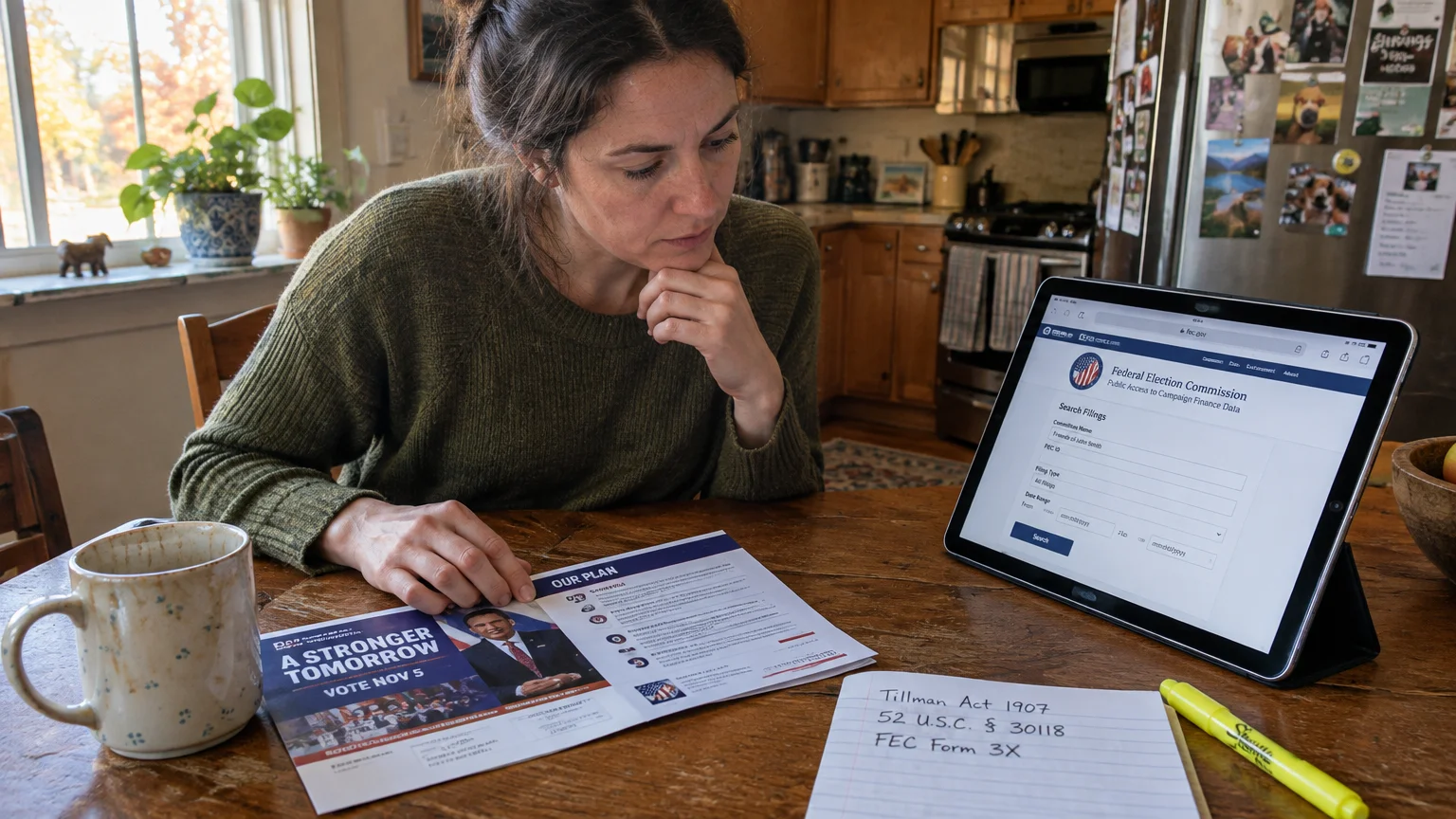
You might hear that Fortune 500 corporations write checks directly from corporate treasuries to bankroll federal candidates. Federal law strictly prohibits this practice under 52 U.S.C. § 30118.
Congress first banned direct corporate contributions when President Theodore Roosevelt signed the Tillman Act of 1907 (34 Stat. 864) on January 26, 1907.
That foundational ban remains fully operative in federal campaigns today.
When a corporation sponsors a political committee, federal regulations classify it as a separate segregated fund under 11 C.F.R. § 114.5. This fund can only solicit voluntary donations from executive personnel, employees, and stockholders.
Your employer cannot divert operating profits, corporate revenue, or treasury balances into candidate campaign committees. Every dollar distributed by a corporate political committee represents strictly voluntary, capped contributions from individual donors.
- Direct corporate treasury gifts: Prohibited under Title 52 of the United States Code, specifically 52 U.S.C. § 30118.
- Permitted funding mechanism: Voluntary personal donations pooled into separate segregated funds under 11 C.F.R. § 114.5.
- Historical enactment: The Tillman Act of 1907 passed the Senate on January 26, 1907, establishing the corporate contribution ban.
- Voter action: Inspect FEC Form 3X filings to verify whether committee contributions derive from segregated employee pools.
The Creation of Super PACs by Citizens United
Popular commentary often claims the Supreme Court created Super PACs in its landmark Citizens United v. FEC ruling. The high court decided that case on January 21, 2010, by a 5–4 vote.
The Supreme Court decision in Citizens United v. FEC struck down statutory bans on independent political expenditures by corporations and labor unions. However, the ruling did not address contribution limits to political committees.
The true legal birth of the Super PAC occurred two months later in the D.C. Circuit Court of Appeals.
On March 26, 2010, a unanimous nine-judge panel decided SpeechNow.org v. FEC (599 F.3d 686).
The appellate court held that government cannot limit contributions to committees that engage exclusively in independent expenditures. That specific appellate holding created the modern independent expenditure-only committee known as the Super PAC.
- Citizens United ruling: Struck down 2 U.S.C. § 441b prohibitions against corporate independent expenditures on January 21, 2010.
- SpeechNow.org ruling: Invalidated contribution limits to independent expenditure committees on March 26, 2010 (Docket No. 08-5223).
- Official classification: The Federal Election Commission designates these entities as independent expenditure-only political committees.
- Practical takeaway: Recognize that Super PACs exist due to D.C. Circuit precedent interpreting the First Amendment, not direct Supreme Court decree.
The Conflation of Super PACs and Dark Money
You might believe that Super PACs operate in secret without revealing who funds their advertisements. In reality, the Federal Election Campaign Act requires Super PACs to disclose every donor publicly.
Super PACs register with the Federal Election Commission and file regular Form 3X disclosure statements under 52 U.S.C. § 30104. You can search these public records to see individual names, contribution amounts, and dates.
Genuine “dark money” originates within tax-exempt non-profit entities organized under sections 501(c)(4) or 501(c)(6) of the Internal Revenue Code. Federal tax regulations allow these advocacy groups and trade associations to withhold donor identities.
According to the Congressional Research Service report on campaign finance policy, non-disclosing groups expanded their footprint dramatically. Dark money spending grew from under $5 million in 2006 to over $1 billion in the 2024 cycle.
- Super PAC disclosure: Complete donor reporting mandated by 52 U.S.C. § 30104 and filed regularly on FEC Form 3X.
- Dark money vehicles: Internal Revenue Code 501(c)(4) social welfare organizations and 501(c)(6) business leagues.
- Intermediary spending: Nonprofits may legally contribute treasury funds to Super PACs, masking original donor sources on FEC disclosures.
- Public access: Access the FEC public disclosure portal to review full donor lists for any registered Super PAC.
Legal Coordination Between Candidates and Super PACs
Critics often assume candidates sit down with allied Super PAC directors to map out advertising strategy. Federal election law explicitly prohibits campaigns from coordinating their expenditures with independent committees.
The FEC enforces a strict three-prong coordination test codified in 11 C.F.R. § 109.21. Regulators evaluate the payment source, the specific communication content, and the underlying conduct between the campaign and the committee.
If a Super PAC produces advertisements based on private campaign instructions or strategic data, the FEC treats the expenditure as an in-kind contribution. Such contributions trigger severe civil fines under 52 U.S.C. § 30109.
Because Super PACs accept unlimited funds, any coordinated payment instantly constitutes an illegal excessive contribution. Candidates who violate these non-coordination boundaries risk mandatory enforcement actions and extensive federal penalties.
- Three-prong standard: 11 C.F.R. § 109.21 examines payment by an outside party, specific content criteria, and conduct interactions.
- Prohibited conduct: Material involvement, private campaign strategy discussions, or common vendor data sharing without firewall protection.
- Statutory enforcement: The FEC investigates coordination complaints under authority granted by 52 U.S.C. § 30109.
- Strategic distinction: Independent groups may support candidates publicly, but they cannot legally operate under candidate direction.
Biennial Aggregate Limits on Individual Donors
Many voters assume a wealthy individual can only donate to a small handful of candidates before hitting a federal ceiling. The Supreme Court dismantled that aggregate cap over a decade ago.
On April 2, 2014, the Supreme Court issued its 5–4 decision in McCutcheon v. FEC (572 U.S. 185). Chief Justice John Roberts wrote the plurality opinion invalidating biennial aggregate contribution limits.
Before that ruling, federal statutes capped the total combined amount any citizen could donate across all federal campaigns in a two-year cycle. The Court ruled this overall ceiling unconstitutionally burdened First Amendment political speech.
You still face strict base limits for each individual candidate—set at $3,500 per election for the 2025–2026 cycle. However, you may give that maximum amount to as many separate candidates as your budget allows.
- Deciding precedent: McCutcheon v. FEC, 572 U.S. 185, announced on April 2, 2014, in a 5–4 roll-call vote.
- Abolished standard: 2 U.S.C. § 441a(a)(3) biennial caps limiting total cycle donations to all federal candidates and committees.
- Base limits intact: Statutory limits per candidate ($3,500 per election for 2025–2026) remain mandatory under federal law.
- Donor impact: Wealthy donors can contribute maximum hard money checks to dozens of congressional candidates nationwide simultaneously.
Unrestricted Soft Money Flowing to National Parties
You might hear that national political parties accept multimillion-dollar corporate donations just like modern Super PACs. Congress abolished unregulated “soft money” donations to national party organizations over two decades ago.
Congress passed the Bipartisan Campaign Reform Act of 2002, sponsored by Senators John McCain and Russell Feingold. President George W.
Bush signed the measure into law on March 27, 2002.
The statute, codified at 52 U.S.C. § 30125, prohibits national party committees from soliciting, receiving, or directing soft money. National parties must finance all federal activities using strictly regulated, capped “hard money” contributions.
For the 2025–2026 cycle, an individual may donate up to $44,300 per calendar year to a national party committee’s main account. Separate statutory caps permit up to $132,900 annually for specialized convention, building, and legal accounts.
- Legislative enactment: Public Law 107-155 (116 Stat. 81), passed by the House 240–189 and Senate 60–40.
- Statutory prohibition: 52 U.S.C. § 30125 bars national parties from raising soft money outside federal contribution limits.
- Specialized party accounts: 52 U.S.C. § 30116(a)(9) permits capped donations for presidential conventions, headquarters buildings, and election recounts.
- State party rules: Individuals may contribute up to $10,000 per calendar year to state and local party federal accounts.
Unlimited Candidate Donations from Traditional PACs
Headlines frequently describe political action committees pouring endless cash directly into congressional and presidential campaigns. In reality, traditional PACs operate under rigid, unyielding statutory donation ceilings.
Under 52 U.S.C. § 30116(a)(2)(A), a qualified multicandidate PAC can donate a maximum of $5,000 per candidate per election. Because the primary and general elections count separately, the maximum total reaches $10,000 per cycle.
To qualify as a multicandidate PAC, a committee must register for six months, receive contributions from fifty persons, and support five federal candidates. Smaller, non-multicandidate PACs face the lower individual limit of $3,500 per election.
Unlike individual candidate limits, Congress did not index multicandidate PAC limits to inflation when updating the law in 2002. As a result, the real financial power of traditional PAC contributions directly to candidates has steadily diminished.
- Statutory limit: 52 U.S.C. § 30116(a)(2)(A) establishes the $5,000 per election ceiling for multicandidate PACs.
- Qualification rules: 52 U.S.C. § 30116(a)(4) mandates registration for 6 months, 50 contributors, and contributions to 5 federal candidates.
- Non-multicandidate rate: Committees falling short of multicandidate criteria cannot exceed individual limits ($3,500 per election for 2025–2026).
- Inflation stagnation: Multicandidate contribution ceilings remain identical to their original 1974 levels without cost-of-living adjustments.
Optional Disclaimers on Political Broadcasts and Ads
You might assume the brief spoken statements and disclaimers at the end of political commercials represent optional advertising courtesies. Federal law mandates these specific disclaimers on virtually all paid public political messaging.
Under 11 C.F.R. § 110.11, every paid political communication must explicitly state who paid for the message and whether a candidate authorized it. The Supreme Court upheld disclaimer requirements in Buckley v. Valeo on Oyez (424 U.S. 1) in 1976.
The Bipartisan Campaign Reform Act added the “Stand By Your Ad” requirement under 52 U.S.C. § 30120. This rule forces candidates to deliver an audio statement confirming their personal approval of broadcast communications.
When outside groups sponsor ads without candidate authorization, the disclaimer must display the committee’s permanent name, street address, and web address. These mandatory notices give you immediate, actionable insight into who funds political arguments.
- Statutory mandate: 52 U.S.C. § 30120 requires visible and audible notices of sponsorship and candidate authorization.
- Regulatory standards: 11 C.F.R. § 110.11 governs disclaimer specifications across television, radio, direct mail, and paid internet advertising.
- Candidate audio statement: Federal law mandates the spoken phrase confirming candidate approval on all broadcast television and radio ads.
- Outside committee requirements: Non-candidate disclaimers must state non-authorization and provide verifiable committee contact credentials.
| Entity Type | Individual Contribution Limit | Corporate Treasury Funds | Direct Candidate Donation | Donor Disclosure |
|---|---|---|---|---|
| Candidate Committee | $3,500 per election | Prohibited | Direct recipient | Mandatory (Form 3) |
| Traditional Multicandidate PAC | $5,000 per calendar year | Prohibited | $5,000 per election | Mandatory (Form 3X) |
| National Party Committee (Main) | $44,300 per calendar year | Prohibited | $62,000 per Senate race | Mandatory (Form 3X) |
| Super PAC (Independent Expenditure) | Unlimited | Permitted | Prohibited | Mandatory (Form 3X) |
| 501(c)(4) Social Welfare Group | Unlimited | Permitted | Prohibited | Non-public |
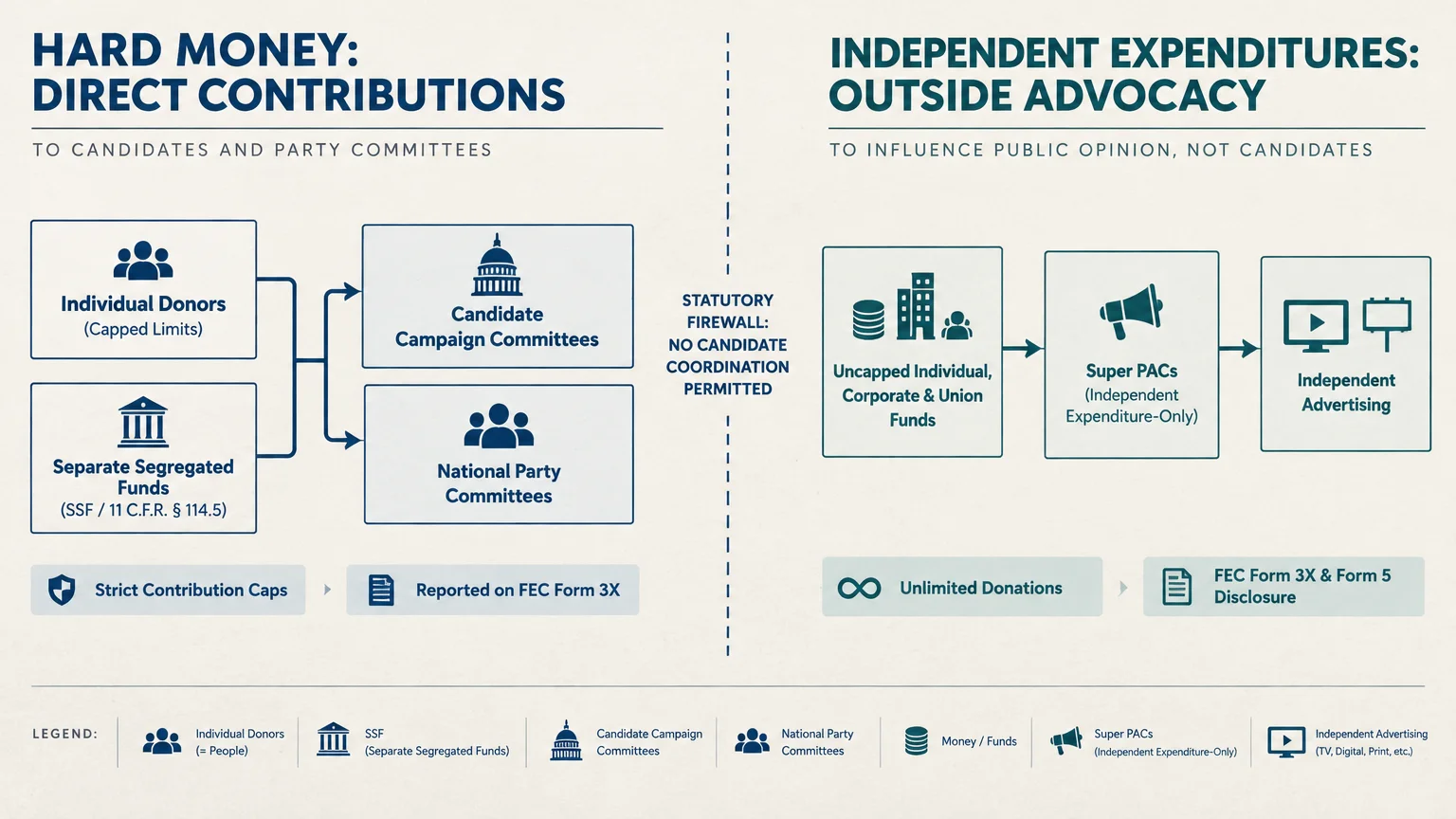
Understanding the Architecture of Federal Campaign Finance
The evolution of federal campaign finance reveals a consistent tension between anti-corruption limits and First Amendment speech rights. Every major statutory reform triggered court challenges that redefined how money flows through our elections.
Congress designed the Federal Election Campaign Act to cap both campaign contributions and outside independent expenditures. However, the Supreme Court ruled in 1976 that limiting independent spending unconstitutionally suppresses political discourse.
That core legal doctrine paved the way for the contemporary bifurcated system. Direct contributions to candidates face strict dollar ceilings, while independent outside groups raise and spend unlimited funds.
Consulting the official FEC Contribution Limits table helps you verify current statutory thresholds in real time. Knowing these legal baselines prevents deception during heated election campaigns.
When you encounter political advertisements, check the disclaimer to identify the sponsoring entity immediately. The distinction between hard money committees and independent Super PACs defines how federal elections function today.
Federal campaign finance laws do not eliminate money from politics; they channel funds through distinct regulatory pathways. Recognizing these statutory pathways allows you to trace political spending directly back to its institutional origins.
Frequently Asked Questions About Campaign Finance
How do I check who funds a specific Super PAC?
You can search the Federal Election Commission’s online database at fec.gov using the committee’s name from the advertisement disclaimer. The site provides downloadable Form 3X reports listing all individual and corporate contributors.
These itemized disclosure records reveal donor names, mailing addresses, contribution dates, and employment information for all amounts over $200. Reviewing these filings allows you to identify the major financial backers behind political messages.
Why do contribution limits increase every election cycle?
The Bipartisan Campaign Reform Act of 2002 mandated that the FEC index individual candidate contribution limits to inflation. The agency calculates and publishes these adjusted caps at the beginning of each odd-numbered year.
For the 2025–2026 cycle, the individual per-election limit rose to $3,500, up from $3,300 in the previous cycle. Conversely, traditional PAC contribution limits remain fixed by statute because Congress did not tie them to inflation.
Can foreign nationals donate to Super PACs or federal candidates?
Federal law strictly bans foreign nationals from contributing money to any federal, state, or local election campaign under 52 U.S.C. § 30121. This ban applies equally to candidates, political parties, traditional PACs, and Super PACs.
Permanent resident green card holders are an exception and may legally contribute under federal guidelines. The FEC vigorously enforces these citizenship requirements across all fundraising platforms and independent expenditure groups.
What happens if a candidate coordinates directly with a Super PAC?
When a candidate coordinates advertising or strategy with an independent committee, the FEC reclassifies the expenditures as in-kind contributions. This reclassification immediately breaches statutory contribution caps and corporate donation prohibitions.
The FEC or the Department of Justice can launch investigations resulting in substantial civil fines or criminal prosecution for willful violations. Committees and campaigns must operate independently to avoid severe legal sanctions.