When you hear commentators claim that presidents govern by unchecked executive decree, you are hearing political rhetoric rather than constitutional law. The Federal Register and federal court records prove that executive orders operate inside rigid, enforceable legal boundaries.
Presidents cannot invent statutory powers out of thin air, nor can they bypass judicial review or congressional spending authority. Every order leaves a documented administrative trail of legal reviews, statutory citations, and published checks that you can inspect yourself.
Understanding how these directives actually work separates sensational political headlines from measurable constitutional limits. Here is what the official historical and regulatory records reveal about the eight most persistent myths surrounding presidential orders.
Measuring Presidential Authority Through the Public Record
You often encounter claims that executive orders bypass the constitutional system and establish unchecked presidential control. Official government archives tell a very different story.
This analysis examines the public record from George Washington’s administration through June 2026. We track directives using the official Federal Register Disposition Tables and landmark Supreme Court decisions.
Our editorial team selected these eight myths based on frequent misconceptions in national news coverage. We cross-referenced each claim directly against statutory law, historical cataloging systems, and judicial precedents.
Under the Federal Register Act of 1935, executive actions must follow transparent legal channels. The National Archives catalogs every formal directive that shapes agency behavior.
You can review these primary documents yourself through the Federal Register presidential documents database. Every order cited here belongs to the permanent administrative record.
By checking public records, you can separate substantive executive administration from political theater. The legal record demonstrates clear boundaries on unilateral presidential power.
These boundaries ensure that executive actions remain accountable to congressional statutes and judicial review. No president can rewrite statutory law through administrative proclamations alone.
Modern Presidents Issue Far More Executive Orders Than Historical Predecessors
You frequently hear political commentators argue that modern presidents sign executive directives at an unprecedented pace. Historical tracking tables maintained by the National Archives prove that the opposite is true.
Presidential reliance on unilateral orders peaked during the early-to-mid twentieth century. Franklin D.
Roosevelt signed 3,721 executive orders between 1933 and 1945, spanning EO 6071 through EO 9537.
Other twentieth-century presidents also issued staggering totals. Woodrow Wilson issued 1,803 orders during his two terms; Calvin Coolidge signed 1,203 directives during his five years in office.
Modern administrations sign a fraction of those historical figures. Bill Clinton signed 364 orders (EO 12834 through EO 13197), while George W.
Bush signed 291 orders (EO 13198 through EO 13488).
Barack Obama issued 276 orders (EO 13489 through EO 13764), averaging just 35 per year. That marked the lowest annual average for any two-term president since the nineteenth century.
Joe Biden signed 162 total orders (EO 13985 through EO 14146), averaging 41 per year. He signed 77 orders in 2021, 29 in 2022, 24 in 2023, 19 in 2024, and 13 in January 2025.
Donald Trump signed 220 orders in his first term (EO 13765 through EO 13984). In his second term, he signed 225 orders in 2025 (EO 14147 through EO 14371) and 64 orders in 2026 through EO 14435.
His combined two-term total of 509 orders places him ninth in U.S. history. Even with that surge, modern presidential volume remains far below mid-century highs.
Historical data compiled by the American Presidency Project confirms that twentieth-century executives utilized executive instruments far more frequently than contemporary presidents.
When politicians claim modern executive activity is out of control, historical records provide necessary perspective. Early-twentieth-century chief executives relied far more heavily on unilateral orders to direct domestic and military operations.
Executive Orders Have Been Formally Numbered and Tracked Since George Washington
Many observers assume that George Washington signed Executive Order 1 and that presidents have numbered them chronologically ever since. The numbering system did not exist during the nation’s first 118 years.
Early presidents issued directives as informal handwritten letters, military commands, and unnumbered circulars. The Department of State did not create a formal numbering system until 1907.
When the State Department instituted the system, clerks worked backward through historical files. They assigned Executive Order 1 retroactively to an order signed by Abraham Lincoln on October 20, 1862.
Lincoln’s directive, titled Establishing a Provisional Court in Louisiana, created a federal occupation court during the Civil War. All earlier directives from Washington through James Buchanan remained unnumbered.
Historians estimate that between 1,500 and 50,000 unnumbered executive orders exist in national archives. Early record-keeping practices were decentralized, leaving many state documents untracked.
When researchers discovered overlooked historical directives after 1907, clerks inserted them using letter suffixes such as Executive Order 7709-A. Consequently, modern order numbers do not represent an exact tally of total orders issued.
Only one chief executive in American history never signed an executive order. William Henry Harrison served for 31 days in 1841 before dying in office, leaving behind exactly zero orders.
Early presidents did not require formal numbering systems because the executive branch remained small. As bureaucratic agencies expanded during industrialization, systematic record-keeping became an administrative necessity.
The modern cataloging process provides order to executive records, but you must recognize it as a twentieth-century administrative reform rather than a founding tradition.
An Executive Order Takes Immediate Legal Effect the Moment the President Signs It on Television
Cable news broadcasts often show presidents signing executive orders behind the Resolute Desk with immediate fanfare. A public signing ceremony does not instantly create enforceable law.
Title 1, Part 19 of the Code of Federal Regulations establishes strict administrative steps before an order takes effect. These rules stem directly from Executive Order 11030, signed by John F.
Kennedy on June 19, 1962.
Proposed orders must first pass through the Director of the Office of Management and Budget (OMB) for policy and budgetary review. The draft then proceeds to the Attorney General for constitutional vetting.
The Office of Legal Counsel (OLC) within the Department of Justice evaluates whether the president possesses statutory or constitutional authority. OLC must formalize its legal approval in writing before processing continues.
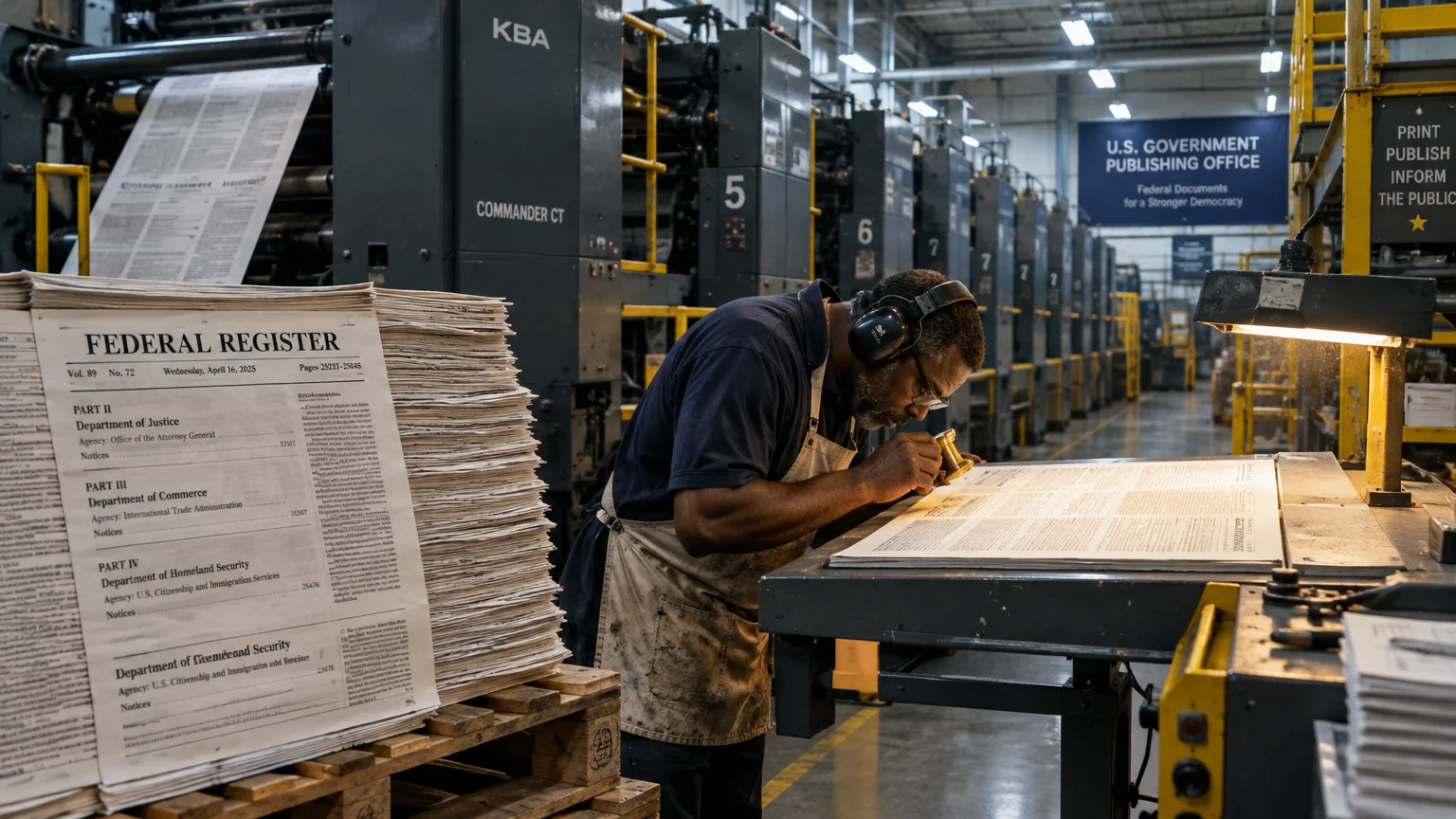
Once approved, the document travels to the Office of the Federal Register (OFR). The OFR logs the text, assigns the next official chronological number, and prepares it for public dissemination.
The publication process typically requires one to several business days after the White House ceremony. An order becomes officially operational only after publication or receipt of official notice by affected federal agencies.
If an agency attempts to enforce an unvetted order without administrative filing, affected parties can challenge the action immediately in federal court. Procedural compliance remains essential to executive validity.
Executive Order 11030 remains the controlling administrative standard for presidential drafting. This formalized process ensures that administrative law safeguards operate before any White House policy reaches the public.
Executive Orders Carry the Permanent Force of Federal Legislation
You might hear critics describe executive orders as permanent decrees that function like statutes. The public record proves that executive orders possess none of the permanence of congressional legislation.
What one president creates through executive action, a successor can dismantle instantly with a single signature. No congressional debate, committee vote, or legislative compromise is required.
Historical transitions demonstrate how quickly policy shifts through executive reversals. On January 20, 2025, President Trump signed Executive Order 14148, titled Initial Rescissions of Harmful Executive Orders and Actions.
That single document immediately revoked 78 executive orders and presidential memoranda signed by President Joe Biden. Decades of administrative policy can vanish during a president’s first afternoon in office.
Statutory laws passed by Congress under Article I remain in force until Congress amends them, repeals them, or courts strike them down. Executive orders, by contrast, survive entirely at the political discretion of the sitting president.
If you want lasting policy changes, executive orders offer an unstable foundation. They provide temporary administrative direction, but they lack the binding permanence of statutory law.
This fundamental impermanence explains why policy advocates prioritize congressional legislation over executive action. Lasting institutional transformation requires statutory codification by the legislative branch.
All White House Directives Must Appear Publicly in the Federal Register
Many citizens believe that federal transparency laws require the president to publish every directive for public inspection. Statutory law contains deliberate exemptions for national security operations.
The modern publication framework began when Congress passed the Federal Register Act on July 26, 1935. Codified under 44 U.S.C.
Chapter 15, the statute took effect in March 1936.
The statute requires chronological publication only for presidential documents possessing general applicability and legal effect on the public. It explicitly excludes classified operations and military contingency plans.
Presidents regularly issue classified directives under names such as National Security Presidential Memoranda or Continuity of Government plans. These orders direct federal intelligence agencies while remaining completely shielded from public gazettes.
The National Archives maintains the Federal Register Executive Orders Disposition Tables to log civilian orders dating back to January 8, 1937. You will not find classified directives listed on these public tables.
While transparency governs domestic agency rules, national security exceptions have shielded executive directives since the Franklin Roosevelt administration. This statutory division balances public notice with state secrecy.
National Security Act provisions interact with the Federal Register Act to protect sensitive intelligence operations. These directives direct cabinet officials while remaining classified under executive privilege.
Congress Cannot Nullify or Defund an Executive Order Without a Two-Thirds Supermajority
Commentators often argue that Congress cannot stop an executive order unless it overrides a presidential veto with two-thirds supermajorities in both chambers. That claim ignores the legislative power of the purse.
Article I, Section 9, Clause 7 of the U.S. Constitution provides that no money shall be drawn from the Treasury except by statutory appropriation. Congress uses this clause to block executive directives routinely.
Lawmakers frequently attach funding restrictions, known as appropriations riders, to annual federal spending bills. These riders prohibit federal agencies from expending a single dollar of appropriated funds to enforce a targeted order.
When Congress includes a funding ban in an omnibus budget bill, the president must accept the restriction or veto the entire federal budget. Presidents rarely shut down the federal government to preserve a defunded order.
A non-partisan Congressional Research Service report on executive directives notes that defunding riders remain one of the most effective congressional tools for neutralizing unilateral presidential actions.
Through appropriations riders, a simple legislative majority can defund an executive program without confronting a standalone presidential veto. Financial leverage gives Congress practical veto power over executive directives.
The power of the purse remains Congress’s most formidable constitutional check on the executive branch. Presidents cannot execute orders when federal agencies lack the legal funding to enforce them.
Presidential Memoranda Are Less Legally Binding Than Executive Orders
Many news consumers assume that presidential memoranda are informal suggestions, whereas executive orders carry the force of law. Federal courts and administrative agencies treat both instruments with equal legal weight.
The legal authority of an executive document derives from the president’s statutory or constitutional powers, not from its title. If a memorandum cites valid statutory authority, executive agencies must obey it.
Presidents often utilize presidential memoranda to manage administrative policy without navigating the technical procedural requirements that govern executive orders. The differences between the two formats are administrative rather than legal.
Unlike executive orders, presidential memoranda are not required by law to be numbered sequentially. Nor must they appear in the Federal Register unless the president determines they carry general legal applicability.
Memoranda also bypass the mandatory Office of Management and Budget cost-assessment statements required for formal executive orders. This procedural flexibility makes memoranda an attractive vehicle for modern administrations pursuing rapid policy directives.
Whether an administration issues an executive order or a memorandum, the judicial standard remains identical. Both directives must rest on valid constitutional or statutory foundations to survive legal challenge.
Presidents since George W. Bush, Barack Obama, and Donald Trump have increasingly utilized memoranda to steer environmental and labor policies.
Both formats bind federal agencies equally under administrative law.
The Constitution Grants the President Inherent Authority to Govern by Executive Decree
Some political figures claim that Article II gives presidents inherent authority to issue binding decrees across the economy during national emergencies. The Supreme Court established strict limits against that theory decades ago.
In the landmark ruling Youngstown Sheet & Tube Co. v. Sawyer (1952), the Supreme Court struck down Harry S. Truman’s Executive Order 10340.
The Court ruled 6–3 in Docket No. 745.
President Truman had ordered Commerce Secretary Charles Sawyer to seize the nation’s commercial steel mills during the Korean War to avert a labor strike. Truman cited his inherent powers as commander-in-chief.
Justice Robert H. Jackson’s concurring opinion established the enduring three-tier framework governing presidential power.
Jackson explained that presidential authority drops to its lowest ebb when a president acts contrary to congressional statute.
Because the Taft-Hartley Act of 1947 had deliberately rejected executive plant seizures, Truman had no constitutional authority to seize the mills. The Court ruled that the president cannot manufacture law without statutory authorization.
Federal courts continue applying Jackson’s framework to test modern executive directives. In early 2025, federal judges blocked executive orders attempting to freeze federal grant funding and eliminate birthright citizenship, citing lack of statutory authorization.
The Youngstown precedent establishes that presidential orders cannot override statutes passed by Congress. Whenever a president acts without statutory or constitutional backing, federal courts step in to invalidate the action.
This constitutional dynamic preserves the separation of powers established in 1787. When executive ambition exceeds legislative authority, independent courts remain empowered to invalidate the order.
| Myth | Official Public Record | Governing Authority | Concrete Example |
|---|---|---|---|
| Modern presidents issue record numbers | FDR signed 3,721 orders; modern totals are far lower | National Archives Disposition Tables | Barack Obama averaged 35 orders per year |
| Numbered since 1789 | State Department created system in 1907 | State Department Historical Office | Lincoln’s 1862 order designated as EO 1 |
| Instant effect at signing | Requires OMB, DOJ, and OFR processing | 1 CFR Part 19; EO 11030 | Mandatory OLC legal reviews before publication |
| Permanent statutory force | Successors can revoke orders immediately | U.S. Constitution, Article II | EO 14148 revoked 78 Biden orders at once |
| All orders published | National security directives are exempt | Federal Register Act (44 U.S.C. Ch. 15) | Classified National Security Memoranda |
| Congress powerless without veto override | Appropriations riders defund enforcement | U.S. Constitution, Article I, Section 9 | Annual budget bans on enforcing specific rules |
| Memoranda lack legal force | Equal legal weight to executive orders | CRS Report R46738; Judicial Precedent | Unnumbered environmental agency directives |
| Inherent decree powers exist | Presidents cannot act contrary to statute | Youngstown Sheet & Tube Co. v. Sawyer | EO 10340 steel mill seizure struck down 6–3 |
How Statutory Frameworks and Judicial Limits Govern Modern Presidential Directives
When you review the administrative record, you see a consistent structural pattern. Executive orders are administrative management tools rather than royal decrees or permanent statutes.
The growth of the modern administrative state between 1935 and 1962 created rigorous oversight mechanisms. The Federal Register Act replaced informal decrees with public accounting and legal transparency.
Executive Order 11030 established essential inter-agency reviews before an order reaches the public. These reviews force the Department of Justice and OMB to verify legal authority beforehand.
The Supreme Court’s Youngstown doctrine ensures that executive authority remains tethered to congressional legislation. A president cannot expand executive power simply by calling a national challenge an emergency.
Congress retains final authority over the federal purse. If lawmakers oppose an executive directive, they can defund its enforcement through standard appropriations riders.
Furthermore, the vulnerability of executive actions to immediate presidential revocation encourages policy instability across administrations. Policies built solely on executive orders rarely outlast the administration that created them.
Real legislative durability requires bipartisan consensus and statutory enactment. As a voter and citizen, understanding these distinctions helps you evaluate whether presidential announcements represent enduring policy or temporary executive posturing.
By relying on the Federal Register and court opinions, you can hold executive claims accountable to the public record. Constitutional checks continue to define the boundaries of executive authority.
Frequently Asked Questions About Executive Orders
Where can you find and read every official executive order?
You can read every public executive order on the official Federal Register website or through the National Archives Disposition Tables. The archives index every order by date, number, and subject.
For historical orders issued before 1937, the American Presidency Project at UC Santa Barbara provides searchable digital copies. You can view original signed documents at individual presidential libraries.
Can a single federal judge issue an injunction against an executive order nationwide?
Yes, federal district judges possess the equitable power to issue nationwide preliminary injunctions against federal policies. Judges issue these orders when plaintiffs demonstrate that an order likely exceeds statutory authority.
The federal government can appeal such injunctions to regional circuit courts and ultimately to the Supreme Court. In recent administrations, nationwide injunctions have frequently paused major executive directives within days of signing.
What happens if an executive order contradicts an existing federal statute?
The federal statute always prevails under Article VI and Article II of the U.S. Constitution. The Supreme Court’s Youngstown decision established that presidents cannot supersede congressional law through unilateral executive action.
If an affected party sues, federal courts will declare the conflicting provisions of the executive order null and void. Agencies that enforce an invalidated order face immediate court sanctions.
Why do modern presidents use presidential memoranda instead of executive orders?
Presidents use memoranda because they offer identical administrative force with fewer procedural hurdles. Memoranda do not require chronological numbering or mandatory publication in the Federal Register.
Additionally, presidential memoranda do not require formal regulatory impact analyses from the Office of Management and Budget. This streamlines agency instructions when White House teams want immediate administrative action.