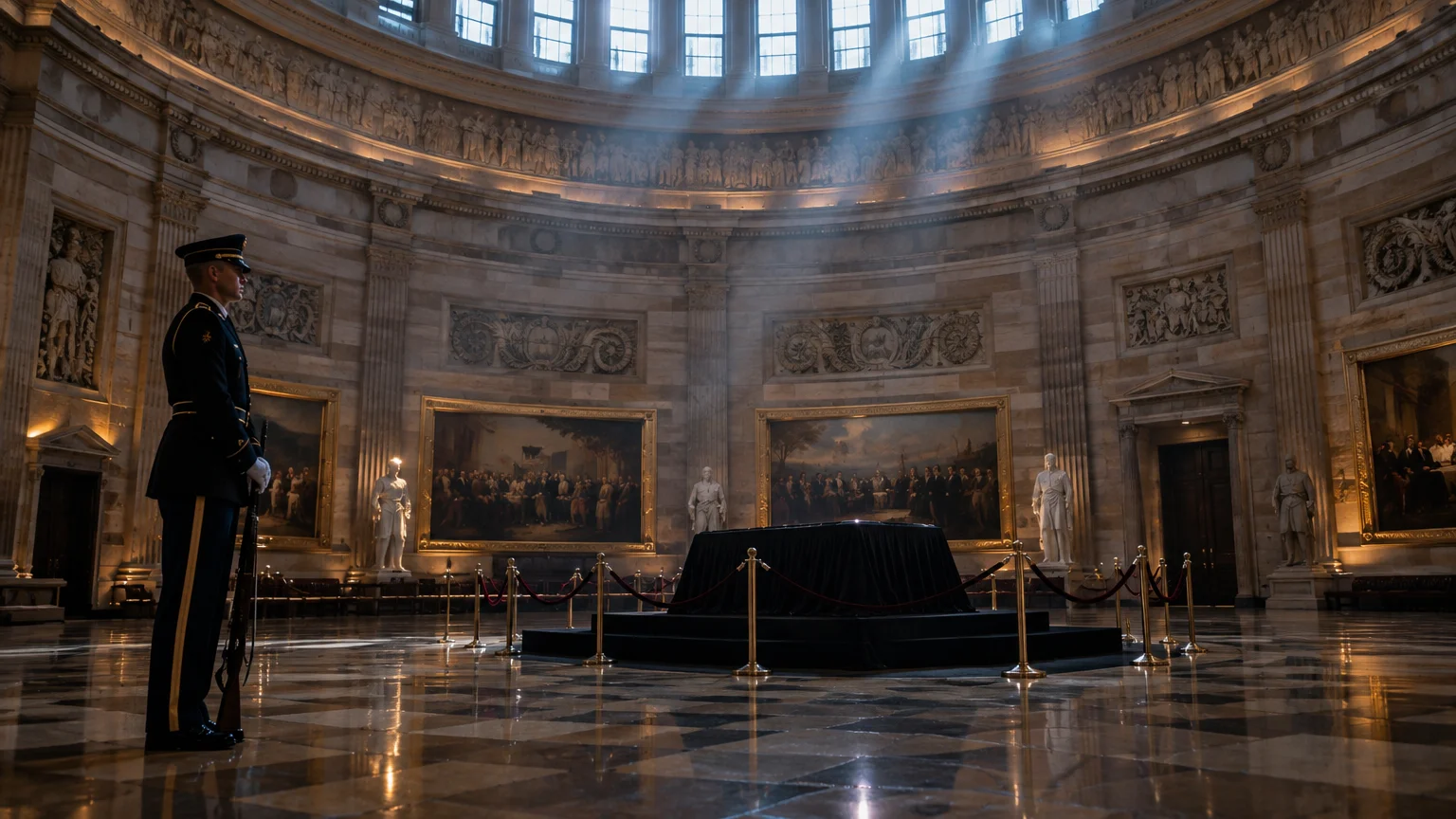
When a prominent American dies, an invitation to the United States Capitol Rotunda represents one of the nation’s highest public tributes. Yet no federal statute guarantees any citizen, general, or former president the right to rest beneath the Capitol dome.
Congress controls the building under its constitutional authority, deciding who enters and what ceremony takes place. Decades of strict protocol determine whether someone lies in state or lies in honor.
Understanding these procedural boundaries shows you exactly how political leaders, military commands, and surviving families navigate this rare national ritual.
How Congressional Precedent and Military Protocol Shape Capitol Services
You might assume that the president holds the power to order a state funeral anywhere in Washington. In practice, our system divides authority between the executive branch and the legislature.
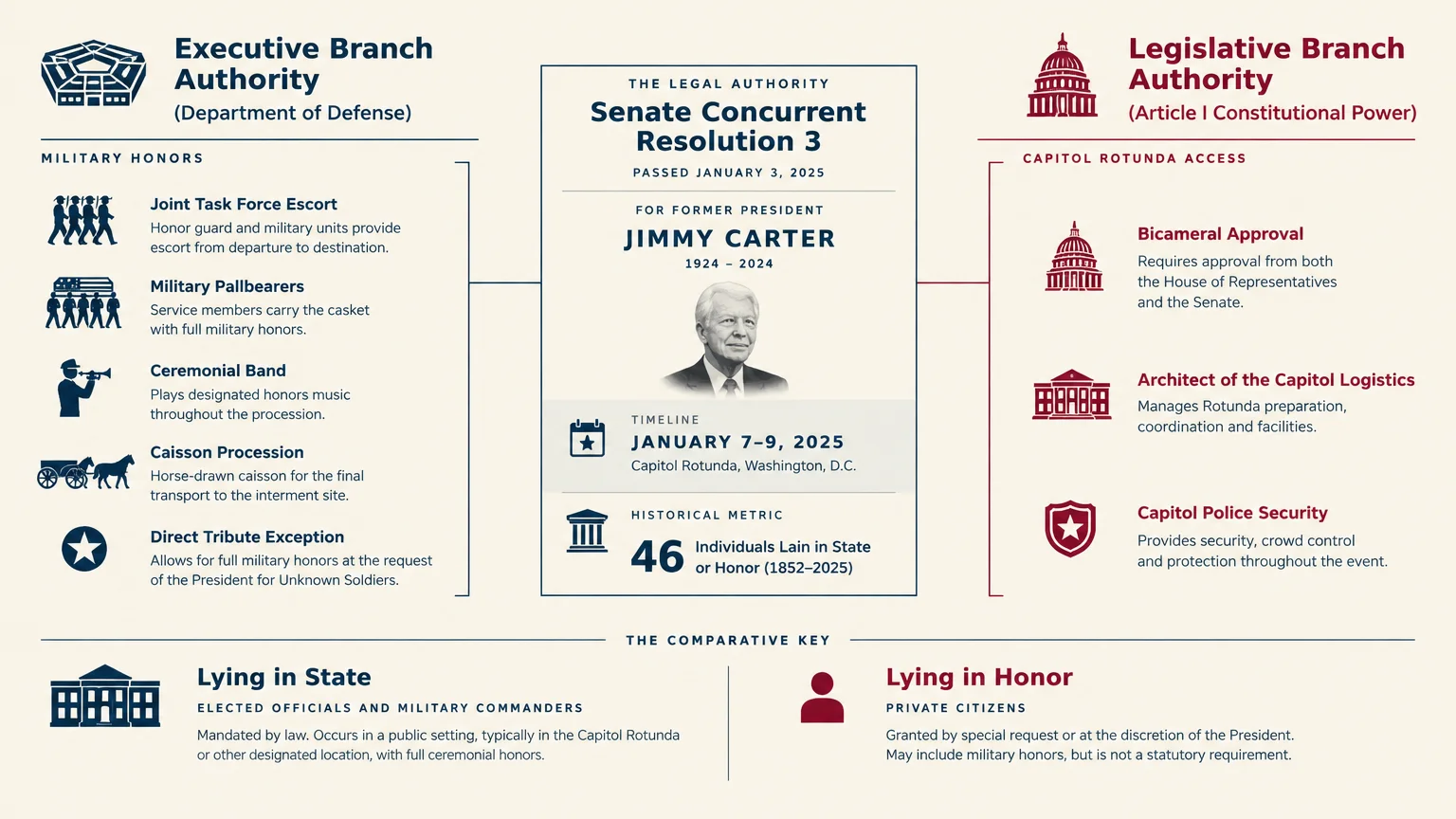
The executive branch directs military honors through the Department of Defense. Meanwhile, the legislative branch retains sole constitutional authority over the Capitol building itself.
As of August 2025, exactly 46 individuals have lain in state or in honor across the Capitol complex. The vast majority of these ceremonies took place beneath the Capitol Rotunda’s soaring cast-iron dome.
Our editorial team examined historical records, congressional resolutions, and military directives to isolate the governing rules. These standards separate binding military laws from discretionary congressional customs.
They clarify why high-ranking officials receive military guards while private citizens receive civilian tributes. Every rule on this list reflects a documented standard drawn from official government sources.
Concurrent Action by Congress
You cannot secure the Capitol Rotunda without explicit permission from both chambers of Congress. According to historical records published by the Office of the Historian of the U.S. House of Representatives, no permanent statute governs Rotunda ceremonies.
Instead, Congress manages the building through its constitutional property powers under Article I. Lawmakers authorize Rotunda use by passing a concurrent resolution, which requires approval from both the House and the Senate.
Because a concurrent resolution does not go to the president for a signature, lawmakers maintain total control over their own chambers. The resolution outlines the exact dates, hours, and logistical terms for the ceremony.
When Congress is not in session, leaders rely on an established administrative shortcut. The Speaker of the House and the Senate Majority Leader can approve Rotunda ceremonies through joint executive agreement.
You saw this formal process unfold following the death of former President Jimmy Carter. On January 3, 2025, lawmakers enacted Senate Concurrent Resolution 3 in the 119th Congress.
That measure specifically permitted the use of the Rotunda for Carter’s casket from January 7 through January 9, 2025. It also authorized the Architect of the Capitol to make all physical arrangements.
An exception to the concurrent resolution requirement exists only for the Unknown Soldiers. In those specific ceremonies, the president or the military service secretaries initiate the tribute directly.
Distinction Between Lying in State and Lying in Honor
Congressional protocol strictly separates government officials from private citizens through specific ceremonial terms. You will hear officials describe a casket as either “lying in state” or “lying in honor.”
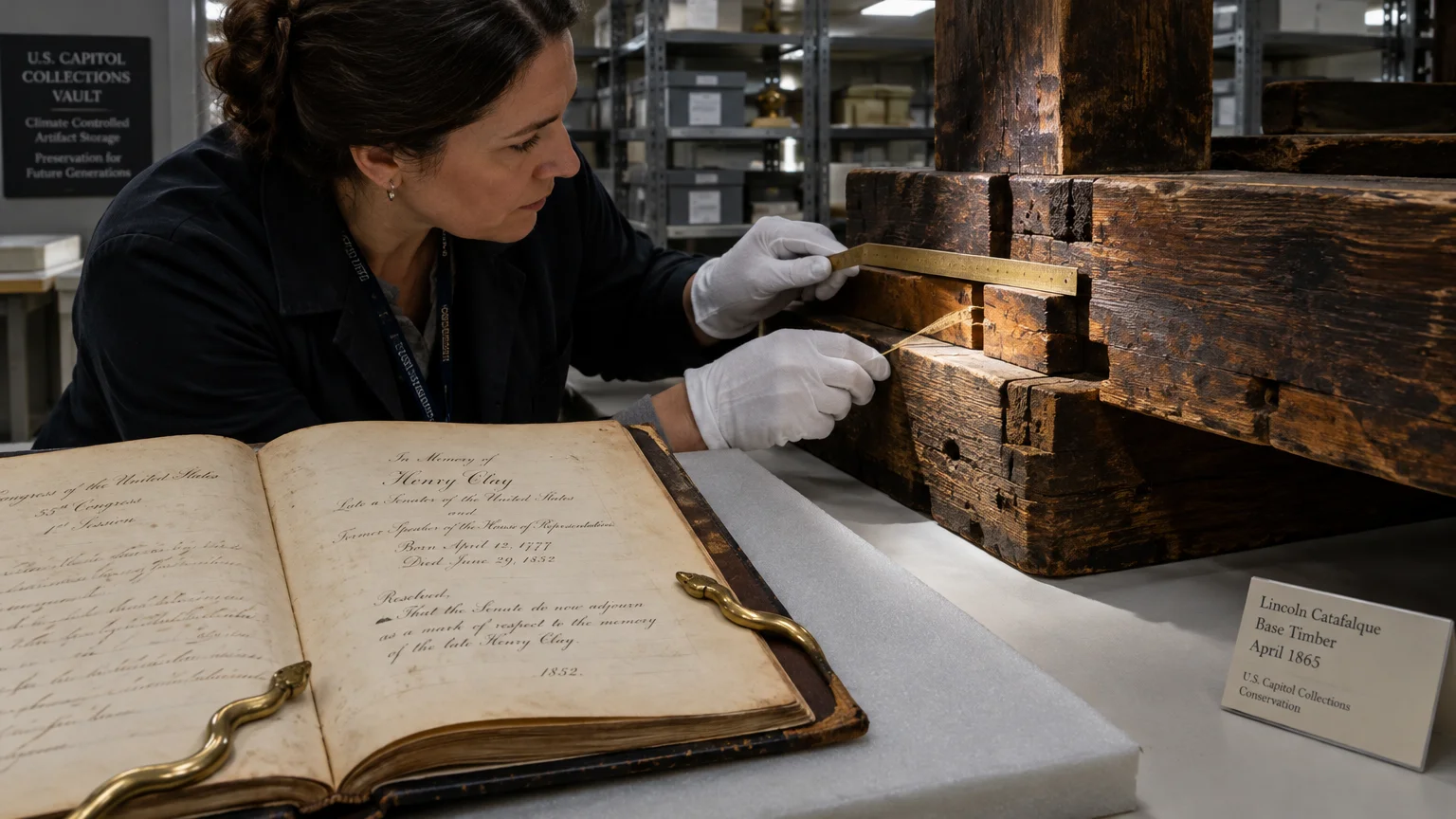
The term “lying in state” applies exclusively to elected government officials and commissioned military commanders. As documented by the U.S. Senate Historical Office, Senator Henry Clay established this precedent on July 1, 1852.
Clay was the first person honored in the Rotunda after serving as a senator, House Speaker, and secretary of state. Abraham Lincoln became the first president to lie in state in April 1865.
Conversely, Congress created the category of “lying in honor” in 1998 for distinguished private citizens. Lawmakers designed this designation for individuals who served the public without holding elected office or senior military command.
Capitol Police Officers Jacob Chestnut and John Gibson became the first Americans to lie in honor under House Concurrent Resolution 311. Both officers died in the line of duty defending the Capitol on July 24, 1998.
In October 2005, civil rights pioneer Rosa Parks became both the first woman and the first private citizen who was not a police officer to lie in honor. Lawmakers approved her tribute through Senate Concurrent Resolution 61.
Through August 2025, 38 individuals have lain in state in the Capitol complex, while only eight have lain in honor. Col.
Ralph Puckett Jr., a Korean War Medal of Honor recipient, became the eighth person to lie in honor on April 29, 2024.
Presidential Authority Under Military Regulations
You must not confuse a formal state funeral with the decision to use the Capitol Rotunda. Department of Defense Directive 1300.30 sets the rules for military support during national memorial services.
Under these regulations, sitting presidents, former presidents, and presidents-elect receive an automatic entitlement to a military state funeral. The president can also designate other distinguished citizens for these services by proclamation.
The Joint Task Force-National Capital Region coordinates these state funerals, providing military escorts, flyovers, and caissons. The ceremony typically unfolds across seven to ten days of structured national observances.
However, executive power stops abruptly at the Capitol plaza. The president can order full military honors at Arlington National Cemetery or the Washington National Cathedral, but cannot order the Capitol doors unlocked.
To place a casket inside the Rotunda, the executive branch must formally coordinate with congressional leadership. The military command handles transportation and honors outside, while legislative officers control the interior space.
This balance maintains the constitutional separation of powers during major national events. Even commander-in-chief orders yield to congressional sovereignty when entering the legislative building.
Mandatory Consent From Surviving Next of Kin
Regardless of what federal officials desire, no Capitol service can occur without explicit permission from the deceased person’s family. You can view next-of-kin authority as an absolute veto over public ceremonies.
Military planners from the Military District of Washington consult directly with living presidents and their families to draft funeral plans years in advance. These personal funeral blueprints remain on file and undergo periodic updates.
When the honoree passes away, the surviving family retains the legal right to alter or cancel any component of the ceremony. Families frequently decline Washington services to avoid political entanglements or prolonged media scrutiny.
For example, the family of former President Harry S. Truman declined a Washington state funeral following his death in December 1972.
They chose private services and burial at his presidential library in Independence, Missouri.
Similarly, the family of former President Richard Nixon declined a Washington ceremony and Rotunda tribute in April 1994. Nixon’s estate selected a funeral at his presidential library in Yorba Linda, California.
This rule protects personal privacy during grief. The government cannot convert a citizen’s death into a public ceremony against the explicit wishes of the surviving relatives.
Designation of Ceremonial Military and Police Guards
The status of the deceased determines who guards the casket while it rests in the Rotunda. You can identify the official nature of the ceremony simply by observing the guards on duty.
When a dignitary lies in state, armed service members maintain an unbroken military vigil. Personnel from the Army, Navy, Marine Corps, Air Force, and Coast Guard stand motionless at the four corners of the catafalque.
These service members execute silent guard changes every thirty minutes throughout the public viewing period. This tradition honors the deceased person’s role as commander-in-chief, military leader, or constitutional officer.
When a civilian lies in honor, military honor guards generally do not maintain the continuous vigil. Instead, civilian agencies or federal law enforcement officers provide the ceremonial watch.
When Capitol Police Officers Brian Sicknick and William Evans lay in honor in 2021, their fellow officers maintained the continuous vigil. This distinction visually reminds you that civilian authority governs private citizens.
The Architect of the Capitol coordinates the interior staging, but the ceremonial guard details answer to their respective commanders. This division reinforces the separation between military service and civilian honors.
Placement Upon the Historic Lincoln Catafalque
Almost every casket brought into the Capitol Rotunda rests upon a single historic platform. According to the Library of Congress, this tradition began in the spring of 1865.
Carpenters hastily assembled a rough pine timber platform to support the coffin of Abraham Lincoln following his assassination. Workers draped this wooden bier in black pleated cloth, creating what historians call the Lincoln Catafalque.
When not hosting ceremonies, the Architect of the Capitol secures the catafalque in a specially designed display area inside the Capitol Visitor Center. Staff members inspect and conserve the fabric and woodwork before each use.
By congressional custom, virtually every individual who has lain in state or honor since 1865 has rested on this specific artifact. Using the catafalque connects modern tributes directly to the preservation of the Union.
Rare exceptions occur only when logistical requirements demand alternate arrangements. For example, during simultaneous honors for the Unknown Soldiers of World War II and the Korean War in 1958, officials constructed identical duplicate biers.
The catafalque measures seven feet one inch long and three feet two inches wide. Its simple design reminds visitors that the dignity of the office supersedes ornate display.
Absolute Discretion of Congressional Leadership
No administrative review or judicial appeal exists if legislative leaders decide against holding a Rotunda service. The Speaker of the House and the Senate Majority Leader hold unilateral gatekeeping power over all requests.
Lawmakers introduce dozens of resolutions proposing honors for prominent public figures, but leaders allow only a tiny fraction to reach the floor. Congressional leaders actively protect the exclusivity of the Rotunda from partisan overuse.
If leadership objects to a proposal, the resolution dies quietly in committee without a roll-call vote. Because leadership controls the legislative calendar, no minority coalition can force a vote on a Rotunda ceremony.
Decisions often involve sensitive political calculations and physical building schedules. Leaders assess whether the public figure achieved true national consensus or merely partisan celebrity.
This unchecked leadership discretion means that personal popularity alone will not secure you a Capitol ceremony. You must possess the bipartisan consensus required for party leaders to alter the legislative calendar.
The system prevents the Capitol from turning into a routine memorial hall. It ensures that only figures representing profound national milestones cross the threshold of the Rotunda.
Historical Precedents for Capitol Memorial Ceremonies
The table below summarizes seven benchmark ceremonies that defined these procedures. You can see how the office held by the individual dictates the classification, the authorization vehicle, and the guard detail.
| Honoree | Year | Category | Authorization | Guard Vigil |
|---|---|---|---|---|
| Henry Clay | 1852 | Lying in State | Senate Arrangement | Military Detail |
| Abraham Lincoln | 1865 | Lying in State | Concurrent Action | Military Detail |
| Jacob Chestnut & John Gibson | 1998 | Lying in Honor | H. Con. Res. 311 | Capitol Police |
| Rosa Parks | 2005 | Lying in Honor | S. Con. Res. 61 | Civilian / Joint |
| Hershel “Woody” Williams | 2022 | Lying in Honor | S. Con. Res. 42 | Military Guard |
| Ralph Puckett Jr. | 2024 | Lying in Honor | H. Con. Res. 104 | Military Guard |
| Jimmy Carter | 2025 | Lying in State | S. Con. Res. 3 | Military Guard |
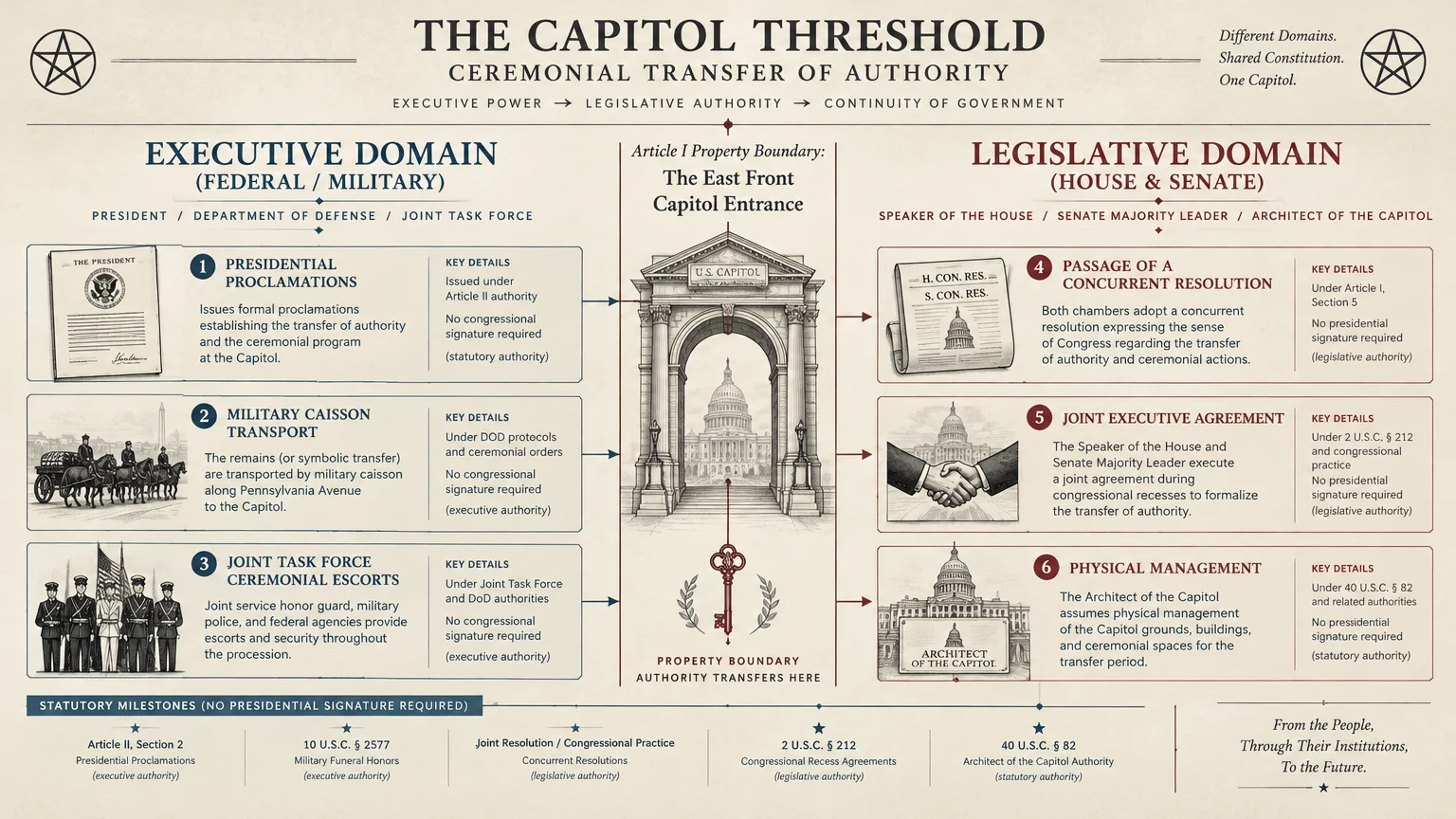
How Capitol Funeral Traditions Balance Executive Honor and Legislative Control
When you examine these rules together, you uncover a deliberate institutional friction between the branches. The presidency commands the military apparatus required to conduct grand state funerals across the country.
Yet the executive branch cannot command access to the legislative seat of government. Congress guards the Rotunda as a separate constitutional preserve, granting entry only on its own terms.
The development of the “lying in honor” protocol in 1998 demonstrates the flexibility of this legislative custom. By creating a new designation, Congress found a way to celebrate civic courage without blurring official constitutional lines.
This procedural distinction ensures that elected officeholders and private citizens are both remembered appropriately. It preserves the historic record while adapting to changing national values.
Families also retain genuine power in this process through mandatory consent rules. The government cannot commandeer a deceased leader’s legacy if surviving relatives prefer a private burial.
As long as the Capitol stands, these ceremonies will require delicate cooperation across party lines and branches of government. A Rotunda service remains an extraordinary exception in American public life, not an ordinary entitlement.
Frequently Asked Questions About Capitol Funerals
Can a sitting president order Congress to hold a funeral in the Rotunda?
No, the president has no legal power to order any ceremony inside the Capitol building. Article I of the Constitution gives Congress exclusive control over its own legislative property and proceedings.
While the president can order a military state funeral under Department of Defense regulations, Congress must pass a concurrent resolution to allow the casket inside.
What is the difference between lying in state and lying in repose?
You use “lying in state” when an elected official or military commander rests inside the Capitol Rotunda. This ceremony features a continuous armed forces guard.
“Lying in repose” describes a public viewing in another government building or private venue. For example, Supreme Court justices routinely lie in repose in the Great Hall of the Supreme Court.
Has any foreign leader ever lain in state in the U.S. Capitol?
No foreign dignitary has ever lain in state or in honor inside the Capitol Rotunda. Congressional custom reserves this tribute strictly for American citizens who rendered distinguished service to the United States.
Foreign leaders and diplomats receive separate military memorial honors coordinated by the Department of State, but those services take place outside the Capitol complex.
Who pays for the costs associated with a state funeral in the Rotunda?
Congress funds the physical arrangements inside the Capitol building through annual appropriations allocated to the Architect of the Capitol. These funds cover staging, security, and preservation of the Lincoln Catafalque.
The Department of Defense funds the military escorts, transportation, and ceremonial guards through its Joint Task Force-National Capital Region operations. Surviving families do not pay for official government ceremonial honors.