You might assume the Congressional Record captures every word spoken on the House and Senate floors exactly as lawmakers uttered it. In reality, the publication functions as a substantially edited journal rather than an unvarnished court transcript.
Lawmakers routinely polish their grammar, soften partisan barbs, and even insert lengthy speeches that nobody delivered aloud. Procedural rules permit these alterations before the Government Publishing Office prints the daily edition overnight.
Understanding these mechanics shows you how Congress shapes its official history and why the printed page often differs from the live video broadcast.
How Congressional Rules Govern the Official Daily Debates
Chapter 9 of Title 44 of the U.S. Code establishes the Congressional Record as the official journal of daily legislative proceedings.
Article I, Section 5, Clause 3 of the U.S. Constitution requires each chamber to keep and publish an official journal of its proceedings.
Congress distinguishes between the formal House and Senate Journals, which log procedural actions and roll-call votes, and the Congressional Record, which captures debate.
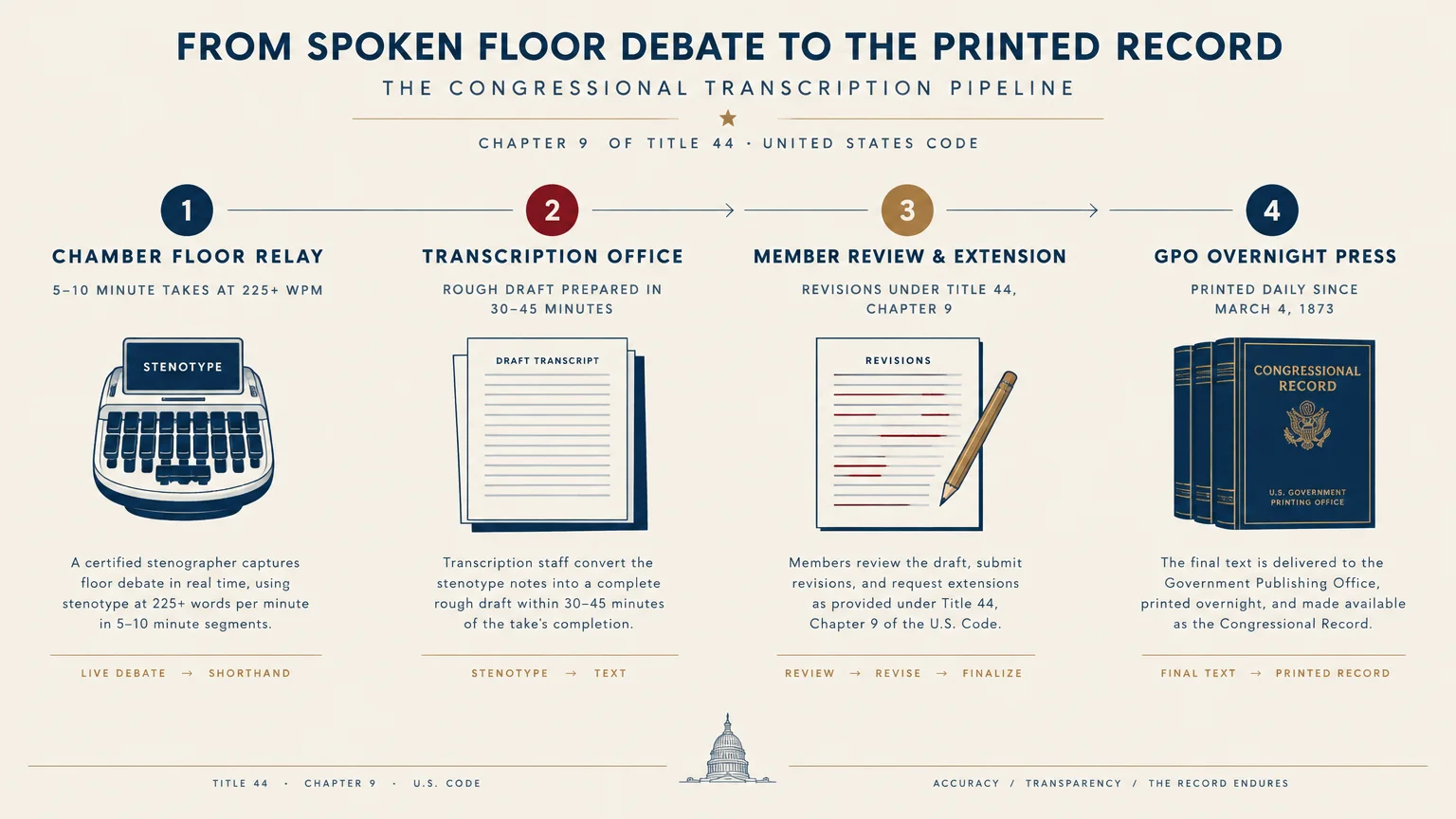
The Government Publishing Office has published the Record continuously since March 4, 1873, when the 43rd Congress ended private printing contracts.
Before 1873, commercial publishers recorded debates with varying accuracy across three predecessor publications: the Annals of Congress, the Register of Debates, and the Congressional Globe.
For the 119th Congress in 2026, the publication documents daily business across Volume 172, following Volume 171 during the 2025 session.
Chamber rules, federal statutes, and directives from the bicameral Joint Committee on Printing govern every page printed in the daily and bound editions.
These six operational rules reveal how spoken debate transforms into the official printed transcript you read today.
Official Floor Reporters Transcribe Debates in Live Relays
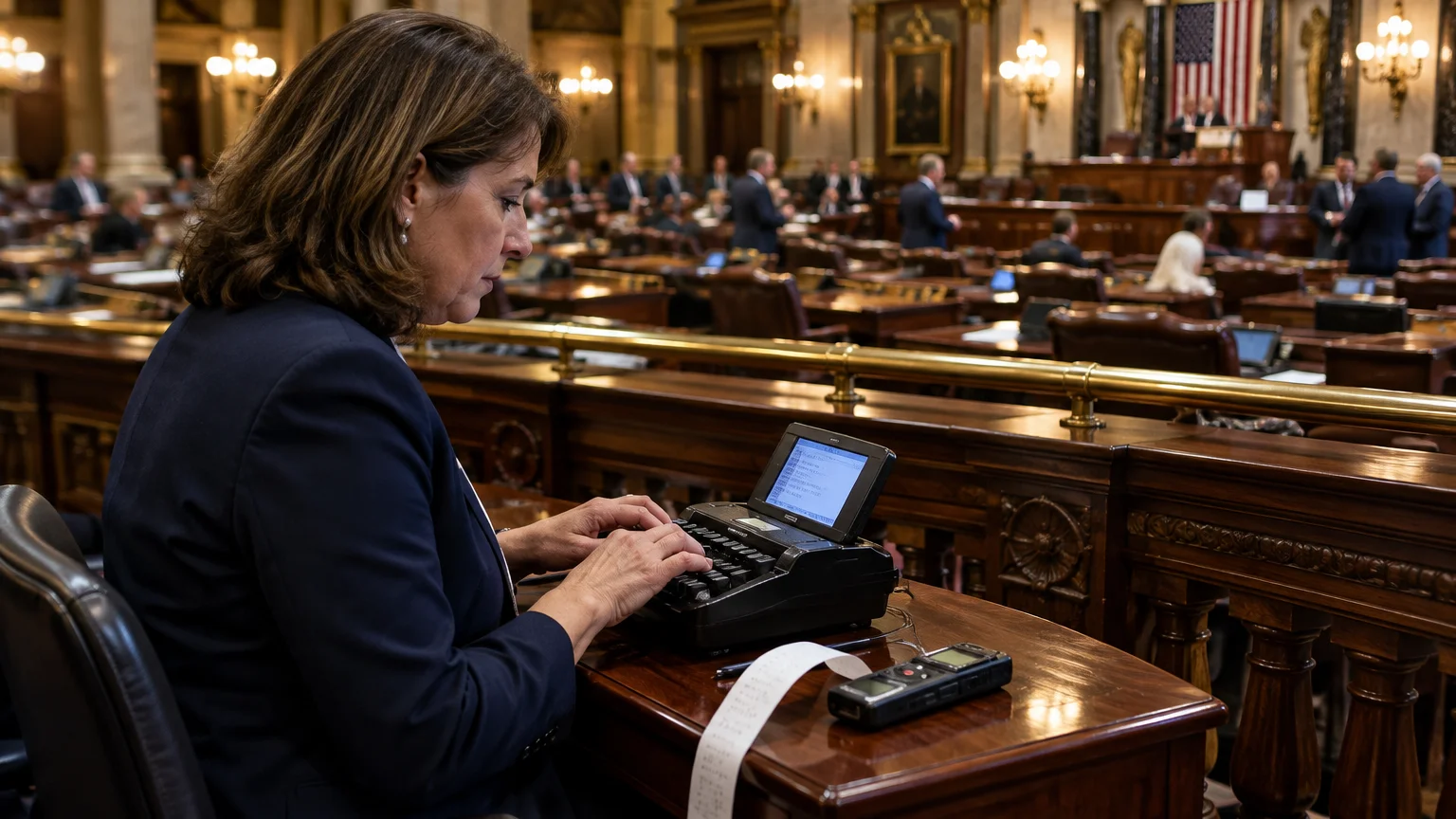
Professional stenographers known as the Official Reporters of Debates capture every spoken exchange on the House and Senate floors in real time.
In the House, these transcribers operate directly under the non-partisan direction of the Office of the Clerk.
In the Senate, floor reporters work under the administrative authority of the Secretary of the Senate.
Floor reporters rotate onto the floor in brief shifts known as “takes,” which typically last only five to ten minutes.
During rapid colloquies and heated debate, reporters stand directly beside speaking members or sit at central floor tables to hear clearly.
They operate specialized computer-aided transcription stenotype machines capable of writing phonetic shorthand at speeds exceeding 225 words per minute.
Digital audio recording systems across the chamber desks and podiums provide an immediate backup track for acoustic verification.
When a reporter finishes a take, they immediately leave the chamber and walk to their Capitol transcription offices to transcribe their shorthand notes.
Transcribers identify each speaker, cross-reference floor sign-in sheets, and verify bill numbers, statutory references, and executive nominations.
The transcription staff produces a rough transcript draft within 30 to 45 minutes of a speech concluding on the floor.
Congressional aides frequently visit the transcription office or check digital portals to review preliminary proofs before the evening publishing cutoff.
This continuous relay system ensures that thousands of lines of spoken debate move efficiently from the chamber floor to overnight typesetting.
You can track how reporters document floor action by monitoring the procedural elements they log during each take:
- Member recognition calls by the presiding officer
- Points of order and formal parliamentary inquiries
- Quorum calls and recorded roll-call votes
- Unanimous consent agreements and legislative motions
By combining mechanical stenography with immediate human editing, the reporting staff delivers an accurate structural foundation for the entire legislative day.
Lawmakers Edit Transcripts Under the Substantially Verbatim Standard
You might expect floor transcripts to lock in every stumble and verbal mistake, but congressional rules allow lawmakers to edit their remarks.
Under House Rule XVII, clause 8, the Congressional Record must provide a “substantially verbatim” account of what occurred on the floor.
Federal authority under 44 U.S.C. § 901 authorizes the Joint Committee on Printing to enforce consistent printing standards across both legislative bodies.
Lawmakers can correct grammatical errors, repair disjointed syntax, and correct unintentional slips of the tongue before publication.
Chamber rules strictly forbid members from altering the substantive meaning of any statement delivered during debate.
A lawmaker cannot delete or modify any remark if another member responded or objected to those specific words during the floor session.
The House established this modern verbatim rule on January 4, 1995, by adopting House Resolution 6 at the opening of the 104th Congress.
Before that 1995 reform, lawmakers routinely stripped out controversial statements or retroactively inserted clever arguments they never actually delivered.
If a member makes an unauthorized substantive change, an opposing lawmaker can raise a question of the privileges of the House under Rule IX.
The presiding officer and chamber parliamentarians consult raw audio recordings and stenographic tapes to verify what the member actually said.
If the presiding officer sustains the point of order, the Clerk publishes a formal correction in a subsequent edition of the Record.
This oversight prevents members from rewriting legislative history while still allowing reasonable grammatical cleanup for printed readability.
Permissible revisions typically fall into a few clear categories:
- Fixing subject-verb agreement and fractured grammar
- Correcting misstated bill numbers or statute titles
- Inserting precise statistical figures mentioned casually during debate
- Adjusting transcript punctuation to match intended spoken meaning
These boundaries preserve the integrity of floor deliberations while preventing misleading revisions from distorting the public record.
General Leave Grants Five Legislative Days for Revisions
During legislative business, floor managers routinely rise to request unanimous consent for “General Leave.”
A floor manager typically states, “I ask unanimous consent that all Members have five legislative days to revise and extend their remarks.”
This standard motion suspends standard reading rules to conserve floor time while passing major statutory packages.
Without General Leave, every individual lawmaker would need separate unanimous consent to submit extended written commentary on a pending bill.
The five-day window gives members time to submit comprehensive legal arguments, constituent letters, and economic data into the permanent record.
Because House debate rules frequently restrict rank-and-file members to one-minute speeches, General Leave provides their only venue for comprehensive policy statements.
Guidance from the Congressional Research Service clarifies that remarks submitted under General Leave must relate directly to the pending legislation.
Staff cannot use a bill’s General Leave authorization to insert unrelated commentary, campaign statements, or personal constituent tributes.
The five legislative days count only formal working sessions of the chamber, not calendar weekend days or district work periods.
If Congress recesses for a week, the deadline for submitting extended remarks pauses until the chamber formally convenes again.
Once the five-day deadline elapses, the Clerk closes the bill file and sends the consolidated remarks for permanent printing.
You can see the practical benefits of this procedural device during crowded legislative sessions:
- Preserves floor time for scheduled amendment debates
- Allows every member to enter written policy explanations for constituents
- Creates a detailed legislative history for executive agencies and courts
- Streamlines debate flow during fast-moving budget reconciliation votes
General Leave strikes a balance between rapid floor voting and thorough, documented legislative deliberation.
Visual Markers and Typeface Changes Identify Unspoken Words
The Congressional Record uses distinct visual markers so readers can tell whether a lawmaker actually spoke or merely submitted written text.
In 1978, the Joint Committee on Printing introduced the black bullet symbol to mark speeches that members inserted without reading aloud.
Congress authorized this marker under Public Law 95-94 to prevent lawmakers from misleading constituents about their physical presence on the floor.
Lawmakers quickly bypassed the bullet requirement by reading a single opening sentence aloud before submitting the rest of the written text.
Because the member spoke one introductory line at the microphone, printing rules allowed the entire unread speech to appear without bullet points.
To close this loophole, the House updated Rule XVII in 1995 to require a distinct typeface for all unspoken statements.
Under modern printing standards, the GPO formats undelivered remarks in a noticeably different font style or italicized typeface.
Under Senate standing rules, senators still use bullet symbols to indicate inserted speeches, statements, and committee explanations.
If you see standard roman typeface in House proceedings, the lawmaker spoke those exact words directly to colleagues on the floor.
When the typography switches to an alternate font, you are reading an insertion submitted silently for the record.
This clear typographical distinction prevents legal researchers from misattributing staff-prepared policy memos to real-time chamber debate.
Federal judges rely on these visual cues when deciding whether a floor statement reflects genuine deliberative debate among lawmakers.
Understanding these markers helps you evaluate floor documentation accurately:
- Standard Roman text: Spoken aloud by the member during live debate
- Distinct font or italics (House): Inserted statement never delivered at the podium
- Bullet symbol (Senate): Unspoken remarks submitted under unanimous consent
- Extensions of Remarks (E-pages): Written statements entered outside chamber debate
These visual identifiers ensure that written insertions cannot pass as live spoken floor proceedings.
Extraneous Insertions Require Cost Estimates Past Two Pages
Lawmakers frequently supplement floor debate by inserting external materials, such as newspaper editorials, academic studies, and constituent correspondence.
To protect public funds, the Joint Committee on Printing enforces a strict two-page ceiling on extraneous insertions.
Two printed pages in the Congressional Record equal roughly five single-spaced or ten double-spaced typed pages of standard manuscript.
If a member wishes to print a document exceeding two pages, they must obtain unanimous consent from the chamber.
Under 44 U.S.C. § 902, the member must attach a formal printing cost estimate certified by the Government Publishing Office.
The GPO calculates this estimate by evaluating paper tonnage, typesetting labor, press time, and distribution costs.
When making the request on the floor, the member must announce the exact dollar estimate directly into the public record.
This procedural obstacle prevents lawmakers from dumping entire government studies, legal briefs, or book manuscripts into the daily record.
Printing regulations also prohibit members from including photographs, political cartoons, technical drawings, and decorative maps in their remarks.
The GPO limits tables strictly to essential legislative tabulations to reduce typesetting complexity and prevent layout delays.
Lawmakers cannot include standard academic footnotes; all citations must appear within the continuous running text of their remarks.
These financial and aesthetic rules keep the daily publication affordable, readable, and focused on core legislative business.
The restrictions on extraneous matter enforce several clear standards:
- Mandatory GPO cost certifications for text exceeding two printed pages
- Total prohibition on photographs, sketches, and decorative artwork
- Exclusion of academic footnotes and complex bibliographic citations
- Strict formatting caps on data tables and graphical figures
By enforcing these boundaries, Congress prevents its official transcript from becoming an expensive depository for outside literature.
Daily Issues Follow a Four-Part Pagination Code Before Bound Consolidation
The Government Publishing Office organizes the daily Congressional Record into four separate sections, each identified by a distinct letter prefix.
Volume 113 of the Record initiated this four-part split during the 90th Congress in 1967 to speed overnight printing.
The “H” prefix designates proceedings and debates of the House of Representatives, including reported bills and floor votes.
The “S” prefix marks Senate floor proceedings, executive business, treaty deliberations, and judicial confirmation debates.
The “E” prefix identifies the Extensions of Remarks section, reserved exclusively for House members submitting undelivered speeches and tributes.
The “D” prefix covers the Daily Digest, which summarizes daily chamber actions, roll-call tallies, and committee hearings.
House rules limit each representative to a maximum of 10 Extensions of Remarks submissions per legislative day.
Members must submit Extensions during a strict window starting 15 minutes before convening and closing 15 minutes after adjournment.
While members traditionally submitted paper copies bearing wet-ink signatures, modern House rules now permit secure electronic submissions via email.
After a congressional session concludes, the GPO collects, re-indexes, and repaginates the daily issues into the permanent Bound Edition.
The Bound Edition removes the H, S, and E letter prefixes, creating a continuous sequential numbering system across all volumes.
You can search modern and historical daily issues freely on Congress.gov and the GPO GovInfo database.
For physical collectors, the GPO still sells daily print subscriptions for $503.00 annually domestically or $252.00 for six months.
The four daily sections serve distinct functions during legislative sessions:
- H section: Houses formal floor debates, motions, and roll calls in the House
- S section: Captures Senate speeches, treaties, and executive confirmations
- E section: Compiles House tributes, policy statements, and constituent honors
- D section: Provides daily summaries of floor votes and committee meetings
This systematic categorization helps lawmakers, journalists, and citizens navigate thousands of daily legislative pages efficiently.
| Section / Feature | Prefix Code | Chamber Scope | Governing Limitation | Bound Transformation |
|---|---|---|---|---|
| House Proceedings | H | House of Representatives | Substantially verbatim rule | Prefix dropped; repaginated |
| Senate Proceedings | S | U.S. Senate | Unspoken words use bullets | Prefix dropped; repaginated |
| Extensions of Remarks | E | House only | Max 10 inserts per day | Consolidated into bound text |
| Daily Digest | D | House and Senate | Committee and floor summaries | Published in separate index |
| Extraneous Insertions | H, S, or E | Bicameral | Cost estimate past 2 pages | Integrated with source take |

Why the Evolving Record Matters for Statutory Interpretation
The operational rules governing the Congressional Record directly affect how federal courts and administrative agencies interpret federal laws.
When statutory language is ambiguous, litigators and judges review floor statements to discern the original legislative intent of Congress.
The late Supreme Court Justice Antonin Scalia frequently warned against relying on floor remarks, arguing that staff ghostwrite inserted statements.
The 1995 typeface reforms gave the judiciary a clear tool to evaluate the reliability of floor statements.
Today, judges can easily determine whether an explanation occurred during live debate or appeared via a quiet insertion.
Live spoken colloquies between committee chairs and bill sponsors carry substantial persuasive weight during judicial statutory interpretation.
In contrast, federal judges routinely discount statements published in the Extensions of Remarks or printed in alternate typefaces.
Courts treat inserted statements as unilateral constituent messaging rather than evidence of collective legislative agreement.
Attorneys who research legislative history must check whether a citation comes from the temporary daily edition or the permanent Bound Edition.
Page citations shift when the GPO removes letter prefixes and repaginates volumes for the permanent Bound Edition.
Understanding these procedural distinctions ensures you evaluate legislative history with the same critical eye as federal appellate judges.
As digital archives expand, the line between live debate and written insertion remains vital for American legal accountability.
Frequently Asked Questions About the Congressional Record
Can lawmakers delete embarrassing remarks after speaking them on the floor?
No, standing chamber rules prohibit lawmakers from making substantive deletions that alter what occurred during floor proceedings.
Under House Rule XVII, members may only correct grammar, fix syntax errors, or repair accidental slips of the tongue.
If a member attempts to remove a controversial statement, an opposing lawmaker can object and demand the restoration of the stenographic text.
Public video archives recorded by C-SPAN make unauthorized deletions immediately obvious to opposing parties, media watchdogs, and constituents.
Where can you read the Congressional Record for free online?
You can search and download daily and bound editions of the Record for free on Congress.gov and GPO GovInfo.
The Government Publishing Office uploads digital PDF and text files each morning following a legislative session.
The Library of Congress maintains digitized historical editions extending back to the first GPO issue printed on March 4, 1873.
Researchers can also access earlier legislative journals dating to 1789 through the Library of Congress American Memory collections.
How does the Bound Edition differ from the daily edition?
The daily edition is an immediate, overnight transcript published while Congress remains in session for day-to-day legislative tracking.
The Bound Edition is the permanent, historical record compiled, corrected, and published after an annual session concludes.
In the Bound Edition, the GPO drops the daily letter prefixes (H, S, and E) and renumbers pages sequentially from page one.
GPO editors also integrate authorized corrections, resolve errata notices, and add comprehensive legislative indexes into the permanent hardbound volumes.
Why do members say “I ask unanimous consent to revise and extend my remarks”?
Members make this request to gain permission to polish their spoken words and insert supplemental written text into the Record.
Because chamber debate rules frequently limit spoken speeches to a single minute, members cannot read comprehensive arguments aloud.
Requesting unanimous consent lets a lawmaker deliver a brief oral summary while entering their complete analysis into the public transcript.
This common procedural maneuver keeps floor debate moving efficiently while preserving a detailed defense of the lawmaker’s vote for the public.