
The Freedom of Information Act grants you legal access to federal government records without requiring you to explain your motive. Enacted in 1966, this landmark statute transformed executive transparency by establishing public disclosure as the baseline legal rule.
Representative John Moss waged a twelve-year campaign to overcome bureaucratic secrecy and secure passage of the bill. President Lyndon B.
Johnson reluctantly signed the measure on July 4, 1966, after intense congressional and media pressure.
Knowing how these statutory mechanics operate helps you navigate executive agency disclosures and avoid procedural rejections. Here are the six primary operational rules that govern how federal agencies must process your public records requests.

How the Public Information Law Operates Inside Executive Agencies
Congress designed the Freedom of Information Act (FOIA) to replace Section 3 of the Administrative Procedure Act of 1946. That older statute allowed agencies to withhold records if secrecy served the public interest or if an applicant lacked standing.
Representative John Moss began investigating administrative secrecy in 1953 after executive departments repeatedly withheld public employment records. His efforts led to the creation of the House Special Subcommittee on Government Information in 1955.
Moss documented widespread withholding across executive departments during eleven years of hearings. He argued that public access to agency records forms a constitutional necessity for self-governing citizens.
The resulting legislation passed the Senate unanimously and cleared the House by a 307–0 roll-call vote on June 20, 1966. The public record at History.house.gov documents this long bipartisan battle.
President Lyndon B. Johnson harbored deep reservations about opening agency files.
He signed Public Law 89-487 quietly at his Texas ranch on July 4, 1966, without holding a public signing ceremony.
In his official signing statement recorded by the American Presidency Project, Johnson praised the principle of public disclosure while defending administrative confidentiality. The act took effect exactly one year later, on July 4, 1967.
Congress codified the statute at 5 U.S.C. § 552. Lawmakers later added major enforcement teeth in 1974, 1996, 2007, and 2016.
The following six rules explain the operational framework governing every FOIA request filed across the executive branch today.
The “Any Person” Eligibility Standard
Under 5 U.S.C. § 552(a)(3), federal agencies must make records promptly available to “any person” who submits a compliant request. You do not need to demonstrate a personal injury, a professional need, or a direct legal interest.
This provision eliminated the restrictive standing requirements of the 1946 Administrative Procedure Act. Agency officials cannot reject your submission simply because you are an activist, a student, a commercial competitor, or a curious resident.
The statutory definition of “person” extends beyond individual U.S. citizens. It includes corporations, partnerships, non-profit advocacy groups, academic researchers, and foreign nationals located outside the United States.
Congress established only narrow exceptions to this open eligibility standard. Following the September 11 attacks, lawmakers passed the Intelligence Authorization Act of 2003, which amended 5 U.S.C. § 552(a)(3)(E).
This amendment bars foreign governments and international governmental organizations from making FOIA requests to elements of the U.S. Intelligence Community. Federal courts also apply the fugitive disentitlement doctrine to dismiss requests submitted by individuals evading federal criminal prosecution.
When you draft a request, you never need to justify your inquiry. The agency must evaluate your submission entirely on the administrative status of the requested records rather than your identity.
The Executive Branch Agency Boundary
FOIA applies strictly to executive branch departments, government corporations, and independent regulatory commissions. The statute relies on the agency definition codified in 5 U.S.C. § 551(1) and expanded under 5 U.S.C. § 552(f).
During Fiscal Year 2025, 117 distinct federal executive agencies operated under FOIA mandates. The law governs entities ranging from cabinet departments like Defense and State to regulatory agencies like the Federal Communications Commission.
However, the statute does not cover the entire federal government. Congress expressly excluded the legislative branch from FOIA oversight, shielding congressional member offices, committee records, and congressional support agencies from statutory document requests.
The federal judiciary also sits outside the statute. You cannot use FOIA to obtain records, draft orders, or internal correspondence from the Supreme Court of the United States or lower federal courts.
Furthermore, FOIA does not apply to the President’s personal advisory units within the Executive Office of the President. The Supreme Court affirmed that units whose sole function is to advise and assist the President fall outside FOIA’s agency definition.
Instead, presidential documents face regulation under the Presidential Records Act of 1978. That statute restricts public access during an administration and imposes a multi-year waiting period before records reach public release through presidential libraries.
FOIA also exerts zero authority over state, county, or municipal governments. If you seek records from local police or state agencies, you must use your state’s public records laws.
The Nine Statutory Exemptions and Three Exclusions
FOIA establishes a mandatory disclosure standard, but 5 U.S.C. § 552(b) allows agencies to redact or withhold information under nine specific exemptions. Agencies bear the administrative burden of demonstrating that withheld material falls squarely into one of these categories:
- Exemption 1: Classified national defense and foreign policy records authorized under executive order.
- Exemption 2: Internal agency personnel rules and administrative practices.
- Exemption 3: Records prohibited from disclosure by other federal statutes.
- Exemption 4: Trade secrets and privileged or confidential commercial or financial data.
- Exemption 5: Inter-agency or intra-agency memorandums covered by deliberative process or legal privileges.
- Exemption 6: Personnel and medical files that would constitute a clearly unwarranted invasion of personal privacy.
- Exemption 7: Records compiled for law enforcement purposes across six distinct risk factors.
- Exemption 8: Regulatory examination reports prepared for financial institutions.
- Exemption 9: Geological and geophysical information, including maps and data concerning oil and gas wells.
In 2011, the Supreme Court narrowed the scope of Exemption 2 in Milner v. Department of the Navy. The Court held that Exemption 2 covers only internal human resources conditions, barring agencies from shielding operational maps or manuals.
Congress enacted the FOIA Improvement Act of 2016 to curtail administrative reliance on Exemption 5. That amendment instituted a strict 25-year sunset period on the deliberative process privilege, opening historical internal agency debates to public scrutiny.
The 2016 reforms also created the statutory “foreseeable harm” standard. An agency can withhold information under a discretionary exemption only if disclosure would cause foreseeable harm to an interest protected by the exemption.
The statute also includes a segregation rule. If only portions of a document qualify for withholding, 5 U.S.C. § 552(b) requires agencies to release all reasonably segregable non-exempt sections with explanatory redaction codes.
Under 5 U.S.C. § 552(c), Congress created three special law enforcement exclusions. These provisions permit agencies to treat sensitive counterintelligence, ongoing undercover investigations, or classified foreign intelligence records as outside FOIA entirely, issuing a “no records” determination.
Mandatory Response Timelines and Administrative Appeals
The initial 1966 statute contained no fixed response deadlines, allowing agencies to delay disclosures indefinitely. Congress fixed this flaw in the 1974 amendments by passing strict procedural schedules codified in 5 U.S.C. § 552(a)(6).
President Gerald Ford vetoed the 1974 overhaul due to national security concerns and short compliance windows. The House voted 371–31 and the Senate voted 65–27 to override his veto, as detailed at Congress.gov.
Under current law, an agency must issue a formal determination on your request within 20 business days. This clock excludes weekends and legal federal public holidays.
If an agency faces “unusual circumstances,” it may extend its response window by an additional 10 business days via written notice. Unusual circumstances include retrieving files from field facilities, reviewing voluminous records, or consulting another agency with substantial subject interest.
You can seek expedited processing if delayed release threatens an individual’s life or safety. Expedited handling also applies when an applicant primarily engaged in disseminating news demonstrates an urgent public interest in government activity.
Under 5 U.S.C. § 552(a)(6)(E)(ii), agencies must adjudicate expedited processing requests within 10 calendar days. Department of Justice annual summary data showed executive agencies maintained a 91% on-time compliance rate for expedited decisions during Fiscal Year 2025.
If an agency issues an adverse determination, the FOIA Improvement Act of 2016 guarantees you a minimum of 90 calendar days to file an administrative appeal. The agency must provide contact information for its internal appellate authority and the Office of Government Information Services.
When an agency fails to meet its 20-day determination deadline without obtaining an extension, you achieve “constructive exhaustion.” This legal status allows you to bypass further administrative steps and immediately file an enforcement lawsuit in federal district court.
The Three-Tiered Requester Fee Structure
Congress overhauled agency fee structures through the Freedom of Information Reform Act of 1986. Codified at 5 U.S.C. § 552(a)(4)(A), the statute splits all requesters into three distinct economic tiers.
Commercial requesters occupy the first tier. If you request records to advance a commercial, trade, or profit interest, the agency charges you for document search time, administrative review time, and duplication.
The second tier covers educational institutions, noncommercial scientific research bodies, and representatives of the news media. Agencies cannot charge these requesters for search or review time, and the law provides their first 100 duplicated pages free of charge.
The third tier encompasses all other requesters, including individual citizens, public interest researchers, and civic groups. Agencies cannot charge tier-three requesters for review time, and they must grant the first two hours of search time and 100 pages of duplication free.
You can also request a full public interest fee waiver regardless of your category. To qualify, you must prove that record disclosure contributes significantly to public understanding of government operations and does not primarily serve a commercial interest.
The OPEN Government Act of 2007 added a vital financial penalty against slow agencies. If an agency misses its statutory 20-day deadline without documenting unusual circumstances, it forfeits the legal right to assess search fees.
For news media or educational requesters, an unexcused agency deadline violation eliminates all duplication charges. This statutory rule gives agencies a direct financial incentive to process public records within mandatory timelines.
De Novo Judicial Review and the Burden of Proof
The critical enforcement mechanism behind FOIA lies in the federal courts under 5 U.S.C. § 552(a)(4)(B). If an agency improperly withholds records, you can file a civil action in United States District Court.
You may file your lawsuit where you reside, where your principal place of business operates, where agency records sit, or inside the District of Columbia. The federal court reviews the withholding decision de novo.
De novo review means the presiding judge evaluates the records fresh, giving no administrative deference to the agency’s initial conclusions. This standard overturned earlier legal doctrines that favored administrative secrecy.
The government carries the full legal burden of proof in court. Agency officials must submit detailed affidavits—known as a Vaughn index—identifying each withheld document and proving an exemption applies.
Congress also granted federal judges statutory authority to inspect contested records in camera. The judge can examine disputed classified or deliberative files privately inside judicial chambers to evaluate agency redactions.
The statute protects requesters from prohibitive legal expenses through fee-shifting provisions under 5 U.S.C. § 552(a)(4)(E). If you substantially prevail in litigation, the court may order the federal government to pay your reasonable attorney fees and litigation costs.
In the OPEN Government Act of 2007, Congress clarified that requesters substantially prevail if their lawsuit prompts a voluntary agency disclosure. This rule prevents agencies from avoiding attorney fee liability by releasing withheld records on the eve of trial.
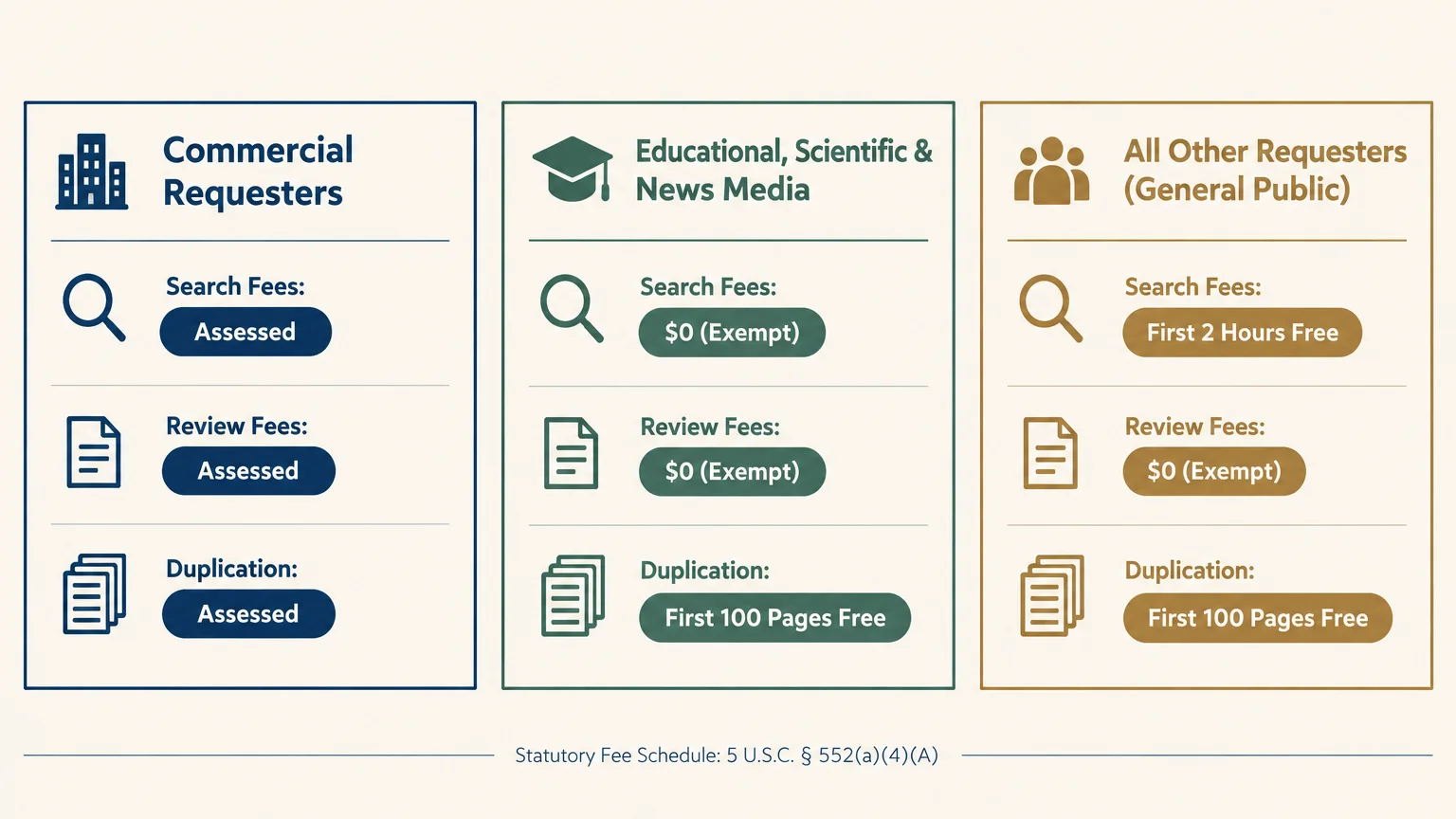
Comparing FOIA Requester Categories and Cost Allocations
Understanding fee tier assignments prevents unexpected costs when you submit a public records request. The 1986 statutory framework balances government administrative costs with public access rights, as explained in legal guides published by the Congressional Research Service.
The table below summarizes the statutory fee obligations, free allowances, and processing protections across each requester category under 5 U.S.C. § 552(a)(4)(A).
| Requester Category | Search Fees | Review Fees | Duplication Fees | Free Statutory Allowances |
|---|---|---|---|---|
| Commercial Use | Full Cost | Full Cost | Standard Rate | None |
| Educational / Scientific | Zero Cost | Zero Cost | Standard Rate | First 100 pages duplicated |
| News Media | Zero Cost | Zero Cost | Standard Rate | First 100 pages duplicated |
| General Public / Other | Standard Rate | Zero Cost | Standard Rate | 2 hours search, 100 pages duplicated |
Agencies cannot charge processing fees to any requester if the total administrative cost amounts to less than the agency’s statutory fee threshold. Most agencies set this administrative waiver ceiling between $14 and $25.
If you anticipate high processing fees, state an explicit expenditure cap in your initial request letter. Doing so prevents an agency from running up billable search hours without your prior written authorization.

The Modern Transparency Framework and What It Means for You
The Freedom of Information Act has evolved from a contested 1966 concept into a foundational administrative routine. Requesters submitted 1,707,197 FOIA requests to federal agencies in Fiscal Year 2025, marking an all-time government record.
Federal agencies processed 1,635,055 requests during that same fiscal year, an increase of roughly 10% over the previous period. Despite high administrative workloads, the public appetite for federal records continues to grow across every major department.
Statutory amendments have increasingly forced agencies into proactive disclosure rather than passive response. Under 5 U.S.C. § 552(a)(2), agencies must maintain online electronic reading rooms featuring final agency opinions, policy statements, and staff manuals.
The 2016 amendments codified the “Rule of 3” for proactive releases. If an agency processes and discloses a record to three or more separate requesters, it must immediately publish that record online for general public access.
According to the Department of Justice Office of Information Policy, executive agencies posted 115% more proactive disclosures in Fiscal Year 2025 than in Fiscal Year 2024. These online releases allow you to locate federal records without submitting a formal request.
The modern statute balances government operational needs against democratic oversight. Requesters filed 32,059 administrative appeals in Fiscal Year 2025, showing that persistent requesters frequently challenge agency redactions and win document releases.
The national FOIA ombudsman, the Office of Government Information Services at the National Archives, offers free mediation services if you face agency disputes. Using administrative mediation often resolves disclosure conflicts without the expense of hiring legal counsel.
When you file a request, research agency record systems and reference specific document identifiers. Precise requests narrow search scopes, avoid administrative delays, and deliver agency records directly to your desk.
Frequently Asked Questions About FOIA Requests
Can foreign nationals submit FOIA requests to American agencies?
Yes, any non-U.S. citizen can file a FOIA request for executive agency records. The statute grants access rights to “any person,” regardless of citizenship or physical residence.
The only exception applies to intelligence agencies under 5 U.S.C. § 552(a)(3)(E). Intelligence components cannot process requests submitted by foreign governments or international governmental organizations.
What happens if a federal agency ignores the 20-day response deadline?
If an agency fails to respond within 20 business days and has not claimed a legal extension, it forfeits its right to charge search fees. Media and educational requesters also receive complete waivers on duplication fees.
Furthermore, an unexcused delay grants you constructive exhaustion of administrative remedies. You gain the immediate legal right to file an enforcement action in federal district court without waiting for an internal agency decision.
How does FOIA differ from the Privacy Act of 1974?
FOIA provides public access to federal agency records covering government operations and policy decisions. It presumes that all government information belongs in the public sphere unless an exemption applies.
The Privacy Act of 1974, codified at 5 U.S.C. § 552a, gives U.S. citizens and lawful permanent residents access to personal records that agencies index under their names. It also restricts agencies from improperly disclosing your personal records to third parties.
Can an agency withhold an entire document if only one sentence is sensitive?
No, agencies cannot legally withhold an entire file simply because a single sentence contains exempt material. The segregation provision in 5 U.S.C. § 552(b) requires agencies to separate exempt text from non-exempt facts.
The agency must release all reasonably segregable portions of the record after redacting confidential words. The agency must also note the specific statutory exemption beside every blacked-out passage on the released document.