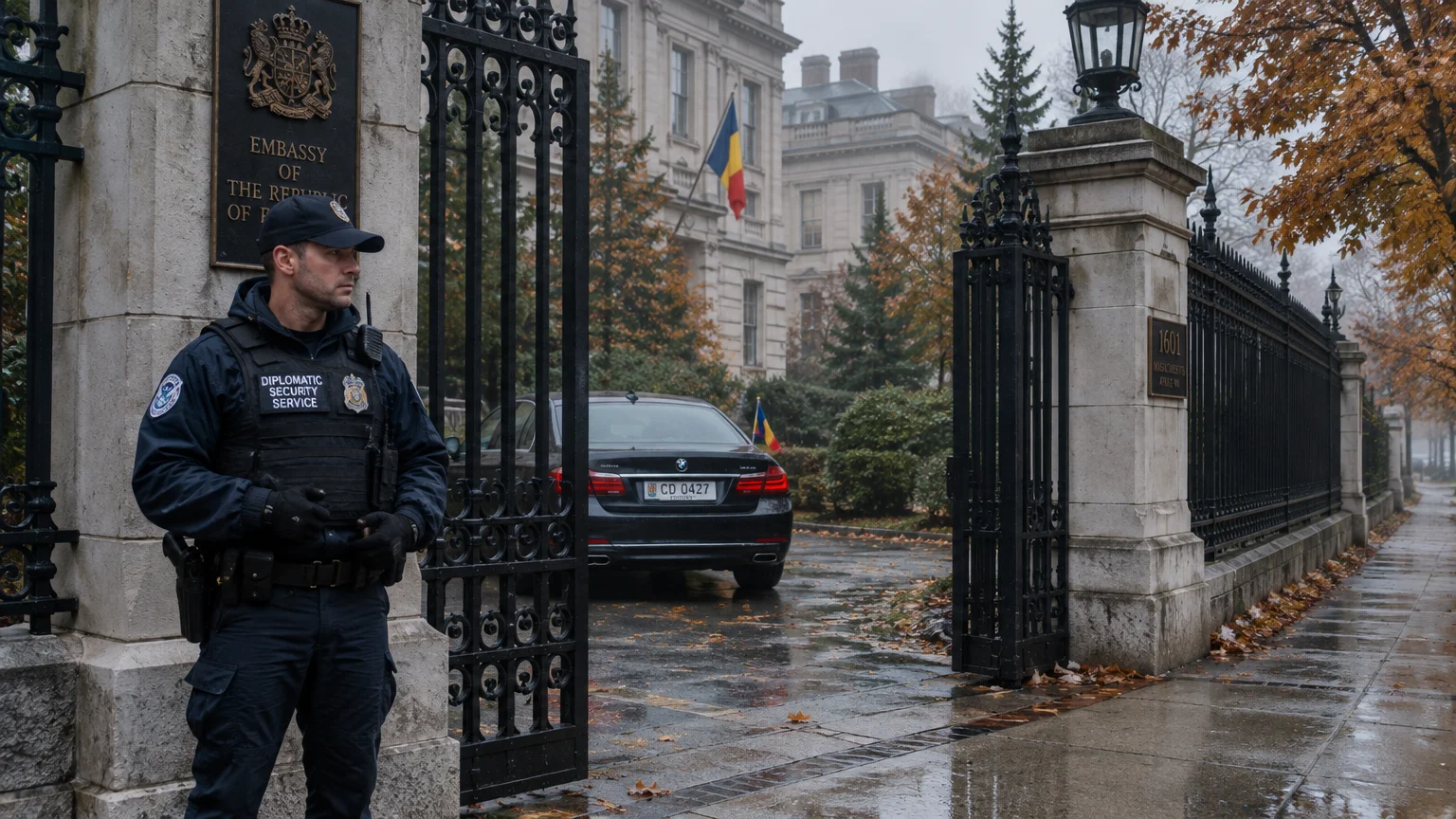
Hollywood movies often depict foreign diplomats committing blatant crimes before waving a passport and walking away completely untouched. In federal courtrooms and embassy compounds across Washington, American statutory law enforces a far more rigorous system of accountability.
You need to know how federal statutes and international treaties actually regulate foreign officials on American soil. Global diplomacy relies on functional legal protections, but modern federal statutes strictly limit these privileges and enforce financial liability.
This guide cuts through popular cinematic fiction to reveal the real operational rules governing foreign embassies and overseas missions under federal law. You will discover exactly where official privileges end and legal exposure begins.
Evaluating Diplomatic Privilege Through Federal Statutes and Court Precedents
This reality check evaluates six pervasive legal misconceptions surrounding diplomatic immunity and embassy operations within the United States. Popular culture frequently distorts these legal doctrines into absolute shields against civil justice and criminal prosecution.
Our analysis reviews statutory developments from the founding era through modern federal administrative enforcement mechanisms. We examine how Congress dismantled outdated blanket protections to safeguard American citizens from unredressed harms.
We selected these six specific items because they represent the most litigated questions involving foreign missions in domestic federal courts. Each entry directly affects civilian legal rights, local municipal governance, or host-nation criminal jurisdiction.
Every myth is contrasted directly against binding treaty text, congressional enactments, federal appellate rulings, and State Department enforcement guidelines. You will see the precise mechanisms that federal authorities use to balance diplomatic reciprocity against domestic public safety.
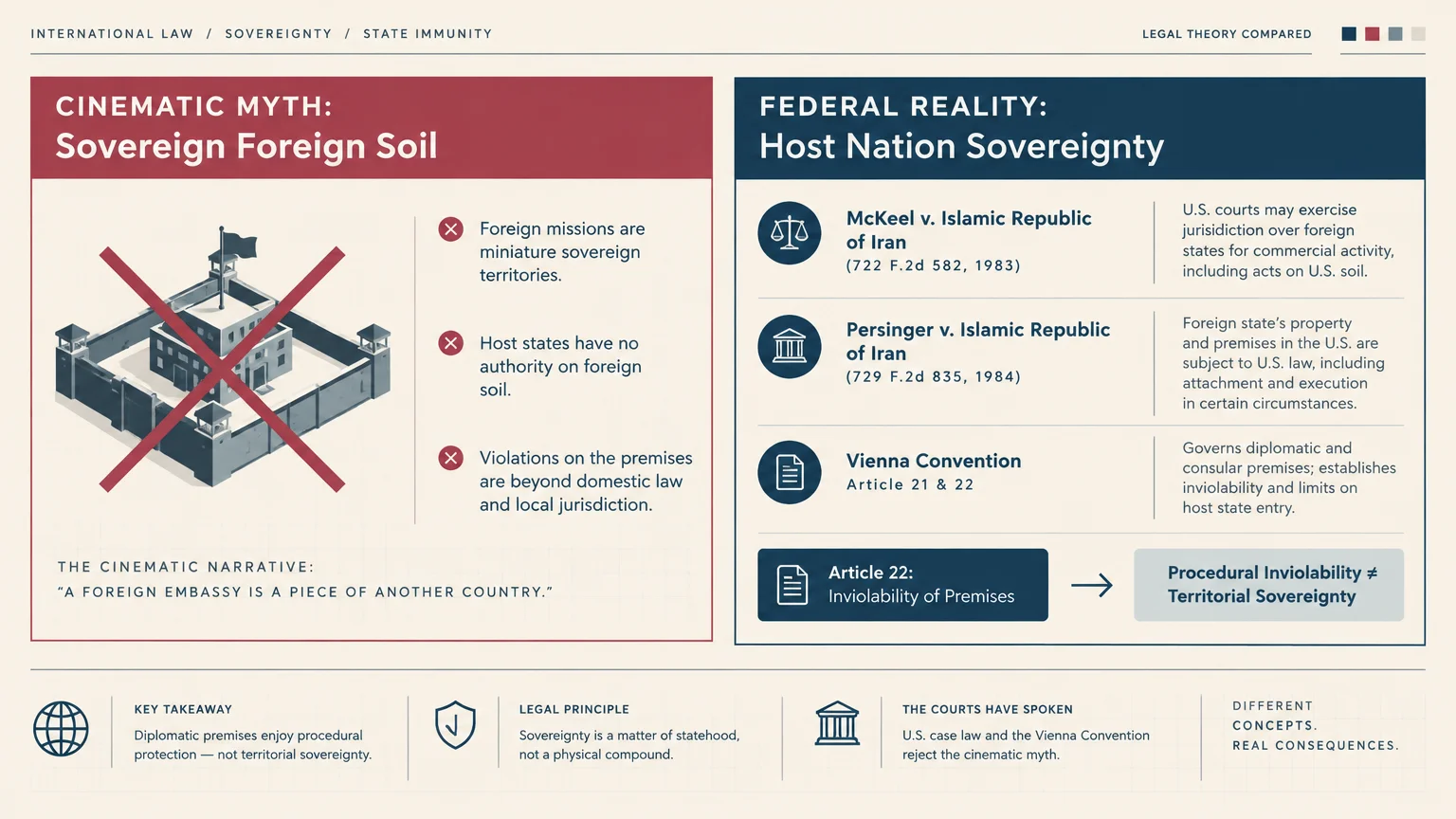
Foreign Embassies and Consulates Constitute Sovereign Soil of the Sending State
A widespread assumption claims that entering a foreign embassy places you on foreign soil. Popular thrillers routinely depict fugitives gaining extraterritorial asylum the moment their feet cross an embassy threshold.
Federal jurisprudence firmly rejects this territorial fiction. In CRS Report R46585, legal analysts outline how U.S. courts interpret sovereign boundaries and foreign property ownership.
The U.S. Court of Appeals for the Ninth Circuit settled this question in McKeel v. Islamic Republic of Iran (722 F.2d 582, 1983). Former American hostages argued that the U.S. Embassy in Tehran constituted U.S. territory under federal law.
The Ninth Circuit held that an embassy remains the sovereign territory of the receiving host nation. Writing for the court, judges determined that embassies do not fall under the territorial jurisdiction of the sending country.
The D.C. Circuit Court of Appeals reinforced this principle in Persinger v. Islamic Republic of Iran (729 F.2d 835, 1984).
That court confirmed that foreign embassies located within host nations remain subject to host territorial sovereignty.
Under Article 21 of the Vienna Convention on Diplomatic Relations, the host country helps the sending state acquire mission premises. The foreign nation merely owns or leases private commercial real estate subject to standard property deeds.
Article 22 of the Vienna Convention grants embassy grounds a special legal status termed inviolability. Host agents cannot enter mission grounds without permission, but this restriction represents procedural protection rather than territorial sovereignty.
Because embassies remain domestic territory, domestic legal principles apply. If a crime occurs within a foreign embassy in Washington, D.C., federal prosecutors retain territorial jurisdiction over the physical space.
You cannot escape domestic legal jurisdiction simply by stepping inside a foreign diplomatic compound. Host governments preserve complete underlying sovereignty over every square foot of land within their national borders.
Diplomatic Immunity Shields Foreign Envoys from All Criminal Accountability
Many people believe foreign envoys possess absolute personal immunity that insulates them from criminal justice. Screenwriters routinely portray foreign agents committing serious felonies without facing any legal reckoning.
Under Article 32 of the Vienna Convention on Diplomatic Relations, diplomatic immunity belongs exclusively to the sending state. An individual diplomat cannot invoke, assert, or waive immunity independently of their home government.
When an accredited foreign official commits a major crime, the U.S. Department of State formally demands a waiver of immunity. If the sending government grants the waiver, U.S. federal or state authorities prosecute the official normally.
A tragic Washington, D.C., collision proved how this waiver mechanism operates in practice. On January 3, 1997, Georgian diplomat Gueorgui Makharadze caused a multi-car collision that killed sixteen-year-old Joviane Waltrick.
The U.S. Department of State immediately pressured the Republic of Georgia to waive Makharadze’s diplomatic immunity. In February 1997, Georgian President Eduard Shevardnadze formally relinquished the diplomat’s legal protections.
Federal prosecutors tried Makharadze in the Superior Court of the District of Columbia. In October 1997, he pleaded guilty to involuntary manslaughter and received a prison sentence of seven to twenty-one years.
Even when a foreign government refuses to waive immunity, the receiving state retains powerful statutory options:
- Article 9 of the Vienna Convention permits the U.S. to declare any diplomat persona non grata.
- The State Department expels the diplomat, typically requiring departure within 48 to 72 hours.
- Article 31(4) preserves the sending nation’s obligation to prosecute the offender in its home courts.
Expulsion terminates diplomatic status immediately upon the individual’s failure to leave the country. Once that grace period expires, federal authorities can arrest and prosecute the former diplomat as an unauthorized foreign national.
Children Born on American Soil to Accredited Diplomats Gain Automatic Birthright Citizenship
Many individuals assume that every child born on U.S. soil receives immediate, unconditional American citizenship. Popular commentary often assumes the Fourteenth Amendment applies uniformly to all live births across the nation.
The text of the Fourteenth Amendment contains a specific legal limitation that excludes diplomatic children. The Citizenship Clause explicitly requires that an individual be “subject to the jurisdiction thereof” at the time of birth.
You can inspect the foundational language of this constitutional protection through the National Archives Fourteenth Amendment Milestone Document. Because foreign diplomats enjoy comprehensive legal immunity, they do not fall under full domestic legal jurisdiction.
Federal immigration regulations formalize this constitutional exception under 8 CFR § 101.3. The regulation specifies that children born to accredited foreign diplomatic officers do not acquire citizenship at birth.
Instead, federal law offers these children a distinct administrative pathway. Under 8 CFR § 101.3, an eligible child may voluntarily register to obtain lawful permanent resident status upon application.
The D.C. Circuit Court of Appeals reaffirmed this constitutional boundary in Muthana v. Pompeo (985 F.3d 893, 2021).
The case involved Hoda Muthana, who was born in New Jersey in October 1994.
Her father had served as a diplomat for Yemen at the United Nations. Muthana claimed birthright citizenship, arguing that her father’s diplomatic service had ended shortly before her birth.
The court examined official State Department records to verify the father’s diplomatic termination date. The federal government did not formally record the termination of his diplomatic status until after Muthana’s birth.
Because her father retained active diplomatic status on official federal registries, Muthana was not subject to U.S. jurisdiction. The appellate court affirmed that she never acquired American citizenship by birth.
This ruling reinforces the administrative power of executive accreditation. If a parent holds certified diplomatic immunity at the moment of childbirth, the child cannot claim automatic Fourteenth Amendment citizenship.
Every Foreign Embassy Employee Receives Identical Blanket Immunity
Popular folklore frequently treats every embassy employee as an untouchable diplomatic agent. Observers often assume that foreign chauffeurs, administrative clerks, and senior ambassadors enjoy the exact same legal protections.
Early American law actually operated under a sweeping blanket immunity model for nearly two centuries. The Crimes Act of 1790 (1 Stat.
112) granted complete civil and criminal immunity to ambassadors, staff, and domestic servants.
By the late 1970s, more than 30,000 foreign individuals held absolute legal immunity within the United States. Congress recognized that this expansive protection shielded routine commercial wrongdoing and burdened American citizens.
Congress repealed that eighteenth-century framework by passing the Diplomatic Relations Act of 1978 (Pub. L. 95-393). The statute aligned federal law with the 1961 Vienna Convention’s tiered immunity structure.
President Jimmy Carter highlighted this policy shift in his Statement on Signing the Diplomatic Relations Act. The new statute eliminated blanket protections and established four precise tiers of immunity.
| Staff Category | Criminal Immunity | Civil Lawsuits | Family Coverage | Governing Authority |
|---|---|---|---|---|
| Diplomatic Agent | Complete | Immune with 3 exceptions | Identical protections | 22 U.S.C. § 254d |
| Admin & Tech Staff | Complete | Official acts only | Criminal only | Vienna Art. 37(2) |
| Service Staff | Official acts only | Official acts only | No immunity | Vienna Art. 37(3) |
| U.S. Permanent Resident | Official acts only | Official acts only | No immunity | Vienna Art. 38 |
Diplomatic agents, such as ambassadors and attachés, receive the highest level of functional protection. They hold complete immunity from criminal jurisdiction and broad immunity from civil claims.
Article 31 of the Vienna Convention establishes three vital exceptions to a diplomatic agent’s civil immunity:
- Private real estate disputes unrelated to official mission business.
- Proceedings involving private succession, such as contested personal wills and estates.
- Professional or commercial activities conducted outside of official diplomatic functions.
Administrative and technical personnel, including computer technicians and office managers, occupy the second legal tier. They enjoy absolute criminal immunity, but their civil immunity covers only official duties.
Service staff members, such as embassy drivers and maintenance personnel, occupy the third legal tier. They possess criminal and civil immunity strictly for acts performed in the course of their duties.
If an embassy driver assaults someone while off duty, local police can arrest and prosecute that individual. You must identify an embassy worker’s specific employment category before determining their legal vulnerability.
Diplomatic License Plates Grant Immunity from Parking Tickets and Traffic Laws
Many drivers believe vehicles displaying diplomatic license plates can disregard traffic regulations with impunity. Drivers frequently complain about foreign officials parking illegally without fear of towing or municipal fines.
Congress curbed embassy operational abuses through the Foreign Missions Act of 1982 (Pub. L. 97-241). Codified at 22 U.S.C. § 4301 et seq., this law created the Office of Foreign Missions (OFM).
The State Department’s OFM exercises exclusive federal authority over diplomatic motor vehicles. The federal government issues all diplomatic driver licenses, title documents, and specialized license plates.
Diplomatic status does not exempt drivers from state and municipal traffic codes. State Department guidance explicitly instructs foreign personnel that operating a motor vehicle is a privilege, not a treaty right.
Between November 1997 and late 2002, foreign missions in New York City accumulated over 150,000 unpaid parking citations. These unpaid tickets generated approximately $18 million in outstanding municipal fines.
Congress intervened by passing the Clinton Amendment to the Foreign Operations Appropriations Act in 2002. This federal provision established aggressive administrative penalties to recover outstanding local revenues.
Under this statutory enforcement system, the federal government acts decisively:
- The U.S. withholds 110 percent of unpaid parking fines directly from a nation’s foreign aid allocation.
- The Office of Foreign Missions refuses to renew vehicle registrations for missions with delinquent violations.
- Municipalities can legally tow diplomatic vehicles that block fire hydrants or disrupt traffic flows.
The State Department also enforces a mandatory administrative driver point system. If an envoy accumulates moving violations, the OFM revokes their diplomatic driving privileges.
Federal preemption protects national foreign policy interests when local jurisdictions overreach. On January 6, 2025, the State Department issued an administrative determination under the Foreign Missions Act.
That ruling preempted New York authority by exempting diplomatic vehicles from Manhattan congestion relief tolls. The federal government established this exemption to shield American diplomats from retaliatory tolls abroad.
Diplomatic plates provide administrative exemptions only when federal foreign policy explicitly mandates reciprocity. They do not grant foreign drivers a license to violate local safety ordinances.
Civilian Victims of Diplomat Accidents Cannot File Lawsuits or Recover Insurance Damages
A prevalent myth suggests that citizens injured by diplomatic vehicles cannot obtain any financial compensation. Before 1978, injured pedestrians frequently faced financial ruin when foreign envoys invoked complete civil immunity.
The Diplomatic Relations Act of 1978 directly solved this injustice for American accident victims. Section 6 of the Act, codified at 22 U.S.C. § 254e, established strict insurance mandates.
Under federal regulations in 22 CFR Part 151, all foreign missions must maintain compulsory liability insurance. Envoys must carry comprehensive coverage on all motor vehicles, vessels, and aircraft operated in the country.
The State Department enforces mandatory minimum insurance limits that far exceed standard state coverage thresholds. The OFM verifies valid commercial insurance policies before issuing or renewing any vehicle registration.
To eliminate procedural obstacles, Congress enacted a dedicated direct-action statute codified at 28 U.S.C. § 1364. This statute creates direct federal court jurisdiction over lawsuits brought against a diplomat’s insurer.
Under 28 U.S.C. § 1364, you can sue the foreign diplomat’s liability insurance company directly. The statute expressly forbids the insurance carrier from asserting diplomatic immunity as a legal defense.
If a diplomatic vehicle strikes your car, you can pursue practical legal remedies:
- Call local law enforcement immediately to document the crash scene and obtain badge numbers.
- Record the vehicle’s federal diplomatic license plate number and OFM registration decal details.
- Request insurance carrier information from the driver or the State Department Diplomatic Motor Vehicle program.
- File your property damage or personal injury lawsuit directly against the commercial insurer in federal court.
This statutory structure separates the diplomat’s personal person from the insurance policy proceeds. American citizens can recover full damages from commercial insurers without breaching international diplomatic conventions.
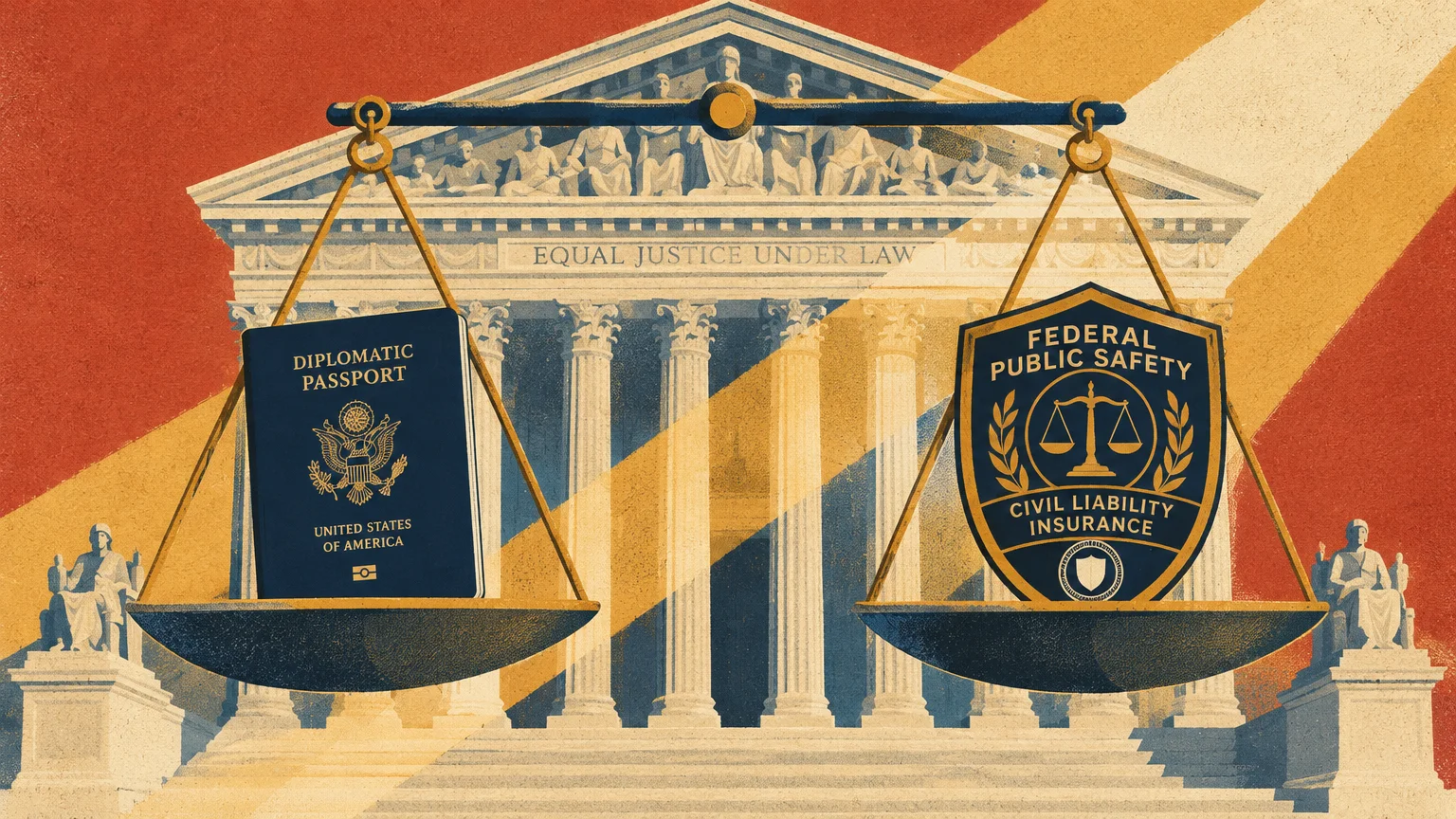
How Modern Federal Frameworks Balance Sovereign Reciprocity and Public Safety
The evolution of American diplomatic law reveals a persistent transition away from absolute feudal privileges toward functional accountability. Congress eliminated ancient blanket immunities because they undermined public confidence in the rule of law.
Today, the principle of functional necessity governs diplomatic legal privileges under federal law. International treaties protect diplomats only to the extent necessary to ensure their home governments maintain unhindered communications.
Reciprocity serves as the indispensable structural foundation supporting all diplomatic interactions. When the United States enforces federal rules on foreign diplomats, foreign ministries apply identical treatment to American envoys.
If federal authorities violate international treaties by arresting foreign envoys, hostile nations will arrest American diplomats abroad. The State Department continually balances domestic law enforcement against the physical safety of thousands of overseas personnel.
The Foreign Missions Act of 1982 provides the executive branch with flexible regulatory instruments to maintain this equilibrium. By conditioning real estate acquisitions and tax benefits on reciprocal treatment, federal authorities protect national interests.
Federal statutes successfully insulate domestic victims from the burdens of foreign sovereign privileges. Direct-action insurance remedies, mandatory aid deductions, and swift expulsion powers ensure that diplomatic status remains manageable and fair.
Frequently Asked Questions About Diplomatic Status and Embassy Law
Can Local Police Enter an Embassy During a Fire or Active Emergency?
Local firefighters and police officers cannot enter a foreign embassy without the explicit consent of the mission chief. Article 22 of the Vienna Convention establishes absolute property inviolability without any humanitarian emergency exceptions.
Emergency responders must wait outside embassy gates until the ambassador or designated charge d’affaires grants access. Entering without permission violates federal treaty commitments and triggers severe international diplomatic repercussions.
What Happens If a U.S. Citizen Commits a Crime Inside an American Embassy Abroad?
A U.S. citizen who commits a crime inside an American embassy overseas faces federal criminal prosecution. Under 18 U.S.C. § 7, embassy grounds fall within the Special Maritime and Territorial Jurisdiction of the United States.
Federal law enforcement agencies, including the Diplomatic Security Service and the FBI, investigate offenses committed on embassy premises. Federal prosecutors try defendants in U.S. District Court once authorities return them to American soil.
Can Foreign Diplomats Buy Real Estate Anywhere in the United States?
Foreign governments cannot purchase real estate within the United States without prior federal administrative approval. Under 22 U.S.C. § 4305, the Office of Foreign Missions reviews all foreign mission property transactions.
The State Department can block real estate acquisitions to protect national security or enforce reciprocal treatment. Local zoning boards cannot approve embassy developments until the federal government grants formal statutory clearance.
How Do Local Police Verify If a Suspect Actually Holds Diplomatic Immunity?
Local law enforcement officers cannot rely on personal claims or foreign passports presented during a traffic stop. Officers must verify diplomatic credentials through the State Department’s Office of Foreign Missions Command Center.
The State Department maintains a certified national database identifying every accredited diplomat and their specific immunity tier. If an individual lacks current federal accreditation, officers proceed with standard arrests and criminal citations.