
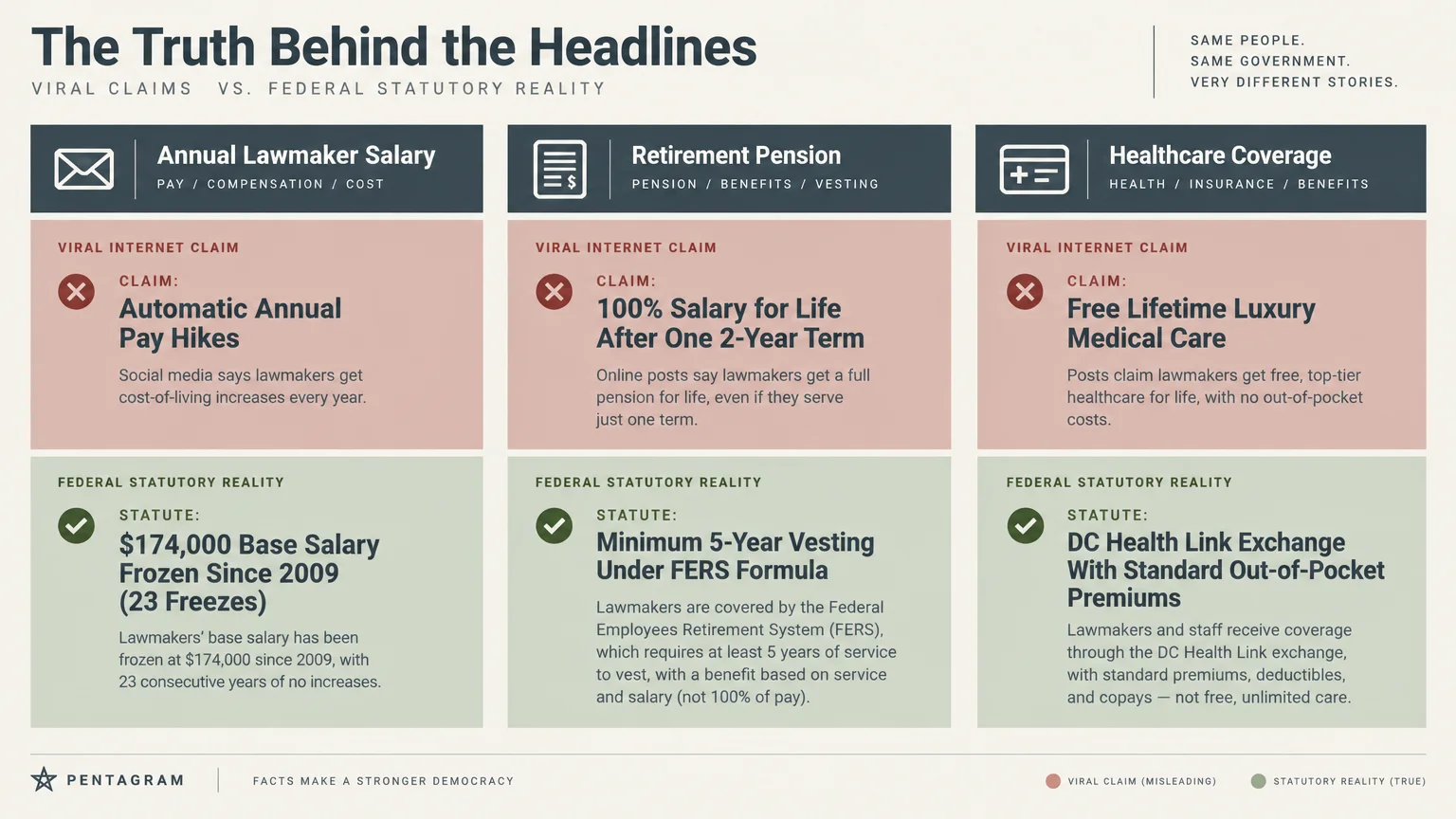
Viral emails and social media posts often claim that members of Congress receive full lifetime salaries after serving a single two-year term. Official records and federal statutes show a completely different reality.
Rank-and-file lawmakers receive a fixed annual salary that has remained frozen for more than fifteen years. Their pensions require years of service to vest, and their health insurance requires regular out-of-pocket premium payments.
You can examine the governing statutes and official agency records to separate political folklore from actual law. Here are the documented facts detailing how congressional compensation, retirement, and healthcare programs really operate.
How Governing Laws and Regulations Define Congressional Pay
This guide examines the federal statutes, constitutional amendments, and administrative regulations that govern compensation for the 535 voting members of the United States Congress.
We selected these eleven entries by reviewing the most persistent viral rumors against public records from the Congressional Research Service and the Office of Personnel Management.
The analysis spans key statutory milestones, from early pension legislation in the twentieth century through the ongoing salary freeze in effect as of October 23, 2025.
By looking directly at federal law, you can verify how compensation systems function without relying on unvetted claims.
Rank-and-File Base Salary Is Capped by Federal Statute
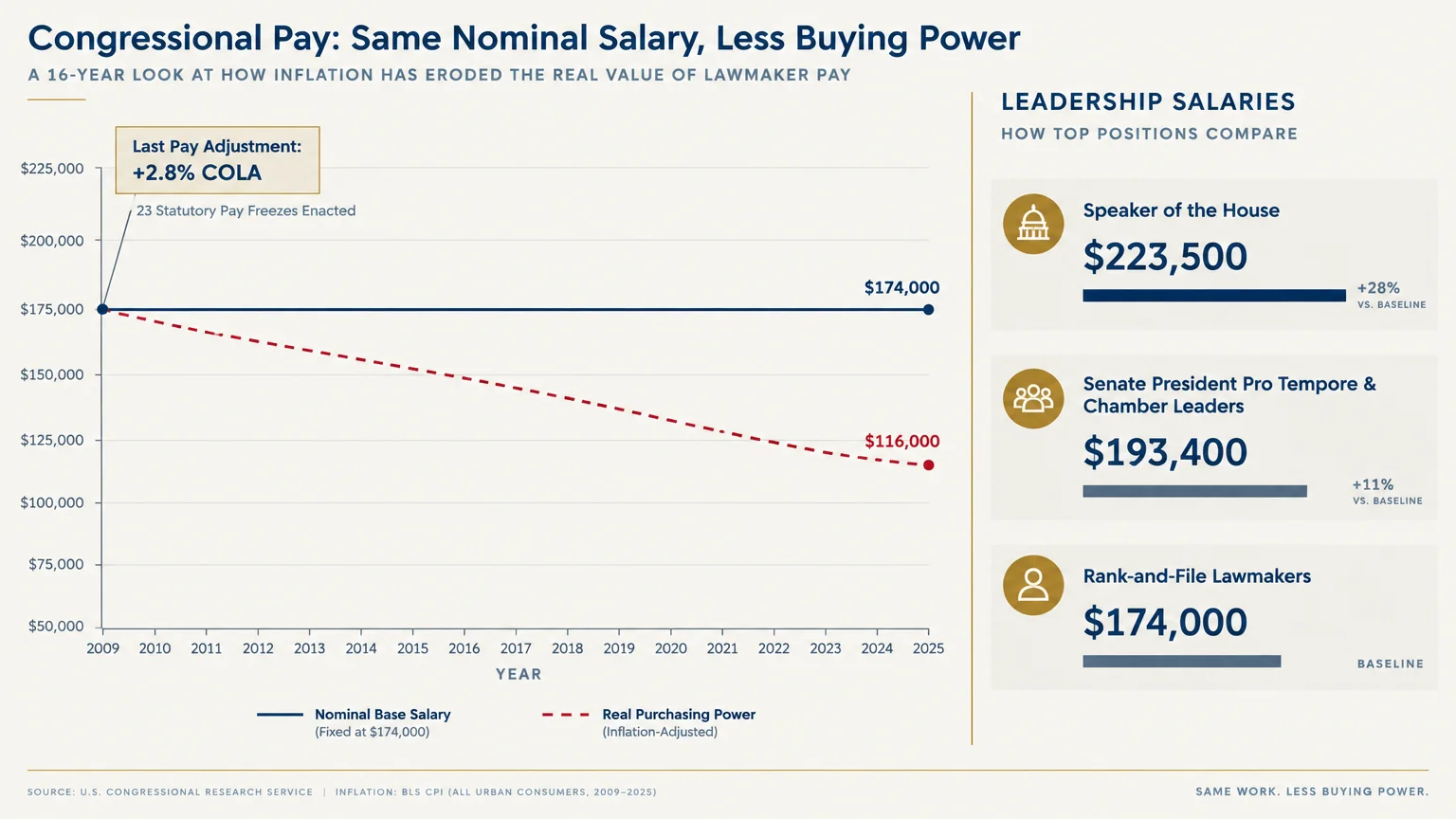
Rank-and-file members of the House of Representatives and the Senate earn a base salary of $174,000 per year. Congress last allowed an annual pay increase in January 2009, when lawmakers accepted a 2.8 percent cost-of-living adjustment.
The Ethics Reform Act of 1989 established an automatic annual adjustment formula tied to the Employment Cost Index. This mechanism was designed to adjust congressional compensation each year without requiring a standalone vote.
Lawmakers have repeatedly intervened to block their own pay increases. Congress has passed statutory language to freeze its pay twenty-three times since 1991, keeping base compensation unchanged every year since 2009.
According to the Congressional Research Service report on congressional pay, inflation has steadily eroded lawmaker purchasing power. The frozen $174,000 salary has lost roughly one-third of its real value over the past sixteen years.
You can review these statutory freezes in the annual legislative branch appropriations acts. Lawmakers routinely insert provisions ensuring their nominal pay rates remain strictly unchanged.
Rank-and-file lawmakers in both chambers receive the identical base rate regardless of seniority or committee assignments. A freshman representative receives the exact same base salary as a thirty-year veteran senator.
Leadership Roles Receive Higher Fixed Annual Compensation
Federal law establishes differential pay scales for specific congressional leadership positions. These higher salaries compensate lawmakers for additional constitutional, administrative, and parliamentary responsibilities.
Under Title 2, Section 4501 of the United States Code, the Speaker of the House of Representatives earns $223,500 annually. This leadership rate has also remained frozen since January 2009.
The Senate President pro tempore, along with the Majority and Minority Leaders in both chambers, earns $193,400 per year. These designated officers earn $19,400 more than rank-and-file members.
These compensation rates reflect the unique constitutional duties assigned to congressional leadership. For example, the Presidential Succession Act of 1947 places the Speaker second in the presidential line of succession.
Committee chairs and ranking members receive no supplemental pay for their committee duties. They earn the standard rank-and-file salary of $174,000 despite overseeing extensive legislative dockets.
You can verify these figures directly through historical payroll tables published by the House Historical Office. Congress cannot create arbitrary leadership stipends without amending existing federal law.
Senior Congressional Staff Members Can Legally Out-Earn Lawmakers
While lawmaker pay has remained frozen since 2009, congressional staff compensation caps have risen substantially. Congress systematically raised staff pay limits to improve recruitment and retain experienced professional aides.
Both the House and Senate set maximum staff salary limits at $228,000 per year. This statutory ceiling matches Level II of the Executive Schedule.
This administrative adjustment creates an uncommon workplace pay inversion. Top committee directors, chiefs of staff, and parliamentarians can earn up to $54,000 more annually than the elected officials who employ them.
Members’ Representational Allowances govern staff spending, meaning offices must budget these salaries within fixed annual office accounts. Lawmakers cannot divert these operational funds to supplement their personal paychecks.
You can check official staff disbursement reports published quarterly by the Clerk of the House and the Secretary of the Senate. These public disclosures detail every staff salary and office expenditure.
These records show that dozens of senior Capitol Hill staffers routinely earn more than rank-and-file representatives and senators.
The Twenty-Seventh Amendment Prevents Immediate Midterm Pay Increases
James Madison originally proposed the Twenty-Seventh Amendment in 1789 to prevent self-dealing among federal legislators. The amendment languished unratified for more than two centuries before public campaigns revived it.
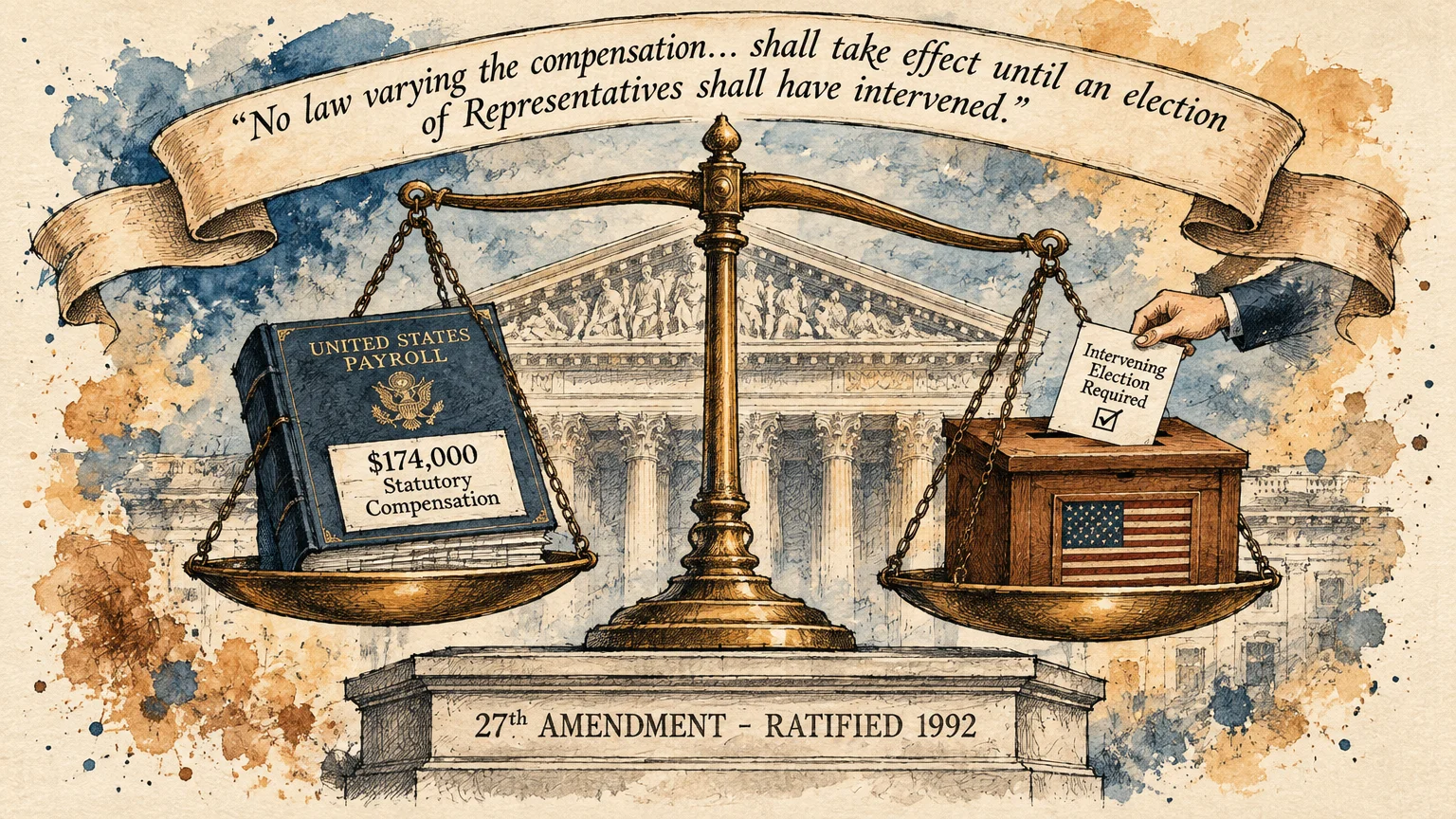
The amendment achieved final ratification on May 7, 1992, when Michigan became the thirty-eighth state to approve the text. You can examine its historical trajectory through the Constitution Annotated.
The constitutional text dictates that no law varying congressional compensation can take effect until after an intervening House election. This mandate prevents sitting members from voting themselves immediate pay raises.
If Congress votes to adjust member pay today, you and your fellow voters have the opportunity to hold them accountable. The electorate votes on representatives before any new pay rate becomes effective.
Federal courts have consistently upheld this rule against legal challenges. In Boehner v. Anderson (1994), the D.C.
Circuit affirmed that statutory adjustment mechanisms must strictly comply with the amendment’s timing constraints.
Any compensation adjustment enacted during a two-year Congress remains dormant until the subsequent Congress convenes in January.
The Constitution Guarantees Lawmaker Paychecks During Government Shutdowns
When federal funding lapses, hundreds of thousands of civil servants face furloughs or work without immediate pay. Members of Congress, however, continue to receive their paychecks on schedule.
This protection originates in Article I, Section 6 of the United States Constitution. The framers mandated that compensation for senators and representatives be drawn directly from the United States Treasury.
Furthermore, congressional salaries are funded through permanent statutory authority rather than annual discretionary appropriations bills. Under 2 U.S.C. § 4501, compensation disburses automatically regardless of whether general agency funding bills pass.
The Antideficiency Act restricts executive branch spending during a funding gap, but it does not override permanent statutory obligations. Congressional pay remains legally insulated from discretionary budget standoffs.
Lawmakers cannot legally refuse their salary checks when they arrive. Federal law prohibits unpaid voluntary service for official government duties under 31 U.S.C. § 1342.
Some lawmakers choose to donate their net pay to charities or write personal refund checks back to the Treasury during funding lapses. However, halting the actual statutory payroll requires amending both permanent statutes and constitutional procedures.
Outside Earned Income Faces Strict Statutory Ceilings and Complete Bans
Federal statutes strictly limit the amount of outside income members of Congress may earn while holding public office. The Ethics Reform Act of 1989 enacted comprehensive restrictions to prevent conflicts of interest.
Under Title 5 of the United States Code, lawmakers cannot earn outside income exceeding 15 percent of Level II of the Executive Schedule. This cap restricts allowable outside compensation to roughly $34,200 annually.
Federal law completely prohibits lawmakers from accepting honoraria or paid speaking fees. You will not find members charging speaking fees for appearances at universities, corporate gatherings, or trade association conventions.
Lawmakers are also barred from practicing professions involving fiduciary relationships, such as law, medicine, or real estate brokerage. They cannot receive compensation for affiliating with firms that provide professional services.
Passive income sources, such as book royalties, corporate stock dividends, and rental real estate, remain exempt from the earned income cap. However, lawmakers must disclose all passive earnings on their annual financial disclosure filings.
House and Senate ethics committees review and approve any advance publishing contracts to ensure they reflect fair market standards rather than disguised compensation.
Lawmakers Never Qualify for Full Lifetime Salaries After One Term
A widespread viral myth claims that members of Congress receive their full salaries for life after serving just one term. Official statutory guidelines completely refute this persistent falsehood.
Members of Congress participate in the Federal Employees Retirement System alongside regular civilian federal workers. FERS requires at least five years of creditable service before an employee vests in any pension benefits.
A representative who serves a single two-year term in the House receives zero pension. Without five years of service, they leave office without qualifying for any defined annuity.
Furthermore, federal law caps congressional pensions well below a member’s full salary. Under 5 U.S.C. § 8415, an initial pension annuity cannot exceed 80 percent of the member’s final average salary.
The Congressional Research Service analysis on congressional retirement confirms that reaching that 80 percent cap requires more than thirty years of federal service. No member receives instant full salary replacement.
Lawmakers also participate in Social Security, paying the standard 6.2 percent payroll tax. Federal law has required all members of Congress to pay into Social Security since January 1, 1984.
Newer Members Pay Substantially Higher Pension Contributions for Reduced Benefits
Congressional retirement rules have grown substantially less generous for newer members over the past decade. Two major budget reform laws restructured the pension math for lawmakers entering office after 2012.
Under the Middle Class Tax Relief and Job Creation Act of 2012 and the Bipartisan Budget Act of 2013, Congress altered employee contribution rates. Lawmakers elected in 2013 or later must contribute 4.4 percent of their salary toward their pension.
Prior to these reforms, members paid just 1.3 percent of their compensation into the retirement fund. Newer lawmakers pay more than triple the contribution rate of their senior colleagues.
The same statutes reduced the pension accrual multiplier from 1.7 percent down to 1.0 percent per year of service. A member who serves at least twenty years and retires at age 62 receives a 1.1 percent accrual rate.
You can review these rules in the Office of Personnel Management FERS guidelines. These changes aligned newer congressional pensions directly with standard civil service retirement formulas.
Members can also contribute to the Thrift Savings Plan, a 401(k)-style retirement savings account. The government provides an automatic 1 percent contribution and matches employee contributions up to an additional 4 percent.
Public Corruption Felonies Trigger the Immediate Forfeiture of Pensions
Members of Congress do not retain their taxpayer-funded pensions if they commit serious crimes in office. Congress enacted strict forfeiture laws to prevent corrupt officials from collecting public retirement annuities.
The Honest Leadership and Open Government Act of 2007 established mandatory pension revocation for lawmakers convicted of specific public corruption felonies. These crimes include bribery, perjury, wire fraud, and witness tampering.
Lawmakers expanded this list of disqualifying offenses in 2012 by passing the Stop Trading on Congressional Knowledge Act, known as the STOCK Act. The statute added insider trading and campaign finance felonies to the forfeiture trigger.
Under 5 U.S.C. § 8332 and § 8411, a convicted member loses all creditable congressional service accrued toward their employer-funded pension annuity. The law strips away the government-subsidized portion of the retirement benefit.
Convicted lawmakers do not forfeit their own personal payroll deductions. They receive a lump-sum refund of the cash they personally paid into the retirement system, without receiving taxpayer-funded monthly checks.
This statutory mechanism applies automatically upon final conviction and sentencing, terminating benefits regardless of the member’s years of service.
Lawmakers Must Purchase Health Insurance Through the DC Health Link Exchange
Viral chain emails frequently claim that lawmakers receive free, gold-plated healthcare for life. In reality, lawmakers face the same healthcare premium and copay obligations as many private-sector workers.
Section 1312 of the Affordable Care Act removed members of Congress and designated personal staff from standard Federal Employees Health Benefits plans. Effective January 1, 2014, federal law required them to purchase health insurance through the DC Health Link small business exchange.
Lawmakers must select private insurance plans offered on the District of Columbia exchange. They pay regular monthly premiums, face annual deductibles, and cover copayments when seeking medical care.
The federal government provides an employer contribution covering roughly 72 to 75 percent of the health plan premium. This subsidy matches the exact employer share provided to standard federal civilian employees under civil service rules.
Members cannot carry health coverage into retirement unless they satisfy strict eligibility rules. They must qualify for an immediate pension annuity and maintain five consecutive years of continuous coverage prior to leaving office.
Retirees pay their standard premium share throughout retirement. If a former member cancels their coverage or fails to pay premiums, they forfeit eligibility permanently.
Capitol Medical Clinic Access Requires an Optional Out-of-Pocket Fee
Lawmakers have access to an on-site primary care facility located within the United States Capitol complex. The Office of the Attending Physician has operated this medical clinic continuously since its establishment in 1928.
A United States Navy Rear Admiral leads the clinic staff, providing emergency response, routine physical exams, and basic triage. You can read about the clinic’s administrative history through the United States Senate Historical Office.
This medical care is not free to members of Congress. Lawmakers who choose to use the facility must pay an optional annual out-of-pocket fee of roughly $650 per year.
The clinic provides primary consultations, on-site laboratory work, and routine prescription management. It does not provide specialized surgery, long-term inpatient hospitalization, or comprehensive off-site medical treatments.
Former lawmakers cannot use the Capitol clinic for routine primary care after leaving office. The facility restricts regular services strictly to current members, Supreme Court justices, and designated Capitol campus staff.
Members who decline to pay the annual fee receive emergency triage only in the event of an acute injury or life-threatening crisis on Capitol grounds.
Comparing Key Congressional Compensation and Benefit Standards
You can use the table below to review how governing federal statutes determine lawmaker compensation, retirement rules, and medical benefits.
| Compensation Category | Governing Statute or Rule | Standard Rate or Formula | Key Limitation or Requirement |
|---|---|---|---|
| Rank-and-File Base Pay | 2 U.S.C. § 4501 | $174,000 annually | Frozen by statute since January 2009 |
| Speaker of the House | 2 U.S.C. § 4501 | $223,500 annually | Leadership pay established by statute |
| Floor Leaders & Pro Tem | 2 U.S.C. § 4501 | $193,400 annually | Covers majority, minority, and pro tem |
| Senior Staff Salary Cap | Executive Schedule Level II | Up to $228,000 annually | Staff can legally out-earn lawmakers |
| Outside Earned Income | 5 U.S.C. app. § 501 | Capped at 15% of Level II | Speaking honoraria completely prohibited |
| Pension Vesting Period | 5 U.S.C. § 8410 | 5 years creditable service | Single two-year term yields zero pension |
| Maximum Pension Annuity | 5 U.S.C. § 8415 | 80% of high-3 average salary | Requires more than 30 years of service |
| Post-2012 FERS Accrual | Public Law 113-67 | 1.0% per year of service | Lawmakers contribute 4.4% of salary |
| Health Plan Enrollment | 42 U.S.C. § 18032 | DC Health Link exchange | Must purchase private exchange plans |
| Capitol Clinic Access | Established in 1928 | ~$650 annual out-of-pocket fee | Primary care only; no hospitalization |
How Modern Statutes Balance Legislative Independence and Accountability
The modern structure of congressional compensation reflects a continuous tension between legislative independence and public accountability. The framers intentionally created a federally funded salary to ensure that citizens of modest means could serve in national office.
Over the past several decades, federal lawmakers have systematically restructured their own benefits to mirror the broader federal workforce. The days of standalone, lucrative congressional retirement schemes have largely disappeared from federal law.
Newer lawmakers participate in standard FERS retirement plans, contribute identical percentages as recent civil servants, and face severe penalties for ethical breaches. Felonies strip taxpayer benefits, and outside earning caps prevent commercial conflicts of interest.
Meanwhile, sixteen consecutive years of salary freezes have significantly reduced the real compensation of rank-and-file members. In response, Congress increased staff pay caps to keep personal and committee operations functioning effectively.
Understanding these statutory boundaries allows you to evaluate legislative actions based on legal reality rather than online mythology. The public record shows a system tightly bound by federal code and constitutional limits.
Frequently Asked Questions About Congressional Compensation
Do members of Congress get free health care for life?
No, members of Congress do not receive free healthcare during office or in retirement. Lawmakers must select private health insurance through the DC Health Link small business marketplace and pay standard monthly premiums.
To maintain federal health benefits in retirement, a former lawmaker must complete at least five consecutive years of continuous coverage and qualify for an immediate federal pension annuity.
Even in retirement, former members pay regular premium cost shares just like retired civilian federal employees. The federal government never provides free lifetime medical coverage.
Can a representative retire with full salary after a single two-year term?
No, a representative cannot receive any pension after serving a single two-year term. Federal retirement law requires a minimum of five years of creditable service before benefits vest.
A one-term House member leaves office with zero pension annuity unless they accumulated prior creditable federal service. Furthermore, federal law caps maximum initial pensions at 80 percent of final average pay.
Reaching that statutory 80 percent cap requires more than three decades of public service. The popular claim that lawmakers get full lifetime pay after one term is entirely false.
Why do lawmakers still receive paychecks during a federal government shutdown?
The United States Constitution mandates that members of Congress receive compensation drawn directly from the United States Treasury. Article I, Section 6 protects legislative independence by preventing executive or legislative pay withholding during budget disputes.
In addition, congressional salaries are disbursed through permanent statutory funding under Title 2, Section 4501 of the United States Code. This permanent appropriation operates independently of the annual discretionary appropriations bills that lapse during shutdowns.
While many civil servants face furloughs, lawmakers continue to receive compensation by law. Some individual members choose to donate their pay to charity during these funding lapses.
How does the Constitution regulate when congressional pay raises take effect?
The Twenty-Seventh Amendment prohibits any law varying congressional compensation from taking effect until an election of representatives has intervened. Ratified in 1992, this amendment prevents sitting lawmakers from granting themselves immediate pay raises.
If lawmakers pass legislation altering member salaries today, the change cannot take effect until the subsequent Congress convenes. This mandatory delay ensures that you and your fellow voters have the power to vote on representatives before new pay rates take effect.
The provision applies equally to pay increases and pay decreases. Federal courts have consistently enforced this timing restriction on all statutory compensation measures.