You cast your ballot in modern primaries expecting your vote to determine the presidential nominees directly. For most of American history, party bosses selected the candidates in private backroom negotiations without public input.
State legislatures and political parties spent seven decades dismantling these secretive systems. They replaced party machines with binding primary elections, open delegate caucuses, and transparent roll-call votes.
This transformation shifted political power from convention wheelers and dealers into your hands. Understanding this institutional evolution reveals why early state voting laws and convention delegate rules matter today.
How Legal Reforms and Grassroots Revolts Broke Party Machine Control
This historical guide examines eight specific milestones between 1901 and contemporary rule changes that dismantled convention boss rule. Each entry marks an enforceable change in statutory voting laws, party charter mandates, or national delegate selection procedures.
Our editorial team selected these turning points by reviewing delegate roll-call records, state statutes, and official commission charters. These verified records reveal how political conventions evolved from closed insider bargains into direct extensions of voter ballots.
Before these systemic changes occurred, municipal bosses and state party committee leaders negotiated presidential tickets behind locked hotel doors. Rank-and-file voters had virtually no say in selecting general election contenders.
Through citizen initiative petitions, state legislative enactments, and open floor revolts, grassroots activists progressively stripped bosses of their private authority. These battles established today’s primary system where individual voters decide delegates.
The public record demonstrates that presidential primaries did not emerge spontaneously or overnight. Instead, each procedural reform responded to glaring delegate injustices, public floor walkouts, and deadlocked conventions that alienated voters.
Florida and Wisconsin Establish Direct Delegate Elections
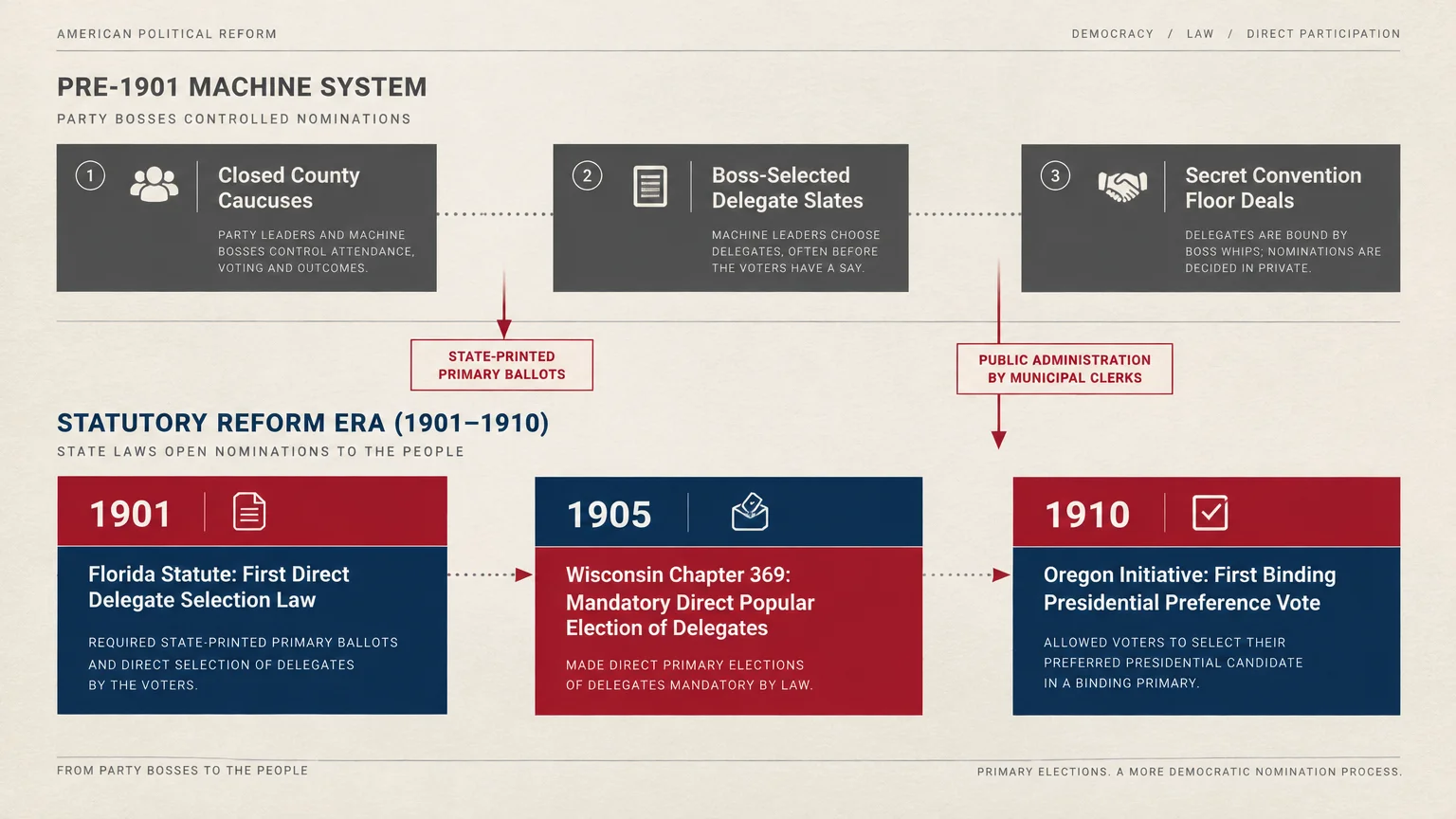
In 1901, the Florida State Legislature passed the nation’s first statute authorizing political parties to select convention delegates through direct primary elections. The law gave party executive committees discretionary authority to conduct state-regulated popular primary contests.
Wisconsin expanded this concept under Progressive Governor Robert M. La Follette with Chapter 369 of the 1905 Wisconsin Laws.
This pioneering act established the mandatory, direct popular election of all national convention delegates across the state.
La Follette designed the statute to eliminate the private caucuses controlled by railroad executives and lumber barons. By requiring delegate candidates to run on public ballots, Wisconsin transferred power directly to ordinary citizens.
According to the Congressional Research Service report on national nominating conventions, this statutory shift proved that state law could regulate private party governance. It created the operational model that dozens of states soon emulated.
- Direct delegate voting on unified, state-printed primary ballots;
- The statutory termination of boss-selected delegate slates at closed county caucuses;
- Public election administration financed and certified by municipal election clerks.
Oregon and North Dakota Mandate Binding Presidential Preference Votes
Oregon electors approved an innovative citizen ballot initiative in 1910 that established the country’s first presidential preference primary. The statute allowed voters to cast ballots directly for individual presidential candidates rather than unpledged delegates.
Crucially, the Oregon enactment required delegates to support the winner of the statewide popular preference vote on convention ballots. This statutory mechanism prevented political power brokers from redirecting state delegates against the documented will of the voters.
In March 1912, North Dakota conducted the country’s first binding presidential preference vote under its own 1911 state statute. Senator Robert La Follette won the historic contest, confirming voter appetite for choosing presidential nominees directly.
Historical analyses preserved in the Library of Congress presidential election archives show that these early binding statutes revolutionized party conventions. They established the fundamental legal principle that citizen votes must dictate national delegate conduct.
- Direct candidate preference lines appearing on municipal primary ballots;
- Enforceable legal oaths requiring delegates to reflect public election totals;
- State-funded delegate travel stipends to prevent corporate bribery during conventions.
The 1912 Republican Floor Battle Exposes Boss Domination
The 1912 presidential campaign provided the first nationwide test of early presidential primary contests. Former President Theodore Roosevelt mounted an aggressive primary challenge against incumbent President William Howard Taft across twelve participating states.
Roosevelt dominated the primary vote, winning nine of the twelve state contests and over 51 percent of the national primary popular vote. Taft won only two primaries, while Wisconsin Senator Robert La Follette also captured two states.
Despite Roosevelt’s primary victories, party leaders controlled the Republican National Committee and non-primary state delegations. Because primary states chose only 42 percent of convention delegates, party bosses systematically awarded contested delegate credentials to Taft.
Roosevelt’s supporters walked out of the Chicago convention hall to launch the Progressive Bull Moose Party. This high-profile rupture proved to citizens that popular primaries remained toothless if unpledged machines controlled delegate seating.
- Overwhelming voter primary margins overturned by machine-dominated credential committees;
- A structural split between delegate credentials and popular primary vote totals;
- The public realization that partial, voluntary primary systems could not curb entrenched machines.
The 1920 Blackstone Hotel Conference Defines the Smoke-Filled Room
At the 1920 Republican National Convention in Chicago, four prominent front-runners deadlocked the presidential roll-call vote. None of the contenders could assemble the majority required to secure the nomination on the convention floor.
On the night of June 11, 1920, influential party leaders gathered in Suite 404 of the Blackstone Hotel. Senator Henry Cabot Lodge and party power brokers met until dawn to negotiate an acceptable compromise candidate.
Associated Press reporter Kirke L. Simpson filed a dispatch on June 12 reporting that leaders selected Ohio Senator Warren G.
Harding in a smoke-filled room. National convention delegates dutifully ratified the backroom compromise on the 10th ballot.
As recorded in the American Presidency Project convention records, campaign manager Harry Daugherty had accurately predicted the late-night hotel deal months earlier. The episode cemented public cynicism toward party gatherings and symbolized boss control.
- Informal power brokers dictating presidential nominees outside official convention proceedings;
- Floor deadlocks broken through backroom trades involving federal patronage and appointments;
- The creation of the smoke-filled room phrase in mainstream American political journalism.
The 1924 and 1952 Deadlocks Mark the Peak of Brokered Conventions
The 1924 Democratic National Convention in New York City demonstrated the paralysis caused by unbound delegates. Deep factional hostility between Governor Al Smith and former Treasury Secretary William Gibbs McAdoo immobilized delegates for sixteen exhausting days.
Delegates endured a record 103 roll-call ballots before party chieftains engineered a face-saving compromise behind closed doors. Weary delegates finally awarded the presidential nomination to dark-horse corporate lawyer John W.
Davis on July 9, 1924.
Twenty-eight years later, the 1952 Democratic convention produced the last multi-ballot convention in American party history. Tennessee Senator Estes Kefauver won twelve of fifteen primary contests, yet party bosses bypassed him on the floor.
President Harry S. Truman and urban leaders marshaled unbound delegates to nominate Illinois Governor Adlai Stevenson on the 3rd ballot.
Stevenson’s nomination demonstrated that popular primary victories still meant nothing without institutional rules binding delegates.
- A 103-ballot deadlock establishing the longest nominating convention in American history;
- Primary candidates winning voter majorities while party bosses hand-picked alternative nominees;
- The complete absence of binding requirements between primary outcomes and convention floor tallies.
The 1968 Chicago Convention Upheaval Triggers Delegate Revolts
The 1968 Democratic National Convention in Chicago highlighted the complete breakdown of democratic representation within political parties. Millions of primary voters had mobilized to register opposition to the ongoing Vietnam War.
Anti-war candidates Eugene McCarthy and Robert F. Kennedy secured 38.7 percent and 30.6 percent of the national primary vote, respectively.
Vice President Hubert Humphrey did not contest a single primary ballot, receiving only 2.2 percent in write-in votes.
Despite entering no primaries, Humphrey won the presidential nomination on the first ballot with backing from machine leaders. In 1968, only seventeen states held Democratic primaries, and most operated as non-binding beauty contests.
Records from the Senate Historical Office documentation on party leadership show intense public anger over this disconnect. Violent protests outside the convention hall prompted delegates to approve a floor resolution mandating sweeping procedural overhauls.
- Nominees selected entirely through closed state caucuses without competing in public primaries;
- Widespread reliance on non-binding advisory primaries that allowed delegates to ignore popular results;
- Approval of an emergency convention resolution mandating comprehensive delegate selection reforms.
The McGovern-Fraser Commission Binds Delegates to Voters
In February 1969, the Democratic National Committee formed the 28-member Commission on Party Structure and Delegate Selection. Chaired initially by Senator George McGovern and later by Representative Donald Fraser, the panel issued its report, “Mandate for Reform.”
The commission enacted 18 binding guidelines that completely transformed national nominating politics ahead of the 1972 election cycle. The new rules prohibited closed caucuses, eliminated proxy voting, and abolished automatic ex-officio delegate seats for party bosses.
State parties were forced to select convention delegates through transparent procedures held during the election year itself. To comply with these complex open-caucus standards, state legislatures across the country enacted binding primary election statutes.
According to the McGovern-Fraser Commission report Mandate for Reform, delegate selection exploded into public view. Primary states expanded from seventeen in 1968 to over forty by 2000, while Republicans adopted parallel reforms.
- Mandatory public notices and uniform voting times for all local caucus gatherings;
- Proportional delegate allocation reflecting candidate performance at the precinct level;
- The complete prohibition of closed-door boss slates selected prior to the election year.
The Hunt Commission and Modern Rules Neutralize Superdelegates
In 1982, the Democratic National Committee adopted recommendations from the Hunt Commission to reintroduce peer review into nominating conventions. Starting in 1984, the party created unpledged delegates, popularizing the term superdelegates for party leaders and elected officials.
These unpledged delegates represented roughly 14 to 20 percent of convention voting strength for three decades. Because superdelegates could endorse candidates regardless of state primary outcomes, grassroots voters argued that smoke-filled rooms still persisted.
Following intense debate during the 2016 primary campaign, the Democratic National Committee enacted major procedural changes in August 2018. The DNC voted to bar approximately 700 superdelegates from voting on the convention’s first nominating ballot.
This rule change guarantees that pledged delegates chosen by voters in primaries and caucuses decide the nomination on the first ballot. Even sudden party shifts, such as the August 2024 electronic roll call, now rely exclusively on voter-selected delegates.
- First-ballot voting restrictions prohibiting unpledged superdelegates from overriding voter mandates;
- Direct empowerment of citizen-elected delegates bound by state primary vote tallies;
- Transparent electronic and roll-call credential systems replacing arbitrary floor gaveling.
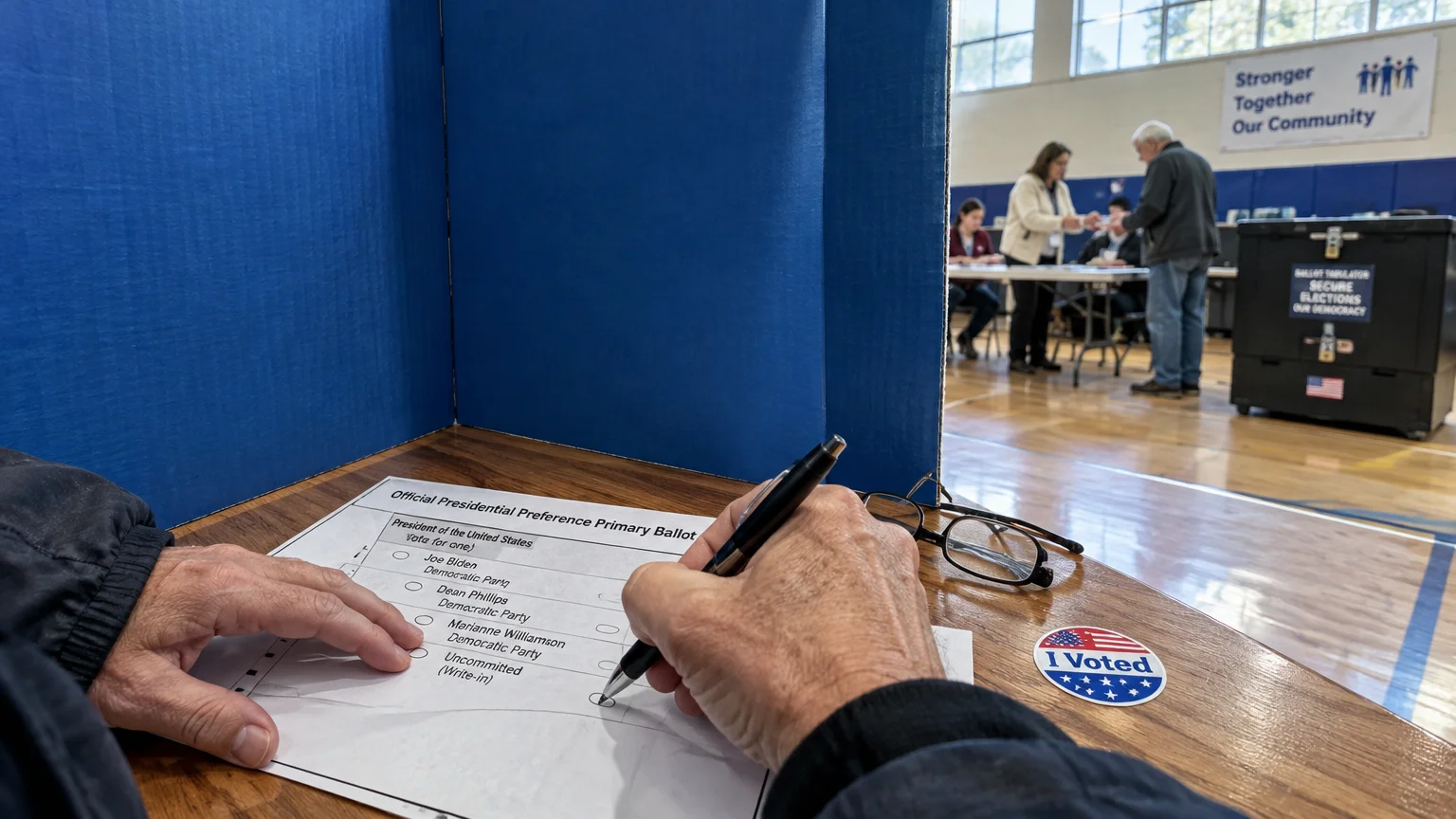
The Legacy of Primary Reforms in Today’s Nominating System
These eight historical milestones replaced an insular party oligarchy with a transparent, voter-driven delegate selection apparatus. Today, you and your fellow primary voters determine convention outcomes long before summer delegates gather.
Statutory mandates and party rules now force convention delegates to reflect certified primary tallies faithfully. Floor fights that dragged on for days or required 103 ballots have vanished from modern political conventions.
Neither major American political party has required more than a single ballot to select its presidential nominee since 1952. The modern convention serves as an official ratification rally rather than a backroom trading floor.
State primary calendars, delegate allocation thresholds, and binding commitments ensure that candidate momentum derives from ballot boxes. Party elites can still voice endorsements, but they no longer possess the structural levers to dictate nominee selection.
The table below highlights how key legal battles, commission rulings, and procedural walkouts dismantled smoke-filled rooms over the past century.
| Year | Reform Milestone | Legal or Procedural Mechanism | Impact on Party Machines |
|---|---|---|---|
| 1901–1905 | Florida and Wisconsin Laws | State-administered direct elections | Ended boss-controlled caucus delegate selection. |
| 1910–1912 | Oregon and North Dakota Primaries | Legally binding presidential preference votes | Prohibited delegates from disregarding voter results. |
| 1912 | Republican Convention Walkout | Contested delegate credential challenges | Exposed how machine credentials nullified popular primaries. |
| 1920 | Blackstone Hotel Suite 404 Deal | Late-night multi-ballot backroom bargaining | Coined smoke-filled room and drove calls for reform. |
| 1924 & 1952 | Multi-Ballot Floor Deadlocks | 103-ballot deadlock and bypass of Kefauver | Marked the final multi-ballot conventions in history. |
| 1968 | Chicago Convention Upheaval | First-ballot nomination without primary votes | Triggered national delegate selection overhauls. |
| 1969–1972 | McGovern-Fraser Commission | 18 binding open delegate selection rules | Triggered rapid expansion of binding state primaries. |
| 1982 & 2018 | Hunt Commission and DNC Voting Reforms | Superdelegates created, then barred on first ballot | Guaranteed voter-pledged delegates control first ballot. |
This structural evolution proves that convention rules are not mere administrative trivia. The technical mechanics governing delegate selection directly govern who can attain the American presidency.
Frequently Asked Questions About Presidential Primaries
Why did Iowa and New Hampshire hold the earliest nominating contests for decades?
Iowa established the first modern caucus calendar in 1972 to accommodate its lengthy, multi-tiered convention delegate reporting deadlines. The McGovern-Fraser reforms required extensive public notice, forcing state party leaders to start their precinct caucuses early in January.
New Hampshire codified its first-in-the-nation primary status by enacting a 1979 state law requiring its election to precede any similar contest by seven days. Candidates and national media outlets prioritized both states, turning early retail campaigning into an essential nominating test.
While the Democratic Party reorganized its official calendar in 2023 to prioritize diverse states like South Carolina, both states shaped modern campaign strategy for five decades.
Could a contested or multi-ballot convention ever happen again?
A contested multi-ballot convention remains legally possible under existing national party charters if no candidate secures a simple majority of pledged delegates. However, proportional allocation rules, sequential state contests, and early candidate dropouts make floor deadlocks exceedingly rare.
If no candidate wins a majority on the first ballot, pledged delegates generally become free agents on subsequent roll calls under individual state laws. Superdelegates would also join subsequent ballots, reintroducing peer negotiation under strict, public parliamentary scrutiny.
How do state laws legally bind convention delegates to primary results?
State election codes vary, but most jurisdictions require delegate candidates to file formal affidavits pledging allegiance to a specific presidential contender. In many states, election boards automatically certify convention delegates based directly on certified primary vote percentages.
The Supreme Court upheld the constitutional authority of national political parties to enforce delegate loyalty standards in landmark rulings like Chiafalo v. Washington in 2020.
Delegates who attempt to break their legal pledges can be replaced immediately by alternate delegates.
What prevents modern party elites from privately choosing candidates?
Modern party rules mandate that convention delegate seats must be contested through public primary elections or open caucuses. Party committees cannot issue credentials to delegates unless they were selected according to published state and national party timetables.
Furthermore, modern federal campaign finance laws and mandatory FEC reporting make covert party financing nearly impossible to execute. Candidate financial backing and delegate counts remain open to constant media and public scrutiny throughout the campaign calendar.