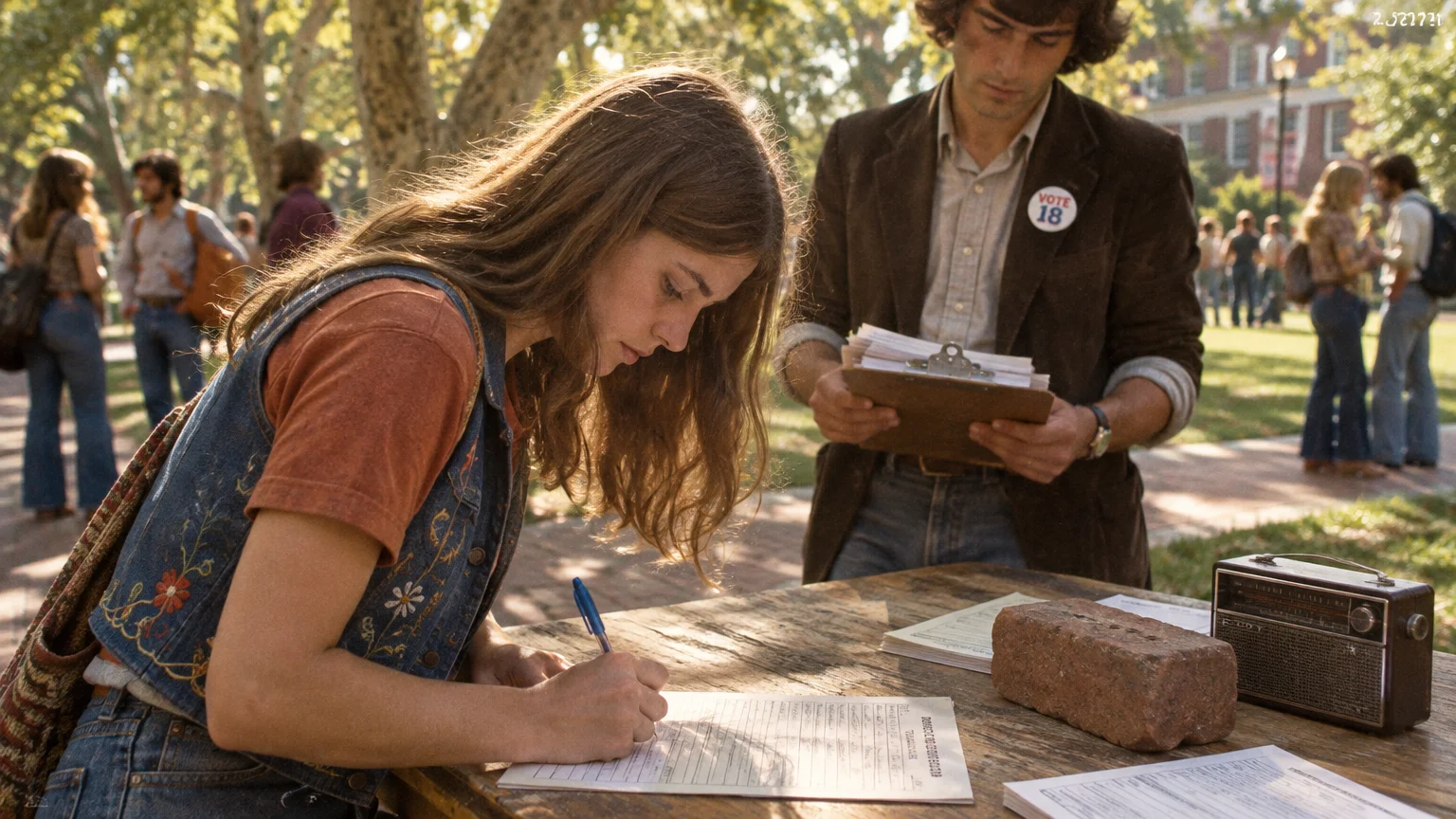
You can trace your constitutional right to vote at age 18 directly to the fastest amendment process in American history. In just 100 days during 1971, the nation altered its supreme law to enfranchise millions of young citizens.
This historic sprint bypassed decades of political gridlock to solve an unprecedented administrative election crisis. Understanding how state legislatures ratified this measure so quickly reveals the precise legal mechanics that can reshape American democracy.
Here is how grassroots activism, high-stakes judicial rulings, and widespread bureaucratic panic converged to lower the national voting age in record time.
How We Identified the Pivotal Catalysts Behind the 100-Day Ratification
Our editorial team examined congressional roll calls, presidential archives, and federal court records between 1942 and 1971 to identify why this amendment succeeded so quickly.
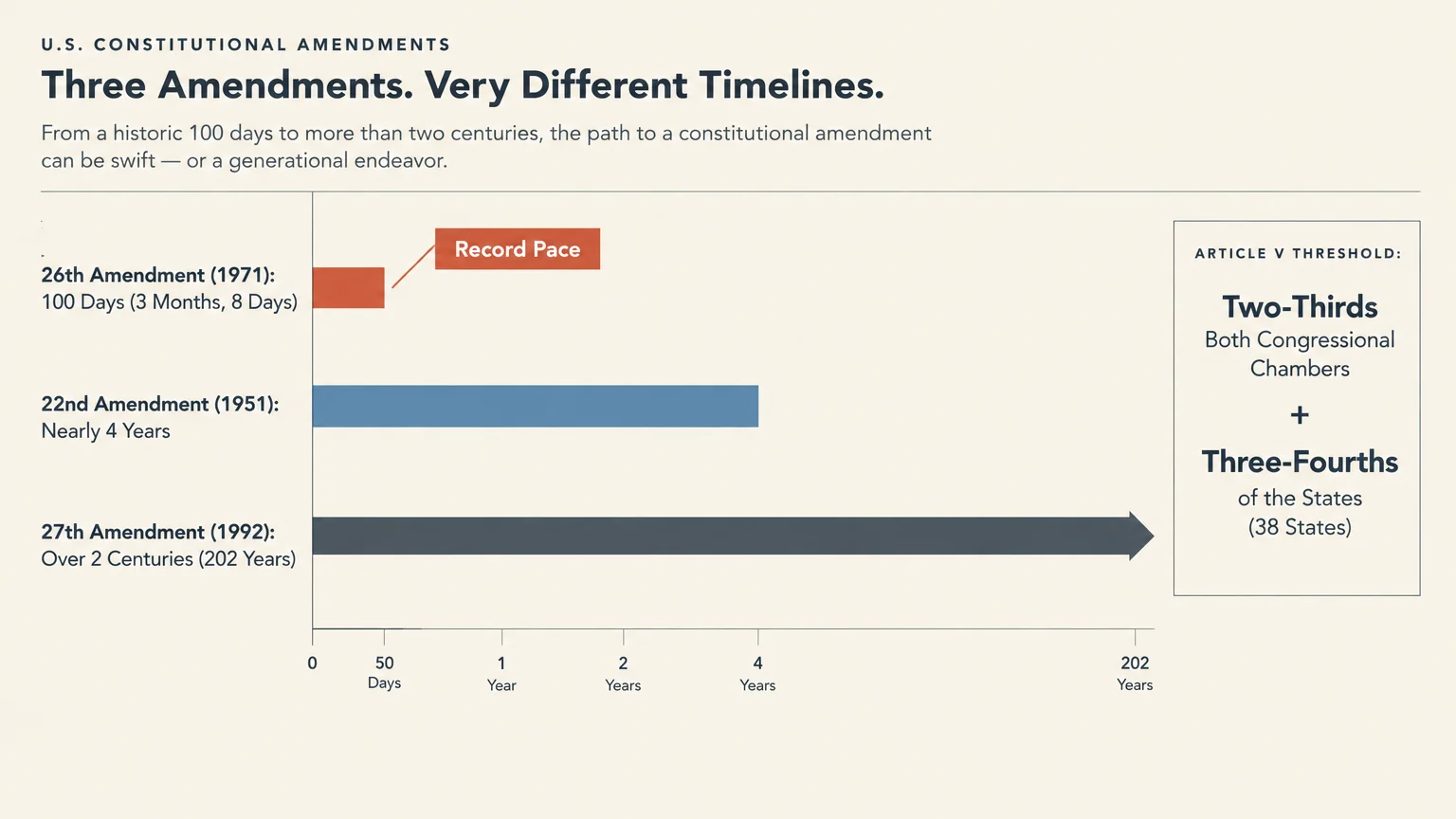
The 26th Amendment remains unmatched across American history; it advanced from congressional proposal to final state ratification in three months and eight days.
By comparison, the 27th Amendment required more than two centuries, while the 22nd Amendment limiting presidential terms took nearly four years.
Article V of the U.S. Constitution creates a notoriously difficult obstacle course; two-thirds of both congressional chambers and three-fourths of the states must concur.
Most proposed amendments fail entirely, while the few that succeed typically require years of contentious state-by-state political campaigning.
To uncover the mechanics of this record pace, we isolated the legislative maneuvers, executive actions, and judicial rulings that eliminated traditional political friction.
Our analysis focuses on how moral arguments regarding wartime military service transformed into an urgent administrative emergency for state election directors.
Every item on this list reflects documented milestones verified through public statutes, the Congressional Record, or Supreme Court jurisprudence.
By completing this demanding constitutional journey in just 100 days, the 26th Amendment set a legal benchmark that remains unbroken today.
These seven factors explain how institutional panic and coordinated public pressure united federal lawmakers and 38 state legislatures in record time.
Military Conscription and the Wartime Equity Mandate
The political momentum to lower the national voting age originated during World War II when federal conscription expanded to include 18-year-olds.
On November 11, 1942, President Franklin D. Roosevelt signed Public Law 77-772, amending the Selective Training and Service Act to lower the draft age from 21 to 18.
Young men ordered into military service overseas faced life-and-death consequences without having any voice in electing the officials who sent them to war.
This fundamental democratic deficit sparked an enduring grassroots rallying cry across military installations and college campuses: “Old Enough to Fight, Old Enough to Vote.”
In February 1943, Representative Jennings Randolph of West Virginia introduced the first formal resolution proposing a constitutional amendment to enfranchise 18-year-olds.
Randolph pursued this civic mission across nearly three decades, introducing the resolution 11 separate times during his tenure in the House and Senate.
During the Korean War and the early stages of the Vietnam War, draft calls continued to pull thousands of young men into military service.
Public frustration deepened because these conscripts could marry, pay taxes, and die on foreign battlefields, yet lacked the basic right to vote.
Major veterans organizations recognized this civic injustice; both the American Legion and the Veterans of Foreign Wars formally passed resolutions endorsing the change in 1968.
Randolph consistently argued that lowering the voting threshold would strengthen American democracy by channeling youthful idealism directly into lawful political institutions.
State governments gradually recognized that denying political representation to drafted soldiers eroded public confidence in democratic institutions.
Georgia became the first state to lower its voting age to 18 in 1943, followed by Kentucky establishing an 18-year-old threshold in 1955.
When Alaska and Hawaii achieved statehood in 1959, their inaugural constitutions established minimum voting ages of 19 and 20, respectively.
These early state adoptions offered concrete empirical proof that younger citizens could participate responsibly in elections without destabilizing local governance.
Bipartisan Presidential Endorsements Across Decades
Sustained executive backing transformed youth enfranchisement from a localized protest movement into an established national priority.
President Dwight D. Eisenhower broke significant institutional ground during his State of the Union address on January 7, 1954.
Eisenhower became the first American president to urge Congress publicly to propose a constitutional amendment lowering the voting age to 18.
Drawing upon his experience as Supreme Allied Commander, Eisenhower maintained that citizens asked to risk their lives for democracy deserved full participation in self-governance.
His 1954 address challenged traditional conservative resistance by framing youth voting as a patriotic imperative rather than a partisan gamble.
Fourteen years later, President Lyndon B. Johnson renewed executive pressure on Capitol Hill as the Vietnam conflict intensified public scrutiny of the draft.
On June 27, 1968, Johnson sent a formal message to Congress titled “To Vote at Eighteen,” urging immediate constitutional action.
Johnson argued that American youth in the 1960s possessed greater education, political literacy, and civic awareness than any previous generation.
When Johnson renewed the call in 1968, he established federal committees to study youth political engagement and civic literacy.
During the 1968 presidential campaign, Republican nominee Richard Nixon also endorsed lowering the voting age, creating complete executive consensus on the policy goal.
This continuous endorsement by both Republican and Democratic presidents insulated the reform from accusations of narrow partisan bias.
Unified presidential backing convinced skeptical civic leaders that the nation could safely integrate younger citizens into the electorate.
By establishing consistent executive support across multiple administrations, the White House laid the essential groundwork for rapid legislative action when a crisis emerged.
Federal Statutory Bypassing Through the Voting Rights Act
Frustrated by decades of stalled constitutional resolutions, congressional reformers decided to bypass the cumbersome Article V amendment process in 1970.
Legislative leaders attached an 18-year-old voting requirement directly to Title III of the Voting Rights Act Amendments of 1970.
Senators Edward Kennedy and Mike Mansfield argued that Congress could lower the voting age by simple statute under the Fourteenth Amendment’s enforcement clause.
In early 1970, congressional reformers calculated that a traditional constitutional amendment would take years to clear state legislative calendars.
However, veteran lawmakers like House Judiciary Committee Chairman Emanuel Celler warned that attempting this change by statute was legally vulnerable.
President Richard Nixon signed the bill into law on June 22, 1970, despite expressing severe reservations about its constitutionality.
In his official signing statement, Nixon warned that Congress lacked the constitutional power to dictate voter qualifications for state and local elections.
Nixon chose not to veto the Voting Rights Act extension because doing so would jeopardize critical civil rights protections nationwide.
Instead, Nixon instructed the Justice Department to facilitate expedited legal challenges so federal courts could clarify the law immediately.
The statute established a national compliance date of January 1, 1971, giving state election officials only six months to implement the mandate.
By choosing an aggressive statutory shortcut, Congress deliberately forced an immediate judicial test over federal control of election standards.
This tactical gamble triggered the exact constitutional showdown that made an expedited amendment necessary to prevent nationwide administrative collapse.
The Supreme Court Split Ruling in Oregon v. Mitchell
State officials immediately challenged Title III, asserting that Article I, Section 2 gave state governments exclusive authority over local voter qualifications.
Four separate states—Oregon, Texas, Idaho, and Arizona—refused to implement Title III and filed suit directly in the Supreme Court.
State attorneys argued that the Fourteenth Amendment was never intended to strip sovereign states of their authority to set voter age limits.
The legal challenge moved swiftly to the high court under original jurisdiction in Oregon v. Mitchell, decided on December 21, 1970.
The Supreme Court delivered an intensely fractured 5–4 ruling that produced five separate opinions totaling over 200 pages in the official reports.
Justice Hugo Black broke with his liberal colleagues, who favored broad federal authority, and his conservative colleagues, who favored complete state control.
Black ruled that Congress possessed constitutional authority under Article I, Section 4 to regulate voting age standards for federal contests.
However, he held that the Tenth Amendment barred Congress from dictating voter age requirements for state, county, and municipal elections.
Four justices believed Congress could lower the age for all elections, while four justices maintained Congress lacked power over any elections.
By issuing five separate opinions on December 21, 1970, the justices left state election directors in an impossible administrative bind.
Black’s solitary compromise created an immediate constitutional paradox: 18-year-olds had the right to vote for president, but states could bar them from local races.
The court’s compromise gave you the right to vote for federal office at 18, but left state contests completely out of reach.
This ruling created a dual-tier voting structure that threatened to paralyze election administration across the entire country.
The Looming Financial Crisis of Dual-Ballot Elections
The split verdict in Oregon v. Mitchell created an administrative nightmare for the 47 states that still restricted voting to citizens 21 and older.
Local election clerks suddenly faced the obligation of operating two completely separate election systems concurrently for the upcoming 1972 races.
Counties had to compile and maintain dual registration rolls: one list for federal ballots and a separate ledger for state contests.
Election boards were forced to print separate ballots that excluded gubernatorial, legislative, and local referenda for voters under 21.
Election directors in major cities faced the daunting task of reconfiguring mechanical lever voting machines before spring primaries began.
Clerks had to manually install physical lockout brackets on lever machines to prevent younger voters from pulling levers for state candidates.
College towns faced especially contentious disputes over whether student voters should register at their campus residences or their hometowns.
State election officials calculated that administering dual-ballot procedures would cost taxpayers an estimated $20 million nationwide.
County commissioners quickly calculated that hiring extra election workers and printing segregated ballots would blow massive holes in local budgets.
Small rural precincts warned that they lacked the physical floor space and poll worker personnel to manage two distinct voter lines.
These local financial realities created a powerful lobbying force that pressured state governors and legislative leaders to act without delay.
State legislators recognized that ratifying a constitutional amendment was vastly cheaper and simpler than overhauling their statutory election systems.
The immediate threat of administrative chaos and runaway municipal expenses quickly converted state-level skeptics into motivated champions of federal reform.
Overwhelming Bipartisan Momentum in Congress
With 1972 candidate filing deadlines approaching, congressional leaders acted with astonishing speed to craft a permanent constitutional solution.
Senator Birch Bayh of Indiana, chair of the Subcommittee on Constitutional Amendments, introduced Senate Joint Resolution 7 in late January 1971.
Bayh organized hearings in late February 1971, emphasizing that Congress had a duty to rescue states from administrative paralysis.
On March 10, 1971, the United States Senate approved the amendment by a unanimous 94–0 roll-call vote.
Representative Emanuel Celler recognized the crisis and dropped his long-standing procedural resistance, speeding the resolution through the House Judiciary Committee.
During the House floor debate on March 23, 1971, lawmakers from both parties spoke of the urgent necessity of uniform ballot access.
On March 23, 1971, the House of Representatives endorsed the measure with an overwhelming bipartisan vote of 401–19.
The final House tally of 401–19 showed that traditional ideological resistance had completely surrendered to pragmatic administrative demands.
Federal lawmakers recognized that failing to pass an amendment before primary season would trigger endless litigation and administrative gridlock.
Congressional staff immediately transmitted the proposed amendment text to state capitals via teletype and priority dispatch.
Governors across the country kept their legislative chambers in special session to receive the official resolution and begin voting immediately.
Five states completed legislative ratification on March 23, 1971, the exact day Congress submitted the text:
- Connecticut and Delaware
- Minnesota and Tennessee
- Washington State
These same-day ratifications created irresistible momentum, signaling that state governments viewed the amendment as an urgent practical rescue.
The Hundred-Day State Ratification Sprint
Under Article V of the Constitution, three-fourths of the states—amounting to 38 of 50 legislatures—must ratify a proposed amendment.
A nationwide coalition of student groups, labor unions, and civic organizations lobbied state capitals to keep the ratification momentum moving forward.
State legislative chambers across the country prioritized the measure, clearing both legislative houses with wide bipartisan majorities.
State after state approved the measure with overwhelming margins, often completing committee reviews and floor votes within a single legislative afternoon.
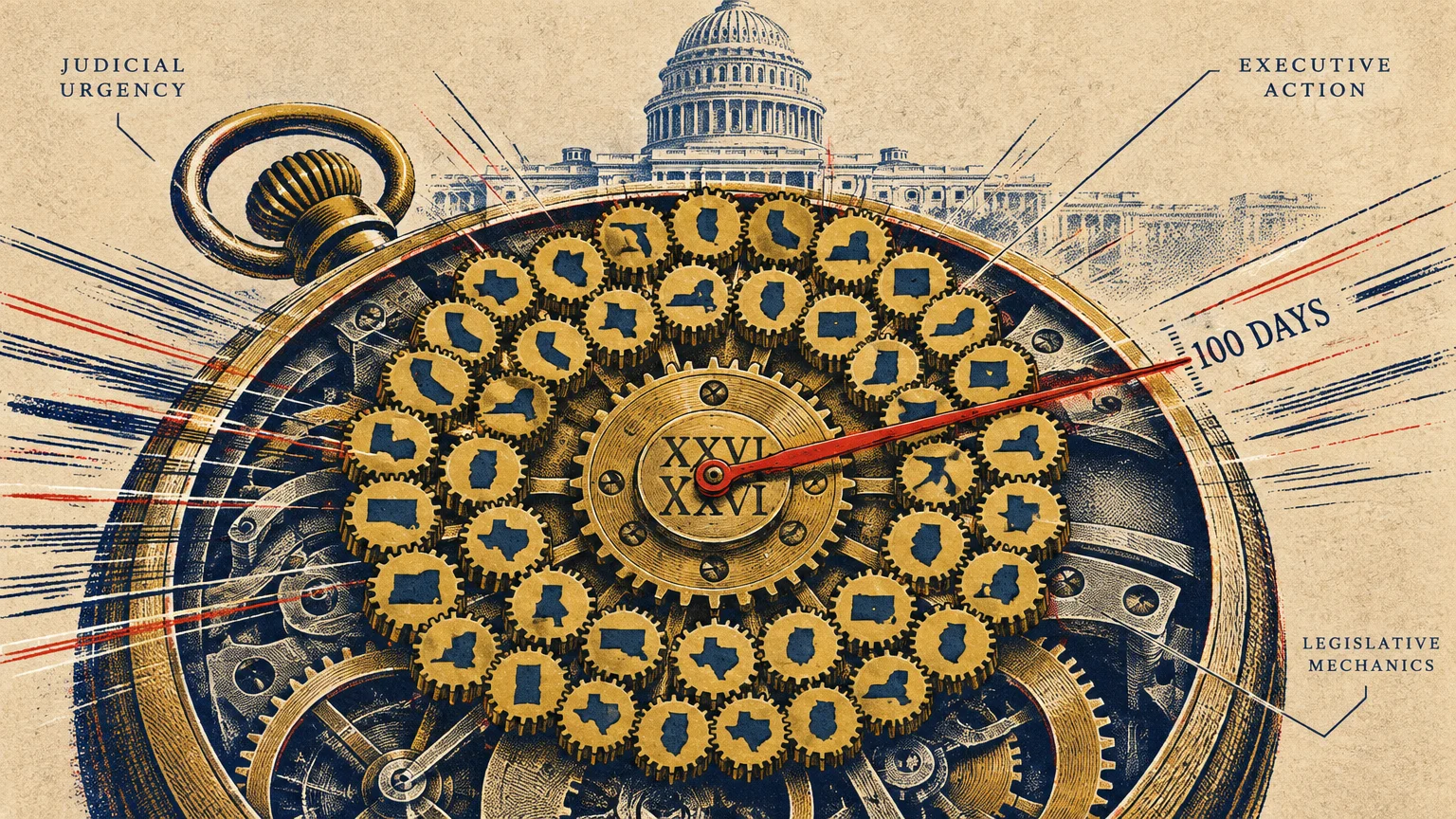
The ratification drive concluded on July 1, 1971, completing the entire process in just 100 days.
This blistering pace cut the previous record held by the 12th Amendment in 1804 by nearly half.
A persistent historical myth claims Ohio was the decisive 38th state after its legislature voted late on June 30, 1971.
President Nixon even issued a public statement that night congratulating Ohio for sealing the constitutional requirement.
When Ohio’s legislature concluded its vote on June 30, observers celebrated, unaware that North Carolina’s official filings had not yet cleared.
On the morning of July 1, 1971, the North Carolina General Assembly completed final action, officially securing the 38th state approval.
Official records from the Government Publishing Office confirm that North Carolina completed its legislative action on July 1, 1971.
Because Ohio voted 37th, North Carolina officially became the crucial 38th state that crossed the constitutional finish line.
General Services Administration records confirm that GSA head Robert Kunzig completed certification within four days, on July 5, 1971.
According to National Archives certification records, President Nixon signed the document as a witness alongside three 18-year-old civic advocates.
During the White House ceremony, President Nixon invited 18-year-old attendees to sign the formal certification document alongside him as witnesses.
Records from the U.S. Census Bureau voting reports confirmed that the amendment immediately enfranchised approximately 11 million young Americans.
Turnout data from the 1972 election proved that millions of young citizens exercised their newly ratified constitutional franchise at polling stations nationwide.
Following initial certification, five additional states eventually ratified the amendment, bringing the total to 43 states, while seven states never took action.
| Year | Institution | Milestone Action | Operational Impact |
|---|---|---|---|
| 1942 | U.S. Congress & FDR | Public Law 77-772 enacted | Lowered military draft age to 18 |
| 1954 | President Eisenhower | State of the Union address | First presidential call for amendment |
| 1970 | 91st U.S. Congress | Voting Rights Act Title III | Statutory 18-year-old voting threshold |
| 1970 | U.S. Supreme Court | Oregon v. Mitchell (400 U.S. 112) | 5–4 split created dual-ballot crisis |
| 1971 | 92nd U.S. Congress | Senate Joint Resolution 7 | Passed Senate 94–0 and House 401–19 |
| 1971 | CT, DE, MN, TN, WA | Five same-day ratifications | Approved amendment on proposal day |
| 1971 | North Carolina General Assembly | Ratification on July 1, 1971 | Official 38th state to cross threshold |
What the 100-Day Ratification Reveals About Constitutional Change
The unprecedented passage of the 26th Amendment proves that constitutional barriers dissolve when moral clarity aligns with direct administrative necessity.
For nearly 30 years, compelling appeals regarding wartime military service failed to overcome political caution and state-level inertia.
Decisive legislative action occurred only after the Supreme Court’s divided ruling imposed immediate, severe logistical costs on local governments.
When legal mandates threaten state election administration with bankruptcy and confusion, federal and state officials discover remarkable common ground.
State officials quickly realized that amending the supreme law was far less burdensome than spending $20 million on dual voting systems.
This episode permanently recalibrated American federalism by establishing a uniform national age requirement across all levels of government.
The speed of the 26th Amendment illustrates how crisis can cut through institutional inertia that otherwise blocks constitutional development.
This historic episode also demonstrates the power of youth organizing when grassroots demands align with practical administrative incentives.
Today, the 26th Amendment guarantees that states cannot use arbitrary age barriers to dilute your political voice in federal, state, or municipal elections.
The amendment continues to protect your right to participate in elections free from arbitrary age-based hurdles or discriminatory voting policies.
When you cast your ballot, you participate in an electoral system reshaped by one hundred days of extraordinary, crisis-driven institutional collaboration.
Frequently Asked Questions About the 26th Amendment
Which state was officially the 38th state to ratify the 26th Amendment?
Official records from the Government Publishing Office confirm that North Carolina was the decisive 38th state to ratify on July 1, 1971.
Contemporary wire reports and President Richard Nixon mistakenly credited Ohio after its legislative vote on the evening of June 30, 1971.
Archival documentation establishes that Ohio was the 37th state, making North Carolina the true legal threshold state that completed ratification.
How did Oregon v. Mitchell threaten state election administration?
The Supreme Court ruled that Congress could lower the voting age for federal races but lacked power over state and local elections.
This split verdict forced 47 states to prepare dual voter registers, separate paper ballots, and segregated voting booths for the 1972 elections.
Local election officials warned Congress that administering this dual-ballot system would cost taxpayers an estimated $20 million and cause widespread chaos.
How many total states have ratified the 26th Amendment?
A total of 43 states have ratified the 26th Amendment since Congress proposed it in March 1971.
South Dakota became the most recent state to approve the amendment, passing a symbolic ratification resolution on March 4, 2014.
Seven states never completed formal legislative action on the measure: Florida, Kentucky, Mississippi, Nevada, New Mexico, North Dakota, and Utah.
How many young voters were enfranchised when the amendment took effect?
The 26th Amendment immediately extended the constitutional right to vote to approximately 11 million Americans aged 18 to 20.
According to U.S. Census Bureau voting surveys, roughly 52 percent of newly eligible 18-to-20-year-olds registered and cast ballots in November 1972.
This sudden expansion represented the largest single influx of newly eligible voters into the American electorate since the ratification of the 19th Amendment.