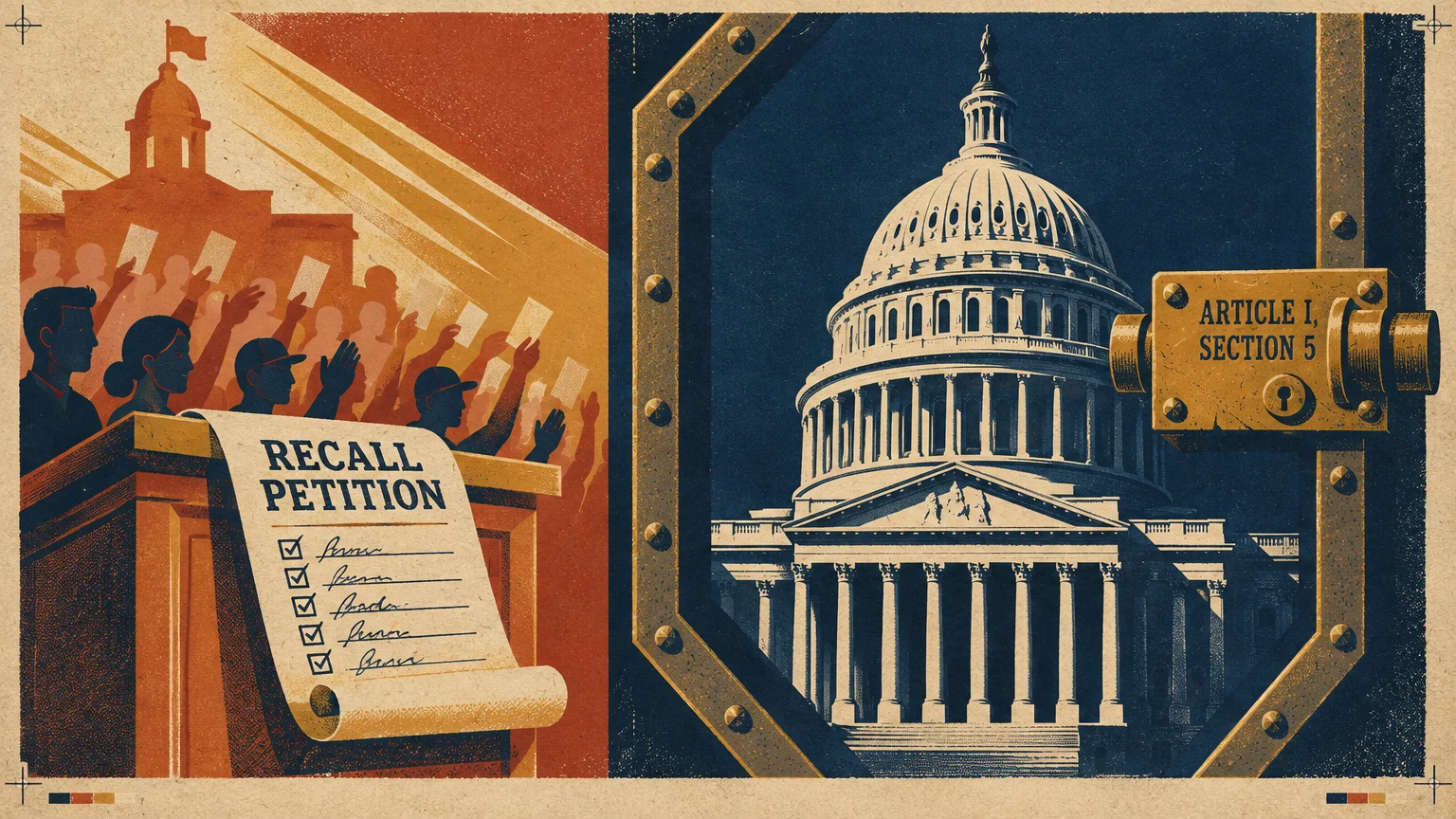
You can remove your governor or mayor through a citizen-led recall election in dozens of states. However, you cannot legally recall your United States Senator or congressional Representative under any circumstances.
While state constitutions grant citizens direct democracy mechanisms, the United States Constitution strictly reserves federal removal power to Congress itself. This division creates two completely different legal frameworks for accountability.
Understanding these legal boundaries protects your time and resources when petitioning government officials. Here are the core constitutional rules governing state recalls and federal tenure.
The Constitutional Rules Dividing State Recalls and Federal Tenure
This guide examines the six defining legal mechanisms that separate state recall powers from federal congressional tenure.
Our non-partisan editorial team selected these rules by analyzing state constitutional provisions, federal court jurisprudence, and congressional removal records.
We examine procedures across the 19 states authorizing statewide recalls, alongside the federal framework governing congressional seats.
The modern recall process emerged during the Progressive Era between 1908 and 1920 to counter political corruption.
Reformers designed citizen petitions to hold local executives and judges directly accountable between regular election cycles.
In stark contrast, the Framers of the U.S. Constitution intentionally rejected recall mechanisms for federal lawmakers in 1787.
They sought to create a stable national legislature insulated from momentary political shifts in individual states.
Reviewing these contrasting traditions reveals how direct democracy functions at home—and why federal law protects national legislative terms.
State Constitutions Control Direct Citizen Removal Powers
State-level recalls exist entirely as creations of individual state constitutions. The federal government possesses no legal authority over these state election procedures.
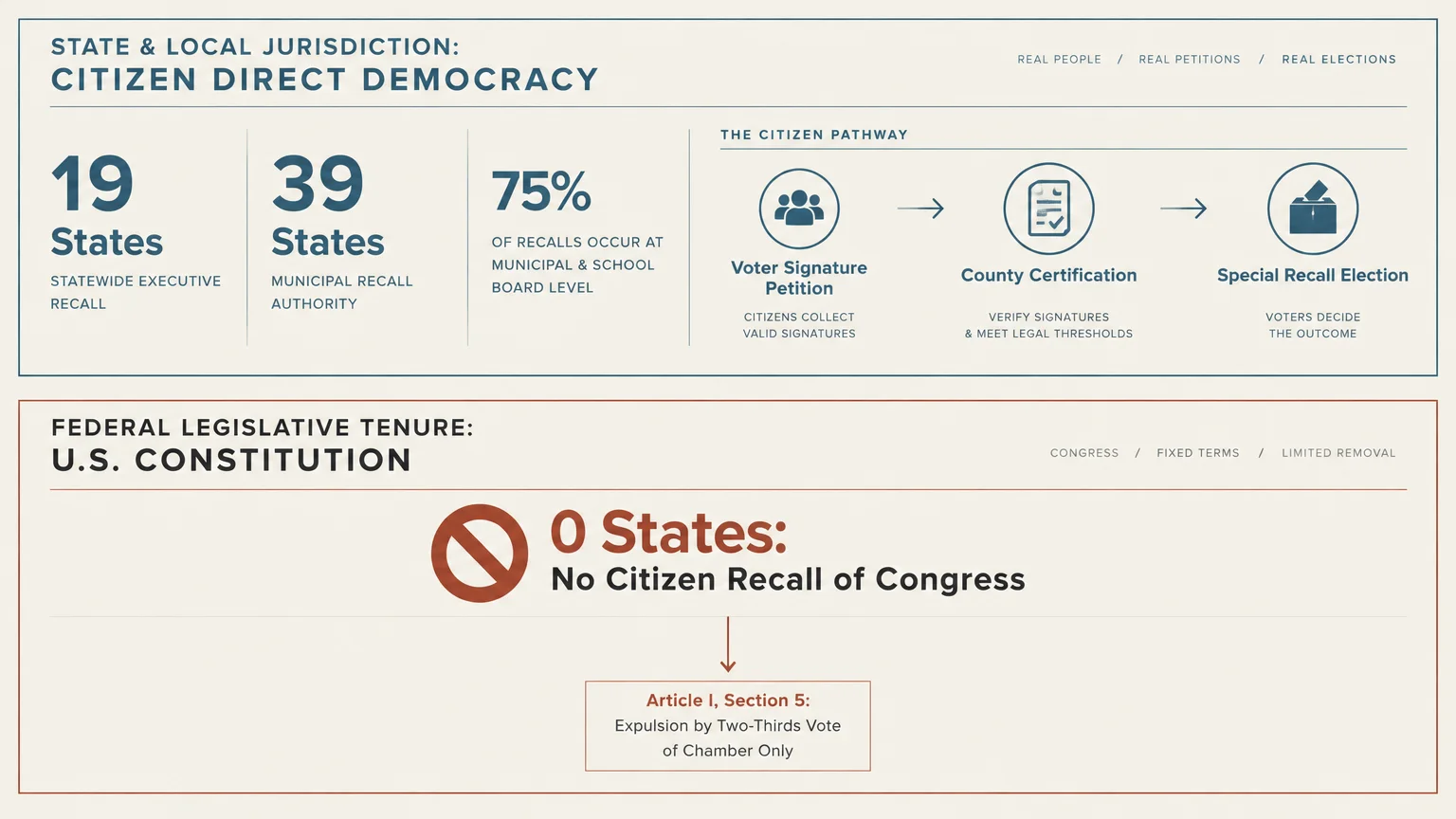
Nineteen states and the District of Columbia currently authorize citizens to recall state-level officials through signature petitions and special elections.
You can verify your specific jurisdiction’s legal framework through the National Conference of State Legislatures recall database.
These 19 states include Alaska, Arizona, California, Colorado, Georgia, Idaho, Illinois, Kansas, Louisiana, and Michigan.
They also include Minnesota, Montana, Nevada, New Jersey, North Dakota, Oregon, Rhode Island, Washington, and Wisconsin.
The modern recall movement began at the municipal level when Los Angeles voters adopted a recall charter amendment in 1903.
Statewide adoption quickly followed. In 1908, Oregon and Michigan became the first two states to enact statewide recall procedures.
By 1920, ten additional states amended their constitutions to add recall mechanisms, led by Western Progressive reformers.
Beyond statewide offices, local recall powers extend much further across the nation. Overall, 39 states authorize recall elections for local municipal officials.
These local procedures govern city council members, mayors, and local school board trustees.
Approximately 75 percent of all recall elections in the United States occur at these municipal and school board levels.
If you live in one of the 31 states without statewide recall laws, you cannot petition to remove your governor.
In those states, legislative impeachment remains the only legal avenue to remove an executive officer before their term concludes.
Specific Legal Grounds Dictate Petition Eligibility Across States
State laws divide sharply over whether citizens need a specific legal reason to circulate a recall petition.
Twelve of the nineteen recall states operate under a “no-excuse” standard. In these states, you can initiate a recall for any political or policy disagreement.
In states like California, Colorado, and Nevada, voters do not need to allege official corruption or legal violations.
You can legally launch a petition simply because you disagree with an official’s tax proposals or executive appointments.
However, eight states strictly require sponsors to prove specific statutory grounds before election officials certify a petition for circulation.
These grounds-required states include Alaska, Georgia, Kansas, Minnesota, Montana, Rhode Island, and Washington.
In these jurisdictions, your petition must allege specific offenses such as malfeasance, misfeasance, nonfeasance, or serious criminal misconduct.
Malfeasance involves committing an unlawful act in office, while nonfeasance means failing to perform a mandatory legal duty.
State election officers and state courts review petition text carefully. If your petition fails to establish legal grounds, authorities will reject it immediately.
Under Minnesota Constitution Article VIII, Section 6, the state Supreme Court must review allegations before organizers can gather signatures.
Washington state law similarly requires a county superior court judge to hold a hearing verifying the legal sufficiency of the claims.
Virginia maintains a unique judicial removal system that differs completely from standard recall elections.
Under Virginia Code Section 24.2-233, citizen petitions do not trigger a public ballot vote.
Instead, verified petition signatures trigger a formal recall trial before a state circuit court judge.
The judge evaluates evidence of material neglect or incompetence and issues a binding legal ruling on removal.
Signature Thresholds and Time Limits Determine Ballot Qualification
Securing a spot on the recall ballot demands substantial organizational resources and strict compliance with statutory deadlines.
Most recall states benchmark required petition signatures against total votes cast in the last election for that specific office.
Depending on the state and office, these thresholds range from 10 percent to 40 percent of the previous vote total.
A 25 percent signature threshold serves as the standard statutory benchmark across the majority of recall states.
California enforces the lowest qualification threshold for statewide executives, requiring signatures equal to 12 percent of the last vote.
Under Article II, Section 14 of the California Constitution, organizers must also collect signatures from at least five separate counties.
California grants petition circulators 160 days to collect, verify, and submit those voter signatures to county election offices.
Conversely, Kansas imposes one of the nation’s most demanding hurdles for citizen organizers.
Kansas requires sponsors to gather signatures equal to 40 percent of total votes cast, within a narrow 90-day window.
Many states enforce even tighter signature-gathering windows. Washington allows only 90 days for local offices, while Wisconsin allows just 60 days.
Illinois established the nation’s most restrictive recall system when voters approved a constitutional amendment in 2010.
Created after federal prosecutors indicted Governor Rod Blagojevich, the Illinois provision applies exclusively to the governor’s office.
Citizens cannot circulate an Illinois recall petition until they clear an extraordinary bipartisan legislative hurdle.
At least 20 members of the Illinois House and 10 members of the Illinois Senate must sign the petition notice.
Furthermore, state law requires that these legislative signatures divide equally between the two major political parties.
Only after securing this rare bipartisan support can citizens begin collecting public signatures equal to 15 percent of the prior vote.
Gubernatorial Recalls Remain Historically Extraordinary Events
While recall elections frequently make national headlines, successful statewide removals are historically extraordinary.
In more than a century of state recall history, only four sitting governors have ever faced a recall ballot.
Out of those four elections, voters successfully removed the incumbent executive on only two occasions.
North Dakota held the nation’s first gubernatorial recall election on October 28, 1921.
Conservative opponents targeted Progressive Governor Lynn Frazier over policies establishing the state-owned Bank of North Dakota and state mill.
Voters narrowly recalled Frazier by a vote of 111,434 to 107,381, replacing him with Independent Voters Association candidate Ragnvald Nestos.
More than 80 years passed before another American governor faced a recall vote.
On October 7, 2003, California voters confronted a historic recall election targeting Governor Gray Davis.
Facing severe energy crises and state budget deficits, Davis became the second recalled governor in U.S. history.
A total of 55.4 percent of California voters supported Davis’s removal, while voters selected Arnold Schwarzenegger from a field of 135 replacement candidates.
The remaining two gubernatorial recall elections resulted in decisive victories for the targeted incumbents.
Wisconsin Governor Scott Walker faced a recall election on June 5, 2012, following massive protests over public-sector collective bargaining legislation.
Walker survived the recall challenge, defeating Milwaukee Mayor Tom Barrett with 53.1 percent of the vote.
On September 14, 2021, California Governor Gavin Newsom faced a recall election driven by opposition to COVID-19 emergency policies.
Newsom defeated the recall decisively, winning 61.9 percent of the vote and preserving his gubernatorial mandate.
These outcomes demonstrate that recalling a statewide executive demands exceptional political momentum, national fundraising, and widespread public anger.
The Federal Constitution Bars States From Recalling Congressional Members
When constituents grow frustrated with their federal representatives, many explore recall petitions. That effort is always a legal dead end.
The United States Constitution provides no authorization whatsoever for voters to recall a federal official.
This omission was entirely intentional on the part of the nation’s constitutional architects.
Under Article V of the Articles of Confederation, states previously held express legal authority to recall their delegates at any time.
When delegates met at the Constitutional Convention of 1787, Edmund Randolph’s Virginia Plan proposed preserving that recall power.
The Framers debated the issue thoroughly and explicitly voted to eliminate the recall mechanism from the national charter.
Delegates such as Roger Sherman and James Madison argued that recall mechanisms would leave federal lawmakers vulnerable to state-level factions.
Instead, the Convention established fixed constitutional terms: two years for members of the House and six years for senators.
An authoritative legal analysis from the Congressional Research Service on the recall of legislators confirms that states cannot remove federal lawmakers.
Several states, including Wisconsin, Michigan, and New Jersey, have historical statutes referencing the recall of federal officials.
However, state and federal courts treat these state laws as completely unenforceable.
In Burton v. United States (1906), the Supreme Court ruled that a senator is a federal officer whose credentials derive from the federal Constitution.
The Supreme Court solidified this principle in U.S. Term Limits, Inc. v. Thornton (1995).
In that landmark 5–4 decision, the Court ruled that states cannot unilaterally add qualifications or alter the terms of federal legislators.
Writing for the majority, Justice John Paul Stevens emphasized that the Constitution established exclusive, uniform national qualifications for federal office.
In 2010, the New Jersey Supreme Court applied this precedent directly in Committee to Recall Robert Menendez v. Wells.
The state court unanimously struck down an attempt to recall a sitting U.S. Senator, ruling the state provision violated the federal Constitution.
Chamber Expulsion Serves as the Exclusive Constitutional Removal Process
The Constitution provides only one legal mechanism to remove a member of Congress before their term concludes.
Barring death, voluntary resignation, or criminal disqualification upon conviction in court, lawmakers can leave office early only through internal chamber expulsion.
Under Article I, Section 5, Clause 2 of the Constitution, each chamber exercises complete disciplinary authority over its own members.
The text explicitly authorizes each house to “punish its Members for disorderly Behaviour, and, with the Concurrence of two thirds, expel a Member.”
This provision establishes a formidable two-thirds supermajority threshold, ensuring that a simple majority faction cannot purge political adversaries.
Because of this rigorous standard, Congress has expelled only 21 members across more than 235 years of legislative history.
The Senate has expelled 15 members in its history, according to the official United States Senate expulsion records.
The Senate expelled its first member, William Blount of Tennessee, in 1797 for conspiring with British agents to seize Spanish-held territories.
The remaining 14 Senate expulsions occurred between 1861 and 1862 after southern senators supported the Confederate rebellion against the United States.
The House of Representatives has expelled only six members in total since the founding of the republic.
In 1861, the House expelled three members—John B. Clark, John W.
Reid, and Henry C. Burnett—for open rebellion against the Union.
The House did not expel another member for nearly 120 years.
On October 2, 1980, the House voted 376–30 to expel Representative Michael Myers following his bribery conviction in the FBI’s Abscam investigation.
On July 24, 2002, the House voted 420–1 to expel Representative James Traficant after federal convictions for bribery, tax fraud, and racketeering.
Most recently, on December 1, 2023, the House voted 311–114 to expel Representative George Santos following an extensive House Ethics Committee report.
The bipartisan vote easily surpassed the necessary two-thirds threshold, making Santos only the sixth representative ever expelled from the chamber.
| Office / Mechanism | Governing Authority | Grounds Required | Removal Action Required | Historical Precedent |
|---|---|---|---|---|
| State Governor (No-Excuse) | State Constitution | None (Voter discretion) | Majority popular vote | 4 elections (2 removed) |
| State Governor (Grounds States) | State Constitution | Malfeasance or crime | Judicial screening + popular vote | Rarely certified to ballot |
| Virginia State Officials | Va. Code Ann. § 24.2-233 | Material neglect or crime | Circuit court trial ruling | Judicial removal only |
| U.S. Representative | U.S. Const. art. I, § 5 | Disorderly behavior | Two-thirds House roll call | 6 members expelled |
| U.S. Senator | U.S. Const. art. I, § 5 | Disorderly behavior | Two-thirds Senate roll call | 15 members expelled |
Why the Division Between State and Federal Accountability Matters for Voters
The sharp distinction between state recall mechanisms and federal tenure rules highlights the dual nature of American constitutional federalism.
Progressive Era reformers successfully democratized state governments by creating direct voter mechanisms to recall state executives and judges.
These state tools provide a practical check when local officials betray the public trust or engage in documented malfeasance.
If you reside in one of the 19 recall states, your signature on a petition carries real legal force.
You can mobilize your local community, gather required signatures, and compel an elected official to face an early referendum.
At the federal level, however, the Framers intentionally prioritized legislative independence over direct popular democracy.
National representatives must balance the immediate demands of their local districts with the long-term strategic interests of the entire republic.
If states could recall federal lawmakers, narrow local majorities could paralyze congressional committees or disrupt critical national policy debates.
A single state could weaponize recalls to overturn the results of close congressional votes on national defense or fiscal budgets.
Recognizing this constitutional reality prevents grassroots activists from spending valuable time and funds on legally impossible federal recall campaigns.
If you wish to challenge a sitting U.S. Senator or Representative, your legal recourse lies in primary and general election campaigns.
You exercise your constitutional authority by organizing voter registration drives, contributing to challengers, and casting your ballot on Election Day.
Frequently Asked Questions About Recalls and Expulsion
Can a state legislature enact a new law authorizing the recall of federal lawmakers?
State legislatures cannot pass valid statutes authorizing the recall of United States Senators or Representatives.
Under the Supremacy Clause of the U.S. Constitution, federal law supersedes conflicting state enactments.
In U.S. Term Limits, Inc. v. Thornton, the Supreme Court ruled that states lack constitutional power to modify federal terms of office.
Any newly enacted state statute attempting to create a federal recall process would be struck down immediately by federal courts.
What happens to a governor’s office immediately following a successful recall election?
The succession process depends entirely on the specific constitutional structure of the state conducting the recall.
In California, the ballot features two separate questions. Voters decide whether to recall the incumbent and simultaneously choose a replacement candidate.
If a majority votes to recall the governor, the replacement candidate who receives a plurality of votes immediately takes office.
In states like Wisconsin and North Dakota, the recall functions as an open special election between the incumbent and challenging nominees.
In states without direct replacement voting, the state lieutenant governor or constitutional successor assumes the governor’s office to finish the term.
Why do the vast majority of successful recall campaigns occur at the municipal level?
Local recalls succeed far more often because municipal signature thresholds require significantly fewer total signatures than statewide efforts.
A municipal race might require only a few hundred or thousand signatures, which grassroots volunteers can collect through door-to-door canvassing.
Statewide campaigns, by contrast, frequently require hundreds of thousands of certified signatures collected within narrow statutory timeframes.
Meeting statewide deadlines often requires millions of dollars to hire commercial petition-gathering firms and legal compliance specialists.
Consequently, city council members and school board trustees account for approximately 75 percent of all recall activity nationwide.
Can Congress use the impeachment process to remove its own sitting members?
Congress does not use the impeachment clause to remove sitting members of the House or Senate.
Although Article II, Section 4 authorizes impeachment for “all civil Officers of the United States,” members of Congress are not civil officers.
The United States Senate established this constitutional precedent in 1799 during the impeachment proceedings against former Senator William Blount.
The Senate dismissed the impeachment articles for lack of jurisdiction, confirming that chamber expulsion under Article I, Section 5 governs congressional removal.