You judge political candidates by their campaign promises, but catchy slogans rarely predict how a president actually governs. A memorable catchphrase can rally millions of voters on Election Day while masking the harsh policy compromises waiting in the Oval Office.
Our editorial team evaluated nearly two centuries of American presidential contests to measure campaign rhetoric against real governing outcomes. You can track whether these ten famous campaign slogans produced landmark legislation, broken commitments, or national crises.
By examining official vote tallies and archival broadsides, you will discover the concrete aftermath behind the most celebrated slogans in American history.

How Campaign Slogans Shape Electoral Outcomes and Policy Realities
Political slogans compress complex party platforms into bite-sized phrases that sway undecided voters. You encounter these lines on yard signs, digital advertisements, and convention banners during every major election cycle.
This analysis examines ten historically defining slogans spanning from the 1840 election through 1984. We selected each entry based on its documented cultural reach and measurable policy impact after the campaign concluded.
You will find verified records from the Smithsonian National Museum of American History and archival election tallies. Each entry compares the campaign’s central promise directly against the administration’s verified legislative record.
Slogans often serve as temporary electoral glue rather than durable governance agendas. As a voter, you can protect yourself from political spin by learning how past presidents executed—or abandoned—their signature rally cries.
Understanding these historical pivots sharpens your critical instincts. You will see how foreign conflicts, economic panics, and internal party revolts routinely upended even the most decisive electoral mandates.
Tippecanoe and Tyler Too
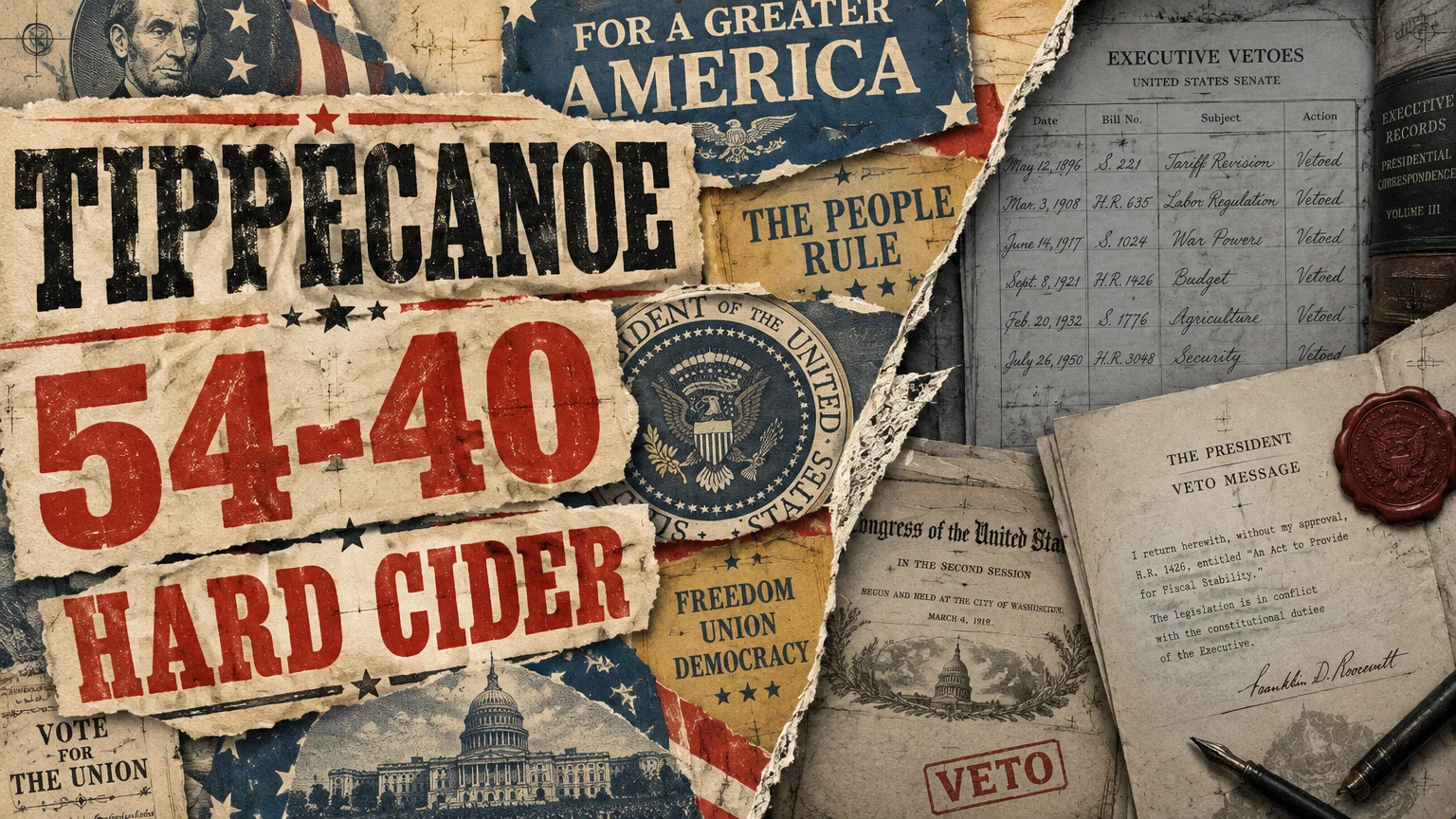
The Whig Party launched this famous chant during the 1840 presidential campaign to promote William Henry Harrison and John Tyler. The phrase celebrated Harrison’s 1811 victory at the Battle of Tippecanoe against a confederacy of Native American tribes.
Harrison presented himself as a humble frontier hero who lived in a log cabin and drank hard cider. In reality, Harrison came from an elite Virginia plantation family, while incumbent Democrat Martin Van Buren faced blame for the Panic of 1837.
On December 2, 1840, Harrison decisively defeated Van Buren in the Electoral College by a margin of 234 to 60. Harrison secured 52.9% of the popular vote, achieving the first presidential victory for the Whig Party.
Official records at the Library of Congress Presidential Election Ephemera Collection show how songbooks and parades spread this slogan nationwide. The campaign established mass merchandising as a standard tool of American presidential politics.
Harrison took the oath of office on March 4, 1841, and delivered a record-setting 8,445-word inaugural address in freezing weather. He developed pneumonia shortly afterward and died on April 4, 1841.
Harrison served just 31 days, making his administration the shortest in American history. John Tyler assumed the presidency and promptly broke with Whig congressional leaders, vetoing their signature national banking legislation.
Tyler’s entire cabinet resigned in protest, leaving the administration isolated and politically paralyzed. When you evaluate ticket-balancing running mates today, remember that Tyler’s succession redefined the executive branch overnight.
54-40 or Fight!
Democratic nominee James K. Polk popularized expansionist demands for the Pacific Northwest during the 1844 presidential election.
The slogan demanded that Great Britain cede the entire Oregon Country up to latitude 54°40′ N.
Polk capitalized on popular enthusiasm for westward expansion, a concept journalists soon branded as Manifest Destiny. He campaigned aggressively against Whig nominee Henry Clay, who urged diplomatic caution regarding territorial acquisitions.
On Election Day in November 1844, Polk defeated Clay by securing 170 electoral votes to 105. Polk captured 49.5% of the popular vote compared to Clay’s 48.1%, winning the decisive state of New York by just 5,106 votes.
Despite the fiery campaign rhetoric, Polk never went to war with Great Britain over the northern boundary. Tensions with Mexico escalated along the Rio Grande, forcing Polk to avoid a simultaneous conflict against the British Empire.
On June 15, 1846, Secretary of State James Buchanan and British envoy Richard Pakenham signed the Oregon Treaty. The treaty established the international border at the 49th parallel, where the boundary between the United States and Canada remains today.
Polk compromised on his northern territorial demand to concentrate military resources on the Mexican-American War. The administration secured valuable Pacific ports around Puget Sound without firing a single shot at British forces.
As you study foreign policy promises, recognize how territorial ultimatums often serve as bargaining postures. Polk weaponized a bellicose slogan to extract peaceful diplomatic concessions at the negotiating table.
Don’t Swap Horses in the Middle of the Stream
Abraham Lincoln adopted this folk adage while campaigning for re-election in 1864 under the National Union Party banner. The slogan urged citizens not to change national leadership while the Civil War hung in the balance.
Lincoln faced intense opposition from Democratic nominee George B. McClellan, the former commanding general of the Army of the Potomac.
McClellan campaigned on a platform that called for an immediate cessation of hostilities with the Confederacy.
Military victories by Union forces in late 1864, including the capture of Atlanta, galvanized Northern voters. On November 8, 1864, Lincoln crushed McClellan, winning 212 electoral votes to 21 and taking 55.0% of the popular vote.
Lincoln’s victory ensured that the Union would pursue the war to unconditional Confederate surrender. Confederate General Robert E.
Lee surrendered to Lieutenant General Ulysses S. Grant at Appomattox Court House on April 9, 1865.
Tragedy interrupted Lincoln’s second term just five days after Lee’s surrender. John Wilkes Booth shot Lincoln at Ford’s Theatre on April 14, 1865, and the president died the following morning on April 15.
Lincoln served just 42 days of his second term before Vice President Andrew Johnson succeeded him. Johnson’s bitter confrontations with congressional Republicans over Reconstruction led to his impeachment in 1868.
Wartime re-election appeals effectively discourage voters from changing course during a national emergency. You should note, however, that continuity slogans cannot safeguard an administration against catastrophic leadership succession risks.
Ma, Ma, Where’s My Pa?
Supporters of Republican candidate James G. Blaine chanted this provocative phrase against Democratic nominee Grover Cleveland in 1884.
The taunt surfaced after newspapers revealed that Cleveland had paid child support to Maria Halpin in Buffalo, New York.
Rather than issuing blanket denials, Cleveland instructed his campaign managers to tell the truth about his personal past. Cleveland admitted to providing financial support for the child, which surprised a public accustomed to political evasions.
The 1884 contest turned into one of the most vitriolic personal campaigns in American political history. Blaine faced his own financial corruption accusations involving railroad bonds and the infamous Mulligan letters.
On November 4, 1884, Cleveland won New York by a microscopic margin of 1,149 votes. That narrow victory secured Cleveland 219 electoral votes against Blaine’s 182, returning Democrats to the White House for the first time since 1856.
Jubilant Democrats quickly added a mocking second line to the Republican taunt: “Gone to the White House, ha, ha, ha!” Cleveland took the oath of office on March 4, 1885.
Cleveland built a reputation for administrative integrity by vetoing hundreds of private pension bills and defending the gold standard. He signed the Interstate Commerce Act of 1887, establishing the first federal regulatory agency.
Cleveland’s candid response proves that direct honesty can neutralize aggressive personal attacks. When you observe modern smear campaigns, evaluate whether targeted candidates address documented facts directly or attempt evasive cover-ups.
He Kept Us Out of War
Democratic incumbent Woodrow Wilson campaigned on this pledge in 1916 while combat engulfed Europe during World War I. Wilson emphasized his successful diplomatic efforts to preserve American neutrality despite repeated maritime provocations.
Wilson faced Republican nominee Charles Evans Hughes, a former Supreme Court justice who criticized Wilson’s military preparedness. Hughes campaigned aggressively across industrial states, arguing that Wilson’s foreign policy invited European aggression.
The November 7, 1916 election produced one of the closest finishes in presidential history. Wilson defeated Hughes by 277 electoral votes to 254, capturing California’s decisive 13 electoral votes by only 3,773 ballots.
Wilson’s peace pledge collapsed almost immediately after his victory. In January 1917, the German Empire announced the resumption of unrestricted submarine warfare against commercial shipping in the Atlantic war zone.
British intelligence then intercepted the Zimmermann Telegram, revealing German proposals for a military alliance with Mexico against the United States. Wilson delivered his war message to Congress on April 2, 1917.
Congress passed a joint declaration of war on April 6, 1917, barely one month after Wilson’s second inauguration. The United States deployed more than two million soldiers to France under General John J.
Pershing.
Wilson’s dramatic policy reversal demonstrates that global events can instantly shatter campaign promises. You must examine whether candidates possess realistic contingency plans when international conditions invalidate their original campaign platforms.
Return to Normalcy
Republican Senator Warren G. Harding coined this phrase during a speech in Boston on May 14, 1920.
Harding promised to restore national stability after the trauma of World War I, wartime economic controls, and the 1918 influenza pandemic.
Harding conducted a traditional “front porch” campaign from his home in Marion, Ohio. He contrasted his restrained domestic vision with the international activism advocated by Democratic nominee James M.
Cox.
According to official tallies at the National Archives Electoral College Results, Harding won a historic landslide on November 2, 1920. He defeated Cox 404 to 127 in electoral votes and secured 60.3% to 34.1% of the popular vote.
Harding’s 26.2 percentage point popular vote margin remains one of the largest presidential victory margins in American history. Voters overwhelmingly favored domestic disengagement and a retreat from Progressive Era regulatory expansion.
Harding signed the Budget and Accounting Act of 1921, creating the modern federal budget system. However, cronyism quickly tainted his administration as close associates, known as the “Ohio Gang,” exploited their federal offices.
The Teapot Dome scandal erupted when Secretary of the Interior Albert Fall accepted illegal bribes for leasing naval oil reserves. Harding died suddenly of a heart attack on August 2, 1923, before congressional investigations exposed the full corruption.
Harding’s slogan offered psychological comfort to an exhausted public, but poor executive appointments doomed his legacy. You should look past comforting campaign rhetoric and rigorously examine a candidate’s managerial ethics and cabinet choices.
A Chicken in Every Pot and a Car in Every Garage
The Republican National Committee circulated advertisements containing this famous phrase during the 1928 presidential campaign. The slogan credited Republican governance for 1920s prosperity and promised continued economic growth under Herbert Hoover.
Hoover, a respected mining engineer and former Secretary of Commerce, ran against Democratic Governor Al Smith of New York. Hoover emphasized American industrial efficiency, technological innovation, and private enterprise as guarantees against poverty.
On November 6, 1928, Hoover swept the election with 444 electoral votes to Smith’s 87. Hoover captured 58.2% of the popular vote, breaking into the traditionally Democratic “Solid South” by winning five former Confederate states.
Hoover’s economic promises evaporated less than eight months into his presidency. The stock market crash of October 1929 wiped out billions of dollars in equity and triggered the Great Depression.
By 1932, national unemployment soared to approximately 23.6%, leaving millions of families without income or food security. Displaced citizens derisively named shantytowns “Hoovervilles” and empty pockets turned inside out “Hoover flags.”
Hoover signed the Smoot-Hawley Tariff Act of 1930 and created the Reconstruction Finance Corporation in 1932. These emergency measures failed to arrest the economic collapse, and Franklin D.
Roosevelt defeated Hoover 472 to 59 in 1932.
Hoover’s slogan illustrates the extreme danger of tying a presidency to ongoing market prosperity. As a voter, you should scrutinize candidates who take personal credit for macroeconomic trends outside federal control.
I Like Ike
The Republican Party built its 1952 presidential bid around General Dwight D. Eisenhower’s immense personal popularity.
Ad executive Jacqueline Cochran popularized the phrase, while Roy Disney produced animated television advertisements featuring the catchy jingle.
Eisenhower, the Supreme Allied Commander in Europe during World War II, presented himself as a trusted, non-partisan leader. He pledged to travel to Korea to end the ongoing military stalemate and root out government corruption.
On November 4, 1952, Eisenhower defeated Democratic Governor Adlai Stevenson in an electoral landslide of 442 to 89. Eisenhower captured 55.2% of the popular vote, ending 20 consecutive years of Democratic rule in the White House.
Archival materials at the Dwight D. Eisenhower Presidential Library confirm the unprecedented effectiveness of his media campaign. Eisenhower’s team pioneered thirty-second television spots that answered questions directly from ordinary voters.
Eisenhower fulfilled his primary campaign promise by securing the Korean Armistice Agreement on July 27, 1953. He also signed the Federal-Aid Highway Act of 1956, authorizing 41,000 miles of interstate highways across the nation.
Eisenhower completed two terms with high public approval, managing Cold War crises while balancing the federal budget three times. His administration demonstrated that personal affection could successfully translate into stable, disciplined executive management.
Eisenhower proved that simple, likable branding works best when reinforced by genuine administrative capability. You should verify whether candidates relying on warm personal branding possess executive management credentials to match their image.
In Your Heart, You Know He’s Right
Republican Senator Barry Goldwater of Arizona adopted this slogan for his 1964 presidential campaign against Lyndon B. Johnson.
The phrase urged voters to trust Goldwater’s uncompromising conservative principles on individual liberty and national defense.
Goldwater had voted against the Civil Rights Act of 1964 on constitutional grounds and advocated aggressive nuclear deterrence against communist states. His rhetoric electrified conservative grassroots activists but alarmed moderate suburban voters.
President Johnson’s campaign exploited Goldwater’s statements by circulating the devastating counter-slogan: “In your guts, you know he’s nuts.” Johnson’s team aired the famous “Daisy” television advertisement on September 7, 1964, highlighting nuclear risks.
On November 3, 1964, Johnson crushed Goldwater in a historic landslide, winning 486 electoral votes to 52. Johnson won 61.1% of the popular vote, establishing the highest popular vote percentage in modern American history.
Johnson capitalized on his massive congressional majorities to pass his Great Society domestic agenda through Congress. He signed the Voting Rights Act of 1965 and established Medicare and Medicaid through the Social Security Amendments of 1965.
Goldwater’s crushing defeat temporarily devastated the Republican Party, but his conservative movement permanently reshaped American politics. Goldwater’s dedicated volunteers built the organizational infrastructure that eventually elected Ronald Reagan sixteen years later.
Slogans that prioritize ideological purity over broad consensus frequently lose general elections. When you evaluate political messaging, watch how hardline rhetoric often energizes loyal primary voters while driving away general election majorities.
It’s Morning Again in America
Advertising executive Hal Riney wrote and narrated this television commercial for Ronald Reagan’s 1984 re-election campaign. Officially titled “Prouder, Stronger, Better,” the ad celebrated declining inflation, lower interest rates, and renewed national self-confidence.
Reagan contrasted current economic recovery with the stagflation and Iranian hostage crisis of the late 1970s. Democratic challenger Walter Mondale struggled to gain traction while warning voters that Reagan’s budget deficits would require tax increases.
On November 6, 1984, Reagan achieved one of the most lopsided victories in presidential history. Reagan won 49 of 50 states, securing a record 525 electoral votes against Mondale’s 13, and winning 58.8% of the popular vote.
Historical election documents at the American Presidency Project illustrate the immense cultural resonance of Reagan’s visual campaign. Riney’s commercial avoided dry statistical arguments, using warm imagery of morning commuters, weddings, and flag-raisings.
Reagan fulfilled key economic goals during his second term, signing the bipartisan Tax Reform Act of 1986. He also negotiated the historic Intermediate-Range Nuclear Forces Treaty with Soviet leader Mikhail Gorbachev in 1987.
Reagan’s second term encountered severe turbulence when the Iran-Contra affair surfaced in November 1986. Congressional investigations revealed that administration officials secretly sold weapons to Iran to fund Nicaraguan Contras, violating federal law.
Uplifting emotional themes can unite a national electorate, but they cannot shield an administration from unauthorized covert operations. You should always separate a candidate’s inspiring public optimism from their administrative control over executive agencies.
| Slogan | Year | Candidate | Electoral Vote | Policy Outcome |
|---|---|---|---|---|
| Tippecanoe and Tyler Too | 1840 | W.H. Harrison (Whig) | 234 to 60 | Harrison died in 31 days; Tyler broke with Whig platform. |
| 54-40 or Fight! | 1844 | James K. Polk (Democrat) | 170 to 105 | Compromised with Britain at 49th parallel to fight Mexico. |
| Don’t Swap Horses | 1864 | Abraham Lincoln (Union) | 212 to 21 | Union won war; Lincoln assassinated 42 days into second term. |
| Ma, Ma, Where’s My Pa? | 1884 | Grover Cleveland (Democrat) | 219 to 182 | Cleveland admitted paternity, won, and cut patronage spending. |
| He Kept Us Out of War | 1916 | Woodrow Wilson (Democrat) | 277 to 254 | Asked Congress for war declaration one month after inauguration. |
| Return to Normalcy | 1920 | Warren G. Harding (Republican) | 404 to 127 | Created budget bureau; administration collapsed into bribery scandals. |
| Chicken in Every Pot | 1928 | Herbert Hoover (Republican) | 444 to 87 | Great Depression hit eight months later; unemployment hit 23.6%. |
| I Like Ike | 1952 | Dwight D. Eisenhower (Republican) | 442 to 89 | Ended Korean War; authorized Interstate Highway System. |
| In Your Heart You Know He’s Right | 1964 | Barry Goldwater (Republican) | 52 to 486 (Lost) | Lost in landslide; LBJ enacted Great Society legislation. |
| It’s Morning Again in America | 1984 | Ronald Reagan (Republican) | 525 to 13 | Passed 1986 tax reform; second term clouded by Iran-Contra. |
What Historical Slogans Reveal About Presidential Accountability
Presidential campaign slogans succeed because they compress vast policy arguments into memorable emotional themes. Slogans serve as marketing devices designed to maximize turnout rather than comprehensive blueprints for governing.
Unforeseen crises frequently destroy the promises made by victorious candidates. Woodrow Wilson entered World War I within weeks of promising neutrality, while Herbert Hoover encountered the Great Depression months after promising enduring wealth.
The American constitutional system divides power between the executive branch, Congress, and the judiciary. Presidents cannot unilaterally enact their campaign slogans without sustained legislative support and legal authorization.
Succession risks present another critical factor that slogans obscure during campaigns. William Henry Harrison and Abraham Lincoln both won on popular slogans, yet their untimely deaths transferred executive power to ideological opposites.
You should treat modern campaign slogans as strategic indicators rather than policy guarantees. When evaluating candidates, examine their past voting records, executive appointments, and statutory proposals rather than their promotional rhetoric.
Cross-referencing campaign promises against historical outcomes helps you anticipate post-election governing challenges. Informed voters assess how well candidates prepare for crisis management rather than how well their slogans poll.
Frequently Asked Questions About U.S. Campaign Slogans
Can a campaign legally trademark a presidential slogan?
Political campaigns can register trademarks with the U.S. Patent and Trademark Office for commercial merchandise. A candidate cannot prevent political opponents or journalists from using the phrase under the First Amendment.
Campaigns routinely register trademarks to maintain exclusive rights over authorized fundraising merchandise like t-shirts and hats.
Who pays for the production and distribution of slogan merchandise?
Authorized candidate committees, national party committees, and political action committees finance the production of campaign merchandise. Federal law requires these organizations to disclose all production and distribution disbursements to the Federal Election Commission.
Under federal campaign finance regulations, purchases of official campaign merchandise count as political contributions from individual donors.
Do positive or negative slogans historically perform better in elections?
Historical outcomes show that broad, positive themes generally win general elections, while aggressive negative slogans often backfire. Barry Goldwater’s confrontational slogan collapsed in 1964, whereas Ronald Reagan’s optimistic morning message secured forty-nine states in 1984.
Negative slogans often succeed at consolidating primary voters, but victorious general election candidates typically build broad coalitions with forward-looking appeals.
How does modern campaign finance disclosure apply to slogan advertising?
Federal campaign finance statutes mandate that all broadcast, print, and digital political advertisements include explicit “paid for by” disclaimers. Broadcast spots must include personal audio endorsements from the candidate verifying approval of the message.
These statutory disclaimer rules ensure that voters can identify who funded specific promotional slogans across all media platforms.