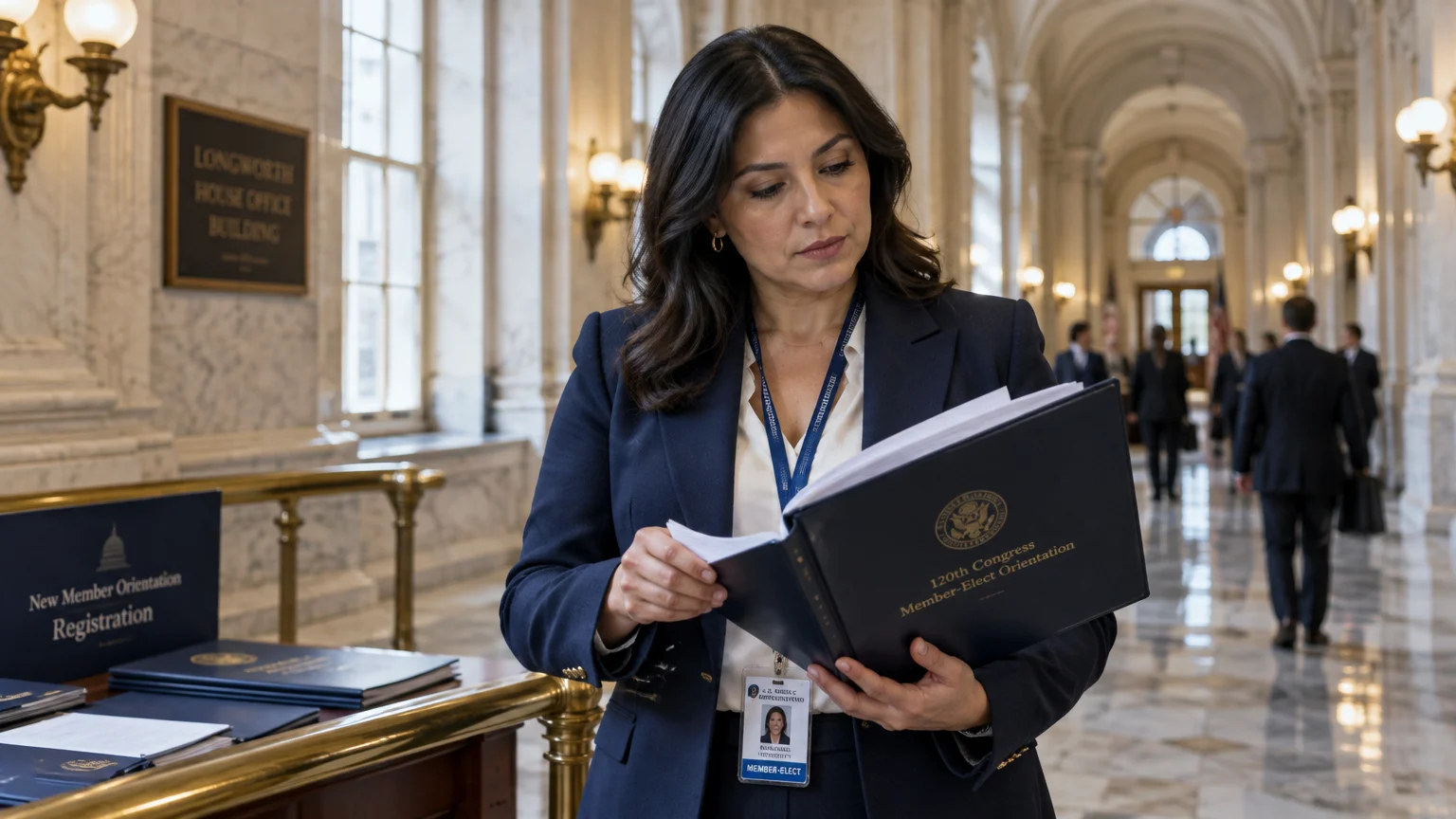
Winning a congressional election initiates an administrative sprint weeks before a representative-elect takes the constitutional oath. Incoming lawmakers must learn federal compliance rules, hire staff, and secure office space in mere days.
Every two years, the Committee on House Administration organizes New Member Orientation for incoming lawmakers. This non-partisan program covers institutional ethics, payroll rules, and floor procedure ahead of the new term.
The Statutory and Administrative Framework of Congressional Orientation
This list details the ten core statutory, procedural, and administrative events that every representative-elect completes during freshman orientation ahead of the 120th Congress convening under the Twentieth Amendment on January 3, 2027.
Entries were selected from the public rules and administrative manuals of the Committee on House Administration, the Architect of the Capitol, and the Congressional Research Service.
Drawing Wooden Numbers in the House Office Lottery
A lawmaker’s physical footprint on Capitol Hill depends on the room lottery managed by the Architect of the Capitol. Incumbent members claim vacant suites first through seniority, leaving remaining offices across the Cannon, Longworth, and Rayburn buildings for freshmen.
According to House historical records on the office lottery, this drawing tradition originated in January 1908. House officials placed numbered marbles inside a wooden box to allocate offices in the newly constructed Cannon building.
In the modern ceremony, each representative-elect draws a numbered wooden button from an antique ballot box. Once staff call a drawn number, that member has strictly five minutes to select a permanent suite from the availability board.
Allocating the Members’ Representational Allowance
During financial onboarding, the Chief Administrative Officer assigns each incoming lawmaker’s primary operational account, the Members’ Representational Allowance (MRA). Authorized under 2 U.S.C. § 5341, this statutory fund pays for official staff, equipment, district rent, and legislative communications.
A Congressional Research Service analysis of the MRA notes that annual member allocations average between $1.85 million and $2.09 million. The exact formula calculates district distance from Washington, commercial lease costs, and the number of residential addresses in the district.
The Committee on House Administration calculates the allowance using three components—personnel, official office expenses, and official mail—though members may shift funds across categories. Federal law prohibits spending MRA funds on campaign activities, and lawmakers are personally liable for unauthorized overspending.
Confronting the Senior Staff Salary Inversion
Human resources briefings introduce incoming lawmakers to statutory congressional pay caps. Under 2 U.S.C. § 4501 and recurring annual appropriations riders, rank-and-file member base pay has remained frozen at $174,000 since 2009.
By contrast, House orders peg the maximum rate for senior staff compensation to Level II of the Executive Schedule, allowing top aides to earn up to $228,000 annually. This discrepancy creates an administrative dynamic known across the Capitol complex as the senior staff salary inversion.
Under these rules, a representative can legally pay a chief of staff or legislative director up to $54,000 more than the member’s own statutory salary.
Structuring Capitol and District Staff Under Federal Caps
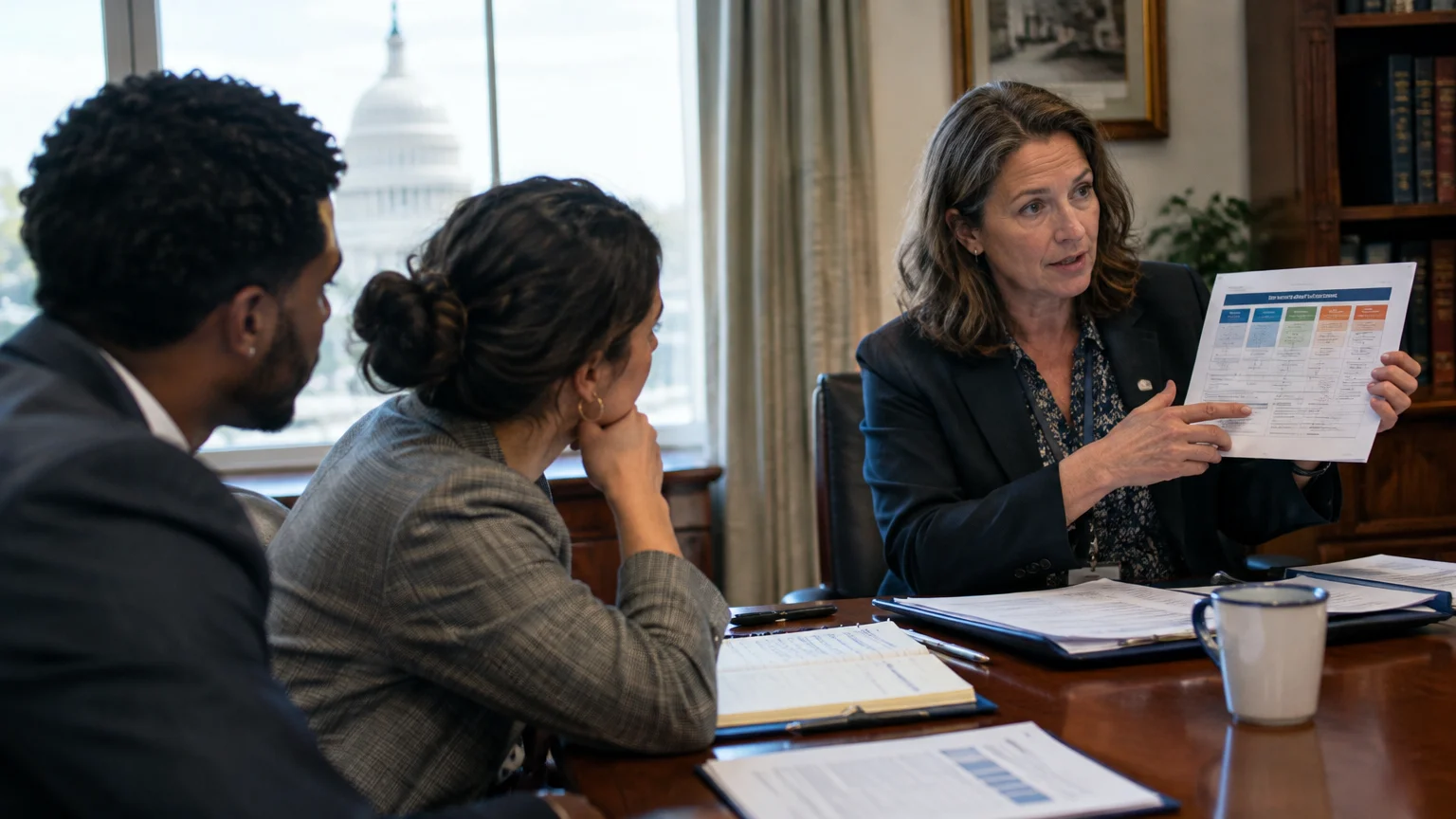
Administrative sessions led by the House Chief Administrative Officer outline the statutory limits governing office personnel. Under 2 U.S.C. § 5321, each House member may employ a maximum roster of 18 permanent full-time staffers.
The statute permits up to four additional employees if they fall into specific categories such as part-time, shared, or temporary staff. This provision sets a hard ceiling of 22 total employees on any member’s official payroll.
Most incoming offices split these 22 slots roughly evenly between legislative staff in Washington and constituent caseworkers in regional district offices.
Completing Mandatory Ethics and Financial Disclosure Briefings
Incoming lawmakers must complete legal compliance trainings conducted by attorneys from the House Committee on Ethics. These mandatory sessions cover statutory requirements under the Ethics in Government Act of 1978 and House Rule 25.
Attorneys review strict gift bans that prohibit accepting meals, travel, or lodging from registered lobbyists and foreign agents. Narrow exceptions cover nominal items, widely attended events, and gifts from personal relatives.
Compliance officers also explain transaction rules under the Stop Trading on Congressional Knowledge (STOCK) Act of 2012 (Public Law 112-105). Under the House Ethics Manual, members must report personal securities transactions exceeding $1,000 within 30 to 45 days or face statutory late fees.
Selecting Mandatory Healthcare and Capitol Physician Coverage
Benefits counselors walk incoming lawmakers through the statutory health insurance rules enacted in the 111th Congress. Under Section 1312 of the Affordable Care Act, codified at 42 U.S.C. § 18032, members seeking employer-sponsored coverage must purchase plans through the D.C.
Health Link small-business exchange.
The federal government contributes roughly 72% to 75% of the premium for a designated Gold-tier exchange plan. Lawmakers pay the remaining balance through monthly payroll deductions.
Members may also enroll in on-site clinical and emergency care through the Office of the Attending Physician inside the Capitol for an optional flat fee of $600 per year.
Consolidating Digital Credentials Through LIMS and Security Vetting
Orientation centralizes technical and security onboarding through the Office of the Clerk and the Chief Administrative Officer. Administrative staff channel incoming biometric and personnel records through the Legislative Information Management System (LIMS).
Each representative-elect sits for a single official portrait that House systems distribute across Capitol directories, voting identification cards, and security badges. The House Sergeant at Arms and U.S. Capitol Police then conduct security briefings covering encrypted communications and threat protocols.
Under Federal Election Commission and House Administration rules, members may use authorized MRA funds to install security systems and cameras at their district offices and personal residences.
Mastering Floor Protocol and the Rules of the House
Freshmen gather inside the House Chamber for direct procedural instruction from the non-partisan Office of the Parliamentarian. These sessions explain the rulemaking framework authorized under Article I, Section 5 of the U.S. Constitution.
Parliamentarians review House parliamentary procedure, demonstrating how to raise points of order, demand recorded votes, and reserve the right to object. Instructors emphasize strict decorum rules, including addressing all remarks to the Speaker rather than directly to colleagues.
Freshmen receive the reference volume House Practice: A Guide to the Rules, Precedents, and Procedures of the House and cast practice votes using the chamber’s electronic voting stations.
Attending the Bipartisan Harvard Kennedy School Seminar
Since 1972, the Institute of Politics at the Harvard Kennedy School has hosted a three-day bipartisan seminar for new members in Cambridge, Massachusetts. More than 700 newly elected representatives have attended the program across five decades.
University faculty, budget specialists, and former cabinet officials lead off-the-record sessions on national defense, international trade, and federal macroeconomics. Incoming Democrats and Republicans dine and attend workshops together before party steering committees finalize legislative committee assignments.
The seminar is funded entirely by university endowments and non-partisan foundation grants, with the curriculum pre-cleared by the House Committee on Ethics.
Executing Commercial District Leases and Regional Operations
Transition duties extend into each member’s home district, where freshmen must lease commercial office space for constituent casework. According to CRS congressional office operations data, every regional lease must comply with Committee on House Administration regulations.
Private landlords must sign a mandatory House lease attachment that subordinates commercial terms to federal law. This clause allows a member to terminate a lease without penalty if Congress reduces MRA funding or if the member leaves office early through resignation or death.
Offices procure furniture and equipment through General Services Administration schedules so district staff can process veterans’ claims, Social Security inquiries, and passport applications starting January 3.
| Orientation Milestone | Governing Authority | Baseline Standard | Operational Impact |
|---|---|---|---|
| Office Space Lottery | Architect of the Capitol | 5-minute room selection limit | Determines Hill office location |
| MRA Allocation | 2 U.S.C. § 5341 | $1.85M to $2.09M annual budget | Funds staff, travel, and rent |
| Staff Pay Inversion | 2 U.S.C. § 4501 & Exec. Schedule | $174,000 base vs. $228,000 staff cap | Allows senior staff to out-earn member |
| Staff Cap Compliance | 2 U.S.C. § 5321 | 18 full-time, 4 additional cap | Restricts total workforce to 22 |
| Ethics & STOCK Act | Ethics in Govt Act; P.L. 112-105 | Mandatory trade reporting in 45 days | Prohibits gifts and lobbyist perks |
| Healthcare Selection | 42 U.S.C. § 18032; OAP rules | D.C. Health Link; $600 OAP fee | Subsidizes 72% to 75% of premiums |
| Identity & LIMS Setup | House Clerk & House CAO | Single official photo portrait sitting | Centralizes digital and Hill credentials |
| House Floor Training | U.S. Const. art. I, § 5 | Precedents in House Practice | Teaches electronic voting and decorum |
| Harvard IOP Seminar | Harvard Kennedy School (Est. 1972) | Three-day bipartisan policy retreat | Builds cross-party working ties |
| District Office Leases | House Admin Committee & GSA | Standard federal lease attachment | Protects member from lease liability |

How Administrative Standardization Shapes Modern Governance
New Member Orientation has evolved from an informal post-election gathering into a tightly regulated administrative operation. Modern orientation curricula reflect decades of statutory reforms designed to prevent financial mismanagement and ethics violations.
By consolidating onboarding paperwork through LIMS, the House has shortened setup times for incoming offices. Representatives-elect now finalize payroll, health benefits, district leases, and cybersecurity protocols weeks before the 120th Congress convenes on January 3, 2027.
Frequently Asked Questions About Congressional Orientation
Do newly elected members receive a salary during orientation?
No. Representatives-elect do not receive congressional salaries until they take the constitutional oath of office when Congress convenes on January 3.
However, the House Chief Administrative Officer reimburses authorized round-trip travel, lodging, and per diem expenses incurred during official orientation sessions in Washington.
Can an incoming member skip New Member Orientation?
Attendance is technically voluntary, but skipping orientation delays critical administrative tasks. Absent members must designate a proxy for the office lottery and schedule separate security, ethics, and electronic voting briefings.
Party caucuses also hold internal leadership elections and steering committee interviews during orientation week, making in-person attendance standard practice.
Who pays for the bipartisan seminar at Harvard University?
The Institute of Politics at the Harvard Kennedy School funds the seminar through its university endowment and non-partisan foundation grants. Institutional rules forbid corporate lobbyists or special interest groups from underwriting the program.
The House Committee on Ethics reviews the academic schedule in advance to certify compliance with House gift regulations.
When does an incoming representative get official access to the House floor?
Freshmen receive guided floor access for procedural training during orientation, but they hold no formal legislative privileges. Representatives-elect cannot sponsor bills, offer amendments, or cast official votes until Congress convenes on January 3.
A new member’s first binding action on the House floor is the roll-call vote to elect the Speaker of the House on opening day.